RankRizz

Mechanical Properties of Fluids — JEE Main Previous Year Questions

Every Mechanical Properties of Fluids question JEE Main has set from 2004–2026, grouped by the idea it tests rather than the order of the syllabus. 193 questions across 9 distinct ideas. Free to read, answer key on every one.

DATA UPDATED

Questions

193

Distinct ideas

9

Share of marks

4.2%

Difficulty

MEDIUM

The ideas inside Mechanical Properties of Fluids

A chapter is not one subject — it is a handful of procedures the examiner reuses. These are the ones Mechanical Properties of Fluids questions actually test.

Every Mechanical Properties of Fluids question

81–100 OF 193 · NEWEST FIRST

JEE MAIN 2023 · 06 APR S2Fluid pressure, Pascal's law and accelerated/rotating liquids

Given below are two statements: one is labelled as Assertion A and the other is labelled as Reason R
Assertion A: When you squeeze one end of a tube to get toothpaste out from the other end, Pascal's principle is observed.
Reason R: A change in the pressure applied to an enclosed incompressible fluid is transmitted undiminished to every portion of the fluid and to the walls of its container.

  1. A

    Both A and R are correct but R is NOT the correct explanation of A

  2. B

    A is not correct but R is correct

  3. C

    A is correct but R is not correct

  4. D

    Both A and R is correct and R is the correct explanation of A
JEE MAIN 2023 · 01 FEB S1Surface tension and surface energy

A mercury drop of radius 10−310^{-3} m is broken into 125 equal size droplets. Surface tension of mercury is 0.45 N m−1^{-1}. The gain in surface energy is:

  1. A

    2.26×10−52.26 \times 10^{-5} J

  2. B

    28×10−528 \times 10^{-5} J

  3. C

    17.5×10−517.5 \times 10^{-5} J

  4. D

    5×10−55 \times 10^{-5} J

JEE MAIN 2023 · 01 FEB S2Equation of continuity and Bernoulli's theorem

The surface of water in a water tank of cross section area 750750 cm2^2 on the top of a house is hh m above the tap level. The speed of water coming out through the tap of cross section area 500500 mm2^2 is 3030 cm s−1^{-1}. At that instant, dhdt\frac{dh}{dt} is x×10−3x \times 10^{-3} m s−1^{-1}. The value of xx will be ______.

JEE MAIN 2023 · 31 JAN S1Surface tension and surface energy

If 1000 droplets of water of surface tension 0.07 N m−1^{-1}, having same radius 1 mm each, combine to form a single drop. In the process the released surface energy is- (Take π=227\pi = \dfrac{22}{7})

  1. A

    7.92×10−67.92 \times 10^{-6} J

  2. B

    7.92×10−47.92 \times 10^{-4} J

  3. C

    9.68×10−49.68 \times 10^{-4} J

  4. D

    8.8×10−58.8 \times 10^{-5} J

JEE MAIN 2023 · 30 JAN S1Angle of contact and capillary rise

The height of liquid column raised in a capillary tube of certain radius when dipped in liquid AA vertically is, 55 cm. If the tube is dipped in a similar manner in another liquid BB of surface tension and density double the values of liquid AA, the height of liquid column raised in liquid B would be ______ m.

  1. A

    0.200.20

  2. B

    0.50.5

  3. C

    0.050.05

  4. D

    0.100.10

JEE MAIN 2023 · 29 JAN S1Surface tension and surface energy

Surface tension of a soap bubble is 2.0×10−22.0 \times 10^{-2} N m−1^{-1}. Work done to increase the radius of soap bubble from 3.53.5 cm to 77 cm will be: [Take π=227\pi = \frac{22}{7}]

  1. A

    0.72×10−40.72 \times 10^{-4} J

  2. B

    5.76×10−45.76 \times 10^{-4} J

  3. C

    18.48×10−418.48 \times 10^{-4} J

  4. D

    9.24×10−49.24 \times 10^{-4} J

JEE MAIN 2023 · 29 JAN S2Speed of efflux and applications of Bernoulli's theorem

A fully loaded boeing aircraft has a mass of 5.4×1055.4 \times 10^5 kg. Its total wing area is 500500 m2^2. It is in level flight with a speed of 10801080 km h−1^{-1}. If the density of air ρ\rho is 1.21.2 kg m−3^{-3}, the fractional increase in the speed of the air on the upper surface of the wing relative to the lower surface in percentage will be (g=10g = 10 m s−2^{-2})

  1. A

    1616

  2. B

    66

  3. C

    88

  4. D

    1010

JEE MAIN 2023 · 29 JAN S2Viscosity, Poiseuille's equation and Reynolds number

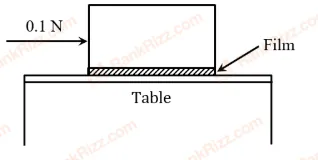
A metal block of base area 0.200.20 m2^2 is placed on a table, as shown in the figure. A liquid film of thickness 0.250.25 mm is inserted between the block and the table. The block is pushed by a horizontal force of 0.10.1 N and moves with a constant speed. If the viscosity of the liquid is 5.0×10−35.0 \times 10^{-3} Pl, the speed of the block is ______ ×10−3\times 10^{-3} m s−1^{-1}.

Figure for JEE Main 2023 Physics question on Viscosity, Poiseuille's equation and Reynolds number
JEE MAIN 2023 · 25 JAN S2Surface tension and surface energy

A spherical drop of liquid splits into 1000 identical spherical drops. If uiu_i is the surface energy of the original drop and ufu_f is the total surface energy of the resulting drops, the (ignoring evaporation), ufui=(10x)\frac{u_f}{u_i} = (\frac{10}{x}). Then value of xx is _____:

JEE MAIN 2023 · 24 JAN S2Stokes' law and terminal velocity

A spherical ball of radius 1 mm and density 10.5 g cc−1^{-1} is dropped in glycerine of coefficient of viscosity 9.8 poise and density 1.5 g cc−1^{-1}. Viscous force on the ball when it attains constant velocity is 3696×10−x3696 \times 10^{-x} N. The value of xx is
(Given, g=9.8g = 9.8 m s−2^{-2} and π=227\pi = \frac{22}{7})

JEE MAIN 2022 · 29 JUL S1Angle of contact and capillary rise

Given below are two statements: One is labelled as Assertion (A) and the other is labelled as Reason (R).
Assertion (A): Clothes containing oil or grease stains cannot be cleaned by water wash.
Reason (R): Because the angle of contact between the oil/grease and water is obtuse.
In the light of the above statements, choose the correct answer from the option given below.

  1. A

    Both (A) and (R) are true and (R) is the correct explanation of (A)

  2. B

    Both (A) and (R) are true but (R) is not the correct explanation of (A)

  3. C

    (A) is true but (R) is false

  4. D

    (A) is true but (R) is true

JEE MAIN 2022 · 29 JUL S2Fluid pressure, Pascal's law and accelerated/rotating liquids

A tube of length 50 cm is filled completely with an incompressible liquid of mass 250 g and closed at both ends. The tube is then rotated in horizontal plane about one of its ends with a uniform angular velocity xFx\sqrt{F} rad s−1^{-1}. If F be the force exerted by the liquid at the other end then the value of x will be _____

JEE MAIN 2022 · 29 JUL S2Stokes' law and terminal velocity

The velocity of a small ball of mass 0.3 g and density 8 g cc−1^{-1} when dropped in a container filled with glycerine becomes constant after some time. If the density of glycerine is 1.3 g cc−1^{-1}, then the value of viscous force acting on the ball will be x×10−4x \times 10^{-4} N, the value of x is _____ [use g=10g = 10 m s−2^{-2}]

JEE MAIN 2022 · 28 JUL S1Stokes' law and terminal velocity

The diameter of an air bubble which was initially 2 mm, rises steadily through a solution of density 1750 kg/m3^3 at the rate of 0.35 cm/s. Coefficient of viscosity of the solution is _____ Poise. (Assume mass of the bubble to be negligible) (Answer in Poise to the nearest integer)

JEE MAIN 2022 · 28 JUL S2Equation of continuity and Bernoulli's theorem

A pressure-pump has a horizontal tube of cross-sectional area 10 cm2^2 for the outflow of water at a speed of 20 m s−1^{-1}. The force exerted on the vertical wall just in front of the tube which stops water horizontally flowing out of the tube, is: [given: density of water =1000= 1000 kg m−3^{-3}]

  1. A

    300 N

  2. B

    500 N

  3. C

    250 N

  4. D

    400 N

JEE MAIN 2022 · 28 JUL S2Speed of efflux and applications of Bernoulli's theorem

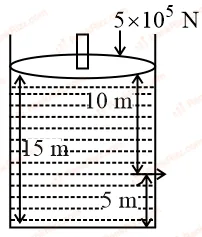
Consider a cylindrical tank of radius 1 m is filled with water. The top surface of water is at 15 m from the bottom of the cylinder. There is a hole on the wall of cylinder at a height of 5 m from the bottom. A force of 5×1055 \times 10^5 N is applied on the top surface of water using a piston. The speed of efflux from the hole will be: (given atmospheric pressure PA=1.01×10⁵P_A = 1.01 \times 10^5 Pa, density of water ρw=1000\rho_w = 1000 kg m−3^{-3} and gravitational acceleration g=10 ms−2g = 10 \ m s^{-2})

Figure for JEE Main 2022 Physics question on Speed of efflux and applications of Bernoulli's theorem
  1. A

    11.6 m s−1^{-1}

  2. B

    10.8 m s−1^{-1}

  3. C

    17.8 m s−1^{-1}

  4. D

    14.4 m s−1^{-1}

JEE MAIN 2022 · 27 JUL S1Fluid pressure, Pascal's law and accelerated/rotating liquids

Two cylindrical vessels of equal cross-sectional area 16 cm216 \text{ cm}^2 contain water upto heights 100 cm100 \text{ cm} and 150 cm150 \text{ cm} respectively. The vessels are interconnected so that the water levels in them become equal. The work done by the force of gravity during the process, is [Take density of water =103 kg m−3= 10^3 \text{ kg m}^{-3} and g=10 m s−2g = 10 \text{ m s}^{-2}]

  1. A

    0.25 J0.25 \text{ J}

  2. B

    1 J1 \text{ J}

  3. C

    8 J8 \text{ J}

  4. D

    12 J12 \text{ J}

JEE MAIN 2022 · 27 JUL S2Excess pressure in drops and bubbles

A spherical soap bubble of radius 3 cm is formed inside another spherical soap bubble of radius 6 cm. If the internal pressure of the smaller bubble of radius 3 cm in the above system is equal to the internal pressure of another single soap bubble of radius rr cm. The value of rr is _____

JEE MAIN 2022 · 26 JUL S1Surface tension and surface energy

A water drop of radius 1 cm1 \text{ cm} is broken into 729729 equal droplets. If surface tension of water is 75 dyne cm−175 \text{ dyne cm}^{-1}, then the gain in surface energy upto first decimal place will be (Given π=3.14\pi = 3.14)

  1. A

    8.5×10⁻⁴ J8.5 \times 10^{-4} \text{ J}

  2. B

    8.2×10⁻⁴ J8.2 \times 10^{-4} \text{ J}

  3. C

    7.5×10⁻⁴ J7.5 \times 10^{-4} \text{ J}

  4. D

    5.3×10⁻⁴ J5.3 \times 10^{-4} \text{ J}

JEE MAIN 2022 · 25 JUL S2Surface tension and surface energy

A drop of liquid of density ρ\rho is floating half immersed in a liquid of density σ\sigma and surface tension 7.5×10⁻⁴ N cm−17.5 \times 10^{-4} \text{ N cm}^{-1}. The radius of drop in cm will be: (Take: g=10 m s−2g = 10 \text{ m s}^{-2})

  1. A

    152ρ−σ\dfrac{15}{\sqrt{2\rho - \sigma}}

  2. B

    15ρ−σ\dfrac{15}{\sqrt{\rho - \sigma}}

  3. C

    32ρ−σ\dfrac{3}{2\sqrt{\rho - \sigma}}

  4. D

    3202ρ−σ\dfrac{3}{20\sqrt{2\rho - \sigma}}