Mechanical Properties of Fluids JEE Main PYQs with answer key
PHYSICS · 193 PAST QUESTIONS · 9 TOPICS · 2004–2026
HOW TO USE THIS SHEET
Every JEE Main Mechanical Properties of Fluids question we hold, grouped by topic, most-asked topic first and newest first inside each. The answer key is at the end (193 of 193 questions have a checked key); the worked solution is on each question’s page, printed beside it.
Stokes' law and terminal velocity 34
A spherical liquid drop of radius acquires the terminal velocity when falls through a gas of viscosity . Now the drop is broken into 64 identical droplets and each droplet acquires terminal velocity falling through the same gas. The ratio of terminal velocities is __________.
- (A)
4
- (B)
0.25
- (C)
32
- (D)
16
rr2.rankrizz.com/jee-main/physics/mechanical-properties-of-fluids/q/8-apr-2026-s2-q34
- (A)
If an air bubble of diameter 2 mm rises steadily through a liquid of density 2000 kg/m at a rate of 0.5 cm/s, then the coefficient of viscosity of liquid is _________ Poise. (Take m/s)
- (A)
- (B)
- (C)
- (D)
rr2.rankrizz.com/jee-main/physics/mechanical-properties-of-fluids/q/2-apr-2026-s2-q35
- (A)
Sixty four rain drops of radius 1 mm each falling down w-ith a terminal velocity of 10 cm/s coalesce to fonn a bigger drop. The terminal velocity of bigger drop is_____cm/s
Answer: ____________
rr2.rankrizz.com/jee-main/physics/mechanical-properties-of-fluids/q/24-jan-2026-s1-q49
A small metallic sphere of diameter 2 mm and density is dropped in glycerine having viscosity 10 Poise and density respectively. The terminal velocity attained by the sphere is __ .
- (A)
1.5
- (B)
2.0
- (C)
1.0
- (D)
3.0
rr2.rankrizz.com/jee-main/physics/mechanical-properties-of-fluids/q/23-jan-2026-s2-q27
- (A)
The terminal velocity of a metallic ball of radius 6 mm in a viscous fluid is 20 cm/s. The terminal velocity of another ball of same material and having radius 3 mm in the same fluid will be ________ cm/ s.
Answer: ____________
rr2.rankrizz.com/jee-main/physics/mechanical-properties-of-fluids/q/21-jan-2026-s2-physics-q25
A solid steel ball of diameter 3.6 mm acquired terminal velocity m/s while falling under gravity through an oil of density . Take density of steel as and g as . The viscosity of the oil in SI unit is
- (A)
2.18
- (B)
2.38
- (C)
1.68
- (D)
1.99
rr2.rankrizz.com/jee-main/physics/mechanical-properties-of-fluids/q/2025-apr-3-s2-q37
- (A)
In the experiment for measurement of viscosity of given liquid with a ball having radius R, consider following statements. A. Graph between terminal velocity V and R will be a parabola. B. The terminal velocities of different diameter balls are constant for a given liquid. C. Measurement of terminal velocity is dependent on the temperature. D. This experiment can be utilized to assess the density of a given liquid. E. If balls are dropped with some initial speed, the value of will change. Choose the correct answer from the options given below:
- (A)
A, B and E Only
- (B)
B, D and E Only
- (C)
A, C and D Only
- (D)
C, D and E Only
rr2.rankrizz.com/jee-main/physics/mechanical-properties-of-fluids/q/28-jan-2025-s1-q37
- (A)
A small rigid spherical ball of mass M is dropped in a long vertical tube containing glycerine. The velocity of the ball becomes constant after some time. If the density of glycerine is half of the density of the ball, then the viscous force acting on the ball will be (consider g as acceleration due to gravity)
- (A)
2 Mg
- (B)
Mg
- (C)
- (D)
rr2.rankrizz.com/jee-main/physics/mechanical-properties-of-fluids/q/22-jan-2025-s2-q27
- (A)
A spherical ball of radius and density falls freely under gravity through a distance before entering a tank of water. If after entering in water the velocity of the ball does not change, then the value of is approximately: (The coefficient of viscosity of water is )
- (A)
- (B)
- (C)
- (D)
rr2.rankrizz.com/jee-main/physics/mechanical-properties-of-fluids/q/9-apr-2024-s2-q6
- (A)
Small water droplets of radius 0.01 mm are formed in the upper atmosphere and falling with a terminal velocity of 10 cm/s. Due to condensation, if 8 such droplets are coalesced and formed a larger drop, the new terminal velocity will be _____ cm/s.
Answer: ____________
rr2.rankrizz.com/jee-main/physics/mechanical-properties-of-fluids/q/8-apr-2024-s2-q23
A small ball of mass and density is dropped in a viscous liquid of density . After sometime, the ball falls with constant velocity. The viscous force on the ball is :
- (A)
- (B)
- (C)
- (D)
rr2.rankrizz.com/jee-main/physics/mechanical-properties-of-fluids/q/6-apr-2024-s1-q8
- (A)
A small steel ball is dropped into a long cylinder containing glycerine. Which one of the following is the correct representation of the velocity time graph for the transit of the ball?
- (A)
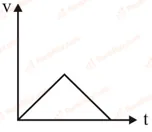
- (B)
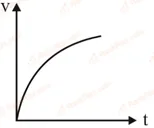
- (C)
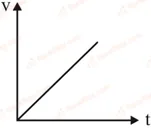
- (D)
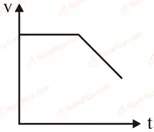
rr2.rankrizz.com/jee-main/physics/mechanical-properties-of-fluids/q/31-jan-2024-s1-q4
- (A)
A small spherical ball of radius , falling through a viscous medium of negligible density has terminal velocity . Another ball of the same mass but of radius , falling through the same viscous medium will have terminal velocity:
- (A)
- (B)
- (C)
- (D)
rr2.rankrizz.com/jee-main/physics/mechanical-properties-of-fluids/q/31-jan-2024-s2-q7
- (A)
Given below are two statements: one is labelled as Assertion A and the other is labelled as Reason R
Assertion A : A spherical body of radius mm having a particular density is falling through a liquid of constant density. The percentage error in the calculation of its terminal velocity is 4%.
Reason R : The terminal velocity of the spherical body falling through the liquid is inversely proportional to its radius. In the light of the above statements, choose the correct answer from the options given below- (A)
Both A and R are true and R is the correct explanation of A
- (B)
Both A and R are true but R is NOT the correct explanation of A
- (C)
A is true but R is false
- (D)
A is false but R is true
rr2.rankrizz.com/jee-main/physics/mechanical-properties-of-fluids/q/13-apr-2023-s2-q7
- (A)
Eight equal drops of water are falling through air with a steady speed of 10 cm s. If the drops coalesce, the new velocity is:-
- (A)
16 cm s
- (B)
40 cm s
- (C)
5 cm s
- (D)
10 cm s
rr2.rankrizz.com/jee-main/physics/mechanical-properties-of-fluids/q/11-apr-2023-s2-q6
- (A)
An air bubble of diameter 6 mm rises steadily through a solution of density 1750 kg m at the rate of 0.35 cm s. The co-efficient of viscosity of the solution (neglect density of air) is ________ Pas (given, m s).
Answer: ____________
rr2.rankrizz.com/jee-main/physics/mechanical-properties-of-fluids/q/8-apr-2023-s1-q23
A small ball of mass and density is dropped in a viscous liquid of density . After some time, the ball falls with a constant velocity. What is the viscous force on the ball?
- (A)
- (B)
- (C)
- (D)
rr2.rankrizz.com/jee-main/physics/mechanical-properties-of-fluids/q/6-apr-2023-s1-q8
- (A)
A spherical ball of radius 1 mm and density 10.5 g cc is dropped in glycerine of coefficient of viscosity 9.8 poise and density 1.5 g cc. Viscous force on the ball when it attains constant velocity is N. The value of is
(Given, m s and )Answer: ____________
rr2.rankrizz.com/jee-main/physics/mechanical-properties-of-fluids/q/24-jan-2023-s2-q23
The velocity of a small ball of mass 0.3 g and density 8 g cc when dropped in a container filled with glycerine becomes constant after some time. If the density of glycerine is 1.3 g cc, then the value of viscous force acting on the ball will be N, the value of x is _____ [use m s]
Answer: ____________
rr2.rankrizz.com/jee-main/physics/mechanical-properties-of-fluids/q/29-jul-2022-s2-q23
The diameter of an air bubble which was initially 2 mm, rises steadily through a solution of density 1750 kg/m at the rate of 0.35 cm/s. Coefficient of viscosity of the solution is _____ Poise. (Assume mass of the bubble to be negligible) (Answer in Poise to the nearest integer)
Answer: ____________
rr2.rankrizz.com/jee-main/physics/mechanical-properties-of-fluids/q/28-jul-2022-s1-q24
A small spherical ball of radius 0.1 mm and density kg m falls freely under gravity through a distance before entering a tank of water. If, after entering the water the velocity of ball does not change and it continue to fall with same constant velocity inside water, then the value of will be ______ m. (Given m s, viscosity of water N-s m).
Answer: ____________
rr2.rankrizz.com/jee-main/physics/mechanical-properties-of-fluids/q/29-jun-2022-s2-q22
A water drop of radius m falls in a situation where the effect of buoyant force is negligible. Co-efficient of viscosity of air is N s m and its density is negligible as compared to that of water g m. Terminal velocity of the water drop is
(Take acceleration due to gravity m s)- (A)
m s
- (B)
m s
- (C)
m s
- (D)
m s
rr2.rankrizz.com/jee-main/physics/mechanical-properties-of-fluids/q/28-jun-2022-s2-q7
- (A)
The velocity of a small ball of mass and density , when dropped in a container filled with glycerine, becomes constant after some time. If the density of glycerine is , then the viscous force acting on the ball will be
- (A)
- (B)
- (C)
- (D)
rr2.rankrizz.com/jee-main/physics/mechanical-properties-of-fluids/q/27-jun-2022-s1-q8
- (A)
The terminal velocity of the spherical rain drop depends on the radius of the spherical rain drop as
- (A)
- (B)
- (C)
- (D)
rr2.rankrizz.com/jee-main/physics/mechanical-properties-of-fluids/q/25-jun-2022-s1-q6
- (A)
In Millikan's oil drop experiment, what is viscous force acting on an uncharged drop of radius m and density kg m? Take viscosity of liquid = N s m. (Neglect buoyancy due to air).
- (A)
N
- (B)
N
- (C)
N
- (D)
N
rr2.rankrizz.com/jee-main/physics/mechanical-properties-of-fluids/q/27-aug-2021-s1-q6
- (A)
A raindrop with radius R = 0.2 mm falls from a cloud at a height h = 2000 m above the ground. Assume that the drop is spherical throughout its fall and the force of buoyancy may be neglected, then the terminal speed attained by the raindrop is: [Density of water kg m and Density of air kg m, g = 10 m/s, Coefficient of viscosity of air = N s m]
- (A)
250.6 m s
- (B)
43.56 m s
- (C)
4.94 m s
- (D)
14.4 m s
rr2.rankrizz.com/jee-main/physics/mechanical-properties-of-fluids/q/27-jul-2021-s2-q8
- (A)
In an experiment to verify Stokes law, a small spherical ball of radius and density falls under gravity through a distance in air before entering a tank of water. If the terminal velocity of the ball inside water is same as its velocity just before entering the water surface, then the value of is proportional to: (ignore viscosity of air)
- (A)
- (B)
- (C)
- (D)
rr2.rankrizz.com/jee-main/physics/mechanical-properties-of-fluids/q/5-sep-2020-s2-q5
- (A)
A solid sphere, of radius R acquires a terminal velocity when falling (due to gravity) through a viscous fluid having a coefficient of viscosity . The sphere is broken into 27 identical solid spheres. If each of these spheres acquires a terminal velocity, , when falling through the same fluid, the ratio equals:
- (A)
- (B)
27
- (C)
- (D)
9
rr2.rankrizz.com/jee-main/physics/mechanical-properties-of-fluids/q/12-apr-2019-s2-q8
- (A)
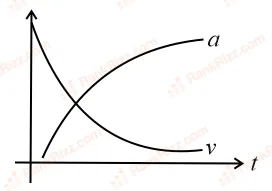
Which of the following option correctly describes the variation of the speed v and acceleration 'a' of a point mass falling vertically in a viscous medium that applies a force , where 'k' is a constant, on the body? (Graphs are schematic and not drawn to scale)
- (A)
- (B)
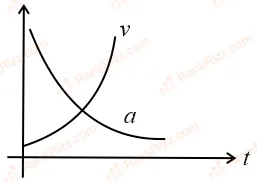
- (C)
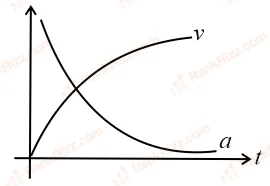
- (D)
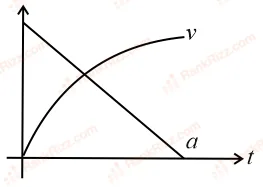
rr2.rankrizz.com/jee-main/physics/mechanical-properties-of-fluids/q/9-apr-2016-online-q3
- (A)
In an experiment, a small steel ball falls through a liquid at a constant speed of 10 cm/s. If the steel ball is pulled upward with a force equal to twice its effective weight, how fast will it move upward?
- (A)
5 cm/s
- (B)
Zero
- (C)
10 cm/s
- (D)
20 cm/s
rr2.rankrizz.com/jee-main/physics/mechanical-properties-of-fluids/q/25-apr-2013-online-q6
- (A)
The terminal velocity of a small sphere of radius in a viscous liquid is proportional to
- (A)
- (B)
- (C)
- (D)
rr2.rankrizz.com/jee-main/physics/mechanical-properties-of-fluids/q/2012-physics-499168
- (A)
A spherical solid ball of volume is made of a material of density . It is falling through a liquid of density . Assume that the liquid applies a viscous force on the ball that is proportional to the square of its speed v, i.e., . The terminal speed of the ball is
- (A)
- (B)
- (C)
- (D)
rr2.rankrizz.com/jee-main/physics/mechanical-properties-of-fluids/q/2008-physics-499872
- (A)
If the terminal speed of a sphere of gold (density ) is in a viscous liquid (density ) of the same size in the same liquid.
- (A)
0.2 m/s
- (B)
0.4 m/s
- (C)
0.133 m/s
- (D)
0.1 m/s
rr2.rankrizz.com/jee-main/physics/mechanical-properties-of-fluids/q/2006-physics-499982
- (A)
Spherical balls of radius are falling in a viscous fluid of viscosity with a velocity . The retarding viscous force acting on the spherical ball is
- (A)
directly proportional to but inversely proportional to .
- (B)
directly proportional to both radius and velocity .
- (C)
inversely proportional to both radius and velocity .
- (D)
inversely proportional to but directly proportional to velocity .
rr2.rankrizz.com/jee-main/physics/mechanical-properties-of-fluids/q/2004-physics-500185
- (A)
Surface tension and surface energy 28
Eight mercury drops, each of radius coalesce to form a bigger drop. The surface energy released in this process is_________ .
( S is the surface tension of mercury).- (A)
- (B)
- (C)
- (D)
rr2.rankrizz.com/jee-main/physics/mechanical-properties-of-fluids/q/5-apr-2026-s2-q33
- (A)
The surface tension of a soap solution is N/m. The work required to increase the radius of a soap bubble from 1 cm to 2 cm is J. The value of is _____.
Answer: ____________
rr2.rankrizz.com/jee-main/physics/mechanical-properties-of-fluids/q/4-apr-2026-s1-q47
A liquid drop of diameter 2 mm breaks into 512 droplets. The change in surface energy is J. The value of is __________. (Take surface tension of liquid = 0.08 N/m)
- (A)
- (B)
- (C)
- (D)
rr2.rankrizz.com/jee-main/physics/mechanical-properties-of-fluids/q/2-apr-2026-s1-q45
- (A)
The surface tension of a soap bubble is 0.03 N/m. The work done in increasing the diameter of bubble from 2 cm to 6 cm is J. The value of is : (Take )
- (A)
- (B)
- (C)
- (D)
rr2.rankrizz.com/jee-main/physics/mechanical-properties-of-fluids/q/2-apr-2026-s2-q33
- (A)
A soap bubble of surface tension 0.04 N/m is blown to a diameter of 7 cm. If (15000 - x) of work is done in blowing it further to make its diameterl4 cm, then the value of x is_____.
Answer: ____________
rr2.rankrizz.com/jee-main/physics/mechanical-properties-of-fluids/q/24-jan-2026-s2-q48
Two water drops each of radius 'r' coalesce to form a bigger drop. If 'T' is the surface tension, the surface energy released in this process is :
- (A)
- (B)
- (C)
- (D)
rr2.rankrizz.com/jee-main/physics/mechanical-properties-of-fluids/q/2025-apr-02-s2-q29
- (A)
The amount of work done to break a big water drop of radius into 27 small drops of equal radius is The work done required to break the same big drop into 64 small drops of equal radius will be:
- (A)
15 J
- (B)
5 J
- (C)
20 J
- (D)
10 J
rr2.rankrizz.com/jee-main/physics/mechanical-properties-of-fluids/q/24-jan-2025-s1-q37
- (A)
A big drop is formed by coalescing 1000 small droplets of water. The ratio of surface energy of 1000 droplets to that of energy of big drop is . The value of is __________
Answer: ____________
rr2.rankrizz.com/jee-main/physics/mechanical-properties-of-fluids/q/6-apr-2024-s1-q23
A soap bubble is blown to a diameter of 7 cm. 36960 erg of work is done in blowing it further. If surface tension of soap solution is 40 dyne/cm then the new radius is ______ cm. (Take )
Answer: ____________
rr2.rankrizz.com/jee-main/physics/mechanical-properties-of-fluids/q/04-apr-2024-s1-q24
A big drop is formed by coalescing 1000 small droplets of water. The surface energy will become:
- (A)
100 times
- (B)
10 times
- (C)
th
- (D)
th
rr2.rankrizz.com/jee-main/physics/mechanical-properties-of-fluids/q/01-feb-2024-s2-q7
- (A)
A big drop is formed by coalescing 1000 small identical drops of water. If be the total surface energy of 1000 small drops of water and be the surface energy of single big drop of water, the is , where = ________.
Answer: ____________
rr2.rankrizz.com/jee-main/physics/mechanical-properties-of-fluids/q/30-jan-2024-s2-q23
A small liquid drop of radius is divided into identical liquid drops. If the surface tension is , then the work done in the process will be:
- (A)
- (B)
- (C)
- (D)
rr2.rankrizz.com/jee-main/physics/mechanical-properties-of-fluids/q/29-jan-2024-s2-q8
- (A)
Given below are two statements :
Statement (I) : Viscosity of gases is greater than that of liquids.
Statement (II) : Surface tension of a liquid decreases due to the presence of insoluble impurities. In the light of the above statements, choose the most appropriate answer from the options given below :
- (A)
Statement I is correct but Statement II is incorrect
- (B)
Statement I is incorrect but Statement II is correct
- (C)
Both Statement I and Statement II are incorrect
- (D)
Both Statement I and Statement II are correct
rr2.rankrizz.com/jee-main/physics/mechanical-properties-of-fluids/q/27-jan-2024-s1-q7
- (A)
The surface tension of soap solution is N m. The amount of work done required to increase the radius of soap bubble from 10 cm to 20 cm is _______ J. (take )
Answer: ____________
rr2.rankrizz.com/jee-main/physics/mechanical-properties-of-fluids/q/11-apr-2023-s2-q24
A mercury drop of radius m is broken into 125 equal size droplets. Surface tension of mercury is 0.45 N m. The gain in surface energy is:
- (A)
J
- (B)
J
- (C)
J
- (D)
J
rr2.rankrizz.com/jee-main/physics/mechanical-properties-of-fluids/q/01-feb-2023-s1-q7
- (A)
If 1000 droplets of water of surface tension 0.07 N m, having same radius 1 mm each, combine to form a single drop. In the process the released surface energy is- (Take )
- (A)
J
- (B)
J
- (C)
J
- (D)
J
rr2.rankrizz.com/jee-main/physics/mechanical-properties-of-fluids/q/31-jan-2023-s1-q7
- (A)
Surface tension of a soap bubble is N m. Work done to increase the radius of soap bubble from cm to cm will be: [Take ]
- (A)
J
- (B)
J
- (C)
J
- (D)
J
rr2.rankrizz.com/jee-main/physics/mechanical-properties-of-fluids/q/29-jan-2023-s1-q6
- (A)
A spherical drop of liquid splits into 1000 identical spherical drops. If is the surface energy of the original drop and is the total surface energy of the resulting drops, the (ignoring evaporation), . Then value of is _____:
Answer: ____________
rr2.rankrizz.com/jee-main/physics/mechanical-properties-of-fluids/q/25-jan-2023-s2-q24
A water drop of radius is broken into equal droplets. If surface tension of water is , then the gain in surface energy upto first decimal place will be (Given )
- (A)
- (B)
- (C)
- (D)
rr2.rankrizz.com/jee-main/physics/mechanical-properties-of-fluids/q/26-jul-2022-s1-q6
- (A)
A drop of liquid of density is floating half immersed in a liquid of density and surface tension . The radius of drop in cm will be: (Take: )
- (A)
- (B)
- (C)
- (D)
rr2.rankrizz.com/jee-main/physics/mechanical-properties-of-fluids/q/25-jul-2022-s2-q8
- (A)
A water drop of diameter cm is broken into equal droplets. The surface tension of water is N m. In this process the gain in surface energy will be
- (A)
J
- (B)
J
- (C)
J
- (D)
J
rr2.rankrizz.com/jee-main/physics/mechanical-properties-of-fluids/q/28-jun-2022-s1-q6
- (A)
Two small drops of mercury each of radius coalesce to form a single large drop. The ratio of total surface energy before and after the change is:
- (A)
- (B)
- (C)
- (D)
rr2.rankrizz.com/jee-main/physics/mechanical-properties-of-fluids/q/20-jul-2021-s2-q10
- (A)
A small spherical droplet of density is floating exactly half immersed in a liquid of density and surface tension . The radius of the droplet is (take note that the surface tension applies an upward force on the droplet):
- (A)
- (B)
- (C)
- (D)
rr2.rankrizz.com/jee-main/physics/mechanical-properties-of-fluids/q/9-jan-2020-s2-q9
- (A)
A large number of liquid drops each of radius r coalesce to form a single drop of the radius R. The energy released in the process is converted into kinetic energy of the big drop so formed. The speed of the big drop is (given surface tension of the liquid T, density )
- (A)
- (B)
- (C)
- (D)
rr2.rankrizz.com/jee-main/physics/mechanical-properties-of-fluids/q/19-apr-2014-online-q9
- (A)
Assume that a drop of a liquid evaporates by a decrease in its surface energy so that its temperature remains unchanged. The minimum radius of the drop for this to be possible is. (The surface tension is T, the density of the liquid is and L is its latent heat of vaporisation.)
- (A)
- (B)
- (C)
- (D)
rr2.rankrizz.com/jee-main/physics/mechanical-properties-of-fluids/q/7-apr-2013-offline-q7
- (A)
A thin liquid film formed between a U-shaped wire and a light slider supports a weight of N (see figure). The length of the slider is cm and its weight negligible. The surface tension of the liquid film is
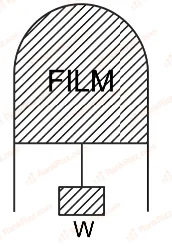
- (A)
- (B)
- (C)
- (D)
rr2.rankrizz.com/jee-main/physics/mechanical-properties-of-fluids/q/2012-physics-499025
- (A)
A large number of droplets, each of radius coalesce to form a bigger drop of radius . An engineer designs a machine so that the energy released in this process is converted into the kinetic energy of the drop. Velocity of the drop is ( = surface tension, = density)
- (A)
- (B)
- (C)
- (D)
rr2.rankrizz.com/jee-main/physics/mechanical-properties-of-fluids/q/2012-physics-499268
- (A)
Work done in increasing the size of a soap bubble from a radius of to is nearly (Surface tension of soap solution ):
- (A)
- (B)
- (C)
- (D)
rr2.rankrizz.com/jee-main/physics/mechanical-properties-of-fluids/q/2011-physics-499476
- (A)
Fluid pressure, Pascal's law and accelerated/rotating liquids 24
An air bubble of volume 2.9 rises from the bottom of a swimming pool of 5 m deep. At the bottom of the pool water temperature is C. The volume of the bubble when it reaches the surface, where the water temperature is C, is ______.
(, density of water = , and 1 atm pressure is Pa)- (A)
3.0
- (B)
2.0
- (C)
4.5
- (D)
4.2
rr2.rankrizz.com/jee-main/physics/mechanical-properties-of-fluids/q/23-jan-2026-s2-q39
- (A)
Given below are two statements:
Statement I : Pressure of a fluid is exerted only on a solid surface in contact as the fluid-pressure does not exist everywhere in a still fluid.
Statement II: Excess potential energy of the molecules on the surface of a liquid, when compared to interior, results in surface tension.In the light of the above statements, choose the correct answer from the options given below
- (A)
Both Statement I and Statement II are true
- (B)
Statement I is true but Statement II is false
- (C)
Both Statement I and Statement II are false
- (D)
Statement I is false but Statement II is true
rr2.rankrizz.com/jee-main/physics/mechanical-properties-of-fluids/q/22-jan-2026-s1-q43
- (A)
Two cylindrical vessels of equal cross sectional area of contain water upto height 10 m and 6 m, respectively. If the vessels are connected at their bottom, then the work done by the force of gravity is: (Density of water is and )
- (A)
J
- (B)
J
- (C)
J
- (D)
J
rr2.rankrizz.com/jee-main/physics/mechanical-properties-of-fluids/q/2025-apr-3-s2-q28
- (A)
A vessel with square cross-section and height of 6 m is vertically partitioned. A small window of 100 cm with hinged door is fitted at a depth of 3 m in the partition wall. One part of the vessel is filled completely with water and the other side is filled with the liquid having density kg/m. What force one needs to apply on the hinged door so that it does not get opened?
(Acceleration due to gravity = 10 m/s)
Answer: ____________
rr2.rankrizz.com/jee-main/physics/mechanical-properties-of-fluids/q/2025-apr-02-s1-q46
In a hydraulic lift, the surface area of the input piston is and that of the output piston is . If 100 N force is applied to the input piston to raise the output piston by 20 cm, then the work done is _______ kJ.
Answer: ____________
rr2.rankrizz.com/jee-main/physics/mechanical-properties-of-fluids/q/29-jan-2025-s1-q46
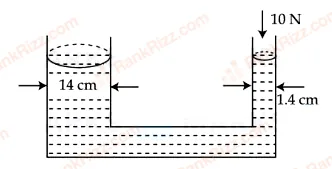
A hydraulic press containing water has two arms with diameters as mentioned in the figure. A force of N is applied on the surface of water in the thinner arm. The force required to be applied on the surface of water in the thicker arm to maintain equilibrium of water is ______ N.Answer: ____________
rr2.rankrizz.com/jee-main/physics/mechanical-properties-of-fluids/q/05-apr-2024-s2-q23
Mercury is filled in a tube of radius cm up to a height of cm. The force exerted by mercury on the bottom of the tube is _____ N. (Given, atmospheric pressure Nm, density of mercury kg m, m s, )
Answer: ____________
rr2.rankrizz.com/jee-main/physics/mechanical-properties-of-fluids/q/04-apr-2024-s2-q23
Given below are two statements:
Statement I: Pressure in a reservoir of water is same at all points at the same level of water.
Statement II: The pressure applied to enclosed water is transmitted in all directions equally.
In the light of the above statements, choose the correct answer from the options given below:- (A)
Both Statement I and Statement II are false
- (B)
Statement I is true but Statement II is false
- (C)
Statement I is false but Statement II is true
- (D)
Both Statement I and Statement II are true
rr2.rankrizz.com/jee-main/physics/mechanical-properties-of-fluids/q/10-apr-2023-s1-q7
- (A)
An air bubble of volume 1 cm rises from the bottom of a lake 40 m deep to the surface at a temperature of 12°C. The atmospheric pressure is Pa, the density of water is 1000 kg m and m s. There is no difference of the temperature of water at the depth of 40 m and on the surface. The volume of air bubble when it reaches the surface will be
- (A)
2 cm
- (B)
3 cm
- (C)
4 cm
- (D)
5 cm
rr2.rankrizz.com/jee-main/physics/mechanical-properties-of-fluids/q/8-apr-2023-s1-q9
- (A)
A hydraulic automobile lift is designed to lift vehicles of mass 5000 kg. The area of cross section of the cylinder carrying load is 250 cm. The maximum pressure the smaller piston would have to bear is [Assume m s]
- (A)
Pa
- (B)
Pa
- (C)
Pa
- (D)
Pa
rr2.rankrizz.com/jee-main/physics/mechanical-properties-of-fluids/q/08-apr-2023-s2-q7
- (A)
Given below are two statements: one is labelled as Assertion A and the other is labelled as Reason R
Assertion A: When you squeeze one end of a tube to get toothpaste out from the other end, Pascal's principle is observed.
Reason R: A change in the pressure applied to an enclosed incompressible fluid is transmitted undiminished to every portion of the fluid and to the walls of its container.- (A)
Both A and R are correct but R is NOT the correct explanation of A
- (B)
A is not correct but R is correct
- (C)
A is correct but R is not correct
- (D)
Both A and R is correct and R is the correct explanation of A
rr2.rankrizz.com/jee-main/physics/mechanical-properties-of-fluids/q/6-apr-2023-s2-q7
- (A)
A tube of length 50 cm is filled completely with an incompressible liquid of mass 250 g and closed at both ends. The tube is then rotated in horizontal plane about one of its ends with a uniform angular velocity rad s. If F be the force exerted by the liquid at the other end then the value of x will be _____
Answer: ____________
rr2.rankrizz.com/jee-main/physics/mechanical-properties-of-fluids/q/29-jul-2022-s2-q21
Two cylindrical vessels of equal cross-sectional area contain water upto heights and respectively. The vessels are interconnected so that the water levels in them become equal. The work done by the force of gravity during the process, is [Take density of water and ]
- (A)
- (B)
- (C)
- (D)
rr2.rankrizz.com/jee-main/physics/mechanical-properties-of-fluids/q/27-jul-2022-s1-q6
- (A)
The pressure acting on a submarine is Pa at a certain depth. If the depth is doubled, the percentage increase in the pressure acting on the submarine would be: (Assume that atmospheric pressure is Pa, density of water is kg m, g = 10 ms)
- (A)
%
- (B)
%
- (C)
%
- (D)
%
rr2.rankrizz.com/jee-main/physics/mechanical-properties-of-fluids/q/16-mar-2021-s1-q6
- (A)
A hydraulic press can lift 100 kg when a mass is placed on the smaller piston. It can lift ______ kg when the diameter of the larger piston is increased by 4 times and that of the smaller piston is decreased by 4 times keeping the same mass on the smaller piston.
Answer: ____________
rr2.rankrizz.com/jee-main/physics/mechanical-properties-of-fluids/q/24-feb-2021-s1-q24
Two identical cylindrical vessels are kept on the ground and each contain the same liquid of density . The area of the base of both vessels is but the height of liquid in one vessel is and in the other . When both cylinders are connected through a pipe of negligible volume very close to the bottom, the liquid flows from one vessel to the other until it comes to equilibrium at a new height. The change in energy of the system in the process is:
- (A)
- (B)
- (C)
- (D)
rr2.rankrizz.com/jee-main/physics/mechanical-properties-of-fluids/q/4-sep-2020-s2-q9
- (A)
A cylindrical vessel containing a liquid is rotated about its axis so that the liquid rises at its sides as shown in the figure. The radius of vessel is 5 cm and the angular speed of rotation is rad s. The difference in the height, h (in cm) of liquid at the Centre of vessel and at the sides of the vessel will be:
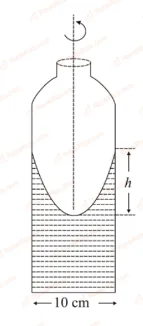
- (A)
- (B)
- (C)
- (D)
rr2.rankrizz.com/jee-main/physics/mechanical-properties-of-fluids/q/2-sep-2020-s1-q8
- (A)
Two liquids of densities and () are filled up behind a square wall of side 10 m as shown in figure. Each liquid has a height of 5 m. The ratio of the forces due to these liquids exerted on upper part MN to that at the lower part NO is (Assume that the liquids are not mixing):
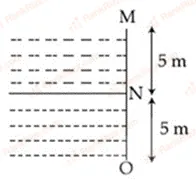
- (A)
- (B)
- (C)
- (D)
rr2.rankrizz.com/jee-main/physics/mechanical-properties-of-fluids/q/8-jan-2020-s2-q7
- (A)
A submarine experiences a pressure of Pa at a depth of d in a sea. When it goes further to a depth of d, it experiences a pressure of Pa. Then d - d is approximately (density of water = 10 kg/m and acceleration due to gravity = 10 ms):
- (A)
600 m
- (B)
500 m
- (C)
300 m
- (D)
400 m
rr2.rankrizz.com/jee-main/physics/mechanical-properties-of-fluids/q/10-apr-2019-s2-q13
- (A)
A long cylindrical vessel is half filled with a liquid. When the vessel is rotated about its own vertical axis, the liquid rises up near the wall. If the radius of vessel is 5 cm and its rotational speed is 2 rotations per second, then the difference in the heights between the center and the sides, in cm, will be:
- (A)
0.4
- (B)
2.0
- (C)
1.2
- (D)
0.1
rr2.rankrizz.com/jee-main/physics/mechanical-properties-of-fluids/q/12-jan-2019-s2-q7
- (A)
A thin uniform tube is bent into a circle of radius r in the vertical plane. Equal volumes of two immiscible liquids, whose densities are and () fill half the circle. The angle between the radius vector passing through the common interface and the vertical is:
- (A)
- (B)
- (C)
- (D)
rr2.rankrizz.com/jee-main/physics/mechanical-properties-of-fluids/q/15-apr-2018-s1-q9
- (A)
When an air bubble of radius r rises from the bottom to the surface of a lake, its radius becomes . Taking the atmospheric pressure to be equal to 10 m height of water column, the depth of the lake would approximately be (ignore the surface tension and the effect of temperature):
- (A)
10.5 m
- (B)
8.7 m
- (C)
11.2 m
- (D)
9.5 m
rr2.rankrizz.com/jee-main/physics/mechanical-properties-of-fluids/q/15-apr-2018-s2-q9
- (A)
There is a circular tube in a vertical plane. Two liquids which do not mix and of densities and are filled in the tube. Each liquid subtends 90° angle at centre. Radius joining their interface makes an angle with vertical. Ratio is:
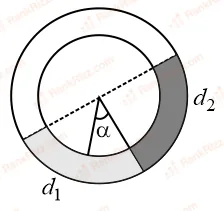
- (A)
- (B)
- (C)
- (D)
rr2.rankrizz.com/jee-main/physics/mechanical-properties-of-fluids/q/6-apr-2014-offline-q8
- (A)
An open glass tube is immersed in mercury in such a way that a length of 8 cm extends above the mercury level. The open end of the tube is then closed and sealed and the tube is raised vertically up by additional 46 cm. What will be length of the air column above mercury in the tube now? (Atmospheric pressure = 76 cm of Hg)
- (A)
16 cm
- (B)
22 cm
- (C)
38 cm
- (D)
6 cm
rr2.rankrizz.com/jee-main/physics/mechanical-properties-of-fluids/q/6-apr-2014-offline-q10
- (A)
Speed of efflux and applications of Bernoulli's theorem 21
A cylindrical vessel of 40 cm radius is completely filled with water and its capacity is 528 dm (dm : decimeter). The vessel is placed on a solid block of exactly same height as vessel. If a small hole is made at 70 cm below the top of water level, then horizontal range of water falling on the ground in the beginning is __________ cm.
- (A)
- (B)
- (C)
- (D)
rr2.rankrizz.com/jee-main/physics/mechanical-properties-of-fluids/q/6-apr-2026-s2-q34
- (A)
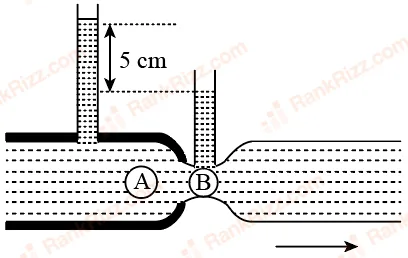
Water flows through a horizontal tube as shown in the figure. The difference in height between the water colunms in vertical tubes is 5 cm and the area of cross-sections at A and B are and respectively. The rate of flow will be ____ .
- (A)
- (B)
- (C)
- (D)
rr2.rankrizz.com/jee-main/physics/mechanical-properties-of-fluids/q/21-jan-2026-s1-physics-q15
- (A)
Consider a completely full cylindrical water tank of height 1.6 m and cross-sectional area 0.5 m. It has a small hole in its side at a height 90 cm from the bottom. Assume, the cross-sectional area of the hole to be negligibly small as compared to that of the water tank. If a load 50 kg is applied at the top surface of the water in the tank then the velocity of the water coming out at the instant when the hole is opened is :
- (A)
m/s
- (B)
m/s
- (C)
m/s
- (D)
m/s
rr2.rankrizz.com/jee-main/physics/mechanical-properties-of-fluids/q/2025-apr-03-s1-q27
- (A)
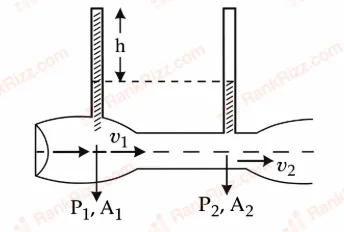
Given below are two statements: Statement I: When speed of liquid is zero everywhere, pressure difference at any two points depends on equation . Statement II: In venturi tube shown, . Choose the most appropriate answer from the options given below.
- (A)
Both Statement I and Statement II are correct
- (B)
Statement I is correct but Statement II is incorrect
- (C)
Statement I is incorrect but Statement II is correct
- (D)
Both Statement I and Statement II are incorrect
rr2.rankrizz.com/jee-main/physics/mechanical-properties-of-fluids/q/04-apr-2024-s1-q8
- (A)
A plane is in level flight at constant speed and each of its two wings has an area of m. If the speed of the air is km h over the lower wing surface and km h over the upper wing surface, the mass of the plane is ________kg. (Take air density to be kg m and m s)
Answer: ____________
rr2.rankrizz.com/jee-main/physics/mechanical-properties-of-fluids/q/01-feb-2024-s1-q23
In a test experiment on a model aeroplane in wind tunnel, the flow speeds on the upper and lower surfaces of the wings are m s and m s respectively. If the wing area is m, the lift of the wing is _______ N. (Given density of air kg m)
Answer: ____________
rr2.rankrizz.com/jee-main/physics/mechanical-properties-of-fluids/q/29-jan-2024-s1-q23
A fully loaded boeing aircraft has a mass of kg. Its total wing area is m. It is in level flight with a speed of km h. If the density of air is kg m, the fractional increase in the speed of the air on the upper surface of the wing relative to the lower surface in percentage will be ( m s)
- (A)
- (B)
- (C)
- (D)
rr2.rankrizz.com/jee-main/physics/mechanical-properties-of-fluids/q/29-jan-2023-s2-q7
- (A)
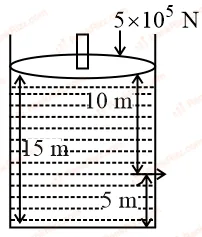
Consider a cylindrical tank of radius 1 m is filled with water. The top surface of water is at 15 m from the bottom of the cylinder. There is a hole on the wall of cylinder at a height of 5 m from the bottom. A force of N is applied on the top surface of water using a piston. The speed of efflux from the hole will be: (given atmospheric pressure Pa, density of water kg m and gravitational acceleration )
- (A)
11.6 m s
- (B)
10.8 m s
- (C)
17.8 m s
- (D)
14.4 m s
rr2.rankrizz.com/jee-main/physics/mechanical-properties-of-fluids/q/28-jul-2022-s2-q7
- (A)
The area of cross-section of a large tank is m. It has a narrow opening near the bottom having area of cross-section cm. A load of kg is applied on the water at the top in the tank. Neglecting the speed of water in the tank, the velocity of the water, coming out of the opening at the time when the height of water level in the tank is cm above the bottom, will be ______ cm s.
[Take m s]Answer: ____________
rr2.rankrizz.com/jee-main/physics/mechanical-properties-of-fluids/q/27-jun-2022-s1-q22
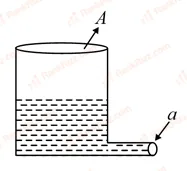
A light cylindrical vessel is kept on a horizontal surface. Area of the base is . A hole of cross-sectional area is made just at its bottom side. The minimum coefficient of friction necessary to prevent sliding the vessel due to the impact force of the emerging liquid is
- (A)
- (B)
None of these
- (C)
- (D)
rr2.rankrizz.com/jee-main/physics/mechanical-properties-of-fluids/q/27-jul-2021-s1-q6
- (A)
The water is filled up to a height of 12 m in a tank having vertical sidewalls. A hole is made in one of the walls at a depth below the water level. The value of for which the emerging stream of water strikes the ground at the maximum range is _________ m.
Answer: ____________
rr2.rankrizz.com/jee-main/physics/mechanical-properties-of-fluids/q/27-jul-2021-s2-q23
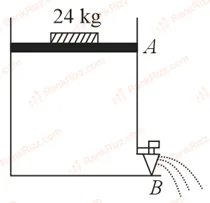
Consider a water tank as shown in the figure. It's cross-sectional area is 0.4 m. The tank has an opening B near the bottom whose cross-section area is 1 cm. A load of 24 kg is applied on the water at the top when the height of the water level is 40 cm above the bottom, the velocity of water coming out the opening B is v m s. The value of , to the nearest integer, is ___. [Take the value of to be 10 m s]
Answer: ____________
rr2.rankrizz.com/jee-main/physics/mechanical-properties-of-fluids/q/18-mar-2021-s2-q24
Water flows into a large tank with flat bottom at the rate of ms. Water is also leaking out of a hole of area 1 cm at its bottom. If the height of the water in the tank remains steady then this height is:
- (A)
5.1 cm
- (B)
1.7 cm
- (C)
2.9 cm
- (D)
4 cm
rr2.rankrizz.com/jee-main/physics/mechanical-properties-of-fluids/q/10-jan-2019-s1-q9
- (A)
The top of a water tank is open to air and its water level is maintained. It is giving out 0.74 m water per minute through a circular opening of 2 cm radius in its wall. The depth of the centre of the opening from the level of water in the tank is close to:
- (A)
2.9 m
- (B)
4.8 m
- (C)
6.0 m
- (D)
9.6 m
rr2.rankrizz.com/jee-main/physics/mechanical-properties-of-fluids/q/9-jan-2019-s2-q8
- (A)
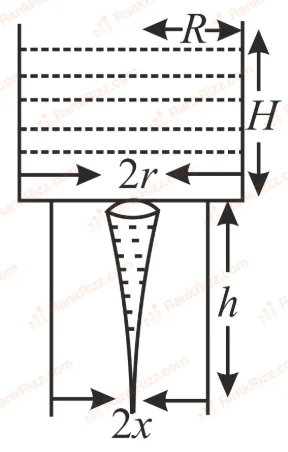
Consider a water jar of radius R that has water filled up to height H and is kept on a stand of height h. Through a hole of radius r (r << R) at its bottom, the water leaks out and the stream of water coming down towards the ground has a shape like a funnel as shown in the figure. If the radius of the cross-section of water stream when it hits the ground is x, then:
- (A)
- (B)
- (C)
- (D)
rr2.rankrizz.com/jee-main/physics/mechanical-properties-of-fluids/q/9-apr-2016-online-q8
- (A)
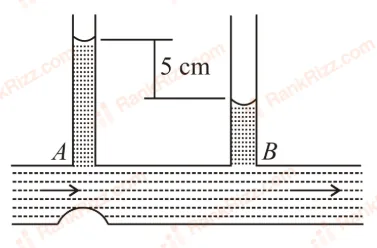
In the diagram shown, the difference in the two tubes of the manometer is 5 cm, the cross-section of the tube at A and B is 6 mm and 10 mm respectively. The rate at which water flows through the tube is (g = 10 m s)
- (A)
7.5 cc s
- (B)
12.5 cc s
- (C)
8.0 cc s
- (D)
10.0 cc s
rr2.rankrizz.com/jee-main/physics/mechanical-properties-of-fluids/q/19-apr-2014-online-q10
- (A)
A cylindrical vessel of cross-section A contains water to a height h. There is a hole in the bottom of radius 'a'. The time in which it will be emptied is:
- (A)
- (B)
- (C)
- (D)
rr2.rankrizz.com/jee-main/physics/mechanical-properties-of-fluids/q/12-apr-2014-online-q9
- (A)
A tank with a small hole at the bottom has been filled with water and kerosene (specific gravity 0.8). The height of water is 3 m and that of kerosene is 2 m. When the hole is opened, the velocity of fluid coming out from it is nearly: (take g = 10 ms and density of water = kg m)
- (A)
10.7 ms
- (B)
9.6 ms
- (C)
8.5 ms
- (D)
7.6 ms
rr2.rankrizz.com/jee-main/physics/mechanical-properties-of-fluids/q/11-apr-2014-online-q9
- (A)
Air of density 1.2 kg m is blowing across the horizontal wings of an aeroplane in such a way that its speeds above and below the wings are 150 ms and 100 ms, respectively. The pressure difference between the upper and lower sides of the wings, is :
- (A)
60 Nm
- (B)
180 Nm
- (C)
7500 Nm
- (D)
12500 Nm
rr2.rankrizz.com/jee-main/physics/mechanical-properties-of-fluids/q/22-apr-2013-online-q8
- (A)
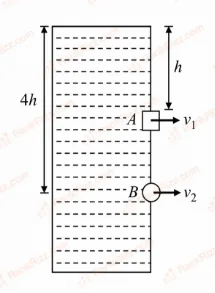
A square hole of side length is made at a depth of and a circular hole of radius is made at a depth of from the surface of water in a water tank kept on a horizontal surface. If and the rate of water flow from the holes is the same, then is equal to
- (A)
- (B)
- (C)
- (D)
rr2.rankrizz.com/jee-main/physics/mechanical-properties-of-fluids/q/2012-physics-499117
- (A)
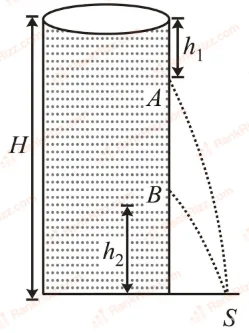
In a cylindrical water tank, there are two small holes and on the wall at a depth of , from the surface of water and at a height of from the bottom of water tank. Surface of water is at height from the bottom of water tank. Surface of water is at height from the bottom of water tank. Water coming out from both holes strikes the ground at the same point . Find the ratio of and .
- (A)
Depends on
- (B)
- (C)
- (D)
rr2.rankrizz.com/jee-main/physics/mechanical-properties-of-fluids/q/2012-physics-499170
- (A)
Equation of continuity and Bernoulli's theorem 20
A liquid of density 600 kg/m flowing steadily in a tube of varying cross-section. The cross-section at a point is 1.0 cm and that at is 20 mm. Both the points and are in same horizontal plane, the speed of the liquid at is 10 cm/s. The difference in pressures at and points is __________ Pa.
- (A)
18
- (B)
144
- (C)
36
- (D)
72
rr2.rankrizz.com/jee-main/physics/mechanical-properties-of-fluids/q/8-apr-2026-s2-q33
- (A)
A water spray gun is attached to a hose of cross sectional area 30 cm. The gun comprises of 10 perforations each of cross sectional area of 15 mm. If the water flows in the hose with the speed of 50 cm/s, calculate the speed at which the water flows out from each perforation. (Neglect any edge effects)
- (A)
m/s
- (B)
m/s
- (C)
m/s
- (D)
m/s
rr2.rankrizz.com/jee-main/physics/mechanical-properties-of-fluids/q/4-apr-2026-s2-q32
- (A)
Water flows in a horizontal pipe whose one end is closed with a valve. The reading of the pressure gauge attached to the pipe is . The reading of the pressure gauge falls to when the valve is opened. The speed of water flowing in the pipe is proportional to
- (A)
- (B)
- (C)
- (D)
rr2.rankrizz.com/jee-main/physics/mechanical-properties-of-fluids/q/23-jan-2025-s2-q32
- (A)
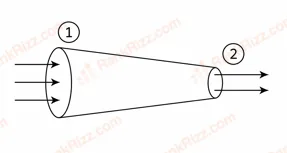
A tube of length L is shown in the figure. The radius of the cross section at point (1) is 2 cm and at point (2) is 1 cm , respectively. If the velocity of water entering at point (1) is 2 m/s, then the velocity of water leaving point (2) will be- (A)
4 m/s
- (B)
2 m/s
- (C)
6 m/s
- (D)
8 m/s
rr2.rankrizz.com/jee-main/physics/mechanical-properties-of-fluids/q/22-jan-2025-s2-q41
- (A)
Correct Bernoulli's equation is (symbols have their usual meaning) :
- (A)
- (B)
- (C)
- (D)
rr2.rankrizz.com/jee-main/physics/mechanical-properties-of-fluids/q/8-apr-2024-s1-q8
- (A)
The reading of pressure metre attached with a closed pipe is N m. On opening the valve, water starts flowing and the reading of pressure metre falls to N m. The velocity of water is found to be m s. The value of is _____.
Answer: ____________
rr2.rankrizz.com/jee-main/physics/mechanical-properties-of-fluids/q/27-jan-2024-s2-q23
The figure shows a liquid of a given density flowing steadily in a horizontal tube of a varying cross-section. Cross-sectional area at A is cm, and that at B is mm, if the speed of liquid at B is cm s then is
(Given and are liquid pressures at A and B points. Density kg m. A and B are on the axis of tube)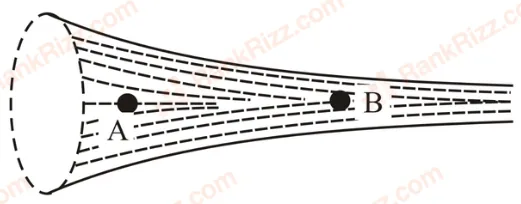
- (A)
- (B)
- (C)
- (D)
rr2.rankrizz.com/jee-main/physics/mechanical-properties-of-fluids/q/13-apr-2023-s1-q9
- (A)
Glycerin of density kg m is flowing through the conical section of pipe. The area of cross-section of the pipe at its ends are cm and cm and pressure drop across its length is N m. The rate of flow of glycerine through the pipe is m s. The value of is _____.
Answer: ____________
rr2.rankrizz.com/jee-main/physics/mechanical-properties-of-fluids/q/12-apr-2023-s1-q24
Figure below shows a liquid being pushed out of the tube by a piston having area of cross section 2.0 cm. The area of cross section at the outlet is 10 mm. If the piston is pushed at a speed of 4 cm s, the speed of outgoing fluid is _______ cm s
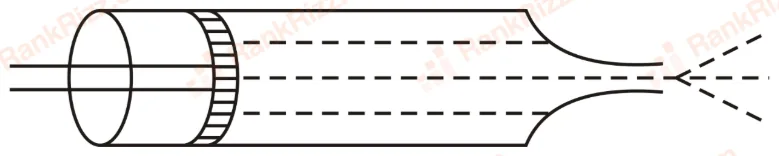
Answer: ____________
rr2.rankrizz.com/jee-main/physics/mechanical-properties-of-fluids/q/10-apr-2023-s2-q23
The surface of water in a water tank of cross section area cm on the top of a house is m above the tap level. The speed of water coming out through the tap of cross section area mm is cm s. At that instant, is m s. The value of will be ______.
Answer: ____________
rr2.rankrizz.com/jee-main/physics/mechanical-properties-of-fluids/q/01-feb-2023-s2-q25
A pressure-pump has a horizontal tube of cross-sectional area 10 cm for the outflow of water at a speed of 20 m s. The force exerted on the vertical wall just in front of the tube which stops water horizontally flowing out of the tube, is: [given: density of water kg m]
- (A)
300 N
- (B)
500 N
- (C)
250 N
- (D)
400 N
rr2.rankrizz.com/jee-main/physics/mechanical-properties-of-fluids/q/28-jul-2022-s2-q6
- (A)
A liquid of density 750 kg m flows smoothly through a horizontal pipe that tapers in cross-sectional area from m to . The pressure difference between the wide and narrow sections of the pipe is 4500 Pa. The rate of flow of liquid is ______ m s.
Answer: ____________
rr2.rankrizz.com/jee-main/physics/mechanical-properties-of-fluids/q/28-jun-2022-s2-q23
An ideal fluid of density kg m, flows smoothly through a bent pipe (as shown in the figure) that tapers in cross-sectional area from to . The pressure difference between the wide and narrow sections of pipe is Pa. At the wider section, the velocity of the fluid is m s for ______. (Given m s)
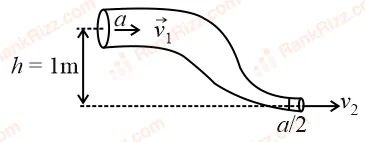
Answer: ____________
rr2.rankrizz.com/jee-main/physics/mechanical-properties-of-fluids/q/26-jun-2022-s1-q25
A fluid is flowing through a horizontal pipe of varying cross-section, with speed at a point where the pressure is P Pascal. At another point where pressure is Pascal its speed is . If the density of the fluid is and the flow is streamline, then is equal to:
- (A)
- (B)
- (C)
- (D)
rr2.rankrizz.com/jee-main/physics/mechanical-properties-of-fluids/q/6-sep-2020-s2-q6
- (A)
Water flows in a horizontal tube (see figure). The pressure of water changes by between and where the area of cross section are and , respectively. Find the rate of flow of water through the tube. (density of water )
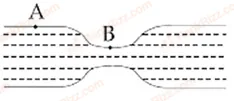
- (A)
- (B)
- (C)
- (D)
rr2.rankrizz.com/jee-main/physics/mechanical-properties-of-fluids/q/9-jan-2020-s1-q6
- (A)
An ideal fluid flows (laminar flow) through a pipe of non-uniform diameter. The maximum and minimum diameters of the pipes are 6.4 cm and 4.8 cm, respectively. The ratio of the minimum and the maximum velocities of fluid in this pipe is:
- (A)
- (B)
- (C)
- (D)
rr2.rankrizz.com/jee-main/physics/mechanical-properties-of-fluids/q/7-jan-2020-s2-q6
- (A)
Water from a tap emerges vertically downwards with an initial speed of 1.0 ms. The cross-sectional area of the tap is m. Assume that the pressure is constant throughout the stream of water and that the flow is streamlined. The cross-sectional area of the stream, 0.15 m below the tap would be:
(Take g = 10 ms)- (A)
m
- (B)
m
- (C)
m
- (D)
m
rr2.rankrizz.com/jee-main/physics/mechanical-properties-of-fluids/q/10-apr-2019-s2-q12
- (A)
A liquid of density is coming out of a hose pipe of radius with horizontal speed and hits a mesh. 50% of the liquid passes through the mesh unaffected. 25% loses all of its momentum and 25% comes back with the same speed. The resultant pressure on the mesh will be:
- (A)
- (B)
- (C)
- (D)
rr2.rankrizz.com/jee-main/physics/mechanical-properties-of-fluids/q/11-jan-2019-s1-q8
- (A)
Water is flowing through a horizontal tube having cross-sectional areas of its two ends being and such that the ratio is . If the pressure difference of water between the two ends is N m, the velocity of water with which it enters the tube will be (neglect gravity effects)
- (A)
m s
- (B)
m s
- (C)
m s
- (D)
m s
rr2.rankrizz.com/jee-main/physics/mechanical-properties-of-fluids/q/2012-physics-499388
- (A)
Water is flowing continuously from a tap having an internal diameter . The water velocity as it leaves the tap is . The diameter of the water stream at a distance below the tap is close to:
- (A)
- (B)
- (C)
- (D)
rr2.rankrizz.com/jee-main/physics/mechanical-properties-of-fluids/q/2011-physics-499477
- (A)
Excess pressure in drops and bubbles 20
The excess pressure inside a soap bubble A in air is half the excess pressure inside another soap bubble B in air. If the volume of the bubble A is times the volume of the bubble B, then the value of n is ________.
Answer: ____________
rr2.rankrizz.com/jee-main/physics/mechanical-properties-of-fluids/q/2025-apr-3-s2-q47
An air bubble of radius lies at a depth of below the free surface of a liquid of density If the pressure inside the bubble is greater than the atmospheric pressure, then the surface tension of the liquid in SI unit is
- (A)
0.1
- (B)
0.05
- (C)
0.02
- (D)
0.25
rr2.rankrizz.com/jee-main/physics/mechanical-properties-of-fluids/q/24-jan-2025-s1-q39
- (A)
An air bubble of radius 1.0 mm is observed at a depth of 20 cm below the free surface of a liquid having surface tension and density . The difference between pressure inside the bubble and atmospheric pressure is _____
Answer: ____________
rr2.rankrizz.com/jee-main/physics/mechanical-properties-of-fluids/q/23-jan-2025-s2-q48
Two soap bubbles of radius 2 cm and 4 cm , respectively, are in contact with each other. The radius of curvature of the common surface, in cm , is ________ .
Answer: ____________
rr2.rankrizz.com/jee-main/physics/mechanical-properties-of-fluids/q/22-jan-2025-s1-q47
The excess pressure inside a soap bubble is thrice the excess pressure inside a second soap bubble. The ratio between the volume of the first and the second bubble is:
- (A)
- (B)
- (C)
- (D)
rr2.rankrizz.com/jee-main/physics/mechanical-properties-of-fluids/q/9-apr-2024-s2-q5
- (A)
A liquid column of height balances excess pressure of a soap bubble of certain radius. If density of liquid is and surface tension of soap solution is , then diameter of the soap bubble is ______ cm. (if )
Answer: ____________
rr2.rankrizz.com/jee-main/physics/mechanical-properties-of-fluids/q/8-apr-2024-s1-q23
Pressure inside a soap bubble is greater than the pressure outside by an amount : (given : = Radius of bubble, = Surface tension of bubble)
- (A)
- (B)
- (C)
- (D)
rr2.rankrizz.com/jee-main/physics/mechanical-properties-of-fluids/q/6-apr-2024-s2-q7
- (A)
There is an air bubble of radius mm in a liquid of surface tension N m and density kg m at a depth of cm below the free surface. The amount by which the pressure inside the bubble is greater than the atmospheric pressure is _____ Pa ( m s).
Answer: ____________
rr2.rankrizz.com/jee-main/physics/mechanical-properties-of-fluids/q/15-apr-2023-s1-q23
A spherical soap bubble of radius 3 cm is formed inside another spherical soap bubble of radius 6 cm. If the internal pressure of the smaller bubble of radius 3 cm in the above system is equal to the internal pressure of another single soap bubble of radius cm. The value of is _____
Answer: ____________
rr2.rankrizz.com/jee-main/physics/mechanical-properties-of-fluids/q/27-jul-2022-s2-q24
A soap bubble of the radius 3 cm is formed inside another soap bubble of radius 6 cm. The radius of an equivalent soap bubble that has the same excess pressure as inside the smaller bubble with respect to the atmospheric pressure is _________ cm.
Answer: ____________
rr2.rankrizz.com/jee-main/physics/mechanical-properties-of-fluids/q/26-aug-2021-s1-q24
Two spherical soap bubbles of radii and in vacuum combine under isothermal conditions. The resulting bubble has a radius equal to:
- (A)
- (B)
- (C)
- (D)
rr2.rankrizz.com/jee-main/physics/mechanical-properties-of-fluids/q/25-jul-2021-s2-q9
- (A)
When two soap bubbles of radii and () coalesce, the radius of curvature of common surface is:
- (A)
- (B)
- (C)
- (D)
rr2.rankrizz.com/jee-main/physics/mechanical-properties-of-fluids/q/17-mar-2021-s1-q6
- (A)
Pressure inside two soap bubbles are 1.01 and 1.02 atmosphere, respectively. The ratio of their volumes is:
- (A)
- (B)
- (C)
- (D)
rr2.rankrizz.com/jee-main/physics/mechanical-properties-of-fluids/q/3-sep-2020-s1-q4
- (A)
A soap bubble, blown by a mechanical pump at the mouth of a tube increases in volume with time at a constant rate. The graph that correctly depicts the time dependence of pressure inside the bubble is given by:
- (A)
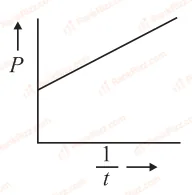
- (B)
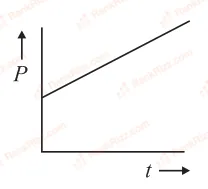
- (C)
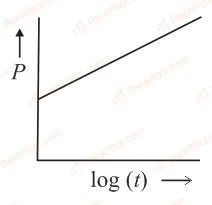
- (D)
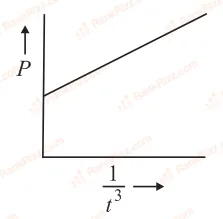
rr2.rankrizz.com/jee-main/physics/mechanical-properties-of-fluids/q/12-jan-2019-s2-q10
- (A)
A small soap bubble of radius 4 cm is trapped inside another bubble of radius 6 cm without any contact. Let P be the pressure inside the inner bubble and P, the pressure outside the outer bubble. Radius of another bubble with pressure difference P - P between its inside and outside would be:
- (A)
2.4 cm
- (B)
12 cm
- (C)
4.8 cm
- (D)
6 cm
rr2.rankrizz.com/jee-main/physics/mechanical-properties-of-fluids/q/16-apr-2018-online-q8
- (A)
If two glass plates have water between them and are separated by very small distance (see the figure below), it is very difficult to pull them apart. It is because the water in between forms cylindrical surface on the side that gives rise to lower pressure in the water in comparison to atmosphere. If the radius of the cylindrical surface is R and surface tension of water is T then the pressure in water between the plates is lower by:
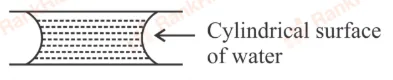
- (A)
- (B)
- (C)
- (D)
rr2.rankrizz.com/jee-main/physics/mechanical-properties-of-fluids/q/10-apr-2015-online-q8
- (A)
Two soap bubbles coalesce to form a single bubble. If V is the subsequent change in volume of contained air and S change in total surface area, T is the surface tension and P atmospheric pressure, then which of the following relation is correct?
- (A)
4PV + 3ST = 0
- (B)
3PV + 4ST = 0
- (C)
2PV + 3ST = 0
- (D)
3PV + 2ST = 0
rr2.rankrizz.com/jee-main/physics/mechanical-properties-of-fluids/q/12-apr-2014-online-q10
- (A)
An air bubble of radius 0.1 cm is in a liquid having surface tension 0.06 N/m and density kg/m. The pressure inside the bubble is 1100 Nm greater than the atmospheric pressure. At what depth is the bubble below the surface of the liquid? ( ms)
- (A)
0.1 m
- (B)
0.15 m
- (C)
0.20 m
- (D)
0.25 m
rr2.rankrizz.com/jee-main/physics/mechanical-properties-of-fluids/q/11-apr-2014-online-q10
- (A)
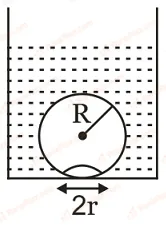
On heating water, bubbles being formed at the bottom of the vessel detach and rise. Take the bubbles to be spheres of radius R and making a circular contact of radius r with the bottom of the vessel. If , and the surface tension of water is T, value of r just before bubbles detach is: (density of water is )
- (A)
- (B)
- (C)
- (D)
rr2.rankrizz.com/jee-main/physics/mechanical-properties-of-fluids/q/6-apr-2014-offline-q9
- (A)
If two soap bubbles of different radii are connected by a tube,
- (A)
air flows from the bigger bubble to the smaller bubble till the sizes are interchanged.
- (B)
air flows from bigger bubble to the smaller bubble till the sizes are interchanged
- (C)
air flows from the smaller bubble to the bigger.
- (D)
there is no flow of air.
rr2.rankrizz.com/jee-main/physics/mechanical-properties-of-fluids/q/2004-physics-500187
- (A)
Angle of contact and capillary rise 19
When a part of a straight capillary tube is placed vertically in a liquid, the liquid raises up to certain height h. If the inner radius of the capillary tube, density of the liquid and surface tension of the liquid decrease by 1 % each, then the height of the liquid in the tube will change by __ %.
- (A)
+3
- (B)
-3
- (C)
+1
- (D)
-1
rr2.rankrizz.com/jee-main/physics/mechanical-properties-of-fluids/q/22-jan-2026-s2-q29
- (A)
Surface tension of two liquids (having same densities), and , are measured using capillary rise method utilizing two tubes with inner radii of and
where . The measured liquid heights in these tubes are and respectively. [Ignore the weight of the liquid about the lowest point of miniscus]. The heights and and surfaces tensions and satisfy the relation :- (A)
and
- (B)
and
- (C)
and
- (D)
and
rr2.rankrizz.com/jee-main/physics/mechanical-properties-of-fluids/q/21-jan-2026-s2-q39
- (A)
A capillary tube of radius 0.1 mm is partly dipped in water (surface tension 70 dyn/cm and glass water contact angle ) with inclined with vertical. The length of water risen in the capillary is _____ cm. (Take m/s)
- (A)
- (B)
- (C)
- (D)
rr2.rankrizz.com/jee-main/physics/mechanical-properties-of-fluids/q/2025-apr-7-s2-q32
- (A)
Two liquids A and B have and as contact angles in a capillary tube. If , then identify the correct statement:
- (A)
K is negative, then liquid A and liquid B have convex meniscus
- (B)
K is negative, then liquid A and liquid B have concave meniscus
- (C)
K is negative, then liquid A has concave meniscus and liquid B has convex meniscus
- (D)
K is zero, then liquid A has convex meniscus and liquid B has concave meniscus
rr2.rankrizz.com/jee-main/physics/mechanical-properties-of-fluids/q/2025-apr-4-s1-q28
- (A)
Given below are two statements :
Statement I : When a capillary tube is dipped into a liquid, the liquid neither rises nor falls in the capillary. The contact angle may be .
Statement II : The contact angle between a solid and a liquid is a property of the material of the solid and liquid as well.
In the light of the above statement, choose the correct answer from the options given below.
- (A)
Both Statement I and Statement II are false
- (B)
Both Statement I and Statement II are true
- (C)
Statement I is false but Statement II is true
- (D)
Statement I is true and Statement II is false
rr2.rankrizz.com/jee-main/physics/mechanical-properties-of-fluids/q/5-apr-2024-s1-q10
- (A)
Given below are two statements: Statement I: The contact angle between a solid and a liquid is a property of the material of the solid and liquid as well. Statement II: The rise of a liquid in a capillary tube does not depend on the inner radius of the tube. In the light of the above statements, choose the correct answer from the options given below:
- (A)
Statement I is true but Statement II is false.
- (B)
Statement I is false but Statement II is true.
- (C)
Both Statement I and Statement II are false.
- (D)
Both Statement I and Statement II are true.
rr2.rankrizz.com/jee-main/physics/mechanical-properties-of-fluids/q/04-apr-2024-s2-q7
- (A)
Given below are two statements:
Statement I : If a capillary tube is immersed first in cold water and then in hot water, the height of capillary rise will be smaller in hot water.
Statement II : If a capillary tube is immersed first in cold water and then in hot water, the height of capillary rise will be smaller in cold water.
In the light of the above statements, choose the most appropriate from the options given below- (A)
Both Statement I and Statement II are true
- (B)
Both Statement I and Statement II are false
- (C)
Statement I is true but Statement II is false
- (D)
Statement I is false but Statement II is true
rr2.rankrizz.com/jee-main/physics/mechanical-properties-of-fluids/q/29-jan-2024-s1-q7
- (A)
The height of liquid column raised in a capillary tube of certain radius when dipped in liquid vertically is, cm. If the tube is dipped in a similar manner in another liquid of surface tension and density double the values of liquid , the height of liquid column raised in liquid B would be ______ m.
- (A)
- (B)
- (C)
- (D)
rr2.rankrizz.com/jee-main/physics/mechanical-properties-of-fluids/q/30-jan-2023-s1-q8
- (A)
Given below are two statements: One is labelled as Assertion (A) and the other is labelled as Reason (R).
Assertion (A): Clothes containing oil or grease stains cannot be cleaned by water wash.
Reason (R): Because the angle of contact between the oil/grease and water is obtuse.
In the light of the above statements, choose the correct answer from the option given below.- (A)
Both (A) and (R) are true and (R) is the correct explanation of (A)
- (B)
Both (A) and (R) are true but (R) is not the correct explanation of (A)
- (C)
(A) is true but (R) is false
- (D)
(A) is true but (R) is true
rr2.rankrizz.com/jee-main/physics/mechanical-properties-of-fluids/q/29-jul-2022-s1-q8
- (A)
Two narrow bores of diameter 5.0 mm and 8.0 mm are joined together to form a U-shaped tube open at both ends. If this U-tube contains water, what is the difference in the level of two limbs of the tube.
[Take surface tension of water N m, angle of contact = 0, m s and density of water = kg m]- (A)
5.34 mm
- (B)
3.62 mm
- (C)
2.19 mm
- (D)
4.97 mm
rr2.rankrizz.com/jee-main/physics/mechanical-properties-of-fluids/q/26-aug-2021-s1-q5
- (A)
When a long glass capillary tube of radius 0.015 cm is dipped in a liquid, the liquid rises to a height of 15 cm within it. If the contact angle between the liquid and glass is close to 0°, the surface tension of the liquid, in milliNewton m, is (Given answer in closed integer)
Answer: ____________
rr2.rankrizz.com/jee-main/physics/mechanical-properties-of-fluids/q/3-sep-2020-s1-q23
A capillary tube made of glass of radius 0.15 mm is dipped vertically in a beaker filled with methylene iodide (surface tension = 0.05 N m, density = 667 kg m) which rises to height h in the tube. It is observed that the two tangents drawn from observed that the two tangents drawn from liquid-glass interfaces (from opp. sides of the capillary) make an angle of 60 with one another. Then h is close to (g = 10 m s):
- (A)
0.049 m
- (B)
0.087 m
- (C)
0.137 m
- (D)
0.172 m
rr2.rankrizz.com/jee-main/physics/mechanical-properties-of-fluids/q/2-sep-2020-s2-q4
- (A)
The ratio of surface tensions of mercury and water is given to be 7.5, while the ratio of their densities is 13.6. Their contact angles, with glass, are close to 135° and 0°, respectively. If it is observed that mercury gets depressed by an amount in a capillary tube of radius , while water rises by the same amount in a capillary tube of radius , then the ratio is close to
- (A)
- (B)
- (C)
- (D)
rr2.rankrizz.com/jee-main/physics/mechanical-properties-of-fluids/q/10-apr-2019-s1-q7
- (A)
If 'M' is the mass of water that rises in a capillary tube of radius 'r', then mass of water which will rise in a capillary tube of radius '2r' is:
- (A)
4 M
- (B)
2 M
- (C)
- (D)
M
rr2.rankrizz.com/jee-main/physics/mechanical-properties-of-fluids/q/9-apr-2019-s1-q9
- (A)
A capillary tube is immersed vertically in water and the height of the water column is . When this arrangement is taken into a mine of depth d, the height of the water column is . If R is the radius of earth, the ratio is:
- (A)
- (B)
- (C)
- (D)
rr2.rankrizz.com/jee-main/physics/mechanical-properties-of-fluids/q/9-apr-2014-online-q8
- (A)
Wax is coated on the inner wall of a capillary tube and the tube is then dipped in water. Then, compared to the unwaxed capillary, the angle of contact and the height upto which water rises change. These changes are :
- (A)
increases and also increases
- (B)
decreases and also decreases
- (C)
increases and decreases
- (D)
decreases and increases
rr2.rankrizz.com/jee-main/physics/mechanical-properties-of-fluids/q/23-apr-2013-online-q8
- (A)
This question has Statement-1 and Statement-2. Of the four choices given after the Statements, choose the one that best describes the two Statements.
Statement-1: A capillary is dipped in a liquid and liquid rises to a height h in it. As the temperature of the liquid is raised, the height h increases (if the density of the liquid and the angle of contact remain the same).
Statement-2: Surface tension of a liquid decreases with the rise in its temperature.- (A)
Statement-1 is true, Statement-2 is true; Statement-2 is not the correct explanation for Statement-1.
- (B)
Statement-1 is false, Statement-2 is true.
- (C)
Statement-1 is true, Statement-2 is false.
- (D)
Statement-1 is true, Statement-2 is true; Statement-2 is the correct explanation for Statement-1.
rr2.rankrizz.com/jee-main/physics/mechanical-properties-of-fluids/q/9-apr-2013-online-q7
- (A)
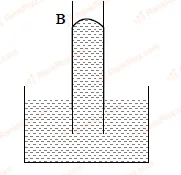
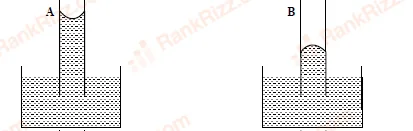
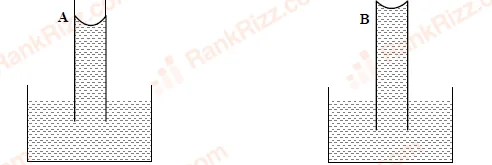
A capillary tube (A) is dropped in water. Another identical tube (B) is dipped in a soap water solution. Which of the following shows the relative nature of the liquid columns in the two tubes?
- (A)
- (B)
- (C)
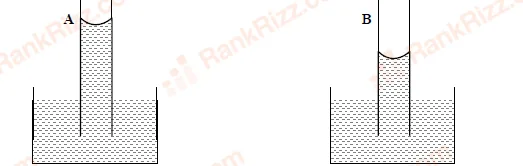
- (D)
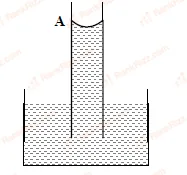
rr2.rankrizz.com/jee-main/physics/mechanical-properties-of-fluids/q/2008-physics-499874
- (A)
A cm long capillary tube is dipped in water. The water rises up to cm. If the entire arrangement is put in a freely falling elevator the length of water column in the capillary tube will be
- (A)
cm
- (B)
cm
- (C)
cm
- (D)
cm
rr2.rankrizz.com/jee-main/physics/mechanical-properties-of-fluids/q/2005-physics-500152
- (A)
Archimedes' principle and floatation 16
A tub is filled with water and a wooden cube 10 cm × 10 cm × 10 cm is placed in the water. The wooden cube is found to float on the water with a part of it submerged in water. When a metal coin is placed on the wooden cube, the submerged part is increased by 3.87 cm. The mass of the metal coin is __________ gram. (Take water density as 1 g/cm and density of wood = 0.4 g/cm)
Answer: ____________
rr2.rankrizz.com/jee-main/physics/mechanical-properties-of-fluids/q/2-apr-2026-s1-q50
A cubical block of density floats in a liquid of density . If the height of block is H = 8.0 cm then height of the submerged part is ________ cm.
- (A)
6.3
- (B)
4.3
- (C)
7.3
- (D)
5.3
rr2.rankrizz.com/jee-main/physics/mechanical-properties-of-fluids/q/24-jan-2026-s2-q28
- (A)
A wooden block is floating in a liquid, 40\ \%\ of its volume is inside the liquid when the vessel is stationary. Percentage of volume immersed when the vessel moves upwards with an acceleration is
- (A)
60\ \%\
- (B)
40\ \%\
- (C)
20\ \%\
- (D)
33.33\%\
rr2.rankrizz.com/jee-main/physics/mechanical-properties-of-fluids/q/2026-physics-515292
- (A)
A cube having a side of 10 cm with unknown mass and 200 gm mass were hung at two ends of an uniform rigid rod of 27 cm long. The rod along with masses was placed on a wedge keeping the distance between wedge point and 200 gm weight as 25 cm. Initially the masses were not at balance. A beaker is placed beneath the unknown mass and water is added slowly to it. At given point the masses were in balance and half volume of the unknown mass was inside the water. The unknown mass is _____ kg.
Answer: ____________
rr2.rankrizz.com/jee-main/physics/mechanical-properties-of-fluids/q/2025-apr-8-s2-q50
A 400 g solid cube having an edge of length 10 cm floats in water. How much volume of the cube is outside the water ? (Given : density of water )
- (A)
1400
- (B)
600
- (C)
4000
- (D)
400
rr2.rankrizz.com/jee-main/physics/mechanical-properties-of-fluids/q/28-jan-2025-s2-q34
- (A)
A sphere of relative density and diameter has concentric cavity of diameter . The ratio of , if it just floats on water in a tank is :
- (A)
- (B)
- (C)
- (D)
rr2.rankrizz.com/jee-main/physics/mechanical-properties-of-fluids/q/9-apr-2024-s1-q7
- (A)
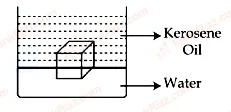
A cube of ice floats partly in water and partly in kerosene oil. The ratio of volume of ice immersed in water to that in kerosene oil (specific gravity of Kerosene oil , specific gravity of ice )
- (A)
1 : 1
- (B)
5 : 4
- (C)
8 : 9
- (D)
9 : 10
rr2.rankrizz.com/jee-main/physics/mechanical-properties-of-fluids/q/8-apr-2024-s2-q7
- (A)
A hollow spherical shell at outer radius floats just submerged under the water surface. The inner radius of the shell is . If the specific gravity of the shell material is with respect to water, the value of is:
- (A)
- (B)
- (C)
- (D)
rr2.rankrizz.com/jee-main/physics/mechanical-properties-of-fluids/q/5-sep-2020-s1-q6
- (A)
An air bubble of radius 1 cm in water has an upward acceleration of 9.8 cms. The density of water is 1 gm cm and water offers negligible drag force on the bubble. The mass of the bubble is cm/s.
- (A)
4.51 gm
- (B)
3.15 gm
- (C)
4.15 gm
- (D)
1.52 gm
rr2.rankrizz.com/jee-main/physics/mechanical-properties-of-fluids/q/4-sep-2020-s1-q6
- (A)
A leak proof cylinder of length 1 m, made of a metal which has very low coefficient of expansion is floating vertically in water at 0C such that its height above the water surface is 20 cm. When the temperature of water is increased to 4C, the height of the cylinder above the water surface becomes 21 cm. The density of water at T = 4C, relative to the density at T = 0C is close to:
- (A)
1.26
- (B)
1.04
- (C)
1.01
- (D)
1.03
rr2.rankrizz.com/jee-main/physics/mechanical-properties-of-fluids/q/8-jan-2020-s1-q6
- (A)
Consider a solid sphere of radius and mass density , . The minimum density of a liquid in which it will float is:
- (A)
- (B)
- (C)
- (D)
rr2.rankrizz.com/jee-main/physics/mechanical-properties-of-fluids/q/8-jan-2020-s1-q7
- (A)
A cubical block of side 0.5 m floats on water with 30% of its volume under water. What is the maximum weight that can be put on the block without fully submerging it under water?
[Take, density of water = 10 kg/m]- (A)
87.5 kg
- (B)
65.4 kg
- (C)
30.1 kg
- (D)
46.3 kg
rr2.rankrizz.com/jee-main/physics/mechanical-properties-of-fluids/q/10-apr-2019-s2-q11
- (A)
A wooden block floating in a bucket of water has of its volume submerged. When certain amount of an oil is poured into the bucket, it is found that the block is just under the oil surface with half of its volume under water and half in oil. The density of oil relative to that of water is:
- (A)
0.8
- (B)
0.7
- (C)
0.5
- (D)
0.6
rr2.rankrizz.com/jee-main/physics/mechanical-properties-of-fluids/q/9-apr-2019-s2-q9
- (A)
A uniform cylinder of length L and mass M having cross-sectional area A is suspended, with its length vertical, from a fixed point by a massless spring, such that it is half submerged in a liquid of density at equilibrium position. The extension of the spring when it is in equilibrium is :
- (A)
- (B)
- (C)
- (D)
rr2.rankrizz.com/jee-main/physics/mechanical-properties-of-fluids/q/7-apr-2013-offline-q3
- (A)
A ball is made of a material of density where with and representing the densities of oil and water, respectively. The oil and water are immiscible. If the above ball is in equilibrium in a mixture of this oil and water, which of the following pictures represents its equilibrium position?
- (A)
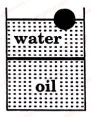
- (B)
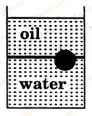
- (C)
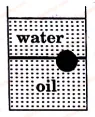
- (D)
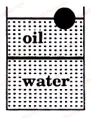
rr2.rankrizz.com/jee-main/physics/mechanical-properties-of-fluids/q/2010-physics-499625
- (A)
A jar filled with two non mixing liquids 1 and 2 having densities and respectively. A solid ball, made of a material of density , is dropped in the jar. It comes to equilibrium in the position shown in the figure. Which of the following is true for and ?
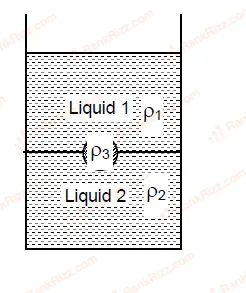
- (A)
- (B)
- (C)
- (D)
rr2.rankrizz.com/jee-main/physics/mechanical-properties-of-fluids/q/2008-physics-499873
- (A)
Viscosity, Poiseuille's equation and Reynolds number 11
Consider following statements: A. Surface tension arises due to extra energy of the molecules at the interior as compared to the molecules at the surface, of a liquid. B. As the temperature of liquid rises, the coefficient of viscosity increases. C. As the temperature of gas increases, the coefficient of viscosity increases D. The onset of turbulence is determined by Reynold's number. E. In a steady flow two stream lines never intersect. Choose the correct answer from the options given below:
- (A)
C, D, E Only
- (B)
A, D, E Only
- (C)
B, C, D Only
- (D)
A, B, C Only
rr2.rankrizz.com/jee-main/physics/mechanical-properties-of-fluids/q/28-jan-2025-s1-q41
- (A)
Given below are two statements:
Statement I: The hot water flows faster than cold water
Statement II: Soap water has higher surface tension as compared to fresh water. In the light above statements, choose the correct answer from the options given below- (A)
Statement I is true but Statement II is false
- (B)
Statement I is false but Statement II is true
- (C)
Both Statement I and Statement II are false
- (D)
Both Statement I and Statement II are true
rr2.rankrizz.com/jee-main/physics/mechanical-properties-of-fluids/q/23-jan-2025-s1-q31
- (A)
A metal block of base area m is placed on a table, as shown in the figure. A liquid film of thickness mm is inserted between the block and the table. The block is pushed by a horizontal force of N and moves with a constant speed. If the viscosity of the liquid is Pl, the speed of the block is ______ m s.
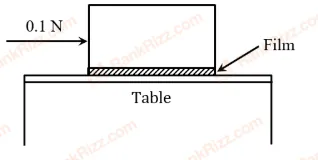
Answer: ____________
rr2.rankrizz.com/jee-main/physics/mechanical-properties-of-fluids/q/29-jan-2023-s2-q23
Assertion A: Product of Pressure () and time () has the same dimension as that of coefficient of viscosity.
Reason: Coefficient of viscosity =- (A)
Both A and R true, and R is correct explanation of A.
- (B)
Both A and R are true but R is NOT the correct explanation of A.
- (C)
A is true but R is false.
- (D)
A is false but R is true.
rr2.rankrizz.com/jee-main/physics/mechanical-properties-of-fluids/q/28-jun-2022-s1-q1
- (A)
If is the density and is coefficient of viscosity of fluid which flows with a speed in the pipe of diameter , the correct formula for Reynolds number is
- (A)
- (B)
- (C)
- (D)
rr2.rankrizz.com/jee-main/physics/mechanical-properties-of-fluids/q/26-jun-2022-s2-q6
- (A)
The velocity of upper layer of water in a river is km h. Shearing stress between horizontal layers of water is N m. Depth of the river is ______ m. (Co-efficient of viscosity of water is Pa s)
Answer: ____________
rr2.rankrizz.com/jee-main/physics/mechanical-properties-of-fluids/q/25-jun-2022-s1-q24
What will be the nature of flow of water from a circular tap, when its flow rate increased from 0.18 L (min) to 0.48 L (min)? The radius of the tap and viscosity of water are 0.5 cm and Pa s, respectively. (Density of water: kg m)
- (A)
Unsteady to steady flow
- (B)
Remains steady flow
- (C)
Remains turbulent flow
- (D)
Steady flow to unsteady flow
rr2.rankrizz.com/jee-main/physics/mechanical-properties-of-fluids/q/16-mar-2021-s2-q5
- (A)
Water from a pipe is coming at a rate of 100 liters per minute. If the radius of the pipe is 5 cm, the Reynolds number for the flow is of the order of: (density of water = 100 kg/m, coefficient of viscosity of water = 1 mPa s)
- (A)
- (B)
- (C)
- (D)
rr2.rankrizz.com/jee-main/physics/mechanical-properties-of-fluids/q/8-apr-2019-s1-q10
- (A)
Two tubes of radii and and lengths and , respectively, are connected in series and a liquid flows through each of them in stream line conditions. and are pressure differences across the two tubes. If is and is then the radius will be equal to:
- (A)
- (B)
- (C)
- (D)
rr2.rankrizz.com/jee-main/physics/mechanical-properties-of-fluids/q/9-apr-2017-online-q8
- (A)
If it takes 5 minutes to fill a 15 litre bucket from a water tap of diameter cm then the Reynolds number for the flow is (density of water = kg/m and viscosity of water = Pa.s) close to:
- (A)
5500
- (B)
550
- (C)
1100
- (D)
11,000
rr2.rankrizz.com/jee-main/physics/mechanical-properties-of-fluids/q/10-apr-2015-online-q9
- (A)
The velocity of water in a river is 18 km h near the surface. If the river is 5 m deep, find the shearing stress between the horizontal layers of water. The coefficient of viscosity of water = poise.
- (A)
N m
- (B)
N m
- (C)
N m
- (D)
N m
rr2.rankrizz.com/jee-main/physics/mechanical-properties-of-fluids/q/19-apr-2014-online-q8
- (A)
Answer key
- 01 D
- 02 B
- 03 160
- 04 B
- 05 5
- 06 D
- 07 C
- 08 D
- 09 B
- 10 40
- 11 D
- 12 B
- 13 A
- 14 C
- 15 B
- 16 10
- 17 C
- 18 7
- 19 25
- 20 11
- 21 20
- 22 B
- 23 B
- 24 B
- 25 B
- 26 C
- 27 A
- 28 D
- 29 C
- 30 C
- 31 A
- 32 A
- 33 D
- 34 B
- 35 B
- 36 264
- 37 B
- 38 C
- 39 11304
- 40 A
- 41 A
- 42 1
- 43 7
- 44 D
- 45 10
- 46 A
- 47 B
- 48 264
- 49 A
- 50 B
- 51 C
- 52 1
- 53 C
- 54 A
- 55 A
- 56 A
- 57 D
- 58 B
- 59 B
- 60 D
- 61 B
- 62 C
- 63 C
- 64 D
- 65 D
- 66 150
- 67 5
- 68 1000
- 69 177
- 70 D
- 71 D
- 72 D
- 73 D
- 74 4
- 75 B
- 76 A
- 77 25600
- 78 D
- 79 C
- 80 D
- 81 C
- 82 B
- 83 A
- 84 D
- 85 C
- 86 A
- 87 B
- 88 D
- 89 D
- 90 B
- 91 9600
- 92 810
- 93 D
- 94 C
- 95 300
- 96 C
- 97 6
- 98 3
- 99 A
- 100 B
- 101 A
- 102 A
- 103 B
- 104 B
- 105 C
- 106 A
- 107 A
- 108 D
- 109 B
- 110 D
- 111 D
- 112 B
- 113 50
- 114 C
- 115 4
- 116 80
- 117 2
- 118 D
- 119 24
- 120 363
- 121 D
- 122 B
- 123 A
- 124 D
- 125 B
- 126 A
- 127 C
- 128 8
- 129 B
- 130 2190
- 131 4
- 132 C
- 133 7
- 134 D
- 135 1150
- 136 2
- 137 2
- 138 C
- 139 A
- 140 C
- 141 D
- 142 A
- 143 D
- 144 B
- 145 A
- 146 A
- 147 C
- 148 C
- 149 C
- 150 A
- 151 C
- 152 C
- 153 A
- 154 C
- 155 C
- 156 A
- 157 C
- 158 101
- 159 B
- 160 D
- 161 B
- 162 D
- 163 C
- 164 B
- 165 C
- 166 D
- 167 387
- 168 D
- 169 B
- 170 3
- 171 B
- 172 B
- 173 A
- 174 A
- 175 C
- 176 C
- 177 C
- 178 A
- 179 D
- 180 A
- 181 B
- 182 D
- 183 A
- 184 A
- 185 25
- 186 C
- 187 C
- 188 100
- 189 D
- 190 B
- 191 D
- 192 A
- 193 B
Past questions are reproduced with their sitting. Not affiliated with NTA or the IITs. Every question, online and free: rr2.rankrizz.com/jee-main/physics/mechanical-properties-of-fluids