JEE MAIN 2021 · 17 MAR S1Excess pressure in drops and bubbles
When two soap bubbles of radii and () coalesce, the radius of curvature of common surface is:
- A
- B
- C
- D
Every Mechanical Properties of Fluids question JEE Main has set from 2004–2026, grouped by the idea it tests rather than the order of the syllabus. 193 questions across 9 distinct ideas. Free to read, answer key on every one.
DATA UPDATED
Questions
193
Distinct ideas
9
Share of marks
4.2%
Difficulty
MEDIUM
A chapter is not one subject — it is a handful of procedures the examiner reuses. These are the ones Mechanical Properties of Fluids questions actually test.
121–140 OF 193 · NEWEST FIRST
When two soap bubbles of radii and () coalesce, the radius of curvature of common surface is:
The pressure acting on a submarine is Pa at a certain depth. If the depth is doubled, the percentage increase in the pressure acting on the submarine would be: (Assume that atmospheric pressure is Pa, density of water is kg m, g = 10 ms)
%
%
%
%
What will be the nature of flow of water from a circular tap, when its flow rate increased from 0.18 L (min) to 0.48 L (min)? The radius of the tap and viscosity of water are 0.5 cm and Pa s, respectively. (Density of water: kg m)
Unsteady to steady flow
Remains steady flow
Remains turbulent flow
Steady flow to unsteady flow
A hydraulic press can lift 100 kg when a mass is placed on the smaller piston. It can lift ______ kg when the diameter of the larger piston is increased by 4 times and that of the smaller piston is decreased by 4 times keeping the same mass on the smaller piston.
A fluid is flowing through a horizontal pipe of varying cross-section, with speed at a point where the pressure is P Pascal. At another point where pressure is Pascal its speed is . If the density of the fluid is and the flow is streamline, then is equal to:
A hollow spherical shell at outer radius floats just submerged under the water surface. The inner radius of the shell is . If the specific gravity of the shell material is with respect to water, the value of is:
In an experiment to verify Stokes law, a small spherical ball of radius and density falls under gravity through a distance in air before entering a tank of water. If the terminal velocity of the ball inside water is same as its velocity just before entering the water surface, then the value of is proportional to: (ignore viscosity of air)
An air bubble of radius 1 cm in water has an upward acceleration of 9.8 cms. The density of water is 1 gm cm and water offers negligible drag force on the bubble. The mass of the bubble is cm/s.
4.51 gm
3.15 gm
4.15 gm
1.52 gm
Two identical cylindrical vessels are kept on the ground and each contain the same liquid of density . The area of the base of both vessels is but the height of liquid in one vessel is and in the other . When both cylinders are connected through a pipe of negligible volume very close to the bottom, the liquid flows from one vessel to the other until it comes to equilibrium at a new height. The change in energy of the system in the process is:
Pressure inside two soap bubbles are 1.01 and 1.02 atmosphere, respectively. The ratio of their volumes is:
When a long glass capillary tube of radius 0.015 cm is dipped in a liquid, the liquid rises to a height of 15 cm within it. If the contact angle between the liquid and glass is close to 0°, the surface tension of the liquid, in milliNewton m, is (Given answer in closed integer)
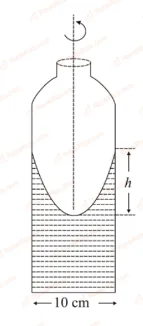
A cylindrical vessel containing a liquid is rotated about its axis so that the liquid rises at its sides as shown in the figure. The radius of vessel is 5 cm and the angular speed of rotation is rad s. The difference in the height, h (in cm) of liquid at the Centre of vessel and at the sides of the vessel will be:
A capillary tube made of glass of radius 0.15 mm is dipped vertically in a beaker filled with methylene iodide (surface tension = 0.05 N m, density = 667 kg m) which rises to height h in the tube. It is observed that the two tangents drawn from observed that the two tangents drawn from liquid-glass interfaces (from opp. sides of the capillary) make an angle of 60 with one another. Then h is close to (g = 10 m s):
0.049 m
0.087 m
0.137 m
0.172 m
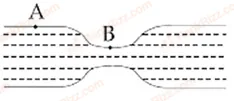
Water flows in a horizontal tube (see figure). The pressure of water changes by between and where the area of cross section are and , respectively. Find the rate of flow of water through the tube. (density of water )
A small spherical droplet of density is floating exactly half immersed in a liquid of density and surface tension . The radius of the droplet is (take note that the surface tension applies an upward force on the droplet):
A leak proof cylinder of length 1 m, made of a metal which has very low coefficient of expansion is floating vertically in water at 0C such that its height above the water surface is 20 cm. When the temperature of water is increased to 4C, the height of the cylinder above the water surface becomes 21 cm. The density of water at T = 4C, relative to the density at T = 0C is close to:
1.26
1.04
1.01
1.03
Consider a solid sphere of radius and mass density , . The minimum density of a liquid in which it will float is:
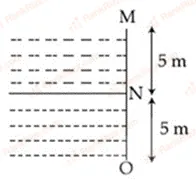
Two liquids of densities and () are filled up behind a square wall of side 10 m as shown in figure. Each liquid has a height of 5 m. The ratio of the forces due to these liquids exerted on upper part MN to that at the lower part NO is (Assume that the liquids are not mixing):
An ideal fluid flows (laminar flow) through a pipe of non-uniform diameter. The maximum and minimum diameters of the pipes are 6.4 cm and 4.8 cm, respectively. The ratio of the minimum and the maximum velocities of fluid in this pipe is:
A solid sphere, of radius R acquires a terminal velocity when falling (due to gravity) through a viscous fluid having a coefficient of viscosity . The sphere is broken into 27 identical solid spheres. If each of these spheres acquires a terminal velocity, , when falling through the same fluid, the ratio equals:
27
9
JEE Advanced has set 33 Mechanical Properties of Fluids questions too. Mechanical Properties of Fluids JEE Advanced PYQs →
OTHER PHYSICS CHAPTERS