JEE MAIN 2021 · 24 FEB S2Photons: energy, momentum and radiation pressure
An X-ray tube is operated at 1.24 million volt. The shortest wavelength of the produced photon will be:
- A
nm
- B
nm
- C
nm
- D
nm
Every Dual Nature of Radiation & Matter question JEE Main has set from 2004–2026, grouped by the idea it tests rather than the order of the syllabus. 216 questions across 4 distinct ideas. Free to read, answer key on every one.
DATA UPDATED
Questions
216
Distinct ideas
4
Share of marks
3.4%
Difficulty
MEDIUM
A chapter is not one subject — it is a handful of procedures the examiner reuses. These are the ones Dual Nature of Radiation & Matter questions actually test.
141–160 OF 216 · NEWEST FIRST
An X-ray tube is operated at 1.24 million volt. The shortest wavelength of the produced photon will be:
nm
nm
nm
nm
The de Broglie wavelength of a proton and -particle are equal. The ratio of their velocities is
4 : 1
4 : 3
1 : 4
4 : 2
An electron, a doubly ionized helium ion and proton are having the same kinetic energy. The relation between their respective de-Broglie wavelength , and is:
Assuming the nitrogen molecule is moving with r.m.s. velocity at 400 K, the de-Broglie wave length of nitrogen molecule is close to: (Given: nitrogen molecule weight: , Boltzman constant: , Planck constant: )
A beam of electrons of energy scatters from a target having atomic spacing of . The first maximum intensity occurs at . Then (in eV) is......... (Planck's constant , , electron mass )
The surface of a metal is illuminated alternately with photons of energies and respectively. The ratio of maximum speeds of the photoelectrons emitted in the two cases is 2. The work function of the metal in (eV) is..........
Particle A of mass moving along the x-axis with velocity collides elastically with another particle B at rest having mass . If both particles move along the x-axis after the collision, the change in the wavelength of particle A, in terms of its de-Broglie wavelength before the collision is:
Given figure shows few data points in a photo-electric effect experiment for a certain metal. The minimum energy for ejection of electrons from its surface is: (Planck's constant h = 6.62 10 J.s)
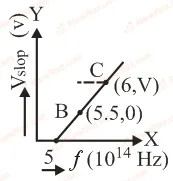
2.27 eV
2.59 eV
1.93 eV
2.10 eV
In a photoelectric effect experiment, the graph of stopping potential versus reciprocal of wavelength obtained is shown in the figure. As the intensity of incident radiation is increased:
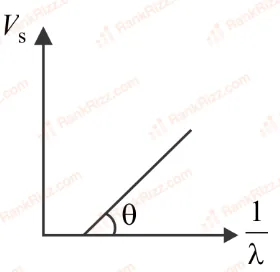
Straight line shifts to right
Slope of the straight line get more steep
Straight line shifts to left
Graph does not change
When the wavelength of radiation falling on a metal is changed from 500 nm to 200 nm, the maximum kinetic energy of the photoelectrons becomes three times larger. The work function of the metal is close to:
0.81 eV
1.02 eV
0.52 eV
0.61 eV
Two sources of light emit X-rays of wavelength 1 nm and visible light of wavelength 500 nm, respectively. Both the sources emit light of the same power 200 W. The ratio of the number density of photons of X-rays to the number density of photons of the visible light of the given wavelengths is:
250
500
When radiation of wavelength A is used to illuminate a metallic surface, the stopping potential is V. When the same surface is illuminated with radiation of wavelength 3A, the stopping potential is . If the threshold wavelength for the metallic surface is then value of n will be ___________.
A particle is moving 5 times as fast as an electron. The ratio of the de-Broglie wavelength of the particle to that of the electron is . The mass of the particle is close to:
kg
kg
kg
kg
Radiation, with wavelength Å falls on a metal surface to produce photoelectrons. The electrons are made to enter a uniform magnetic field of T. If the radius of the largest circular path followed by the electrons is mm, the work function of the metal is close to:
1.6 eV
0.8 eV
1.1 eV
1.8 eV
A particle moving with kinetic energy has de Broglie wavelength . If energy is added to its energy, the wavelength become . Value of , is:
An electron of mass and magnitude of charge at rest, gets accelerated by a constant electric field . The rate of change of de-Broglie wavelength of this electron at time is (ignore relativistic effects):
When photon of energy 4.0 eV strikes the surface of a metal A, the ejected photoelectrons have maximum kinetic energy eV and de-Broglie wavelength . The maximum kinetic energy of photoelectrons liberated from another metal B by photon of energy 4.50 eV is eV. If the de-Broglie wavelength of these photoelectrons , then the work function of metal B is:
4 eV
2 eV
1.5 eV
3 eV
An electron (mass m) with initial velocity is in an electric field . If is initial de-Broglie wavelength of electron, its de-Broglie wave length at time is given by:
A beam of electromagnetic radiation of intensity W/cm is comprised of wavelength, nm. It falls normally on a metal (work function eV) of surface area of 1 cm. If one in photons ejects an electron, total number of electrons ejected in 1s is . ( eVnm, eV J), then is
An electron (of mass ) and a photon have the same energy in the range of a few eV. The ratio of the de-Broglie wavelength associated with the electron and the wavelength of the photon is (c = speed of light in vacuum)
JEE Advanced has set 25 Dual Nature of Radiation & Matter questions too. Dual Nature of Radiation & Matter JEE Advanced PYQs →
OTHER PHYSICS CHAPTERS