Dual Nature of Radiation & Matter JEE Main PYQs with answer key
PHYSICS · 216 PAST QUESTIONS · 4 TOPICS · 2004–2026
HOW TO USE THIS SHEET
Every JEE Main Dual Nature of Radiation & Matter question we hold, grouped by topic, most-asked topic first and newest first inside each. The answer key is at the end (216 of 216 questions have a checked key); the worked solution is on each question’s page, printed beside it.
Photoelectric effect and Einstein's equation 98
and be the maximum kinetic energies of photoelectrons emitted from a surface of a given material for the light of wavelength and , respectively. If then the work function of material is given by :
- (A)
- (B)
- (C)
- (D)
rr2.rankrizz.com/jee-main/physics/dual-nature-of-radiation-and-matter/q/8-apr-2026-s2-q43
- (A)
Light source having wavelength 331 nm is used to generate photo-electrons whose stopping potential is 0.2 V. The work function of the used metal in the experiment is J. The value of is _______. (h = J s, e = C and c = m/s)
- (A)
- (B)
- (C)
- (D)
rr2.rankrizz.com/jee-main/physics/dual-nature-of-radiation-and-matter/q/5-apr-2026-s1-q41
- (A)
The graph shows variation of stopping potential with the frequency of the incident radiation for three photosensitive metals , and . Which metal will give out electrons with greater kinetic energy, for the same wavelength of incident radiation?
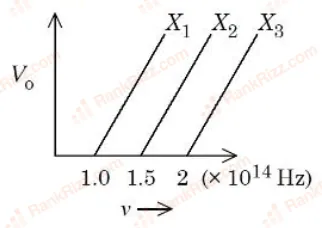
- (A)
- (B)
- (C)
- (D)
All same
rr2.rankrizz.com/jee-main/physics/dual-nature-of-radiation-and-matter/q/4-apr-2026-s1-q32
- (A)
For a certain metal, when monochromatic light of wavelength is incident, the stopping potential for photoelectrons is . When the same metal is illuminated by light of wavelength , then the stopping potential becomes . The threshold wavelength for photoelectric emission for the given metal is . The value of is __________.
- (A)
- (B)
- (C)
- (D)
rr2.rankrizz.com/jee-main/physics/dual-nature-of-radiation-and-matter/q/2-apr-2026-s1-q42
- (A)
When a light of a given wavelength falls on a metallic surface the stopping potential for photoelectrons is 3.2 V. If a second light having wavelength twice of first light is used, the stopping potential drops to 0. 7 V. The wavelength of first light is ___ m.
- (A)
- (B)
- (C)
- (D)
rr2.rankrizz.com/jee-main/physics/dual-nature-of-radiation-and-matter/q/24-jan-2026-s2-q27
- (A)
Light is incident on a metallic plate having work function . If the produced photoelectrons have zero kinetic energy then the angular frequency of the incident light is ___ rad/s. (h = ).
- (A)
- (B)
- (C)
- (D)
rr2.rankrizz.com/jee-main/physics/dual-nature-of-radiation-and-matter/q/22-jan-2026-s2-q31
- (A)
A light wave described by (in SI units) falls on a metal surface of work function 2.8 eV. The maximum kinetic energy of ejected photoelectron is (approximately) ___ eV.
- (A)
7.8
- (B)
6.0
- (C)
3.8
- (D)
5.1
rr2.rankrizz.com/jee-main/physics/dual-nature-of-radiation-and-matter/q/21-jan-2026-s1-physics-q14
- (A)
In the photoelectric experiment, if we use a monochromatic light, the curve is as shown. If the work function of the metal is , estimate the power of light used.
(Assume efficiency of photo emission = , i.e. the number of photoelectrons emitted are of the number of photons incident on the metal.)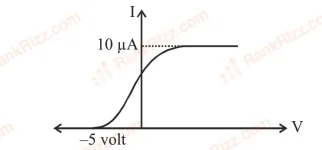
- (A)
- (B)
- (C)
- (D)
rr2.rankrizz.com/jee-main/physics/dual-nature-of-radiation-and-matter/q/2026-physics-516000
- (A)
Given below are two statements:
Assertion A: In photoelectric effect, on increasing the intensity of incident light the stopping potential increases.
Reason R: Increase in intensity of light increases the rate of photoelectrons emitted, provided the frequency of incident light is greater than threshold frequency.
Choose the correct answer:- (A)
Both A and R are true but R is NOT the correct explanation of A
- (B)
A is false but R is true
- (C)
A is true but R is false
- (D)
Both A and R are true and R is the correct explanation of A
rr2.rankrizz.com/jee-main/physics/dual-nature-of-radiation-and-matter/q/2025-apr-4-s1-q35
- (A)
The work function of a metal is . The color of the visible light that is required to cause emission of photoelectrons is
- (A)
Green
- (B)
Blue
- (C)
Red
- (D)
Yellow
rr2.rankrizz.com/jee-main/physics/dual-nature-of-radiation-and-matter/q/2025-apr-03-s1-q40
- (A)
A monochromatic light is incident on a metallic plate having work function . An electron, emitted normally to the plate from a point A with maximum kinetic energy, enters a constant magnetic field, perpendicular to the initial velocity of electron. The electron passes through a curve and hits back the plate at a point B. The distance between A and B is:
(Given: The magnitude of charge of an electron is e and mass is m, h is Planck's constant and c is velocity of light. Take the magnetic field exists throughout the path of electron)
- (A)
- (B)
- (C)
- (D)
rr2.rankrizz.com/jee-main/physics/dual-nature-of-radiation-and-matter/q/2025-apr-02-s1-q45
- (A)
Given below are two statements : one is labelled as Assertion (A) and the other is labelled as Reason (R). Assertion (A) : Emission of electrons in photoelectric effect can be suppressed by applying a sufficiently negative electron potential to the photoemissive substance. Reason (R) : A negative electric potential, which stops the emission of electrons from the surface of a photoemissive substance, varies linearly with frequency of incident radiation. In the light of the above statements, choose the most appropriate answer from the options given below :
- (A)
(A) is false but (R) is true
- (B)
(A) is true but (R) is false
- (C)
Both (A) and (R) are true and (R) is the correct explanation of (A)
- (D)
Both (A) and (R) are true but (R) is not the correct explanation of (A)
rr2.rankrizz.com/jee-main/physics/dual-nature-of-radiation-and-matter/q/29-jan-2025-s1-q33
- (A)
In an experiment with photoelectric effect, the stopping potential,
- (A)
increases with increase in the intensity of the incident light
- (B)
decreases with increase in the intensity of the incident light
- (C)
increases with increase in the wavelength of the incident light
- (D)
is times the maximum kinetic energy of the emitted photoelectrons
rr2.rankrizz.com/jee-main/physics/dual-nature-of-radiation-and-matter/q/29-jan-2025-s2-q37
- (A)
In photoelectric effect, the stopping potential frequency curve is plotted. ( is Planck's constant and is work function of the metal) is linear. } The slope of } v/s line.(D) The value of electric charge of electron is not required to determine using the v/s curve. The work function can be estimated without knowing the value of h.Choose the correct answer from the options given below:
- (A)
(C) and (D) only
- (B)
(A), (C) and (E) only
- (C)
(A), (B) and (C) only
- (D)
(D) and (E) only
rr2.rankrizz.com/jee-main/physics/dual-nature-of-radiation-and-matter/q/24-jan-2025-s2-q32
- (A)
In photoelectric effect an em-wave is incident on a metal surface and electrons are ejected from the surface. If the work function of the metal is 2.14 eV and stopping potential is 2 V , what is the wavelength of the emwave ? (Given hc = 1242eVnm where h is the Planck's constant and c is the speed of light in vaccum.)
- (A)
300 nm
- (B)
400 nm
- (C)
600 nm
- (D)
200 nm
rr2.rankrizz.com/jee-main/physics/dual-nature-of-radiation-and-matter/q/23-jan-2025-s2-q45
- (A)
The work functions of cesium (Cs) and lithium (Li) metals are 1.9 eV and 2.5 eV , respectively. If we incident a light of wavelength 550 nm on these two metal surfaces, then photo-electric effect is possible for the case of
- (A)
Both Cs and Li
- (B)
Neither Cs nor Li
- (C)
Cs only
- (D)
Li only
rr2.rankrizz.com/jee-main/physics/dual-nature-of-radiation-and-matter/q/22-jan-2025-s1-q40
- (A)
light source of wavelength illuminates a metal surface and electrons are ejected with maximum kinetic energy of 2 eV . If the same surface is illuminated by a light source of wavelength , then the maximum kinetic energy of ejected electrons will be (The work function of metal is 1 eV )
- (A)
3 eV
- (B)
2 eV
- (C)
6 eV
- (D)
5 eV
rr2.rankrizz.com/jee-main/physics/dual-nature-of-radiation-and-matter/q/22-jan-2025-s2-q42
- (A)
UV light of is incident on a photosensitive metal surface having work function . The maximum kinetic energy of ejected photoelectrons will be:
- (A)
- (B)
- (C)
- (D)
rr2.rankrizz.com/jee-main/physics/dual-nature-of-radiation-and-matter/q/9-apr-2024-s2-q15
- (A)
In photoelectric experiment energy of irradiates a photo sensitive material. The stopping potential was measured to be . Work function of the photo sensitive material is :
- (A)
- (B)
- (C)
- (D)
rr2.rankrizz.com/jee-main/physics/dual-nature-of-radiation-and-matter/q/6-apr-2024-s1-q16
- (A)
When UV light of wavelength is incident on the metal surface having work function , electron emission takes place. The stopping potential is: (Given )
- (A)
- (B)
- (C)
- (D)
rr2.rankrizz.com/jee-main/physics/dual-nature-of-radiation-and-matter/q/6-apr-2024-s2-q17
- (A)
Given below are two statements :
Statement I :
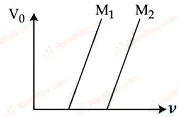
Figure shows the variation of stopping potential with frequency for the two photosensitive materials and . The slope gives value of , where is Planck's constant, is the charge of electron.
Statement II : will emit photoelectrons of greater kinetic energy for the incident radiation having same frequency.
In the light of the above statements, choose the most appropriate answer from the options given below.
- (A)
Both Statement I and Statement II are correct
- (B)
Statement I is incorrect but Statement II is correct
- (C)
Both Statement I and Statement II are incorrect
- (D)
Statement I is correct and Statement II is incorrect
rr2.rankrizz.com/jee-main/physics/dual-nature-of-radiation-and-matter/q/5-apr-2024-s1-q18
- (A)
Which of the following statement is not true about stopping potential ?
- (A)
It is times the maximum kinetic energy of electrons emitted.
- (B)
It increases with increase in intensity of the incident light.
- (C)
It depends on the nature of emitter material.
- (D)
It depends upon frequency of the incident light.
rr2.rankrizz.com/jee-main/physics/dual-nature-of-radiation-and-matter/q/05-apr-2024-s2-q17
- (A)
Which figure shows the correct variation of applied potential difference (V) with photoelectric current (I) at two different intensities of light of same wavelengths:
- (A)
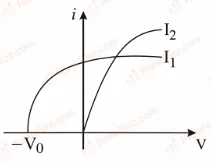
- (B)
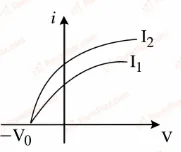
- (C)
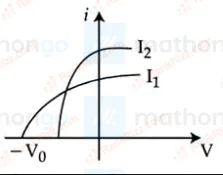
- (D)
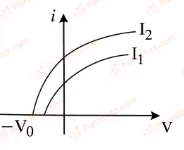
rr2.rankrizz.com/jee-main/physics/dual-nature-of-radiation-and-matter/q/04-apr-2024-s1-q18
- (A)
Given below are two statements: one is labelled as Assertion A and the other is labelled as Reason R. Assertion A: Number of photons increases with increase in frequency of light. Reason R: Maximum kinetic energy of emitted electrons increases with the frequency of incident radiation. In the light of the above statements, choose the most appropriate answer from the options given below:
- (A)
Both A and R are correct and R is the correct explanation of A.
- (B)
Both A and R are correct and R is NOT the correct explanation of A.
- (C)
A is not correct but R is correct.
- (D)
A is correct but R is not correct.
rr2.rankrizz.com/jee-main/physics/dual-nature-of-radiation-and-matter/q/04-apr-2024-s2-q17
- (A)
When a metal surface is illuminated by light of wavelength , the stopping potential is V. When the same surface is illuminated by light of wavelength , stopping potential is V. The threshold wavelength for this surface is :
- (A)
- (B)
- (C)
- (D)
rr2.rankrizz.com/jee-main/physics/dual-nature-of-radiation-and-matter/q/31-jan-2024-s1-q18
- (A)
In a photoelectric effect experiment a light of frequency 1.5 times the threshold frequency is made to fall on the surface of photosensitive material. Now if the frequency is halved and intensity is doubled, the number of photo electrons emitted will be:
- (A)
Doubled
- (B)
Quadrupled
- (C)
Zero
- (D)
Halved
rr2.rankrizz.com/jee-main/physics/dual-nature-of-radiation-and-matter/q/31-jan-2024-s2-q17
- (A)
The work function of a substance is . The longest wavelength of light that can cause the emission of photoelectrons from this substance is approximately:
- (A)
- (B)
- (C)
- (D)
rr2.rankrizz.com/jee-main/physics/dual-nature-of-radiation-and-matter/q/30-jan-2024-s1-q18
- (A)
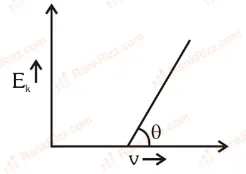
For the photoelectric effect, the maximum kinetic energy of the photoelectrons is plotted against the frequency of the incident photons as shown in figure. The slope of the graph give
- (A)
Ratio of Planck's constant to electric charge
- (B)
Work function of the metal
- (C)
Charge of electron
- (D)
Planck's constant
rr2.rankrizz.com/jee-main/physics/dual-nature-of-radiation-and-matter/q/30-jan-2024-s2-q16
- (A)
The threshold frequency of a metal with work function 6.63 eV is :
- (A)
Hz
- (B)
Hz
- (C)
Hz
- (D)
Hz
rr2.rankrizz.com/jee-main/physics/dual-nature-of-radiation-and-matter/q/27-jan-2024-s2-q17
- (A)
The difference between threshold wavelengths for two metal surfaces and having work function eV and eV in nm is:
{Given, eV nm}- (A)
- (B)
- (C)
- (D)
rr2.rankrizz.com/jee-main/physics/dual-nature-of-radiation-and-matter/q/13-apr-2023-s1-q17
- (A)
Given below are two statements:
Statement I : Out of microwaves, infrared rays and ultraviolet rays, ultraviolet rays are the most effective for the emission of electrons from a metallic surface
Statement II : Above the threshold frequency, the maximum kinetic energy of photoelectrons is inversely proportional to the frequency of the incident light
In the light of above statements, choose the correct answer from the options given below- (A)
Statement I is false but Statement II is true
- (B)
Statement I is true but Statement II is false
- (C)
Both Statement I and Statement II are true
- (D)
Both Statement I and Statement II are false
rr2.rankrizz.com/jee-main/physics/dual-nature-of-radiation-and-matter/q/13-apr-2023-s2-q15
- (A)
A metallic surface is illuminated with radiation of wavelength , the stopping potential is . If the same surface is illuminated with radiation of wavelength , the stopping potential becomes . The threshold wavelength for this metallic surface will be
- (A)
- (B)
- (C)
- (D)
rr2.rankrizz.com/jee-main/physics/dual-nature-of-radiation-and-matter/q/11-apr-2023-s1-q17
- (A)
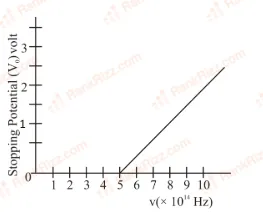
The variation of stopping potential as a function of the frequency of the incident light for a metal is shown in figure. The work function of the surface is
- (A)
2.98 eV
- (B)
2.07 eV
- (C)
1.36 eV
- (D)
18.6 eV
rr2.rankrizz.com/jee-main/physics/dual-nature-of-radiation-and-matter/q/10-apr-2023-s2-q16
- (A)
In photoelectric effect
A. The photocurrent is proportional to the intensity of the incident radiation.
B. Maximum kinetic energy with which photoelectrons are emitted depends on the intensity of incident light.
C. Max K.E. with which photoelectrons are emitted depends on the frequency of incident light.
D. The emission of photoelectrons require a minimum threshold intensity of incident radiation.
E. Max K.E. of the photoelectrons is independent of the frequency of the incident light.
Choose the correct option from the options given below:- (A)
A and B only
- (B)
A and E only
- (C)
A and C only
- (D)
B and C only
rr2.rankrizz.com/jee-main/physics/dual-nature-of-radiation-and-matter/q/08-apr-2023-s2-q17
- (A)
The work functions of Aluminium and Gold are 4.1 eV and 5.1 eV respectively. The ratio of the slope of the stopping potential versus frequency plot for Gold to that of Aluminium is
- (A)
1.24
- (B)
2
- (C)
1
- (D)
1.5
rr2.rankrizz.com/jee-main/physics/dual-nature-of-radiation-and-matter/q/6-apr-2023-s2-q18
- (A)
The threshold frequency of metal is . When the light of frequency is incident on the metal plate, the maximum velocity of photoelectron is . When the frequency of incident radiation is increased to , the maximum velocity of photoelectrons emitted is . The ratio of to is:
- (A)
- (B)
- (C)
- (D)
rr2.rankrizz.com/jee-main/physics/dual-nature-of-radiation-and-matter/q/01-feb-2023-s2-q17
- (A)
If the two metals and are exposed to radiation of wavelength 350 nm. The work functions of metals and are 4.8 eV and 2.2 eV. Then choose the correct option
- (A)
Metal B will not emit photo-electrons
- (B)
Both metals A and B will emit photo-electrons
- (C)
Both metals A and B will not emit photoelectrons
- (D)
Metal A will not emit photo-electrons
rr2.rankrizz.com/jee-main/physics/dual-nature-of-radiation-and-matter/q/31-jan-2023-s2-q17
- (A)
The threshold wavelength for photoelectric emission from a material is . Photoelectrons will be emitted, when this material is illuminated with monochromatic radiation from a
A. 75 W infra-red lamp
B. 10 W infra-red lamp
C. 75 W ultra-violet lamp
D. 10 W ultra-violet lamp
Choose the correct answer from the options given below:- (A)
B and C only
- (B)
A and D only
- (C)
C only
- (D)
C and D only
rr2.rankrizz.com/jee-main/physics/dual-nature-of-radiation-and-matter/q/29-jan-2023-s1-q16
- (A)
Given below are two statements:
Statement I: Stopping potential in photoelectric effect does not depend on the power of the light source.
Statement II: For a given metal, the maximum kinetic energy of the photoelectron depends on the wavelength of the incident light.
In the light of above statements, choose the most appropriate answer from the options given below.- (A)
Statement I is incorrect but statement II is correct
- (B)
Both Statement I and Statement II are incorrect
- (C)
Statement I is correct but statement II is incorrect
- (D)
Both statement I and statement II are correct
rr2.rankrizz.com/jee-main/physics/dual-nature-of-radiation-and-matter/q/25-jan-2023-s2-q18
- (A)
From the photoelectric effect experiment, following observations are made. Identify which of these are correct
A. The stopping potential depends only on the work function of the metal.
B. The saturation current increases as the intensity of incident light increases.
C. The maximum kinetic energy of a photo electron depends on the intensity of the incident light.
D. Photoelectric effect can be explained using wave theory of light.
Choose the correct answer from the options given below:- (A)
B, C only
- (B)
A, C, D only
- (C)
B only
- (D)
A, B, D only
rr2.rankrizz.com/jee-main/physics/dual-nature-of-radiation-and-matter/q/24-jan-2023-s1-q17
- (A)
From the photoelectric effect experiment, following observations are made. Identify which of these are correct:
A. The stopping potential depends only on the work function of the metal.
B. The saturation current increases as the intensity of incident light increases.
C. The maximum kinetic energy of a photo electron depends on the intensity of the incident light.
D. Photoelectric effect can be explained using wave theory of light.
Choose the correct answer from the options given below:- (A)
B, C only
- (B)
A, C, D only
- (C)
B only
- (D)
A, B, D only
rr2.rankrizz.com/jee-main/physics/dual-nature-of-radiation-and-matter/q/24-jan-2023-s1-q17-494032
- (A)
The kinetic energy of emitted electron is E when the light incident on the metal has wavelength . To double the kinetic energy, the incident light must have wavelength:
- (A)
- (B)
- (C)
- (D)
rr2.rankrizz.com/jee-main/physics/dual-nature-of-radiation-and-matter/q/29-jul-2022-s1-q16
- (A)
Two streams of photons, possessing energies equal to five and ten times the work function of metal are incident on the metal surface successively. The ratio of the maximum velocities of the photoelectron emitted, in the two cases respectively, will be
- (A)
1:2
- (B)
1:3
- (C)
2:3
- (D)
3:2
rr2.rankrizz.com/jee-main/physics/dual-nature-of-radiation-and-matter/q/28-jul-2022-s2-q17
- (A)
With reference to the observations in photo-electric effect, identify the correct statements from below:
A. The square of maximum velocity of photoelectrons varies linearly with frequency of incident light.
B. The value of saturation current increases on moving the source of light away from the metal surface.
C. The maximum kinetic energy of photo-electrons decreases on decreasing the power of LED (light emitting diode) source of light.
D. The immediate emission of photo-electrons out of metal surface can not be explained by particle nature of light/electromagnetic waves.
E. Existence of threshold wavelength can not be explained by wave nature of light/electromagnetic waves.
Choose the correct answer from the options given below:- (A)
A and B only
- (B)
A and E only
- (C)
C and E only
- (D)
D and E only
rr2.rankrizz.com/jee-main/physics/dual-nature-of-radiation-and-matter/q/27-jul-2022-s2-q17
- (A)
A metal exposed to light of wavelength and emits photoelectrons with a certain kinetic energy. The maximum kinetic energy of photo-electron doubles when light of wavelength is used. The work function of the metal is (Take ).
- (A)
- (B)
- (C)
- (D)
rr2.rankrizz.com/jee-main/physics/dual-nature-of-radiation-and-matter/q/25-jul-2022-s1-q18
- (A)
Given below are two statements: one is labelled as Assertion A and the other is labelled as Reason R.
Assertion A: The photoelectric effect does not take place, if the energy of the incident radiation is less than the work function of a metal.
Reason R: Kinetic energy of the photoelectrons is zero, if the energy of the incident radiation is equal to the work function of a metal.- (A)
Both A and R are correct and R is the correct explanation of A
- (B)
Both A and R are correct but R is not the correct explanation of A
- (C)
A is correct but R is not correct
- (D)
A is not correct but R is correct
rr2.rankrizz.com/jee-main/physics/dual-nature-of-radiation-and-matter/q/29-jun-2022-s1-q18
- (A)
The electric field at a point associated with a light wave is given by
Vm
Given: eVs
If this light falls on a metal surface having a work function of 2.50 eV, the maximum kinetic energy of the photoelectrons will be- (A)
1.90 eV
- (B)
3.27 eV
- (C)
3.60 eV
- (D)
3.42 eV
rr2.rankrizz.com/jee-main/physics/dual-nature-of-radiation-and-matter/q/29-jun-2022-s2-q18
- (A)
Let and be the maximum kinetic energies of photo-electrons emitted when two monochromatic beams of wavelength and , respectively are incident on a metallic surface. If then:
- (A)
- (B)
- (C)
- (D)
rr2.rankrizz.com/jee-main/physics/dual-nature-of-radiation-and-matter/q/28-jun-2022-s2-q17
- (A)
A metal surface is illuminated by a radiation of wavelength Å. The ejected photo-electron enters a constant magnetic field of mT making an angle of with the magnetic field. If it starts revolving in a circular path of radius mm, the work function of the metal is approximately
- (A)
eV
- (B)
eV
- (C)
eV
- (D)
eV
rr2.rankrizz.com/jee-main/physics/dual-nature-of-radiation-and-matter/q/26-jun-2022-s2-q14
- (A)
The stopping potential for photoelectrons emitted from a surface illuminated by light of wavelength Å is V. If the threshold frequency is s, where is (nearest integer): (Given, speed light m s, Planck's constant J s)
Answer: ____________
rr2.rankrizz.com/jee-main/physics/dual-nature-of-radiation-and-matter/q/26-jun-2022-s2-q29
When light of frequency twice the threshold frequency is incident on the metal plate, the maximum velocity of emitted electron is . When the frequency of incident radiation is increased to five times the threshold value, the maximum velocity of emitted electron becomes . If , the value of will be ______.
Answer: ____________
rr2.rankrizz.com/jee-main/physics/dual-nature-of-radiation-and-matter/q/24-jun-2022-s1-q29
The light of two different frequencies whose photons have energies eV and eV respectively, illuminate a metallic surface whose work function is eV successively. The ratio of maximum speeds of emitted electrons for the two frequencies respectively will be :
- (A)
- (B)
- (C)
- (D)
rr2.rankrizz.com/jee-main/physics/dual-nature-of-radiation-and-matter/q/24-jun-2022-s2-q19
- (A)
In a photoelectric experiment, increasing the intensity of incident light:
- (A)
increases the number of photons incident and also increases the K.E. of the ejected electrons.
- (B)
increases the frequency of photons incident and increases the K.E. of the ejected electrons.
- (C)
increases the number of photons incident and the K.E. of the ejected electrons remains unchanged.
- (D)
increases the frequency of photons incident and the K.E. of the ejected electrons remains unchanged.
rr2.rankrizz.com/jee-main/physics/dual-nature-of-radiation-and-matter/q/27-aug-2021-s1-q18
- (A)
A monochromatic neon lamp with wavelength of 670.5 nm illuminates a photo-sensitive material which has a stopping voltage of 0.48 V. What will be the stopping voltage if the source light is changed with another source of wavelength of 474.6 nm?
- (A)
0.24 V
- (B)
1.5 V
- (C)
1.25 V
- (D)
0.96 V
rr2.rankrizz.com/jee-main/physics/dual-nature-of-radiation-and-matter/q/27-aug-2021-s2-q18
- (A)
In a photoelectric experiment, ultraviolet light of wavelength 280 nm is used with lithium cathode having work function eV. If the wavelength of incident light is switched to 400 nm, find out the change in the stopping potential.
( J s, m s)- (A)
1.1 V
- (B)
0.6 V
- (C)
1.3 V
- (D)
1.9 V
rr2.rankrizz.com/jee-main/physics/dual-nature-of-radiation-and-matter/q/26-aug-2021-s1-q16
- (A)
An electron and proton are separated by a large distance. The electron starts approaching the proton with energy 3 eV. The proton captures the electrons and forms a hydrogen atom in second excited state. The resulting photon is incident on a photosensitive metal of threshold wavelength 4000 A. What is the maximum kinetic energy of the emitted photoelectron?
- (A)
7.61 eV
- (B)
1.41 eV
- (C)
3.3 eV
- (D)
No photoelectron would be emitted
rr2.rankrizz.com/jee-main/physics/dual-nature-of-radiation-and-matter/q/27-jul-2021-s2-q18
- (A)
When radiation of wavelength is incident on a metallic surface, the stopping potential of ejected photoelectrons is 4.8 V. If the same surface is illuminated by radiation of double the previous wavelength, then the stopping potential becomes 1.6 V. The threshold wavelength of the metal is:
- (A)
- (B)
- (C)
- (D)
rr2.rankrizz.com/jee-main/physics/dual-nature-of-radiation-and-matter/q/25-jul-2021-s2-q20
- (A)
A light beam of wavelength 500 nm is incident on a metal having work function of 1.25 eV, placed in a magnetic field of intensity . The electrons emitted perpendicular to the magnetic field , with maximum kinetic energy are bent into a circular arc of radius 30 cm. The value of is _________ T.
Given J m, the mass of the electron = kg.Answer: ____________
rr2.rankrizz.com/jee-main/physics/dual-nature-of-radiation-and-matter/q/25-jul-2021-s2-q26
The radiation corresponding to transition of a hydrogen atom falls on a gold surface to generate photoelectrons. These electrons are passed through a magnetic field of T. Assume that the radius of the largest circular path followed by these electrons is 7 mm, the work function of the metal is:
(Mass of electron kg)- (A)
1.36 eV
- (B)
1.88 eV
- (C)
0.16 eV
- (D)
0.82 eV
rr2.rankrizz.com/jee-main/physics/dual-nature-of-radiation-and-matter/q/20-jul-2021-s1-q17
- (A)
A certain metallic surface is illuminated by monochromatic radiation of wavelength . The stopping potential for photoelectric current for this radiation is . If the same surface is illuminated with a radiation of wavelength , the stopping potential is . The threshold wavelength of this surface for photoelectric effect is ___ .
Answer: ____________
rr2.rankrizz.com/jee-main/physics/dual-nature-of-radiation-and-matter/q/20-jul-2021-s2-q27
Two identical photocathodes receive the light of frequencies and respectively. If the velocities of the photo-electrons coming out are and respectively, then:
- (A)
- (B)
- (C)
- (D)
rr2.rankrizz.com/jee-main/physics/dual-nature-of-radiation-and-matter/q/17-mar-2021-s2-q17
- (A)
The stopping potential in the context of photoelectric effect depends on the following property of incident electromagnetic radiation:
- (A)
Phase
- (B)
Intensity
- (C)
Amplitude
- (D)
Frequency
rr2.rankrizz.com/jee-main/physics/dual-nature-of-radiation-and-matter/q/16-mar-2021-s1-q19
- (A)
Two stream of photons, possessing energies equal to twice and ten times the work function of metal are incident on the metal surface successively. The value of ratio of maximum velocities of the photoelectrons emitted in the two respective cases is . The value of is
Answer: ____________
rr2.rankrizz.com/jee-main/physics/dual-nature-of-radiation-and-matter/q/26-feb-2021-s2-q28
The stopping potential for electrons emitted from a photosensitive surface illuminated by light of wavelength 491 nm is 0.710 V. When the incident wavelength is changed to a new value, the stopping potential is 1.43 V. The new wavelength is:
- (A)
382 nm
- (B)
309 nm
- (C)
329 nm
- (D)
400 nm
rr2.rankrizz.com/jee-main/physics/dual-nature-of-radiation-and-matter/q/25-feb-2021-s2-q16
- (A)
The surface of a metal is illuminated alternately with photons of energies and respectively. The ratio of maximum speeds of the photoelectrons emitted in the two cases is 2. The work function of the metal in (eV) is..........
Answer: ____________
rr2.rankrizz.com/jee-main/physics/dual-nature-of-radiation-and-matter/q/5-sep-2020-s2-q25
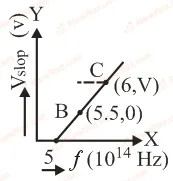
Given figure shows few data points in a photo-electric effect experiment for a certain metal. The minimum energy for ejection of electrons from its surface is: (Planck's constant h = 6.62 10 J.s)
- (A)
2.27 eV
- (B)
2.59 eV
- (C)
1.93 eV
- (D)
2.10 eV
rr2.rankrizz.com/jee-main/physics/dual-nature-of-radiation-and-matter/q/4-sep-2020-s1-q19
- (A)
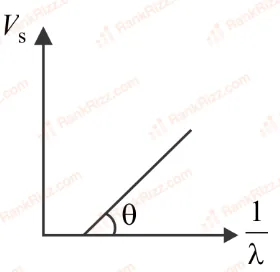
In a photoelectric effect experiment, the graph of stopping potential versus reciprocal of wavelength obtained is shown in the figure. As the intensity of incident radiation is increased:
- (A)
Straight line shifts to right
- (B)
Slope of the straight line get more steep
- (C)
Straight line shifts to left
- (D)
Graph does not change
rr2.rankrizz.com/jee-main/physics/dual-nature-of-radiation-and-matter/q/4-sep-2020-s2-q18
- (A)
When the wavelength of radiation falling on a metal is changed from 500 nm to 200 nm, the maximum kinetic energy of the photoelectrons becomes three times larger. The work function of the metal is close to:
- (A)
0.81 eV
- (B)
1.02 eV
- (C)
0.52 eV
- (D)
0.61 eV
rr2.rankrizz.com/jee-main/physics/dual-nature-of-radiation-and-matter/q/3-sep-2020-s1-q17
- (A)
When radiation of wavelength A is used to illuminate a metallic surface, the stopping potential is V. When the same surface is illuminated with radiation of wavelength 3A, the stopping potential is . If the threshold wavelength for the metallic surface is then value of n will be ___________.
Answer: ____________
rr2.rankrizz.com/jee-main/physics/dual-nature-of-radiation-and-matter/q/2-sep-2020-s1-q25
Radiation, with wavelength Å falls on a metal surface to produce photoelectrons. The electrons are made to enter a uniform magnetic field of T. If the radius of the largest circular path followed by the electrons is mm, the work function of the metal is close to:
- (A)
1.6 eV
- (B)
0.8 eV
- (C)
1.1 eV
- (D)
1.8 eV
rr2.rankrizz.com/jee-main/physics/dual-nature-of-radiation-and-matter/q/9-jan-2020-s1-q13
- (A)
When photon of energy 4.0 eV strikes the surface of a metal A, the ejected photoelectrons have maximum kinetic energy eV and de-Broglie wavelength . The maximum kinetic energy of photoelectrons liberated from another metal B by photon of energy 4.50 eV is eV. If the de-Broglie wavelength of these photoelectrons , then the work function of metal B is:
- (A)
4 eV
- (B)
2 eV
- (C)
1.5 eV
- (D)
3 eV
rr2.rankrizz.com/jee-main/physics/dual-nature-of-radiation-and-matter/q/8-jan-2020-s1-q18
- (A)
The stopping potential V (in volt) as a function of frequency () for a sodium emitter, is shown in the figure. The work function of sodium, from the data plotted in the figure, will be:
(Given: Planck's constant h = J s, electron charge (e) = C)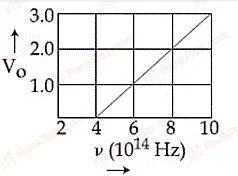
- (A)
2.12 eV
- (B)
1.82 eV
- (C)
1.95 eV
- (D)
1.66 eV
rr2.rankrizz.com/jee-main/physics/dual-nature-of-radiation-and-matter/q/12-apr-2019-s1-q27
- (A)
In a photoelectric effect experiment, the threshold wavelength of light is 380 nm. If the wavelength of incident light is 260 nm, the maximum kinetic energy of emitted electrons will be
Given E (in eV) =- (A)
4.5 eV
- (B)
3.0 eV
- (C)
1.5 eV
- (D)
15.1 eV
rr2.rankrizz.com/jee-main/physics/dual-nature-of-radiation-and-matter/q/10-apr-2019-s1-q26
- (A)
The electric field of light wave is given as . This light falls on a metal plate of work function 2 eV. The stopping potential of the photo-electrons is: Given, E (in eV) =
- (A)
0.72 V
- (B)
2.0 V
- (C)
2.48 V
- (D)
0.48 V
rr2.rankrizz.com/jee-main/physics/dual-nature-of-radiation-and-matter/q/9-apr-2019-s1-q27
- (A)
When a certain photosensitive surface is illuminated with monochromatic light of frequency , the stopping potential of the photo current is . When the surface is illuminated by monochromatic light of frequency , the stopping potential is . The threshold frequency for photoelectric emission is
- (A)
- (B)
- (C)
- (D)
rr2.rankrizz.com/jee-main/physics/dual-nature-of-radiation-and-matter/q/12-jan-2019-s2-q25
- (A)
In a photoelectric experiment, the wavelength of the light incident on a metal is changed from 300 nm to 400 nm. The decrease in the stopping potential is close to:
- (A)
0.5 V
- (B)
1.5 V
- (C)
1.0 V
- (D)
2.0 V
rr2.rankrizz.com/jee-main/physics/dual-nature-of-radiation-and-matter/q/11-jan-2019-s2-q26
- (A)
A metal plate of area m is illuminated by a radiation of intensity 16 m W/m. The work function of the metal is 5 eV. The energy of the incident photons is 10 eV and only 10% of it produces photo electrons. The number of emitted photo electrons per second and their maximum energy, respectively, will be: [ J]
- (A)
and 10 eV
- (B)
and 5 eV
- (C)
and 5 eV
- (D)
and 5 eV
rr2.rankrizz.com/jee-main/physics/dual-nature-of-radiation-and-matter/q/10-jan-2019-s2-q27
- (A)
The surface of certain metal is first illuminated with light of wavelength nm and then, by a light of wavelength nm. It is found that the maximum speed of the photoelectrons in the two cases differ by a factor of 2. The work function of the metal (in eV) is close to (Energy of photon eV)
- (A)
2.5
- (B)
1.8
- (C)
5.6
- (D)
1.4
rr2.rankrizz.com/jee-main/physics/dual-nature-of-radiation-and-matter/q/9-jan-2019-s1-q29
- (A)
The magnetic field associated with a light wave is given, at the origin, by . If this light falls on a silver plate having a work function of 4.7 eV, what will be the maximum kinetic energy of the photoelectrons? ( m s, J s)
- (A)
6.82 eV
- (B)
7.72 eV
- (C)
12.5 eV
- (D)
8.52 eV
rr2.rankrizz.com/jee-main/physics/dual-nature-of-radiation-and-matter/q/9-jan-2019-s2-q26
- (A)
The maximum velocity of the photoelectrons emitted from the surface is when light of frequency falls on a metal surface. If the incident frequency is increased to , the maximum velocity of the ejected photoelectrons will be:
- (A)
more than
- (B)
equal to
- (C)
- (D)
less than
rr2.rankrizz.com/jee-main/physics/dual-nature-of-radiation-and-matter/q/8-apr-2017-online-q25
- (A)
A photoelectric surface is illuminated successively by monochromatic light of wavelengths and . If the maximum kinetic energy of the emitted photoelectrons in the second case is 3 times that in the first case, the work function of the surface is:
- (A)
- (B)
- (C)
- (D)
rr2.rankrizz.com/jee-main/physics/dual-nature-of-radiation-and-matter/q/10-apr-2016-online-q25
- (A)
When photons of wavelength are incident on an isolated sphere, the corresponding stopping potential is found to be . When photons of wavelength are used, the corresponding stopping potential was thrice that of the above value. If light of wavelength is used then find the stopping potential for this case:
- (A)
- (B)
- (C)
- (D)
rr2.rankrizz.com/jee-main/physics/dual-nature-of-radiation-and-matter/q/9-apr-2016-online-q25
- (A)
Radiation of wavelength is incident on a photocell. The fastest emitted photoelectron has a speed v. If the wavelength is changed to , the speed of the fastest emitted photoelectron will be:
- (A)
- (B)
- (C)
- (D)
rr2.rankrizz.com/jee-main/physics/dual-nature-of-radiation-and-matter/q/3-apr-2016-offline-q23
- (A)
A beam of light has two wavelengths of 4972 and 6216 with a total intensity of Wm equally distributed among the two wavelengths. The beam falls normally on an area of 1 cm of a clean metallic surface of work function 2.3 eV. Assume that there is no loss of light by reflection and that each capable photon ejects one electron. The number of photoelectrons liberated in 2 s is approximately:
- (A)
- (B)
- (C)
- (D)
rr2.rankrizz.com/jee-main/physics/dual-nature-of-radiation-and-matter/q/12-apr-2014-online-q27
- (A)
In an experiment on photoelectric effect, a student plots stopping potential against reciprocal of the wavelength of the incident light for two different metals A and B. These are shown in the figure.
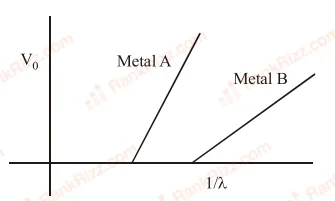
Looking at the graphs, you can most appropriately say that:
- (A)
Work function of metal B is greater than that of metal A
- (B)
For light of certain wavelength falling on both metal, maximum kinetic energy of electrons emitted from A will be greater than those emitted from B.
- (C)
Work function of metal A is greater than that of metal B
- (D)
Students data is not correct
rr2.rankrizz.com/jee-main/physics/dual-nature-of-radiation-and-matter/q/25-apr-2013-online-q26
- (A)
A copper ball of radius 1 cm and work function 4.47 eV is irradiated with ultraviolet radiation of wavelength 2500 . The effect of irradiation results in the emission of electrons from the ball. Further the ball will acquire charge and due to this there will be a finite value of the potential on the ball. The charge acquired by the ball is :
- (A)
C
- (B)
C
- (C)
C
- (D)
C
rr2.rankrizz.com/jee-main/physics/dual-nature-of-radiation-and-matter/q/25-apr-2013-online-q27
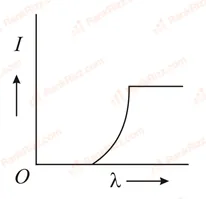
- (A)
The anode voltage of a photocell is kept fixed. The wavelength of the light falling on the cathode is gradually changed. The plate current I of the photocell varies as follows :
- (A)
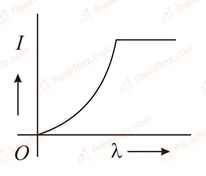
- (B)
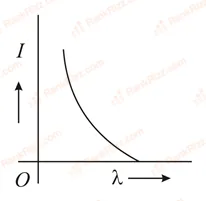
- (C)
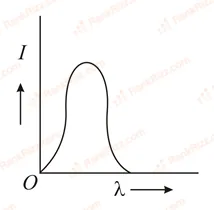
- (D)
rr2.rankrizz.com/jee-main/physics/dual-nature-of-radiation-and-matter/q/7-apr-2013-offline-q27
- (A)
Photoelectrons are ejected from a metal when light of frequency falls on it. Pick out the wrong statement from the following.
- (A)
No electrons are emitted if is less than , where is the work function of the metal
- (B)
The ejection of the photoelectrons is instantaneous.
- (C)
The maximum energy of the photoelectrons is .
- (D)
The maximum energy of the photoelectrons is independent of the intensity of the light.
rr2.rankrizz.com/jee-main/physics/dual-nature-of-radiation-and-matter/q/2012-physics-499203
- (A)
This question has Statement 1 and Statement 2. Of the four choices given after the Statements, choose the one that best describes the two Statements. Statement 1: A metallic surface is irradiated by a monochromatic light of frequency (the threshold frequency). If the incident frequency is now doubled, the photocurrent and the maximum kinetic energy are also doubled. Statement 2: The maximum kinetic energy of photoelectrons emitted from a surface is linearly dependent on the frequency of the incident light. The photocurrent depends only on the intensity of the incident light.
- (A)
Statement 1 is true, Statement 2 is true, Statement 2 is the correct explanation of Statement 1.
- (B)
Statement 1 is false, Statement 2 is true.
- (C)
Statement 1 is true, Statement 2 is false.
- (D)
Statement 1 is true, Statement 2 is true, Statement 2 is not the correct explanation of Statement 1.
rr2.rankrizz.com/jee-main/physics/dual-nature-of-radiation-and-matter/q/2012-physics-499303
- (A)
This question has Statement-1 and Statement-2. Of the four choices given after the statements, choose the one that best describes the two statements. Statement-1: A metallic surface is irradiated by a monochromatic light of frequency (the threshold frequency). The maximum kinetic energy and the stopping potential are and respectively. If the frequency incident on the surface doubled, both the and are also doubled. Statement-2: The maximum kinetic energy and the stopping potential of photoelectrons emitted from a surface are linearly dependent on the frequency of incident light.
- (A)
Statement-1 is true, Statement-2 is true; Statement-2 is the correct explanation of Statement-1.
- (B)
Statement-1 is true, Statement-2 is true; Statement-2 is not the correct explanation of Statement-1.
- (C)
Statement-1 is false, Statement-2 is true.
- (D)
Statement-1 is true, Statement-2 is false.
rr2.rankrizz.com/jee-main/physics/dual-nature-of-radiation-and-matter/q/2011-physics-499494
- (A)
Statement-1 : When ultraviolet light is incident on a photocell, its stopping potential is and the maximum kinetic energy of the photoelectrons is . When the ultraviolet light is replaced by X-rays, both and increase. Statement-2 : Photoelectrons are emitted with speeds ranging from zero to a maximum value because of the range of frequencies present in the incident light. Of the four choices given after the statements, choose the one that best describes the two statements.
- (A)
Statement-1 is true, Statement-2 is true; Statement-2 is the correct explanation of Statement-1.
- (B)
Statement-1 is true, Statement-2 is true; Statement-2 is not the correct explanation of Statement-1.
- (C)
Statement-1 is false, Statement-2 is true.
- (D)
Statement-1 is true, Statement-2 is false.
rr2.rankrizz.com/jee-main/physics/dual-nature-of-radiation-and-matter/q/2010-physics-499655
- (A)
The surface of a metal is illuminated with the light of nm. The kinetic energy of the ejected photoelectrons was found to be eV. The work function of the metal is (hc eVnm)
- (A)
eV
- (B)
eV
- (C)
eV
- (D)
eV
rr2.rankrizz.com/jee-main/physics/dual-nature-of-radiation-and-matter/q/2009-physics-499583
- (A)
The time by a photoelectron to come out after the photon strikes is approximately
- (A)
- (B)
- (C)
- (D)
rr2.rankrizz.com/jee-main/physics/dual-nature-of-radiation-and-matter/q/2006-physics-500010
- (A)
The threshold frequency for a metallic surface corresponds to an energy of , and the stopping potential for a radiation incident on this surface . The incident radiation lies in
- (A)
X-ray region
- (B)
ultra-violet region
- (C)
infra-red region
- (D)
visible region
rr2.rankrizz.com/jee-main/physics/dual-nature-of-radiation-and-matter/q/2006-physics-500011
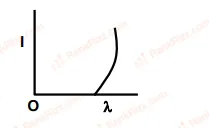
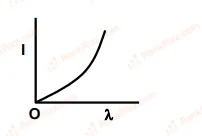
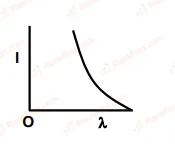
- (A)
The anode voltage of a photocell is kept fixed. The wavelength of the light falling on the cathode is gradually changed. The plate current of the photocell varies as follows :
- (A)
- (B)
- (C)
- (D)
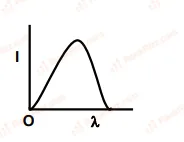
rr2.rankrizz.com/jee-main/physics/dual-nature-of-radiation-and-matter/q/2006-physics-500012
- (A)
A photocell is illuminated by a small bright source placed m away. When the same source of light is placed m away, the number of electrons emitted by photo cathode would
- (A)
decrease by a factor of 4
- (B)
increase by a factor of 4
- (C)
decrease by a factor of 2
- (D)
increase by a factor of 2
rr2.rankrizz.com/jee-main/physics/dual-nature-of-radiation-and-matter/q/2005-physics-500233
- (A)
According to Einstein's photoelectric equation, the plot of the kinetic energy of the emitted photo electrons from a metal the frequency, of the incident radiation gives straight line whose slope
- (A)
depends on the nature of the metal used
- (B)
depends on the intensity of the radiation
- (C)
depends both on the intensity of the radiation and the metal used
- (D)
is the same for all metals and independent of the intensity of the radiation.
rr2.rankrizz.com/jee-main/physics/dual-nature-of-radiation-and-matter/q/2004-physics-500275
- (A)
The work function of a substance is eV. Then longest wavelength of light that can cause photoelectron emission from this substance approximately
- (A)
nm
- (B)
nm
- (C)
nm
- (D)
nm
rr2.rankrizz.com/jee-main/physics/dual-nature-of-radiation-and-matter/q/2004-physics-500277
- (A)
de Broglie wavelength of matter waves 82
The de Broglie wavelength for an electron accelerated through the potential difference of volt is . When the potential difference is changed to volt, the associated de Broglie wavelength is increased by 50%. If , then the value of is __________.
Answer: ____________
rr2.rankrizz.com/jee-main/physics/dual-nature-of-radiation-and-matter/q/6-apr-2026-s2-q47
An electron of mass is moving in an electric field ( = constant > 0), with an initial velocity ( = constant > 0). If , its de Broglie wavelength at time is _______. ( = charge of electron)
- (A)
- (B)
- (C)
- (D)
rr2.rankrizz.com/jee-main/physics/dual-nature-of-radiation-and-matter/q/5-apr-2026-s1-q35
- (A)
An electron is travelling with a velocity in free space and when it enters a medium, its velocity is reduced by 20%. The de Broglie wavelength of electron in the medium is .where is its de Broglie wavelength in free space. The value of is :
- (A)
- (B)
- (C)
- (D)
rr2.rankrizz.com/jee-main/physics/dual-nature-of-radiation-and-matter/q/5-apr-2026-s2-q43
- (A)
The de Broglie wavelength associated with an electron accelerated through a potential difference V is and the de Broglie wavelength associated with a proton accelerated through the same potential difference is . If their corresponding masses are and , respectively, then the ratio of their de Broglie wavelengths is ______.
- (A)
- (B)
- (C)
- (D)
rr2.rankrizz.com/jee-main/physics/dual-nature-of-radiation-and-matter/q/4-apr-2026-s2-q44
- (A)
The ratio of de Broglie wavelength of a deutron with kinetic energy E to that of an alpha particle with kinetic energy 2E, is n : 1. The value of n is __.
(Assume mass of proton= mass of neutron) :Answer: ____________
rr2.rankrizz.com/jee-main/physics/dual-nature-of-radiation-and-matter/q/28-jan-2026-s1-q46
The de Broglie wavelength of an oxygen molecule at . The value of x is (take Planck's constant , Boltzmann constant , mass of oxygen molecule )
- (A)
20
- (B)
24
- (C)
30
- (D)
26
rr2.rankrizz.com/jee-main/physics/dual-nature-of-radiation-and-matter/q/23-jan-2026-s1-q31
- (A)
A particle having electric charge C and mass kg is accelerated by applying an electric Potential of 1.21 V. Wavelength of the matter wave
associated with the particle is . The value of is __________. (Take Planck's constant = J.s. )Answer: ____________
rr2.rankrizz.com/jee-main/physics/dual-nature-of-radiation-and-matter/q/21-jan-2026-s2-physics-q24
An electron is released from rest near an infinite non-conducting sheet of uniform charge density ''. The rate of change of de-Broglie wave length associated with the electron varies inversely as power of time. The numerical value of n is _____.
Answer: ____________
rr2.rankrizz.com/jee-main/physics/dual-nature-of-radiation-and-matter/q/2025-apr-8-s2-q46
A photo-emissive substance is illuminated with a radiation of wavelength so that it releases electrons with de-Broglie wavelength . The longest wavelength of radiation that can emit photoelectron is . Expression for de-Broglie wavelength is given by : (m : mass of the electron, h : Planck's constant and c : speed of light)
- (A)
- (B)
- (C)
- (D)
rr2.rankrizz.com/jee-main/physics/dual-nature-of-radiation-and-matter/q/2025-apr-7-s2-q50
- (A)
An electron with mass 'm' with an initial velocity enters a magnetic field . If the initial de-Broglie wavelength at is then its value after time 't' would be :
- (A)
- (B)
- (C)
- (D)
rr2.rankrizz.com/jee-main/physics/dual-nature-of-radiation-and-matter/q/2025-apr-02-s2-q30
- (A)
If and are de Broglie wavelength and kinetic energy, respectively, of a particle with constant mass. The correct graphical representation for the particle will be
- (A)
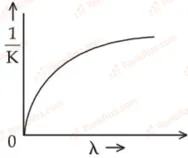
- (B)
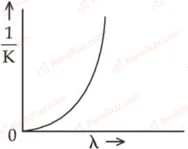
- (C)
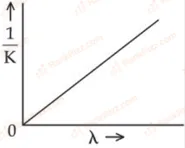
- (D)
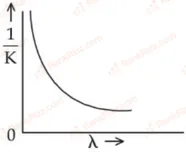
rr2.rankrizz.com/jee-main/physics/dual-nature-of-radiation-and-matter/q/29-jan-2025-s1-q32
- (A)
A proton of mass has same energy as that of a photon of wavelength . If the proton is moving at non- relativistic speed, then ratio of its deBroglie wavelength to the wavelength of photon is.
- (A)
- (B)
- (C)
- (D)
rr2.rankrizz.com/jee-main/physics/dual-nature-of-radiation-and-matter/q/28-jan-2025-s1-q45
- (A)
An electron of mass with an initial velocity enters an electric field If the initial de Broglie wavelength is the value after time would be:
- (A)
- (B)
- (C)
- (D)
rr2.rankrizz.com/jee-main/physics/dual-nature-of-radiation-and-matter/q/24-jan-2025-s1-q32
- (A)
A sub-atomic particle of mass kg is moving with a velocity m/s . Under the matter wave consideration, the particle will behave closely like
- (A)
Visible radiation
- (B)
Gamma rays
- (C)
Infra-red radiation
- (D)
X-rays
rr2.rankrizz.com/jee-main/physics/dual-nature-of-radiation-and-matter/q/23-jan-2025-s1-q34
- (A)
An electron in the ground state of the hydrogen atom has the orbital radius of while that for the electron in third excited state is The ratio of the de Broglie wavelengths of electron in the excited state to that in the ground state is
- (A)
3
- (B)
16
- (C)
9
- (D)
4
rr2.rankrizz.com/jee-main/physics/dual-nature-of-radiation-and-matter/q/22-jan-2025-s1-q30
- (A)
A proton, an electron and an alpha particle have the same energies. Their de-Broglie wavelengths will be compared as :
- (A)
- (B)
- (C)
- (D)
rr2.rankrizz.com/jee-main/physics/dual-nature-of-radiation-and-matter/q/9-apr-2024-s1-q17
- (A)
A proton and an electron are associated with same de-Broglie wavelength. The ratio of their kinetic energies is: (Assume , and )
- (A)
- (B)
- (C)
- (D)
rr2.rankrizz.com/jee-main/physics/dual-nature-of-radiation-and-matter/q/8-apr-2024-s1-q16
- (A)
A proton and an electron have the same de Broglie wavelength. If and be the kinetic energies of proton and electron respectively, then choose the correct relation :
- (A)
- (B)
- (C)
- (D)
rr2.rankrizz.com/jee-main/physics/dual-nature-of-radiation-and-matter/q/8-apr-2024-s2-q16
- (A)
The de Broglie wavelengths of a proton and an particle are and respectively. The ratio of the velocities of proton and particle will be :
- (A)
- (B)
- (C)
- (D)
rr2.rankrizz.com/jee-main/physics/dual-nature-of-radiation-and-matter/q/01-feb-2024-s1-q17
- (A)
The de-Broglie wavelength of an electron is the same as that of a photon. If velocity of electron is of the velocity of light, then the ratio of K.E. of electron and K.E. of photon will be:
- (A)
- (B)
- (C)
- (D)
rr2.rankrizz.com/jee-main/physics/dual-nature-of-radiation-and-matter/q/29-jan-2024-s1-q18
- (A)
The de Broglie wavelength of an electron having kinetic energy is . If the kinetic energy of electron becomes , then its de-Broglie wavelength will be:
- (A)
- (B)
- (C)
- (D)
rr2.rankrizz.com/jee-main/physics/dual-nature-of-radiation-and-matter/q/15-apr-2023-s1-q18
- (A)
A proton and an -particle are accelerated from rest by V and V potentials, respectively. The ratio of their de-Broglie wavelength is :
- (A)
- (B)
- (C)
- (D)
rr2.rankrizz.com/jee-main/physics/dual-nature-of-radiation-and-matter/q/12-apr-2023-s1-q17
- (A)
The ratio of the de-Broglie wavelengths of proton and electron having same kinetic energy:
(Assume )- (A)
1 : 43
- (B)
1 : 30
- (C)
1 : 62
- (D)
2 : 43
rr2.rankrizz.com/jee-main/physics/dual-nature-of-radiation-and-matter/q/11-apr-2023-s2-q17
- (A)
The de Broglie wavelength of a molecule in a gas at room temperature 300 K is . If the temperature of the gas is increased to 600 K, then the de Broglie wavelength of the same gas molecule becomes
- (A)
- (B)
- (C)
- (D)
rr2.rankrizz.com/jee-main/physics/dual-nature-of-radiation-and-matter/q/10-apr-2023-s1-q17
- (A)
Proton (P) and electron (e) will have same de-Broglie wavelength when the ratio of their momentum is (assume, )
- (A)
1 : 1
- (B)
1 : 1849
- (C)
1 : 43
- (D)
43 : 1
rr2.rankrizz.com/jee-main/physics/dual-nature-of-radiation-and-matter/q/8-apr-2023-s1-q17
- (A)
The kinetic energy of an electron, -particle and a proton are given as 4K, 2K and K respectively. The de-Broglie wavelength associated with electron , -particle and the proton are as follows:
- (A)
- (B)
- (C)
- (D)
rr2.rankrizz.com/jee-main/physics/dual-nature-of-radiation-and-matter/q/6-apr-2023-s1-q16
- (A)
A proton moving with one tenth of velocity of light has a certain de Broglie wavelength of . An alpha particle having certain kinetic energy has the same de-Broglie wavelength . The ratio of kinetic energy of proton and that of alpha particle is:
- (A)
2 : 1
- (B)
4 : 1
- (C)
1 : 2
- (D)
1 : 4
rr2.rankrizz.com/jee-main/physics/dual-nature-of-radiation-and-matter/q/01-feb-2023-s1-q17
- (A)
An electron accelerated through a potential difference has a de-Broglie wavelength of . When the potential is changed to , its de-Broglie wavelength increases by . The value of is equal to:
- (A)
- (B)
- (C)
- (D)
rr2.rankrizz.com/jee-main/physics/dual-nature-of-radiation-and-matter/q/30-jan-2023-s2-q16
- (A)
The ratio of de-Broglie wavelength of an -particle and a proton accelerated from rest by the same potential is , the value of is:
- (A)
4
- (B)
16
- (C)
8
- (D)
2
rr2.rankrizz.com/jee-main/physics/dual-nature-of-radiation-and-matter/q/29-jan-2023-s2-q29
- (A)
Electron beam used in an electron microscope, when accelerated by a voltage of 20 kV has a de-Broglie wavelength of . If the voltage is increased to 40 kV then the de-Broglie wavelength associated with the electron beam would be:
- (A)
- (B)
- (C)
- (D)
rr2.rankrizz.com/jee-main/physics/dual-nature-of-radiation-and-matter/q/25-jan-2023-s1-q17
- (A)
An particle, a proton and an electron have the same kinetic energy. Which one of the following is correct in case of their de-Broglie wavelength:
- (A)
- (B)
- (C)
- (D)
rr2.rankrizz.com/jee-main/physics/dual-nature-of-radiation-and-matter/q/24-jan-2023-s2-q17
- (A)
An particle and a proton are accelerated from rest through the same potential difference. The ratio of linear momenta acquired by above two particles will be:
- (A)
- (B)
- (C)
- (D)
8:1
rr2.rankrizz.com/jee-main/physics/dual-nature-of-radiation-and-matter/q/29-jul-2022-s2-q19
- (A)
The equation nm can be used to find the de-Broglie wavelength of an electron. In this equation stands for:
Where, = mass of electron, = momentum of electron, = Kinetic energy of electron, = Accelerating potential in volts for electron- (A)
- (B)
- (C)
- (D)
rr2.rankrizz.com/jee-main/physics/dual-nature-of-radiation-and-matter/q/28-jul-2022-s1-q17
- (A)
An electron (mass ) with an initial velocity () is moving in an electric field ( is constant). If at , de-Broglie wavelength is , then its de-Broglie wavelength after time is given by
- (A)
- (B)
- (C)
- (D)
rr2.rankrizz.com/jee-main/physics/dual-nature-of-radiation-and-matter/q/27-jul-2022-s1-q17
- (A)
A nucleus of mass at rest splits into two parts having masses and (). The ratio of de Broglie wavelength of two parts will be
- (A)
- (B)
- (C)
- (D)
rr2.rankrizz.com/jee-main/physics/dual-nature-of-radiation-and-matter/q/26-jul-2022-s2-q17
- (A)
The ratio of wavelengths of proton and deuteron accelerated by potential and is . Then, the ratio of to will be
- (A)
- (B)
- (C)
- (D)
rr2.rankrizz.com/jee-main/physics/dual-nature-of-radiation-and-matter/q/25-jul-2022-s2-q18
- (A)
The de Broglie wavelengths for an electron and a photon are and respectively. For the same kinetic energy of electron and photon, which of the following presents the correct relation between the de Broglie wavelengths of two?
- (A)
- (B)
- (C)
- (D)
rr2.rankrizz.com/jee-main/physics/dual-nature-of-radiation-and-matter/q/28-jun-2022-s1-q15
- (A)
An particle and a carbon 12 atom has same kinetic energy . The ratio of their de-Broglie wavelengths is
- (A)
- (B)
- (C)
- (D)
rr2.rankrizz.com/jee-main/physics/dual-nature-of-radiation-and-matter/q/27-jun-2022-s1-q18
- (A)
An electron with speed and a photon with speed have the same de-Broglie wavelength. If the kinetic energy and momentum of electron are and and that of photon are and respectively. Which of the following is correct?
- (A)
- (B)
- (C)
- (D)
rr2.rankrizz.com/jee-main/physics/dual-nature-of-radiation-and-matter/q/26-jun-2022-s1-q17
- (A)
A proton, a neutron, an electron and an -particle have same energy. If and are the de Broglie's wavelengths of proton, neutron, electron and particle respectively, then choose the correct relation from the following
- (A)
- (B)
- (C)
- (D)
rr2.rankrizz.com/jee-main/physics/dual-nature-of-radiation-and-matter/q/25-jun-2022-s2-q17
- (A)
The temperature of an ideal gas in three dimensions is 300 K. The corresponding de-Broglie wavelength of the electron approximately at 300 K is:
= mass of electron = kg, = Planck constant = J s, = Boltzmann constant = J K- (A)
2.26 nm
- (B)
3.25 nm
- (C)
8.46 nm
- (D)
6.26 nm
rr2.rankrizz.com/jee-main/physics/dual-nature-of-radiation-and-matter/q/1-sep-2021-s2-q18
- (A)
A moving proton and electron have the same de-Broglie wavelength. If and denote the K.E. and momentum respectively. Then choose the correct option:
- (A)
and
- (B)
and
- (C)
and
- (D)
and
rr2.rankrizz.com/jee-main/physics/dual-nature-of-radiation-and-matter/q/31-aug-2021-s1-q17
- (A)
Consider two separate ideal gases of electrons and protons having same number of particles. The temperature of both the gases are same. The ratio of the uncertainty in determining the position of an electron to that of a proton is proportional to:
- (A)
- (B)
- (C)
- (D)
rr2.rankrizz.com/jee-main/physics/dual-nature-of-radiation-and-matter/q/31-aug-2021-s2-q17
- (A)
The de-Broglie wavelength of a particle having kinetic energy is . How much extra energy must be given to this particle so that the de-Broglie wavelength reduces to 75% of the initial value?
- (A)
- (B)
- (C)
- (D)
rr2.rankrizz.com/jee-main/physics/dual-nature-of-radiation-and-matter/q/26-aug-2021-s2-q17
- (A)
A particle of mass kg travels in a medium with a speed of m s and a photon of radiation of linear momentum kg m s travels in a vacuum. The wavelength of the photon is _________ times the wavelength of the particle.
Answer: ____________
rr2.rankrizz.com/jee-main/physics/dual-nature-of-radiation-and-matter/q/27-jul-2021-s1-q26
What should be the order of arrangement of de-Broglie wavelength of electron , an -particle and proton given that all have the same kinetic energy?
- (A)
- (B)
- (C)
- (D)
rr2.rankrizz.com/jee-main/physics/dual-nature-of-radiation-and-matter/q/25-jul-2021-s1-q15
- (A)
A particle of mass 4M at rest disintegrates into two particles of mass M and 3M, respectively, having non zero velocities. The ratio of de-Broglie wavelength of particle of mass M to that of mass 3M will be:
- (A)
1 : 3
- (B)
3 : 1
- (C)
1 :
- (D)
1 : 1
rr2.rankrizz.com/jee-main/physics/dual-nature-of-radiation-and-matter/q/25-jul-2021-s1-q16
- (A)
An electron moving with speed and a photon moving with speed , have the same D-Broglie wavelength. The ratio of the kinetic energy of the electron to that of a photon is:
- (A)
- (B)
- (C)
- (D)
rr2.rankrizz.com/jee-main/physics/dual-nature-of-radiation-and-matter/q/25-jul-2021-s2-q19
- (A)
An electron of mass and a proton of mass are accelerated through the same potential difference. The ratio of the de-Broglie wavelength associated with the electron to that with the proton is:
- (A)
- (B)
1
- (C)
- (D)
rr2.rankrizz.com/jee-main/physics/dual-nature-of-radiation-and-matter/q/22-jul-2021-s1-q17
- (A)
An electron having de-Broglie wavelength is incident on a target in a X-ray tube. Cut-off wavelength of emitted X-ray is:
- (A)
0
- (B)
- (C)
- (D)
rr2.rankrizz.com/jee-main/physics/dual-nature-of-radiation-and-matter/q/20-jul-2021-s2-q19
- (A)
The speed of electrons in a scanning electron microscope is ms. If the protons having the same speed are used instead of electrons, then the resolving power of scanning proton microscope will be changed by a factor of:
- (A)
1837
- (B)
- (C)
- (D)
rr2.rankrizz.com/jee-main/physics/dual-nature-of-radiation-and-matter/q/18-mar-2021-s2-q18
- (A)
An electron of mass and a photon have same energy . The ratio of wavelength of electron to that of photon is: ( being the velocity of light)
- (A)
- (B)
- (C)
- (D)
rr2.rankrizz.com/jee-main/physics/dual-nature-of-radiation-and-matter/q/17-mar-2021-s1-q16
- (A)
The de-Broglie wavelength associated with an electron and a proton were calculated by accelerating them through same potential of 100 V. What should nearly be the ratio of their wavelengths? ( u, u)
- (A)
1860 : 1
- (B)
: 1
- (C)
41.4 : 1
- (D)
43 : 1
rr2.rankrizz.com/jee-main/physics/dual-nature-of-radiation-and-matter/q/16-mar-2021-s2-q16
- (A)
An particle and a proton are accelerated from rest by a potential difference of 200 V. After this, their de Broglie wavelengths are and respectively. The ratio is:
- (A)
8
- (B)
3.8
- (C)
2.8
- (D)
7.8
rr2.rankrizz.com/jee-main/physics/dual-nature-of-radiation-and-matter/q/25-feb-2021-s1-q16
- (A)
An electron of mass and a proton of mass are moving with the same speed. The ratio of their de Broglie wavelength will be:
- (A)
1836
- (B)
- (C)
918
- (D)
1
rr2.rankrizz.com/jee-main/physics/dual-nature-of-radiation-and-matter/q/25-feb-2021-s2-q15
- (A)
The de Broglie wavelength of a proton and -particle are equal. The ratio of their velocities is
- (A)
4 : 1
- (B)
4 : 3
- (C)
1 : 4
- (D)
4 : 2
rr2.rankrizz.com/jee-main/physics/dual-nature-of-radiation-and-matter/q/24-feb-2021-s2-q16
- (A)
An electron, a doubly ionized helium ion and proton are having the same kinetic energy. The relation between their respective de-Broglie wavelength , and is:
- (A)
- (B)
- (C)
- (D)
rr2.rankrizz.com/jee-main/physics/dual-nature-of-radiation-and-matter/q/6-sep-2020-s1-q17
- (A)
Assuming the nitrogen molecule is moving with r.m.s. velocity at 400 K, the de-Broglie wave length of nitrogen molecule is close to: (Given: nitrogen molecule weight: , Boltzman constant: , Planck constant: )
- (A)
- (B)
- (C)
- (D)
rr2.rankrizz.com/jee-main/physics/dual-nature-of-radiation-and-matter/q/6-sep-2020-s2-q9
- (A)
Particle A of mass moving along the x-axis with velocity collides elastically with another particle B at rest having mass . If both particles move along the x-axis after the collision, the change in the wavelength of particle A, in terms of its de-Broglie wavelength before the collision is:
- (A)
- (B)
- (C)
- (D)
rr2.rankrizz.com/jee-main/physics/dual-nature-of-radiation-and-matter/q/4-sep-2020-s1-q18
- (A)
A particle is moving 5 times as fast as an electron. The ratio of the de-Broglie wavelength of the particle to that of the electron is . The mass of the particle is close to:
- (A)
kg
- (B)
kg
- (C)
kg
- (D)
kg
rr2.rankrizz.com/jee-main/physics/dual-nature-of-radiation-and-matter/q/2-sep-2020-s2-q18
- (A)
A particle moving with kinetic energy has de Broglie wavelength . If energy is added to its energy, the wavelength become . Value of , is:
- (A)
- (B)
- (C)
- (D)
rr2.rankrizz.com/jee-main/physics/dual-nature-of-radiation-and-matter/q/9-jan-2020-s1-q19
- (A)
An electron of mass and magnitude of charge at rest, gets accelerated by a constant electric field . The rate of change of de-Broglie wavelength of this electron at time is (ignore relativistic effects):
- (A)
- (B)
- (C)
- (D)
rr2.rankrizz.com/jee-main/physics/dual-nature-of-radiation-and-matter/q/9-jan-2020-s2-q18
- (A)
An electron (mass m) with initial velocity is in an electric field . If is initial de-Broglie wavelength of electron, its de-Broglie wave length at time is given by:
- (A)
- (B)
- (C)
- (D)
rr2.rankrizz.com/jee-main/physics/dual-nature-of-radiation-and-matter/q/8-jan-2020-s2-q19
- (A)
An electron (of mass ) and a photon have the same energy in the range of a few eV. The ratio of the de-Broglie wavelength associated with the electron and the wavelength of the photon is (c = speed of light in vacuum)
- (A)
- (B)
- (C)
- (D)
rr2.rankrizz.com/jee-main/physics/dual-nature-of-radiation-and-matter/q/7-jan-2020-s2-q19
- (A)
A particle 'P' is formed due to a completely inelastic collision of particles 'x' and 'y' having de-Broglie wavelengths '' and '' respectively. If x and y were moving in opposite directions, then the de-Broglie wavelength of 'P' is:
- (A)
- (B)
- (C)
- (D)
rr2.rankrizz.com/jee-main/physics/dual-nature-of-radiation-and-matter/q/9-apr-2019-s2-q27
- (A)
Two particles move at right angle to each other. Their de Broglie wavelengths are and respectively. The particles suffer perfectly inelastic collision. The de Broglie wavelength of the final particle, is given by:
- (A)
- (B)
- (C)
- (D)
rr2.rankrizz.com/jee-main/physics/dual-nature-of-radiation-and-matter/q/8-apr-2019-s1-q27
- (A)
A nucleus A, with a finite de-broglie wavelength , undergoes spontaneous fission into two nuclei B and C of equal mass. B flies in the same direction as that of A, while C flies in the opposite direction with a velocity equal to half of that of B. The de-Broglie wavelengths and of B and C are respectively:
- (A)
- (B)
- (C)
- (D)
rr2.rankrizz.com/jee-main/physics/dual-nature-of-radiation-and-matter/q/8-apr-2019-s2-q27
- (A)
A particle A of mass m and charge q is accelerated by a potential difference of 50 V. Another particle B of mass 4m and charge q is accelerated by a potential difference of 2500 V. The ratio of de-Broglie wavelengths is close to:
- (A)
0.07
- (B)
10.00
- (C)
4.47
- (D)
14.14
rr2.rankrizz.com/jee-main/physics/dual-nature-of-radiation-and-matter/q/12-jan-2019-s1-q25
- (A)
If the deBroglie wavelength of an electron is equal to times the wavelength of a photon of frequency Hz, then the speed of electron is equal to: (Speed of light m/s, Planck's constant J.s, Mass of electron kg)
- (A)
m/s
- (B)
m/s
- (C)
m/s
- (D)
m/s
rr2.rankrizz.com/jee-main/physics/dual-nature-of-radiation-and-matter/q/11-jan-2019-s1-q26
- (A)
In an electron microscope, the resolution that can be achieved is of the order of the wavelength of electrons used. To resolve a width of m, the minimum electron energy required is close to:
- (A)
100 keV
- (B)
25 keV
- (C)
1 keV
- (D)
500 keV
rr2.rankrizz.com/jee-main/physics/dual-nature-of-radiation-and-matter/q/10-jan-2019-s1-q26
- (A)
The de-Broglie wavelength () associated with the electron orbiting in the second excited state of hydrogen atom is related to that in the ground state () by:
- (A)
- (B)
- (C)
- (D)
rr2.rankrizz.com/jee-main/physics/dual-nature-of-radiation-and-matter/q/16-apr-2018-online-q26
- (A)
Two electrons are moving with non-relativistic speeds perpendicular to each other. If corresponding de Broglie wavelengths are and , their de Broglie wavelength in the frame of reference attached to their centre of mass is:
- (A)
- (B)
- (C)
- (D)
rr2.rankrizz.com/jee-main/physics/dual-nature-of-radiation-and-matter/q/15-apr-2018-s1-q25
- (A)
If the de Broglie wavelengths associated with a proton and an -particle are equal, then the ratio of velocities of the proton and the -particle will be:
- (A)
1 : 4
- (B)
1 : 2
- (C)
4 : 1
- (D)
2 : 1
rr2.rankrizz.com/jee-main/physics/dual-nature-of-radiation-and-matter/q/15-apr-2018-s2-q26
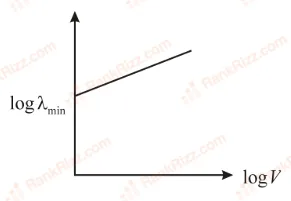
- (A)
An electron beam is accelerated by a potential difference to hit a metallic target to produce X-rays. It produces continuous as well as characteristic X-rays. If is the smallest possible wavelength of X-ray in the spectrum, the variation of with is correctly represented in:
- (A)
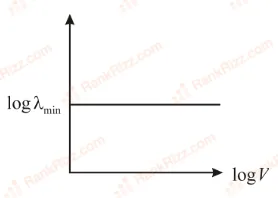
- (B)
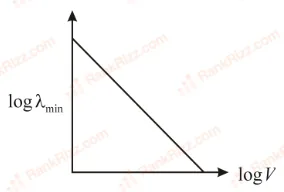
- (C)
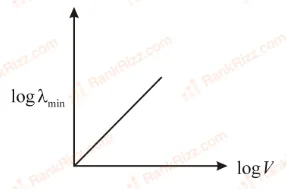
- (D)
rr2.rankrizz.com/jee-main/physics/dual-nature-of-radiation-and-matter/q/2-apr-2017-offline-q23
- (A)
A particle of mass and initial velocity collides with a particle of mass which is at rest. The collision is head on, and elastic. The ratio of the de-Broglie wavelengths to after the collision is:
- (A)
- (B)
- (C)
- (D)
rr2.rankrizz.com/jee-main/physics/dual-nature-of-radiation-and-matter/q/2-apr-2017-offline-q26
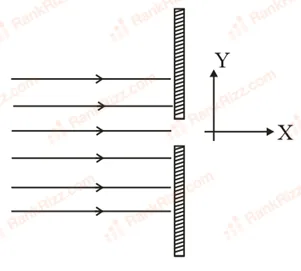
- (A)
A parallel beam of electrons travelling in x - direction falls on a slit of width d (see the figure below). If after passing the slit, an electron acquires momentum in the y - direction, then for a majority of electrons passing through the slit (h is Planck's constant):
- (A)
- (B)
- (C)
- (D)
rr2.rankrizz.com/jee-main/physics/dual-nature-of-radiation-and-matter/q/10-apr-2015-online-q26
- (A)
De-Broglie wavelength of an electron accelerated by a voltage of 50 V is close to C, kg, J s
- (A)
0.5
- (B)
1.2
- (C)
1.7
- (D)
2.4
rr2.rankrizz.com/jee-main/physics/dual-nature-of-radiation-and-matter/q/10-apr-2015-online-q27
- (A)
Match List-I (Experiment performed) with List-II (Phenomena discovered/associated) and select the correct option from the options given below the lists.
List-I: List-II:
(a) Davisson and Germer experiment (i) Wave nature of electrons
(b) Millikan's oil drop experiment (ii) Charge of an electron
(c) Rutherford experiment (iii) Quantisation of energy levels
(d) Franck-Hertz experiment (iv) Existence of the nucleus- (A)
(a)-(iii), (b)-(iv), (c)-(i), (d)-(ii)
- (B)
(a)-(i), (b)-(ii), (c)-(iv), (d)-(iii)
- (C)
(a)-(iv), (b)-(iii), (c)-(ii), (d)-(i)
- (D)
(a)-(i), (b)-(ii), (c)-(iii), (d)-(iv)
rr2.rankrizz.com/jee-main/physics/dual-nature-of-radiation-and-matter/q/19-apr-2014-online-q26
- (A)
For which of the following particles will it be most difficult to experimentally verify the de-Broglie relationship?
- (A)
An electron
- (B)
An -particle
- (C)
A dust particle
- (D)
A proton
rr2.rankrizz.com/jee-main/physics/dual-nature-of-radiation-and-matter/q/9-apr-2014-online-q26
- (A)
Electrons are accelerated through a potential difference V and protons are accelerated through a potential difference 4 V. The de-Broglie wavelengths are and for electrons and protons respectively. The ratio of is given by: (given is mass of electron and is mass of proton).
- (A)
- (B)
- (C)
- (D)
rr2.rankrizz.com/jee-main/physics/dual-nature-of-radiation-and-matter/q/23-apr-2013-online-q26
- (A)
Orbits of a particle moving in a circle are such that the perimeter of the orbit equals an integer number of de-Broglie wavelengths of the particle. For a charged particle moving in a plane perpendicular to a magnetic field, the radius of the orbital will therefore be proportional to :
- (A)
- (B)
- (C)
- (D)
rr2.rankrizz.com/jee-main/physics/dual-nature-of-radiation-and-matter/q/22-apr-2013-online-q28
- (A)
If the kinetic energy of a free electron doubles, its deBroglie wavelength changes by the factor
- (A)
- (B)
- (C)
- (D)
rr2.rankrizz.com/jee-main/physics/dual-nature-of-radiation-and-matter/q/2005-physics-500235
- (A)
Photons: energy, momentum and radiation pressure 29
A monochromatic source of light operating at 15 kW emits photons/s. The region of an electromagnetic spectrum to which the emitted electromagnetic radiation belongs to __________. (Take J.s and m/s).
- (A)
Microwave
- (B)
Infrared
- (C)
Visible
- (D)
Ultraviolet
rr2.rankrizz.com/jee-main/physics/dual-nature-of-radiation-and-matter/q/8-apr-2026-s2-q38
- (A)
Number of photons of equal energy emitted per second by a 6 mW laser source operating at 663 nm is ____ . (Given: )
- (A)
- (B)
- (C)
- (D)
rr2.rankrizz.com/jee-main/physics/dual-nature-of-radiation-and-matter/q/28-jan-2026-s2-q28
- (A)
The radiation force experienced by body exposed to radiation of intensity , assuming surface of body to be perfectly absorbing is :
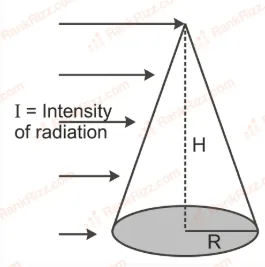
- (A)
- (B)
- (C)
- (D)
rr2.rankrizz.com/jee-main/physics/dual-nature-of-radiation-and-matter/q/2026-physics-516352
- (A)
A small mirror of mass m is suspended by a massless thread of length . Then the small angle through which the thread will be deflected when a short pulse of laser of energy E falls normal on the mirror (c = speed of light in vacuum and g = acceleration due to gravity)
- (A)
- (B)
- (C)
- (D)
rr2.rankrizz.com/jee-main/physics/dual-nature-of-radiation-and-matter/q/2025-apr-4-s1-q27
- (A)
The radiation pressure exerted by a 450 W light source on a perfectly reflecting surface placed at 2m away from it, is :
- (A)
Pascals
- (B)
- (C)
Pascals
- (D)
Pascals
rr2.rankrizz.com/jee-main/physics/dual-nature-of-radiation-and-matter/q/2025-apr-03-s1-q29
- (A)
Which of the following phenomena can not be explained by wave theory of light?
- (A)
Compton effect
- (B)
Refraction of light
- (C)
Reflection of light
- (D)
Diffraction of light
rr2.rankrizz.com/jee-main/physics/dual-nature-of-radiation-and-matter/q/28-jan-2025-s2-q40
- (A)
The ratio of the power of a light source to that of the light source is 2. is emitting photons per second at 600,nm. If the wavelength of the source is 300, nm,then the number of photons per second emitted by is
Answer: ____________
rr2.rankrizz.com/jee-main/physics/dual-nature-of-radiation-and-matter/q/24-jan-2025-s2-q46
Which of the following phenomena does not explain by wave nature of light. A. reflection B. diffraction C. photoelectric effect D. interference E. polarization. Choose the most appropriate answer from the options given below:
- (A)
E only
- (B)
B, D only
- (C)
C only
- (D)
A, C only
rr2.rankrizz.com/jee-main/physics/dual-nature-of-radiation-and-matter/q/6-apr-2024-s1-q17
- (A)
Monochromatic light of frequency Hz is produced by a laser. The power emitted is W. How many photons per second on an average, are emitted by the source? (Given J s)
- (A)
- (B)
- (C)
- (D)
rr2.rankrizz.com/jee-main/physics/dual-nature-of-radiation-and-matter/q/01-feb-2024-s2-q18
- (A)
If the total energy transferred to a surface in time is J, then the magnitude of the total momentum delivered to this surface for complete absorption will be:
- (A)
kg m s
- (B)
kg m s
- (C)
kg m s
- (D)
kg m s
rr2.rankrizz.com/jee-main/physics/dual-nature-of-radiation-and-matter/q/30-jan-2024-s2-q15
- (A)
Two sources of light emit with a power of W. The ratio of number of photons of visible light emitted by each source having wavelengths nm and nm respectively, will be:
- (A)
- (B)
- (C)
- (D)
rr2.rankrizz.com/jee-main/physics/dual-nature-of-radiation-and-matter/q/29-jan-2024-s2-q18
- (A)
An atom absorbs a photon of wavelength nm and emits another photon of wavelength nm. The net energy absorbed by the atom in this process is eV. The value of is [Assume the atom to be stationary during the absorption and emission process] (Take J s and m s).
Answer: ____________
rr2.rankrizz.com/jee-main/physics/dual-nature-of-radiation-and-matter/q/13-apr-2023-s2-q30
If a source of electromagnetic radiation having power 15 kW produces photons per second, the radiation belongs to a part of spectrum is:
(Take Planck constant J s)- (A)
Micro waves
- (B)
Ultraviolet rays
- (C)
Gamma rays
- (D)
Radio waves
rr2.rankrizz.com/jee-main/physics/dual-nature-of-radiation-and-matter/q/31-jan-2023-s1-q17
- (A)
A small object at rest, absorbs a light pulse of power mW and duration ns. Assuming speed of light as m s. The momentum of the object becomes equal to:
- (A)
kg m s
- (B)
kg m s
- (C)
kg m s
- (D)
kg m s
rr2.rankrizz.com/jee-main/physics/dual-nature-of-radiation-and-matter/q/30-jan-2023-s1-q17
- (A)
A parallel beam of light of wavelength and intensity is incident on a surface perpendicular to the beam. The number of photons crossing area perpendicular to the beam in one second is
- (A)
- (B)
- (C)
- (D)
rr2.rankrizz.com/jee-main/physics/dual-nature-of-radiation-and-matter/q/26-jul-2022-s1-q17
- (A)
A free electron of 2.6 eV energy collides with a H ion. This results in the formation of a hydrogen atom in the first excited state and a photon is released. Find the frequency of the emitted photon. (h = J s)
- (A)
MHz
- (B)
MHz
- (C)
MHz
- (D)
MHz
rr2.rankrizz.com/jee-main/physics/dual-nature-of-radiation-and-matter/q/31-aug-2021-s2-q18
- (A)
The recoil speed of a hydrogen atom after it emits a photon in going from state to state will be
- (A)
4.17 m s
- (B)
2.19 m s
- (C)
4.34 m s
- (D)
3.25 m s
rr2.rankrizz.com/jee-main/physics/dual-nature-of-radiation-and-matter/q/26-feb-2021-s2-q18
- (A)
The wavelength of an X-ray beam is 10 Å. The mass of a fictitious particle having the same energy as that of the X-ray photons is kg. The value of is ______. ( = Planck's constant)
Answer: ____________
rr2.rankrizz.com/jee-main/physics/dual-nature-of-radiation-and-matter/q/25-feb-2021-s2-q30
Given below are two statements:
Statement I: Two photons having equal linear momenta have equal wavelengths.
Statement II: If the wavelength of the photon is decreased, then the momentum and energy of a photon will also decrease.
In the light of the above statements, choose the correct answer from the options given below.- (A)
Both Statement I and Statement II are false
- (B)
Both Statement I and Statement II are true
- (C)
Statement I is true but Statement II is false
- (D)
Statement I is false but Statement II is true
rr2.rankrizz.com/jee-main/physics/dual-nature-of-radiation-and-matter/q/24-feb-2021-s1-q18
- (A)
An X-ray tube is operated at 1.24 million volt. The shortest wavelength of the produced photon will be:
- (A)
nm
- (B)
nm
- (C)
nm
- (D)
nm
rr2.rankrizz.com/jee-main/physics/dual-nature-of-radiation-and-matter/q/24-feb-2021-s2-q13
- (A)
Two sources of light emit X-rays of wavelength 1 nm and visible light of wavelength 500 nm, respectively. Both the sources emit light of the same power 200 W. The ratio of the number density of photons of X-rays to the number density of photons of the visible light of the given wavelengths is:
- (A)
- (B)
250
- (C)
- (D)
500
rr2.rankrizz.com/jee-main/physics/dual-nature-of-radiation-and-matter/q/3-sep-2020-s2-q17
- (A)
A beam of electromagnetic radiation of intensity W/cm is comprised of wavelength, nm. It falls normally on a metal (work function eV) of surface area of 1 cm. If one in photons ejects an electron, total number of electrons ejected in 1s is . ( eVnm, eV J), then is
Answer: ____________
rr2.rankrizz.com/jee-main/physics/dual-nature-of-radiation-and-matter/q/7-jan-2020-s1-q25
A 2 mW laser operates at a wavelength of 500 nm. The number of photons that will be emitted per second is:
[Given Planck's constant h = J s, speed of light c = m/s]- (A)
- (B)
- (C)
- (D)
rr2.rankrizz.com/jee-main/physics/dual-nature-of-radiation-and-matter/q/10-apr-2019-s2-q27
- (A)
In a Frank-Hertz experiment, an electron of energy 5.6 eV passes through mercury vapour and emerges with an energy 0.7 eV. The minimum wavelength of photons emitted by mercury atoms is close to:
- (A)
250 nm
- (B)
1700 nm
- (C)
220 nm
- (D)
2020 nm
rr2.rankrizz.com/jee-main/physics/dual-nature-of-radiation-and-matter/q/12-jan-2019-s2-q26
- (A)
A laser light of wavelength 660 nm is used to weld Retina detachment. If a laser pulse of width 60 ms and power 0.5 kW is used, the approximate number of photons in the pulse are (Take Planck's Constant, J s)
- (A)
- (B)
- (C)
- (D)
rr2.rankrizz.com/jee-main/physics/dual-nature-of-radiation-and-matter/q/9-apr-2017-online-q26
- (A)
A photon of wavelength is scattered from an electron, which was at rest. The wavelength shift is three times of and the angle of scattering is 60°. The angle at which the electron recoiled is . The value of is: (electron speed is much smaller than the speed of light)
- (A)
0.16
- (B)
0.22
- (C)
0.25
- (D)
0.28
rr2.rankrizz.com/jee-main/physics/dual-nature-of-radiation-and-matter/q/11-apr-2014-online-q27
- (A)
A kW transmitter emits radio waves of wavelength m. The number of photons emitted per second by the transmitter is of the order of
- (A)
- (B)
- (C)
- (D)
rr2.rankrizz.com/jee-main/physics/dual-nature-of-radiation-and-matter/q/2012-physics-499408
- (A)
Photon of frequency has a momentum associated with it. If is the velocity of light, the momentum is
- (A)
- (B)
- (C)
- (D)
rr2.rankrizz.com/jee-main/physics/dual-nature-of-radiation-and-matter/q/2007-physics-499775
- (A)
A radiation of energy falls normally on a perfectly reflecting surface. The momentum transferred to the surface is
- (A)
- (B)
- (C)
- (D)
rr2.rankrizz.com/jee-main/physics/dual-nature-of-radiation-and-matter/q/2004-physics-500274
- (A)
Davisson-Germer experiment 7
Given below are two statements: One is labelled as Assertion A and the other is labelled as Reason R
Assertion A: The beam of electrons shows wave nature and exhibit interference and diffraction.
Reason R: Davisson Germer Experimentally verified the wave nature of electrons.
In the light of the above statements. Choose the most appropriate answer from the options given below:- (A)
A is correct but R is not correct
- (B)
A is not correct but R is correct
- (C)
Both A and R are correct but R is Not the correct explanation of A
- (D)
Both A and R are correct and R is the correct explanation of A
rr2.rankrizz.com/jee-main/physics/dual-nature-of-radiation-and-matter/q/31-jan-2023-s1-q16
- (A)
Given below are two statements :
Statement I : Davisson-Germer experiment establishes the wave nature of electrons.
Statement II : If electrons have wave nature, they can interfere and show diffraction.
In the light of the above statements choose the correct answer from the option given below :- (A)
Both Statement I and Statement II are true.
- (B)
Both Statement I and Statement II are false.
- (C)
Statement I is true but Statement II is false.
- (D)
Statement I is false but Statement II is true.
rr2.rankrizz.com/jee-main/physics/dual-nature-of-radiation-and-matter/q/25-jun-2022-s1-q17
- (A)
A beam of electrons of energy scatters from a target having atomic spacing of . The first maximum intensity occurs at . Then (in eV) is......... (Planck's constant , , electron mass )
Answer: ____________
rr2.rankrizz.com/jee-main/physics/dual-nature-of-radiation-and-matter/q/5-sep-2020-s1-q25
Match list-I (Fundamental Experiment) with List-II (its conclusion) and select the correct option from the choices given below the list:
List-I List-II
A. Franck-Hertz Experiment (i) Particle nature of light
B. Photo-electric experiment (ii) Discrete energy levels of the atom
C. Davison-Germer Experiment (iii) Wave nature of electron
(iv) Structure of atom- (A)
A - (iv); B - (iii); C - (ii)
- (B)
A - (i); B - (iv); C - (iii)
- (C)
A - (ii); B - (iv); C - (iii)
- (D)
A - (ii); B - (i); C - (iii)
rr2.rankrizz.com/jee-main/physics/dual-nature-of-radiation-and-matter/q/4-apr-2015-offline-q28
- (A)
This question has statement 1 and statement 2. Of the four choices given after the statements, choose the one that best describes the two statements. Statement 1: Davisson-Germer experiment established the wave nature of electrons. Statement 2: If electrons have wave nature, they can interfere and show diffraction.
- (A)
Statement 1 is false, Statement 2 is true
- (B)
Statement 1 is true, Statement 2 is false
- (C)
Statement 1 is true, Statement 2 is the correct explanation for statement 1
- (D)
Statement 1 is true, Statement 2 is true, Statement 2 is not the correct explanation for statement 1.
rr2.rankrizz.com/jee-main/physics/dual-nature-of-radiation-and-matter/q/2012-physics-499042
- (A)
Paragraph: Wave property of electrons implies that they will show diffraction effects. Davisson and Germer demonstrated this by diffracting electrons from crystals. The law governing the diffraction from a crystal is obtained by requiring that electron waves reflected from the planes of atoms in a crystal interfere constructively (see in figure).
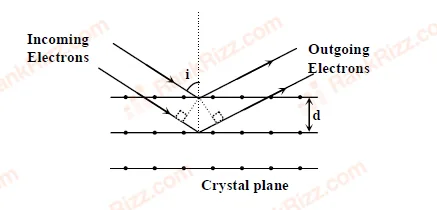
Question: Electrons accelerated by potential are diffracted from a crystal. If and , should be about- (A)
2000 V
- (B)
50 V
- (C)
500 V
- (D)
1000 V
rr2.rankrizz.com/jee-main/physics/dual-nature-of-radiation-and-matter/q/2008-physics-499889
- (A)
Paragraph: Wave property of electrons implies that they will show diffraction effects. Davisson and Germer demonstrated this by diffracting electrons from crystals. The law governing the diffraction from a crystal is obtained by requiring that electron waves reflected from the planes of atoms in a crystal interfere constructively (see in figure).
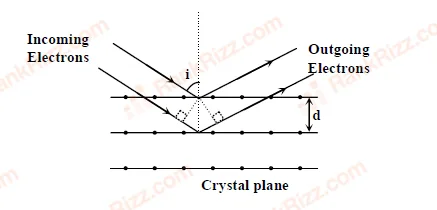
Question: If a strong diffraction peak is observed when electrons are incident at an angle '' from the normal to the crystal planes with distance '' between them (see figure), de Broglie wavelength of electrons can be calculated by the relationship ( is an integer)- (A)
- (B)
- (C)
- (D)
rr2.rankrizz.com/jee-main/physics/dual-nature-of-radiation-and-matter/q/2008-physics-499890
- (A)
Answer key
- 01 D
- 02 C
- 03 A
- 04 B
- 05 B
- 06 A
- 07 D
- 08 B
- 09 B
- 10 B
- 11 C
- 12 D
- 13 D
- 14 B
- 15 A
- 16 C
- 17 D
- 18 C
- 19 C
- 20 C
- 21 D
- 22 B
- 23 B
- 24 C
- 25 C
- 26 C
- 27 B
- 28 D
- 29 D
- 30 B
- 31 B
- 32 A
- 33 B
- 34 C
- 35 C
- 36 A
- 37 D
- 38 D
- 39 D
- 40 C
- 41 C
- 42 B
- 43 C
- 44 B
- 45 C
- 46 B
- 47 D
- 48 B
- 49 A
- 50 35
- 51 2
- 52 A
- 53 C
- 54 C
- 55 C
- 56 B
- 57 B
- 58 125
- 59 D
- 60 4
- 61 A
- 62 D
- 63 1
- 64 A
- 65 2
- 66 A
- 67 D
- 68 D
- 69 9
- 70 C
- 71 A
- 72 D
- 73 C
- 74 D
- 75 B
- 76 C
- 77 C
- 78 B
- 79 B
- 80 A
- 81 A
- 82 D
- 83 C
- 84 B
- 85 D
- 86 A
- 87 B
- 88 C
- 89 B
- 90 C
- 91 D
- 92 B
- 93 C
- 94 B
- 95 C
- 96 B
- 97 D
- 98 C
- 99 4
- 100 C
- 101 C
- 102 A
- 103 2
- 104 D
- 105 10
- 106 2
- 107 A
- 108 D
- 109 B
- 110 D
- 111 A
- 112 D
- 113 D
- 114 A
- 115 D
- 116 B
- 117 D
- 118 B
- 119 D
- 120 C
- 121 A
- 122 C
- 123 A
- 124 B
- 125 B
- 126 D
- 127 C
- 128 A
- 129 B
- 130 B
- 131 D
- 132 D
- 133 C
- 134 D
- 135 A
- 136 A
- 137 B
- 138 B
- 139 D
- 140 B
- 141 A
- 142 B
- 143 910
- 144 C
- 145 D
- 146 C
- 147 C
- 148 C
- 149 A
- 150 B
- 151 D
- 152 C
- 153 A
- 154 A
- 155 C
- 156 A
- 157 D
- 158 D
- 159 C
- 160 D
- 161 C
- 162 C
- 163 C
- 164 D
- 165 B
- 166 D
- 167 D
- 168 B
- 169 A
- 170 C
- 171 C
- 172 B
- 173 C
- 174 A
- 175 C
- 176 B
- 177 C
- 178 D
- 179 C
- 180 C
- 181 D
- 182 D
- 183 D
- 184 D
- 185 C
- 186 A
- 187 5
- 188 C
- 189 C
- 190 B
- 191 D
- 192 4125
- 193 C
- 194 B
- 195 B
- 196 B
- 197 A
- 198 10
- 199 C
- 200 A
- 201 A
- 202 11
- 203 B
- 204 A
- 205 C
- 206 C
- 207 B
- 208 D
- 209 B
- 210 D
- 211 A
- 212 50
- 213 D
- 214 C
- 215 B
- 216 D
Past questions are reproduced with their sitting. Not affiliated with NTA or the IITs. Every question, online and free: rr2.rankrizz.com/jee-main/physics/dual-nature-of-radiation-and-matter