and be the maximum kinetic energies of photoelectrons emitted from a surface of a given material for the light of wavelength and , respectively. If then the work function of material is given by :
- A
- B
- C
- D
Photoelectric effect and Einstein's equation has been asked 98 times in JEE Main, in 19 different years between 2004 and 2026, and in all of the last five exam years (2022–2026), 52 questions in all. That is 45% of Dual Nature of Radiation & Matter, its most-asked topic. Last asked in JEE Main 08 Apr 2026, Shift 2. 91 are multiple choice and 7 numerical-value; 41 easy and 45 medium by our difficulty labels. All of them are below, newest first, free to read.
Questions
98
Years asked
19
Since
2004
Of the chapter
45%
Questions on Photoelectric effect and Einstein's equation in every year it was asked, newest first.
| Year | Relative frequency | Questions |
|---|---|---|
| 2026 | 8 | |
| 2025 | 9 | |
| 2024 | 12 | |
| 2023 | 12 | |
| 2022 | 11 | |
| 2021 | 12 | |
| 2020 | 7 | |
| 2019 | 8 | |
| 2017 | 1 | |
| 2016 | 3 | |
| 2014 | 1 | |
| 2013 | 3 | |
| 2012 | 2 | |
| 2011 | 1 | |
| 2010 | 1 | |
| 2009 | 1 | |
| 2006 | 3 | |
| 2005 | 1 | |
| 2004 | 2 | |
| Total | 98 |
1–20 OF 98 · NEWEST FIRST
and be the maximum kinetic energies of photoelectrons emitted from a surface of a given material for the light of wavelength and , respectively. If then the work function of material is given by :
Light source having wavelength 331 nm is used to generate photo-electrons whose stopping potential is 0.2 V. The work function of the used metal in the experiment is J. The value of is _______. (h = J s, e = C and c = m/s)
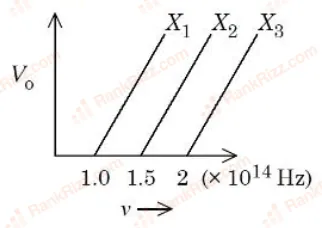
The graph shows variation of stopping potential with the frequency of the incident radiation for three photosensitive metals , and . Which metal will give out electrons with greater kinetic energy, for the same wavelength of incident radiation?

All same
For a certain metal, when monochromatic light of wavelength is incident, the stopping potential for photoelectrons is . When the same metal is illuminated by light of wavelength , then the stopping potential becomes . The threshold wavelength for photoelectric emission for the given metal is . The value of is __________.
When a light of a given wavelength falls on a metallic surface the stopping potential for photoelectrons is 3.2 V. If a second light having wavelength twice of first light is used, the stopping potential drops to 0. 7 V. The wavelength of first light is ___ m.
Light is incident on a metallic plate having work function . If the produced photoelectrons have zero kinetic energy then the angular frequency of the incident light is ___ rad/s. (h = ).
A light wave described by (in SI units) falls on a metal surface of work function 2.8 eV. The maximum kinetic energy of ejected photoelectron is (approximately) ___ eV.
7.8
6.0
3.8
5.1
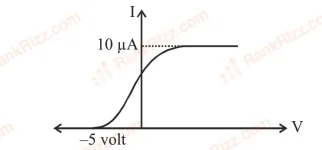
In the photoelectric experiment, if we use a monochromatic light, the curve is as shown. If the work function of the metal is , estimate the power of light used.
(Assume efficiency of photo emission = , i.e. the number of photoelectrons emitted are of the number of photons incident on the metal.)

Given below are two statements:
Assertion A: In photoelectric effect, on increasing the intensity of incident light the stopping potential increases.
Reason R: Increase in intensity of light increases the rate of photoelectrons emitted, provided the frequency of incident light is greater than threshold frequency.
Choose the correct answer:
Both A and R are true but R is NOT the correct explanation of A
A is false but R is true
A is true but R is false
Both A and R are true and R is the correct explanation of A
The work function of a metal is . The color of the visible light that is required to cause emission of photoelectrons is
Green
Blue
Red
Yellow
A monochromatic light is incident on a metallic plate having work function . An electron, emitted normally to the plate from a point A with maximum kinetic energy, enters a constant magnetic field, perpendicular to the initial velocity of electron. The electron passes through a curve and hits back the plate at a point B. The distance between A and B is:
(Given: The magnitude of charge of an electron is e and mass is m, h is Planck's constant and c is velocity of light. Take the magnetic field exists throughout the path of electron)
Given below are two statements : one is labelled as Assertion (A) and the other is labelled as Reason (R). Assertion (A) : Emission of electrons in photoelectric effect can be suppressed by applying a sufficiently negative electron potential to the photoemissive substance. Reason (R) : A negative electric potential, which stops the emission of electrons from the surface of a photoemissive substance, varies linearly with frequency of incident radiation. In the light of the above statements, choose the most appropriate answer from the options given below :
(A) is false but (R) is true
(A) is true but (R) is false
Both (A) and (R) are true and (R) is the correct explanation of (A)
Both (A) and (R) are true but (R) is not the correct explanation of (A)
In an experiment with photoelectric effect, the stopping potential,
increases with increase in the intensity of the incident light
decreases with increase in the intensity of the incident light
increases with increase in the wavelength of the incident light
is times the maximum kinetic energy of the emitted photoelectrons
In photoelectric effect, the stopping potential frequency curve is plotted. ( is Planck's constant and is work function of the metal) is linear. } The slope of } v/s line.(D) The value of electric charge of electron is not required to determine using the v/s curve. The work function can be estimated without knowing the value of h.Choose the correct answer from the options given below:
(C) and (D) only
(A), (C) and (E) only
(A), (B) and (C) only
(D) and (E) only
In photoelectric effect an em-wave is incident on a metal surface and electrons are ejected from the surface. If the work function of the metal is 2.14 eV and stopping potential is 2 V , what is the wavelength of the emwave ? (Given hc = 1242eVnm where h is the Planck's constant and c is the speed of light in vaccum.)
300 nm
400 nm
600 nm
200 nm
The work functions of cesium (Cs) and lithium (Li) metals are 1.9 eV and 2.5 eV , respectively. If we incident a light of wavelength 550 nm on these two metal surfaces, then photo-electric effect is possible for the case of
Both Cs and Li
Neither Cs nor Li
Cs only
Li only
light source of wavelength illuminates a metal surface and electrons are ejected with maximum kinetic energy of 2 eV . If the same surface is illuminated by a light source of wavelength , then the maximum kinetic energy of ejected electrons will be (The work function of metal is 1 eV )
3 eV
2 eV
6 eV
5 eV
UV light of is incident on a photosensitive metal surface having work function . The maximum kinetic energy of ejected photoelectrons will be:
In photoelectric experiment energy of irradiates a photo sensitive material. The stopping potential was measured to be . Work function of the photo sensitive material is :
When UV light of wavelength is incident on the metal surface having work function , electron emission takes place. The stopping potential is: (Given )
RELATED DUAL NATURE OF RADIATION & MATTER TOPICS