JEE MAIN 2023 · 15 APR S1de Broglie wavelength of matter waves
The de Broglie wavelength of an electron having kinetic energy is . If the kinetic energy of electron becomes , then its de-Broglie wavelength will be:
- A
- B
- C
- D
Every Dual Nature of Radiation & Matter question JEE Main has set from 2004–2026, grouped by the idea it tests rather than the order of the syllabus. 216 questions across 4 distinct ideas. Free to read, answer key on every one.
DATA UPDATED
Questions
216
Distinct ideas
4
Share of marks
3.4%
Difficulty
MEDIUM
A chapter is not one subject — it is a handful of procedures the examiner reuses. These are the ones Dual Nature of Radiation & Matter questions actually test.
61–80 OF 216 · NEWEST FIRST
The de Broglie wavelength of an electron having kinetic energy is . If the kinetic energy of electron becomes , then its de-Broglie wavelength will be:
The difference between threshold wavelengths for two metal surfaces and having work function eV and eV in nm is:
{Given, eV nm}
Given below are two statements:
Statement I : Out of microwaves, infrared rays and ultraviolet rays, ultraviolet rays are the most effective for the emission of electrons from a metallic surface
Statement II : Above the threshold frequency, the maximum kinetic energy of photoelectrons is inversely proportional to the frequency of the incident light
In the light of above statements, choose the correct answer from the options given below
Statement I is false but Statement II is true
Statement I is true but Statement II is false
Both Statement I and Statement II are true
Both Statement I and Statement II are false
An atom absorbs a photon of wavelength nm and emits another photon of wavelength nm. The net energy absorbed by the atom in this process is eV. The value of is [Assume the atom to be stationary during the absorption and emission process] (Take J s and m s).
A proton and an -particle are accelerated from rest by V and V potentials, respectively. The ratio of their de-Broglie wavelength is :
A metallic surface is illuminated with radiation of wavelength , the stopping potential is . If the same surface is illuminated with radiation of wavelength , the stopping potential becomes . The threshold wavelength for this metallic surface will be
The ratio of the de-Broglie wavelengths of proton and electron having same kinetic energy:
(Assume )
1 : 43
1 : 30
1 : 62
2 : 43
The de Broglie wavelength of a molecule in a gas at room temperature 300 K is . If the temperature of the gas is increased to 600 K, then the de Broglie wavelength of the same gas molecule becomes
The variation of stopping potential as a function of the frequency of the incident light for a metal is shown in figure. The work function of the surface is
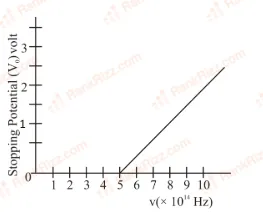
2.98 eV
2.07 eV
1.36 eV
18.6 eV
Proton (P) and electron (e) will have same de-Broglie wavelength when the ratio of their momentum is (assume, )
1 : 1
1 : 1849
1 : 43
43 : 1
In photoelectric effect
A. The photocurrent is proportional to the intensity of the incident radiation.
B. Maximum kinetic energy with which photoelectrons are emitted depends on the intensity of incident light.
C. Max K.E. with which photoelectrons are emitted depends on the frequency of incident light.
D. The emission of photoelectrons require a minimum threshold intensity of incident radiation.
E. Max K.E. of the photoelectrons is independent of the frequency of the incident light.
Choose the correct option from the options given below:
A and B only
A and E only
A and C only
B and C only
The kinetic energy of an electron, -particle and a proton are given as 4K, 2K and K respectively. The de-Broglie wavelength associated with electron , -particle and the proton are as follows:
The work functions of Aluminium and Gold are 4.1 eV and 5.1 eV respectively. The ratio of the slope of the stopping potential versus frequency plot for Gold to that of Aluminium is
1.24
2
1
1.5
A proton moving with one tenth of velocity of light has a certain de Broglie wavelength of . An alpha particle having certain kinetic energy has the same de-Broglie wavelength . The ratio of kinetic energy of proton and that of alpha particle is:
2 : 1
4 : 1
1 : 2
1 : 4
The threshold frequency of metal is . When the light of frequency is incident on the metal plate, the maximum velocity of photoelectron is . When the frequency of incident radiation is increased to , the maximum velocity of photoelectrons emitted is . The ratio of to is:
Given below are two statements: One is labelled as Assertion A and the other is labelled as Reason R
Assertion A: The beam of electrons shows wave nature and exhibit interference and diffraction.
Reason R: Davisson Germer Experimentally verified the wave nature of electrons.
In the light of the above statements. Choose the most appropriate answer from the options given below:
A is correct but R is not correct
A is not correct but R is correct
Both A and R are correct but R is Not the correct explanation of A
Both A and R are correct and R is the correct explanation of A
If a source of electromagnetic radiation having power 15 kW produces photons per second, the radiation belongs to a part of spectrum is:
(Take Planck constant J s)
Micro waves
Ultraviolet rays
Gamma rays
Radio waves
If the two metals and are exposed to radiation of wavelength 350 nm. The work functions of metals and are 4.8 eV and 2.2 eV. Then choose the correct option
Metal B will not emit photo-electrons
Both metals A and B will emit photo-electrons
Both metals A and B will not emit photoelectrons
Metal A will not emit photo-electrons
A small object at rest, absorbs a light pulse of power mW and duration ns. Assuming speed of light as m s. The momentum of the object becomes equal to:
kg m s
kg m s
kg m s
kg m s
An electron accelerated through a potential difference has a de-Broglie wavelength of . When the potential is changed to , its de-Broglie wavelength increases by . The value of is equal to:
JEE Advanced has set 25 Dual Nature of Radiation & Matter questions too. Dual Nature of Radiation & Matter JEE Advanced PYQs →
OTHER PHYSICS CHAPTERS