RankRizz

Thermal Properties of Matter — JEE Main Previous Year Questions

Every Thermal Properties of Matter question JEE Main has set from 2004–2026, grouped by the idea it tests rather than the order of the syllabus. 116 questions across 6 distinct ideas. Free to read, answer key on every one.

DATA UPDATED

Questions

116

Distinct ideas

6

Share of marks

1.6%

Difficulty

MEDIUM

The ideas inside Thermal Properties of Matter

A chapter is not one subject — it is a handful of procedures the examiner reuses. These are the ones Thermal Properties of Matter questions actually test.

Every Thermal Properties of Matter question

81–100 OF 116 · NEWEST FIRST

JEE MAIN 2019 · 11 JAN S2Temperature scales and thermal expansion

A thermometer graduated according to a linear scale reads a value x0x_0 when in contact with boiling water, and x0/3x_0/3 when in contact with ice. What is the temperature of an object in °C, if this thermometer in the contact with the object reads x0/2x_0/2?

  1. A

    25

  2. B

    60

  3. C

    40

  4. D

    35

JEE MAIN 2019 · 11 JAN S2Calorimetry and specific heat capacity

When 100 g of a liquid A at 100°C100°C is added to 50 g of a liquid B at temperature 75°C75°C, the temperature of the mixture becomes 90°C90°C. The temperature of the mixture, if 100 g of liquid A at 100°C100°C is added to 50 g of liquid B at 50°C50°C, will be:

  1. A

    85°C85°C

  2. B

    60°C60°C

  3. C

    80°C80°C

  4. D

    70°C70°C

JEE MAIN 2019 · 11 JAN S2Calorimetry and specific heat capacity

A metal ball of mass 0.1 kg is heated upto 500°C500°C and dropped into a vessel of heat capacity 800 JK−1800 \text{ JK}^{-1} and containing 0.5 kg water. The initial temperature of water and vessel is 30°C30°C. What is the approximate percentage increment in the temperature of the water? [Specific Heat Capacities of water and metal are, respectively, 4200 Jkg−1K−14200 \text{ Jkg}^{-1} \text{K}^{-1} and 400 Jkg−1K−1400 \text{ Jkg}^{-1} \text{K}^{-1}]

  1. A

    15%

  2. B

    30%

  3. C

    25%

  4. D

    20%

JEE MAIN 2019 · 10 JAN S1Heat conduction and thermal resistance

A heat source at T=103T = 10^3 K is connected to another heat reservoir at T=102T = 10^2 K by a copper slab which is 1 m thick. Given that the thermal conductivity of copper is 0.1 W K−1^{-1} m−1^{-1}, the energy flux through it in the steady-state is:

  1. A

    65 W m−2^{-2}

  2. B

    120 W m−2^{-2}

  3. C

    90 W m−2^{-2}

  4. D

    200 W m−2^{-2}

JEE MAIN 2019 · 10 JAN S2Calorimetry and specific heat capacity

An unknown metal of mass 192 g heated to a temperature of 100∘^{\circ}C was immersed into a brass calorimeter of mass 128 g containing 240 g of water at a temperature of 8.4∘^{\circ}C. Calculate the specific heat of the unknown metal if water temperature stabilizes at 21.5∘^{\circ}C. (Specific heat of brass is 394 J kg−1^{-1}K−1^{-1})

  1. A

    916 J kg−1^{-1} K−1^{-1}

  2. B

    458 J kg−1^{-1} K−1^{-1}

  3. C

    654 J kg−1^{-1} K−1^{-1}

  4. D

    1232 J kg−1^{-1} K−1^{-1}

JEE MAIN 2019 · 09 JAN S1Heat conduction and thermal resistance

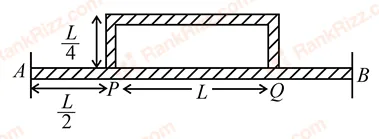
Temperature difference of 120∘^{\circ}C is maintained between two ends of a uniform rod ABAB of length 2L2L. Another bent rod PQPQ, of same cross-section as ABAB and length 3L2\frac{3L}{2}, is connected across ABAB (See figure). In steady state, temperature difference between PP and QQ will be close to:

Figure for JEE Main 2019 Physics question on Heat conduction and thermal resistance
  1. A

    45∘^{\circ}C

  2. B

    35∘^{\circ}C

  3. C

    60∘^{\circ}C

  4. D

    75∘^{\circ}C

JEE MAIN 2018 · 15 APR S2Newton's law of cooling

A body takes 10 minutes to cool from 60∘^\circC to 50∘^\circC. The temperature of surroundings is constant at 25∘^\circC. Then, the temperature of the body after next 10 minutes will be approximately

  1. A

    43∘^\circC

  2. B

    47∘^\circC

  3. C

    41∘^\circC

  4. D

    45∘^\circC

JEE MAIN 2018 · 08 APR OFFLINECalorimetry and specific heat capacity

The mass of a hydrogen molecule is 3.32×10−273.32 \times 10^{-27} kg. If 102310^{23} hydrogen molecules strike, per second, a fixed wall of the area 2 cm2^2 at an angle of 45∘^\circ to the normal, and rebound elastically with a speed of 10310^3 m s−1^{-1}, then the pressure on the wall is nearly:

  1. A

    4.70×1024.70 \times 10^2 N m−2^{-2}

  2. B

    2.35×1032.35 \times 10^3 N m−2^{-2}

  3. C

    4.70×1034.70 \times 10^3 N m−2^{-2}

  4. D

    2.35×1022.35 \times 10^2 N m−2^{-2}

JEE MAIN 2018 · 08 APR OFFLINECalorimetry and specific heat capacity

Two moles of an ideal monoatomic gas occupies a volume V at 27∘^\circC. The gas expands adiabatically to a volume 2V. Calculate (a) the final temperature of the gas and (b) change in its internal energy.

  1. A

    (a) 195 K (b) 2.7 kJ

  2. B

    (a) 189 K (b) 2.7 kJ

  3. C

    (a) 195 K (b) -2.7 kJ

  4. D

    (a) 189 K (b) -2.7 kJ

JEE MAIN 2017 · 08 APR ONLINECalorimetry and specific heat capacity

In an experiment, a sphere of aluminium of mass 0.20 kg is heated up to 150°C. Immediately, it is put into water of volume 150 cc at 27°C kept in a calorimeter of water equivalent to 0.025 kg. The final temperature of the system is 40°C. The specific heat of the aluminium is (take 4.2 Joule = 1 calorie):

  1. A

    434 J kg−1^{-1} °C−1^{-1}

  2. B

    378 J kg−1^{-1} °C−1^{-1}

  3. C

    315 J kg−1^{-1} °C−1^{-1}

  4. D

    476 J kg−1^{-1} °C−1^{-1}

JEE MAIN 2017 · 02 APR OFFLINECalorimetry and specific heat capacity

A copper ball of mass 100 g is at a temperature TT. It is dropped in a copper calorimeter of mass 100 g, filled with 170 g of water at room temperature. Subsequently, the temperature of the system is found to be 75°C. TT is given by:
(Given: room temperature = 30°C, specific heat of copper = 0.1 cal g−1^{-1} °C−1^{-1})

  1. A

    825°C

  2. B

    800°C

  3. C

    885°C

  4. D

    1250°C

JEE MAIN 2016 · 09 APR ONLINETemperature scales and thermal expansion

A simple pendulum made of a bob of mass m and a metallic wire of a negligible mass has a time period of 2 s at T=0°CT = 0°C. If the temperature of the wire is increased, and the corresponding change in its time period is plotted against its temperature, the resulting graph is a line of slope SS. If the coefficient of linear expansion of metal is α\alpha, then the value of SS is

  1. A

    α2\frac{\alpha}{2}

  2. B

    2α2\alpha

  3. C

    α\alpha

  4. D

    1α\frac{1}{\alpha}

JEE MAIN 2016 · 09 APR ONLINECalorimetry and specific heat capacity

200 g water is heated from 40°C to 60°C. Ignoring the slight expansion of water, the change in its internal energy is close to (Given specific heat of water = 4184 J kg−1^{-1} K−1^{-1}):

  1. A

    167.4 kJ

  2. B

    8.4 kJ

  3. C

    4.2 kJ

  4. D

    16.7 kJ

JEE MAIN 2016 · 03 APR OFFLINETemperature scales and thermal expansion

A pendulum clock loses 12 s a day if the temperature is 40°C and gains 4 s a day if the temperature is 20°C. The temperature at which the clock will show correct time, and the co-efficient of linear expansion (α\alpha) of the metal of the pendulum shaft are respectively:

  1. A

    30°C; α=1.85×10⁻³\alpha = 1.85 \times 10^{-3} /°C

  2. B

    55°C; α=1.85×10⁻²\alpha = 1.85 \times 10^{-2} /°C

  3. C

    25°C; α=1.85×10⁻⁵\alpha = 1.85 \times 10^{-5} /°C

  4. D

    60°C; α=1.85×10⁻⁴\alpha = 1.85 \times 10^{-4} /°C

JEE MAIN 2015 · 11 APR ONLINEChange of state and latent heat

An experiment takes 10 min to raise the temperature of water in a container from 0∘^\circC to 100∘^\circC and another 55 min to convert it totally into steam by a heater supplying heat at a uniform rate. Neglecting the specific heat of the container and taking specific heat of the water to be 1 cal (g∘^\circC)−1^{-1}, the heat of vaporization according to this experiment will come out to be:

  1. A

    530 cal g−1^{-1}

  2. B

    550 cal g−1^{-1}

  3. C

    540 cal g−1^{-1}

  4. D

    560 cal g−1^{-1}

JEE MAIN 2014 · 19 APR ONLINEThermal radiation: Stefan's law, Wien's law and Kirchhoff's law

A black coloured solid sphere of radius R and mass M is inside a cavity with vacuum inside. The walls of the cavity are maintained at temperature T0T_0. The initial temperature of the sphere is 3T03T_0. If the specific heat of the material of the sphere varies as αT3\alpha T^3 per unit mass with the temperature T of the sphere, where α\alpha is a constant, then the time taken for the sphere to cool down to temperature 2T02T_0 will be (σ\sigma is Stefan Boltzmann constant)

  1. A

    Mα16πR2σln⁡(32)\frac{M\alpha}{16\pi R^2\sigma}\ln\left(\frac{3}{2}\right)

  2. B

    Mα16πR2σln⁡(163)\frac{M\alpha}{16\pi R^2\sigma}\ln\left(\frac{16}{3}\right)

  3. C

    Mα4πR2σln⁡(32)\frac{M\alpha}{4\pi R^2\sigma}\ln\left(\frac{3}{2}\right)

  4. D

    Mα4πR2σln⁡(163)\frac{M\alpha}{4\pi R^2\sigma}\ln\left(\frac{16}{3}\right)

JEE MAIN 2014 · 12 APR ONLINENewton's law of cooling

Hot water cools from 60°C to 50°C in the first 10 minutes and to 42°C in the next 10 minutes. The temperature of the surroundings is:

  1. A

    25°C

  2. B

    10°C

  3. C

    15°C

  4. D

    20°C

JEE MAIN 2014 · 11 APR ONLINENewton's law of cooling

A hot body, obeying Newton's law of cooling is cooling down from its peak value 80°C to an ambient temperature of 30°C. It takes 5 minutes in cooling down from 80°C to 40°C. How much time will it take to cool down from 62°C to 32°C? (Given ln 2 = 0.693, ln 5 = 1.609)

  1. A

    3.75 minutes

  2. B

    8.6 minutes

  3. C

    9.6 minutes

  4. D

    6.5 minutes

JEE MAIN 2014 · 09 APR ONLINECalorimetry and specific heat capacity

Water of volume 2 L in a closed container is heated with a coil of 1 kW. While water is heated, the container loses energy at a rate of 160 J/s. In how much time will the temperature of water rise from 27°C to 77°C? (Specific heat of water is 4.2 kJ/kg and that of the container is negligible).

  1. A

    8 min 20 s

  2. B

    7 min

  3. C

    14 min

  4. D

    6 min 2 s

JEE MAIN 2014 · 06 APR OFFLINEHeat conduction and thermal resistance

Three rods of Copper, Brass and Steel are welded together to form a Y-shaped structure. Area of cross-section of each rod is 4 cm2^2. End of copper rod is maintained at 100 °C. Where as ends of brass and steel are kept at 0 °C. Lengths of the copper, brass and steel rods are 46, 13 and 12 cms respectively. The rods are thermally insulated from surroundings except at ends. Thermal conductivities of copper, brass and steel are 0.92, 0.26 and 0.12 CGS units respectively. Rate of heat flow through copper rod is:

  1. A

    1.2 Cal/s

  2. B

    2.4 Cal/s

  3. C

    4.8 Cal/s

  4. D

    6.0 Cal/s