RankRizz

Thermal Properties of Matter — JEE Main Previous Year Questions

Every Thermal Properties of Matter question JEE Main has set from 2004–2026, grouped by the idea it tests rather than the order of the syllabus. 116 questions across 6 distinct ideas. Free to read, answer key on every one.

DATA UPDATED

Questions

116

Distinct ideas

6

Share of marks

1.6%

Difficulty

MEDIUM

The ideas inside Thermal Properties of Matter

A chapter is not one subject — it is a handful of procedures the examiner reuses. These are the ones Thermal Properties of Matter questions actually test.

Every Thermal Properties of Matter question

41–60 OF 116 · NEWEST FIRST

JEE MAIN 2022 · 29 JUN S1Heat conduction and thermal resistance

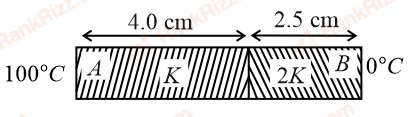
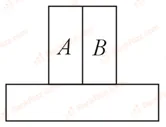
As per the given figure, two plates AA and BB of thermal conductivity KK and 2K2K are joined together to form a compound plate. The thickness of plates are 4.0 cm and 2.5 cm respectively and the area of cross-section is 120 cm2^2 for each plate. The equivalent thermal conductivity of the compound plate is (1+5α)K\left(1 + \frac{5}{\alpha}\right)K, then the value of α\alpha will be ______.
Figure for JEE Main 2022 Physics question on Heat conduction and thermal resistance

JEE MAIN 2022 · 29 JUN S2Temperature scales and thermal expansion

At what temperature a gold ring of diameter 6.230 cm be heated so that it can be fitted on a wooden bangle of diameter 6.241 cm? Both the diameters have been measured at room temperature (27°C).
(Given: coefficient of linear thermal expansion of gold αL=1.4×10⁻⁵\alpha_L = 1.4 \times 10^{-5} K−1^{-1})

  1. A

    125.7°C

  2. B

    91.7°C

  3. C

    425.7°C

  4. D

    152.7°C

JEE MAIN 2022 · 27 JUN S2Change of state and latent heat

A lead bullet penetrates into a solid object and melts. Assuming that 40%40\% of its kinetic energy is used to heat it, the initial speed of bullet is
(Given, initial temperature of the bullet =127°= 127°C, Melting point of the bullet =327°= 327°C, Latent heat of fusion of lead =2.5×104= 2.5 \times 10^4 J kg−1^{-1}, Specific heat capacity of lead =125= 125 J kg−1^{-1} K−1^{-1})

  1. A

    125125 m s−1^{-1}

  2. B

    500500 m s−1^{-1}

  3. C

    250250 m s−1^{-1}

  4. D

    600600 m s−1^{-1}

JEE MAIN 2022 · 26 JUN S2Calorimetry and specific heat capacity

A geyser heats water flowing at a rate of 2.02.0 kg per minute from 30°30°C to 70°70°C. If geyser operates on a gas burner, the rate of combustion of fuel will be ______ g min−1^{-1}.
[Heat of combustion =8×103= 8 \times 10^3 J g−1^{-1}, Specific heat of water =4.2= 4.2 J g−1^{-1} °C−1^{-1}]

JEE MAIN 2022 · 25 JUN S1Change of state and latent heat

A steam engine intakes 5050 g of steam at 100°100°C per minute and cools it down to 20°20°C. If latent heat of vaporization of steam is 540540 cal g−1^{-1}, then the heat rejected by the steam engine per minute is ______ ×103\times 10^3 cal
(Given : specific heat capacity of water : 11 cal g−1^{-1} °C−1^{-1})

JEE MAIN 2022 · 25 JUN S2Temperature scales and thermal expansion

A solid metallic cube having total surface area 2424 m2^2 is uniformly heated. If its temperature is increased by 10°10°C, calculate the increase in volume of the cube. (Given α=5.0×10⁻⁴\alpha = 5.0 \times 10^{-4} °C−1^{-1}).

  1. A

    2.4×1062.4 \times 10^6 cm3^3

  2. B

    1.2×1051.2 \times 10^5 cm3^3

  3. C

    6×1046 \times 10^4 cm3^3

  4. D

    4.8×1054.8 \times 10^5 cm3^3

JEE MAIN 2022 · 25 JUN S2Change of state and latent heat

A copper block of mass 5.05.0 kg is heated to a temperature of 500°500°C and is placed on a large ice block. What is the maximum amount of ice that can melt?
[Specific heat of copper : 0.390.39 J g−1^{-1} °C−1^{-1} and latent heat of fusion of water : 335335 J g−1^{-1}]

  1. A

    1.5 kg

  2. B

    5.8 kg

  3. C

    2.9 kg

  4. D

    3.8 kg

JEE MAIN 2022 · 24 JUN S1Heat conduction and thermal resistance

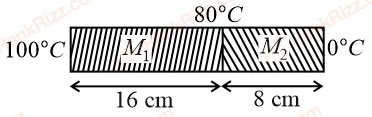
Two metallic blocks M1M_1 and M2M_2 of same area of cross-section are connected to each other (as shown in figure). If the thermal conductivity of M2M_2 is KK then the thermal conductivity of M1M_1 will be : [Assume steady state heat conduction]

Figure for JEE Main 2022 Physics question on Heat conduction and thermal resistance
  1. A

    10K10K

  2. B

    8K8K

  3. C

    12.5K12.5K

  4. D

    2K2K

JEE MAIN 2022 · 24 JUN S2Calorimetry and specific heat capacity

A 100100 g of iron nail is hit by a 1.51.5 kg hammer striking at a velocity of 6060 ms−1^{-1}. What will be the rise in the temperature of the nail if one fourth of energy of the hammer goes into heating the nail? [Specific heat capacity of iron =0.42= 0.42 J g−1^{-1} °C−1^{-1}]

  1. A

    16.07°16.07°C

  2. B

    6.75°6.75°C

  3. C

    1600°1600°C

  4. D

    675°675°C

JEE MAIN 2022 · 24 JUN S2Newton's law of cooling

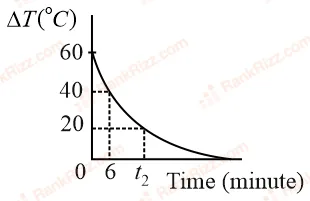
In an experiment to verify Newton's law of cooling, a graph is plotted between the temperature difference (ΔT)(\Delta T) of the water and surroundings and time as shown in figure. The initial temperature of water is taken as 80°80°C. The value of t2t_2 as mentioned in the graph will be ______

Figure for JEE Main 2022 Physics question on Newton's law of cooling
JEE MAIN 2021 · 31 AUG S2Heat conduction and thermal resistance

Two thin metallic spherical shells of radii r1r_1 and r2r_2 (r1<r2r_1 < r_2) are placed with their centres coinciding. A material of thermal conductivity KK is filled in the space between the shells. The inner shell is maintained at temperature θ1\theta_1 and the outer shell at temperature θ2\theta_2 (θ1<θ2\theta_1 < \theta_2). The rate at which heat flows radially through the material is:

  1. A

    Kθ2−θ1r2−r1\frac{K\theta_2 - \theta_1}{r_2 - r_1}

  2. B

    K(θ2−θ1)r2r14πr1r2\frac{K(\theta_2 - \theta_1)r_2 r_1}{4\pi r_1 r_2}

  3. C

    πKr1r2(θ2−θ1)r2−r1\frac{\pi K r_1 r_2(\theta_2 - \theta_1)}{r_2 - r_1}

  4. D

    4πKr1r2(θ2−θ1)r2−r1\frac{4\pi K r_1 r_2(\theta_2 - \theta_1)}{r_2 - r_1}

JEE MAIN 2021 · 27 AUG S1Heat conduction and thermal resistance

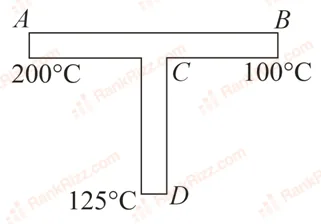
A rod CDCD of thermal resistance 10.010.0 KW−1^{-1} is joined at the middle of an identical rod ABAB as shown in figure. The ends AA, BB and DD are maintained at 200°C, 100°C and 125°C respectively. The heat current in CDCD is _________ P W. The value of PP is _________.

Figure for JEE Main 2021 Physics question on Heat conduction and thermal resistance
JEE MAIN 2021 · 27 AUG S2Calorimetry and specific heat capacity

The height of victoria's falls is 63 m. What is the difference in the temperature of water at the top and at the bottom of the fall? [Given 1 cal = 4.2 J and specific heat of water = 1 cal g−1^{-1} °C−1^{-1}]

  1. A

    14.76 °C

  2. B

    1.476 °C

  3. C

    0.147 °C

  4. D

    0.014 °C

JEE MAIN 2021 · 26 AUG S2Calorimetry and specific heat capacity

The temperature of equal masses of three different liquids xx, yy and zz are 10°C, 20°C and 30°C respectively. The temperature of mixture when xx is mixed with yy is 16°C and that when yy is mixed with zz is 26°C. The temperature of mixture when xx and zz are mixed will be:

  1. A

    25.62°C

  2. B

    20.28°C

  3. C

    28.32°C

  4. D

    23.84°C

JEE MAIN 2021 · 27 JUL S1Newton's law of cooling

A body takes 4 min to cool from 61°C to 59°C. If the temperature of the surroundings is 30°C, the time taken by the body to cool from 51°C to 49°C is:

  1. A

    4 min.

  2. B

    3 min.

  3. C

    8 min.

  4. D

    6 min.

JEE MAIN 2021 · 25 JUL S1Calorimetry and specific heat capacity

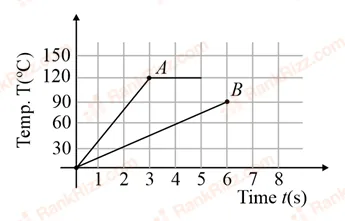
Two different metal bodies A and B of equal mass are heated at a uniform rate under similar conditions. The variation of temperature of the bodies is graphically represented as shown in the figure. The ratio of specific heat capacities is:

Figure for JEE Main 2021 Physics question on Calorimetry and specific heat capacity
  1. A

    83\frac{8}{3}

  2. B

    38\frac{3}{8}

  3. C

    34\frac{3}{4}

  4. D

    43\frac{4}{3}

JEE MAIN 2021 · 22 JUL S1Newton's law of cooling

In 5 minutes, a body cools from 75 ∘^\circC to 65 ∘^\circC at room temperature of 25 ∘^\circC. The temperature of body at the end of next 5 minutes is ___ ∘^\circC.

JEE MAIN 2021 · 17 MAR S1Heat conduction and thermal resistance

Two identical metal wires of thermal conductivities K1K_1 and K2K_2 respectively are connected in series. The effective thermal conductivity of the combination is:

  1. A

    2K1K2K1+K2\frac{2K_1 K_2}{K_1 + K_2}

  2. B

    K1+K22K1K2\frac{K_1 + K_2}{2K_1 K_2}

  3. C

    K1+K2K1K2\frac{K_1 + K_2}{K_1 K_2}

  4. D

    K1K2K1+K2\frac{K_1 K_2}{K_1 + K_2}

JEE MAIN 2021 · 16 MAR S2Temperature scales and thermal expansion

A bimetallic strip consists of metals AA and BB. It is mounted rigidly as shown. The metal AA has higher coefficient of expansion compared to that of metal BB. When the bimetallic strip is placed in a cold bath, it will:

Figure for JEE Main 2021 Physics question on Temperature scales and thermal expansion
  1. A

    Bend towards the right

  2. B

    Not bend but shrink

  3. C

    Neither bend nor shrink

  4. D

    Bend towards the left

JEE MAIN 2021 · 24 FEB S1Temperature scales and thermal expansion

Each side of a box made of metal sheet in cubic shape is aa at room temperature TT, the coefficient of linear expansion of the metal sheet is α\alpha. The metal sheet is heated uniformly, by a small temperature ΔT\Delta T, so that its new temperature is T+ΔTT + \Delta T. Calculate the increase in the volume of the metal box.

  1. A

    4a3αΔT4a^3 \alpha \Delta T

  2. B

    3a3αΔT3a^3 \alpha \Delta T

  3. C

    4πa3αΔT4\pi a^3 \alpha \Delta T

  4. D

    43πa3αΔT\frac{4}{3}\pi a^3 \alpha \Delta T