Thermal Properties of Matter JEE Main PYQs with answer key
PHYSICS · 116 PAST QUESTIONS · 6 TOPICS · 2004–2026
HOW TO USE THIS SHEET
Every JEE Main Thermal Properties of Matter question we hold, grouped by topic, most-asked topic first and newest first inside each. The answer key is at the end (116 of 116 questions have a checked key); the worked solution is on each question’s page, printed beside it.
Temperature scales and thermal expansion 26
The temperature of a metal strip having coefficient of linear expansion is increased from to resulting in increase of its length by . The temperature is further increased from to such that the increase in its length is . Given and , the value of is ______.
- (A)
- (B)
- (C)
- (D)
rr2.rankrizz.com/jee-main/physics/thermal-properties-of-matter/q/4-apr-2026-s2-q34
- (A)
An aluminium and steel rods having same lengths and cross-sections are joined to make total length of 120 cm at 30°C. The coefficient of linear expansion of aluminium and steel are , respectively. The length of this composite rod when its temperature is raised to C, is ___ cm.
- (A)
120.06
- (B)
120.20
- (C)
120.15
- (D)
120.03
rr2.rankrizz.com/jee-main/physics/thermal-properties-of-matter/q/21-jan-2026-s1-physics-q10
- (A)
Consider a rectangular sheet of solid material of length cm and width cm. The coefficient of linear expansion is K at room temperature and one atmospheric pressure. The mass of sheet kg and the specific heat capacity J kgK. If the amount of heat supplied to the material is J then change in area of the rectangular sheet is :
- (A)
m
- (B)
m
- (C)
m
- (D)
m
rr2.rankrizz.com/jee-main/physics/thermal-properties-of-matter/q/2025-apr-4-s2-q28
- (A)
Which of the following figure represents the relation between Celsius and Fahrenheit temperatures?
- (A)
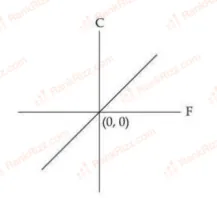
- (B)
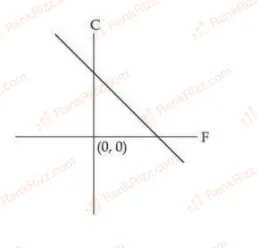
- (C)
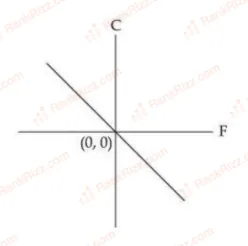
- (D)
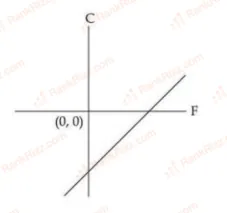
rr2.rankrizz.com/jee-main/physics/thermal-properties-of-matter/q/24-jan-2025-s2-q26
- (A)
The resistances of the platinum wire of a platinum resistance thermometer at the ice point and steam point are 8Ω and 10Ω respectively. After inserting in a hot bath of temperature 400°C, the resistance of platinum wire is:
- (A)
- (B)
- (C)
- (D)
rr2.rankrizz.com/jee-main/physics/thermal-properties-of-matter/q/04-apr-2024-s1-q9
- (A)
On Celsius scale the temperature of body increases by 40°C. The increase in temperature on Fahrenheit scale is:
- (A)
- (B)
- (C)
- (D)
rr2.rankrizz.com/jee-main/physics/thermal-properties-of-matter/q/04-apr-2024-s1-q10
- (A)
On a temperature scale 'X', the boiling point of water is 65X and the freezing point is X. Assuming that the X scale is linear. The equivalent temperature corresponding to X on the Fahrenheit scale would be
- (A)
F
- (B)
F
- (C)
F
- (D)
F
rr2.rankrizz.com/jee-main/physics/thermal-properties-of-matter/q/11-apr-2023-s1-q7
- (A)
A faulty thermometer reads C in melting ice and C in steam. The correct temperature on absolute scale will be ______ K when the faulty thermometer reads C.
Answer: ____________
rr2.rankrizz.com/jee-main/physics/thermal-properties-of-matter/q/30-jan-2023-s2-q23
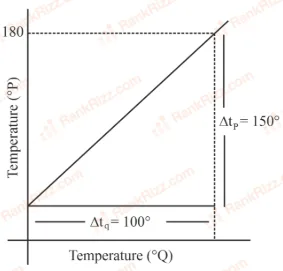
The graph between two temperature scales P and Q is shown in the figure. Between upper fixed point and lower fixed point there are 150 equal divisions of scale P and 100 divisions on scale Q. The relationship for conversion between the two scales is given by:
- (A)
- (B)
- (C)
- (D)
rr2.rankrizz.com/jee-main/physics/thermal-properties-of-matter/q/25-jan-2023-s2-q8
- (A)
A hole is drilled in a metal sheet. At 27 °C, the diameter of hole is 5 cm. When the sheet is heated to 177 °C, the change in the diameter of hole is cm. The value of will be _____, if coefficient of linear expansion of the metal is
Answer: ____________
rr2.rankrizz.com/jee-main/physics/thermal-properties-of-matter/q/24-jan-2023-s1-q24
A hole is drilled in a metal sheet. At 27 °C, the diameter of hole is 5 cm. When the sheet is heated to 177 °C, the change in the diameter of hole is cm. The value of will be _____, if coefficient of linear expansion of the metal is / °C
Answer: ____________
rr2.rankrizz.com/jee-main/physics/thermal-properties-of-matter/q/24-jan-2023-s1-q24-494039
A unit scale is to be prepared whose length does not change with temperature and remains , using a bimetallic strip made of brass and iron each of different length. The length of both components would change in such a way that difference between their lengths remains constant. If length of brass is and length of iron will be ______ cm.
and .Answer: ____________
rr2.rankrizz.com/jee-main/physics/thermal-properties-of-matter/q/25-jul-2022-s1-q24
At what temperature a gold ring of diameter 6.230 cm be heated so that it can be fitted on a wooden bangle of diameter 6.241 cm? Both the diameters have been measured at room temperature (27°C).
(Given: coefficient of linear thermal expansion of gold K)- (A)
125.7°C
- (B)
91.7°C
- (C)
425.7°C
- (D)
152.7°C
rr2.rankrizz.com/jee-main/physics/thermal-properties-of-matter/q/29-jun-2022-s2-q7
- (A)
A solid metallic cube having total surface area m is uniformly heated. If its temperature is increased by C, calculate the increase in volume of the cube. (Given °C).
- (A)
cm
- (B)
cm
- (C)
cm
- (D)
cm
rr2.rankrizz.com/jee-main/physics/thermal-properties-of-matter/q/25-jun-2022-s2-q5
- (A)
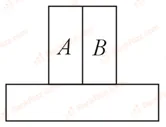
A bimetallic strip consists of metals and . It is mounted rigidly as shown. The metal has higher coefficient of expansion compared to that of metal . When the bimetallic strip is placed in a cold bath, it will:
- (A)
Bend towards the right
- (B)
Not bend but shrink
- (C)
Neither bend nor shrink
- (D)
Bend towards the left
rr2.rankrizz.com/jee-main/physics/thermal-properties-of-matter/q/16-mar-2021-s2-q6
- (A)
Each side of a box made of metal sheet in cubic shape is at room temperature , the coefficient of linear expansion of the metal sheet is . The metal sheet is heated uniformly, by a small temperature , so that its new temperature is . Calculate the increase in the volume of the metal box.
- (A)
- (B)
- (C)
- (D)
rr2.rankrizz.com/jee-main/physics/thermal-properties-of-matter/q/24-feb-2021-s1-q8
- (A)
Two different wires having lengths and and respective temperature coefficient of linear expansion and , are joined end-to-end. Then the effective temperature coefficient of linear expansion is:
- (A)
- (B)
- (C)
- (D)
rr2.rankrizz.com/jee-main/physics/thermal-properties-of-matter/q/5-sep-2020-s2-q6
- (A)
A bakelite beaker has volume capacity of 500 cc at 30°C. When it is partially filled with volume (at 30°C) of mercury, it is found that the unfilled volume of the beaker remains constant as temperature is varied. If °C, where is the coefficient of volume expansion, then (in cc) is close to...
Answer: ____________
rr2.rankrizz.com/jee-main/physics/thermal-properties-of-matter/q/3-sep-2020-s1-q24
When the temperature of a metal wire is increased from 0C to 10C, its length increases by 0.02%. The percentage change in its mass density will be closed to:
- (A)
0.06
- (B)
2.3
- (C)
0.008
- (D)
0.8
rr2.rankrizz.com/jee-main/physics/thermal-properties-of-matter/q/2-sep-2020-s2-q5
- (A)
A non-isotropic solid metal cube has coefficients of linear expansion as: /C along the x-axis and /C along the y and the z-axis. If the coefficient of volume expansion of the solid is /C then the value of C is
Answer: ____________
rr2.rankrizz.com/jee-main/physics/thermal-properties-of-matter/q/7-jan-2020-s1-q22
Two rods A and B of identical dimensions are at temperature . If A is heated upto and B upto , then the new lengths are the same. If the ratio of the coefficients of linear expansion of A and B is 4 : 3, then the value of T is
- (A)
- (B)
- (C)
- (D)
rr2.rankrizz.com/jee-main/physics/thermal-properties-of-matter/q/11-jan-2019-s2-q8
- (A)
A thermometer graduated according to a linear scale reads a value when in contact with boiling water, and when in contact with ice. What is the temperature of an object in °C, if this thermometer in the contact with the object reads ?
- (A)
25
- (B)
60
- (C)
40
- (D)
35
rr2.rankrizz.com/jee-main/physics/thermal-properties-of-matter/q/11-jan-2019-s2-q9
- (A)
A simple pendulum made of a bob of mass m and a metallic wire of a negligible mass has a time period of 2 s at . If the temperature of the wire is increased, and the corresponding change in its time period is plotted against its temperature, the resulting graph is a line of slope . If the coefficient of linear expansion of metal is , then the value of is
- (A)
- (B)
- (C)
- (D)
rr2.rankrizz.com/jee-main/physics/thermal-properties-of-matter/q/9-apr-2016-online-q9
- (A)
A pendulum clock loses 12 s a day if the temperature is 40°C and gains 4 s a day if the temperature is 20°C. The temperature at which the clock will show correct time, and the co-efficient of linear expansion () of the metal of the pendulum shaft are respectively:
- (A)
30°C; /°C
- (B)
55°C; /°C
- (C)
25°C; /°C
- (D)
60°C; /°C
rr2.rankrizz.com/jee-main/physics/thermal-properties-of-matter/q/3-apr-2016-offline-q7
- (A)
The ratio of the coefficient of volume expansion of a glass container to that of a viscous liquid kept inside the container is 1 : 4. What fraction of the inner volume of the container should the liquid occupy so that the volume of the remaining vacant space will be same at all temperatures?
- (A)
2 : 5
- (B)
1 : 4
- (C)
1 : 64
- (D)
1 : 8
rr2.rankrizz.com/jee-main/physics/thermal-properties-of-matter/q/23-apr-2013-online-q10
- (A)
On a linear temperature scale Y, water freezes at Y and boils at Y. On this Y scale, a temperature of 340 K would be read as : (water freezes at 273 K and boils at 373 K)
- (A)
Y
- (B)
Y
- (C)
Y
- (D)
Y
rr2.rankrizz.com/jee-main/physics/thermal-properties-of-matter/q/9-apr-2013-online-q8
- (A)
Calorimetry and specific heat capacity 23
A gas based geyser heats water flowing at the rate of 5.0 litres per minute from 27°C to 87°C. The rate of consumption of the gas is ___ g/s. (take heat of combustion of ) specific heat capacity of water =4200 J/ kg.°C
- (A)
0.42
- (B)
0.21
- (C)
2.1
- (D)
4.2
rr2.rankrizz.com/jee-main/physics/thermal-properties-of-matter/q/21-jan-2026-s1-physics-q2
- (A)
Water falls from a height of 200 m into a pool. Calculate the rise in temperature of the water assuming no heat dissipation from the water in the pool. (Take m/s, specific heat of water = 4200 J/(kg K))
- (A)
0.23 K
- (B)
0.36 K
- (C)
0.14 K
- (D)
0.48 K
rr2.rankrizz.com/jee-main/physics/thermal-properties-of-matter/q/2025-apr-8-s2-q30
- (A)
Match List-I with List-II.
List-I
(A) Heat capacity of body
(B) Specific heat capacity of body
(C) Latent heat
(D) Thermal conductivity
List-II
(I) J kg
(II) J K
(III) J kg K
(IV) J m K s
Choose the correct answer from the options given below :- (A)
(A)-(III), (B)-(I), (C)-(II), (D)-(IV)
- (B)
(A)-(IV), (B)-(III), (C)-(II), (D)-(I)
- (C)
(A)-(III), (B)-(IV), (C)-(I), (D)-(II)
- (D)
(A)-(II), (B)-(III), (C)-(I), (D)-(IV)
rr2.rankrizz.com/jee-main/physics/thermal-properties-of-matter/q/2025-apr-02-s2-q44
- (A)
A water heater of power 2000 W is used to heat water. The specific heat capacity of water is 4200 J kg K. The efficiency of heater is 70%. Time required to heat 2 kg of water from 10°C to 60°C is ______ s. (Assume that the specific heat capacity of water remains constant over the temperature range of the water).
Answer: ____________
rr2.rankrizz.com/jee-main/physics/thermal-properties-of-matter/q/31-jan-2023-s2-q24
A geyser heats water flowing at a rate of kg per minute from C to C. If geyser operates on a gas burner, the rate of combustion of fuel will be ______ g min.
[Heat of combustion J g, Specific heat of water J g °C]Answer: ____________
rr2.rankrizz.com/jee-main/physics/thermal-properties-of-matter/q/26-jun-2022-s2-q24
A g of iron nail is hit by a kg hammer striking at a velocity of ms. What will be the rise in the temperature of the nail if one fourth of energy of the hammer goes into heating the nail? [Specific heat capacity of iron J g °C]
- (A)
C
- (B)
C
- (C)
C
- (D)
C
rr2.rankrizz.com/jee-main/physics/thermal-properties-of-matter/q/24-jun-2022-s2-q7
- (A)
The height of victoria's falls is 63 m. What is the difference in the temperature of water at the top and at the bottom of the fall? [Given 1 cal = 4.2 J and specific heat of water = 1 cal g °C]
- (A)
14.76 °C
- (B)
1.476 °C
- (C)
0.147 °C
- (D)
0.014 °C
rr2.rankrizz.com/jee-main/physics/thermal-properties-of-matter/q/27-aug-2021-s2-q6
- (A)
The temperature of equal masses of three different liquids , and are 10°C, 20°C and 30°C respectively. The temperature of mixture when is mixed with is 16°C and that when is mixed with is 26°C. The temperature of mixture when and are mixed will be:
- (A)
25.62°C
- (B)
20.28°C
- (C)
28.32°C
- (D)
23.84°C
rr2.rankrizz.com/jee-main/physics/thermal-properties-of-matter/q/26-aug-2021-s2-q8
- (A)
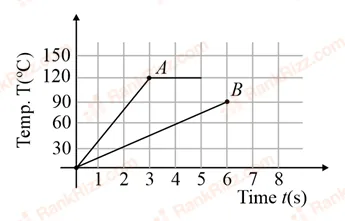
Two different metal bodies A and B of equal mass are heated at a uniform rate under similar conditions. The variation of temperature of the bodies is graphically represented as shown in the figure. The ratio of specific heat capacities is:
- (A)
- (B)
- (C)
- (D)
rr2.rankrizz.com/jee-main/physics/thermal-properties-of-matter/q/25-jul-2021-s1-q7
- (A)
A bullet of mass , travelling with a speed of , strikes a fixed wooden target. One half of its kinetic energy is converted into heat in the wood. The rise of temperature of the bullet if the specific heat of its material is () close to:
- (A)
- (B)
- (C)
- (D)
rr2.rankrizz.com/jee-main/physics/thermal-properties-of-matter/q/5-sep-2020-s1-q9
- (A)
Three containers , and have water at different temperatures. The table below shows the final temperature T when different amounts of water (given in liters) are taken from each container and mixed (assume no loss of heat during the process)
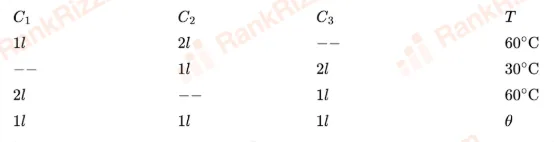
The value of (in C to the nearest integer) is__________
Answer: ____________
rr2.rankrizz.com/jee-main/physics/thermal-properties-of-matter/q/8-jan-2020-s2-q23
A massless spring (k = 800 N/m), attached with a mass (500 g) is completely immersed in 1 kg of water. The spring is stretched by 2 cm and released so that it starts vibrating. What would be the order of magnitude of the change in the temperature of water when the vibrations stop completely? (Assume that the water container and spring receive negligible heat and specific heat of mass = 400 J/kg K, water = 4184 J/kg K)
- (A)
K
- (B)
K
- (C)
K
- (D)
K
rr2.rankrizz.com/jee-main/physics/thermal-properties-of-matter/q/9-apr-2019-s2-q12
- (A)
When 100 g of a liquid A at is added to 50 g of a liquid B at temperature , the temperature of the mixture becomes . The temperature of the mixture, if 100 g of liquid A at is added to 50 g of liquid B at , will be:
- (A)
- (B)
- (C)
- (D)
rr2.rankrizz.com/jee-main/physics/thermal-properties-of-matter/q/11-jan-2019-s2-q11
- (A)
A metal ball of mass 0.1 kg is heated upto and dropped into a vessel of heat capacity and containing 0.5 kg water. The initial temperature of water and vessel is . What is the approximate percentage increment in the temperature of the water? [Specific Heat Capacities of water and metal are, respectively, and ]
- (A)
15%
- (B)
30%
- (C)
25%
- (D)
20%
rr2.rankrizz.com/jee-main/physics/thermal-properties-of-matter/q/11-jan-2019-s2-q12
- (A)
An unknown metal of mass 192 g heated to a temperature of 100C was immersed into a brass calorimeter of mass 128 g containing 240 g of water at a temperature of 8.4C. Calculate the specific heat of the unknown metal if water temperature stabilizes at 21.5C. (Specific heat of brass is 394 J kgK)
- (A)
916 J kg K
- (B)
458 J kg K
- (C)
654 J kg K
- (D)
1232 J kg K
rr2.rankrizz.com/jee-main/physics/thermal-properties-of-matter/q/10-jan-2019-s2-q10
- (A)
The mass of a hydrogen molecule is kg. If hydrogen molecules strike, per second, a fixed wall of the area 2 cm at an angle of 45 to the normal, and rebound elastically with a speed of m s, then the pressure on the wall is nearly:
- (A)
N m
- (B)
N m
- (C)
N m
- (D)
N m
rr2.rankrizz.com/jee-main/physics/thermal-properties-of-matter/q/8-apr-2018-offline-q7
- (A)
Two moles of an ideal monoatomic gas occupies a volume V at 27C. The gas expands adiabatically to a volume 2V. Calculate (a) the final temperature of the gas and (b) change in its internal energy.
- (A)
(a) 195 K (b) 2.7 kJ
- (B)
(a) 189 K (b) 2.7 kJ
- (C)
(a) 195 K (b) -2.7 kJ
- (D)
(a) 189 K (b) -2.7 kJ
rr2.rankrizz.com/jee-main/physics/thermal-properties-of-matter/q/8-apr-2018-offline-q12
- (A)
In an experiment, a sphere of aluminium of mass 0.20 kg is heated up to 150°C. Immediately, it is put into water of volume 150 cc at 27°C kept in a calorimeter of water equivalent to 0.025 kg. The final temperature of the system is 40°C. The specific heat of the aluminium is (take 4.2 Joule = 1 calorie):
- (A)
434 J kg °C
- (B)
378 J kg °C
- (C)
315 J kg °C
- (D)
476 J kg °C
rr2.rankrizz.com/jee-main/physics/thermal-properties-of-matter/q/8-apr-2017-online-q9
- (A)
A copper ball of mass 100 g is at a temperature . It is dropped in a copper calorimeter of mass 100 g, filled with 170 g of water at room temperature. Subsequently, the temperature of the system is found to be 75°C. is given by:
(Given: room temperature = 30°C, specific heat of copper = 0.1 cal g °C)- (A)
825°C
- (B)
800°C
- (C)
885°C
- (D)
1250°C
rr2.rankrizz.com/jee-main/physics/thermal-properties-of-matter/q/2-apr-2017-offline-q9
- (A)
200 g water is heated from 40°C to 60°C. Ignoring the slight expansion of water, the change in its internal energy is close to (Given specific heat of water = 4184 J kg K):
- (A)
167.4 kJ
- (B)
8.4 kJ
- (C)
4.2 kJ
- (D)
16.7 kJ
rr2.rankrizz.com/jee-main/physics/thermal-properties-of-matter/q/9-apr-2016-online-q11
- (A)
Water of volume 2 L in a closed container is heated with a coil of 1 kW. While water is heated, the container loses energy at a rate of 160 J/s. In how much time will the temperature of water rise from 27°C to 77°C? (Specific heat of water is 4.2 kJ/kg and that of the container is negligible).
- (A)
8 min 20 s
- (B)
7 min
- (C)
14 min
- (D)
6 min 2 s
rr2.rankrizz.com/jee-main/physics/thermal-properties-of-matter/q/9-apr-2014-online-q9
- (A)
of water is heated from to . Ignoring the slight expansion of the water, the change in its internal energy is (specific heat of water is ):
- (A)
- (B)
- (C)
- (D)
rr2.rankrizz.com/jee-main/physics/thermal-properties-of-matter/q/2011-physics-499478
- (A)
Time taken by a W heater to heat one litre of water from C to C is
- (A)
s
- (B)
s
- (C)
s
- (D)
s
rr2.rankrizz.com/jee-main/physics/thermal-properties-of-matter/q/2004-physics-500195
- (A)
Heat conduction and thermal resistance 23
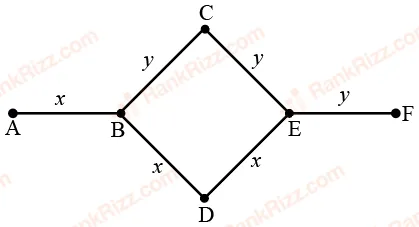
Rods and of equal dimensions but of different materials are joined as shown in figure. Temperatures of end points and are maintained at and respectively. Given the thermal conductivity of rod is three times of that of rod , the temperature at junction points and are (close to):
- (A)
and respectively
- (B)
and respectively
- (C)
and respectively
- (D)
and respectively
rr2.rankrizz.com/jee-main/physics/thermal-properties-of-matter/q/22-jan-2026-s1-q39
- (A)
Two cylindrical rods A and B made of different materials, are joined in a straight line. The ratio of lengths, radii and thermal conductivities are: , and . The free ends of rods A and B are maintained at 400 K, 200 K respectively. The temperature of rods interface is _____ K,when equilibrium is established.
Answer: ____________
rr2.rankrizz.com/jee-main/physics/thermal-properties-of-matter/q/2025-apr-7-s2-q47
The difference of temperature in a material can convert heat energy into electrical energy. To harvest the heat energy, the material should have
- (A)
high thermal conductivity and high electrical conductivity
- (B)
low thermal conductivity and low electrical conductivity
- (C)
high thermal conductivity and low electrical conductivity
- (D)
low thermal conductivity and high electrical conductivity
rr2.rankrizz.com/jee-main/physics/thermal-properties-of-matter/q/29-jan-2025-s2-q31
- (A)
Three conductors of same length having thermal conductivity are connected as shown in figure.
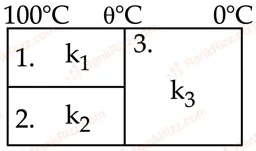
Area of cross sections of conductor are same and for conductor it is double of the conductor. The temperatures are given in the figure. In steady state condition, the value of 0 is _______ .
Answer: ____________
rr2.rankrizz.com/jee-main/physics/thermal-properties-of-matter/q/22-jan-2025-s1-q49
Two plates A and B have thermal conductivities W m K and W m K respectively. They have same surface area and same thickness. They are placed in contact along their surfaces. If the temperatures of the outer surfaces of A and B are kept at C and C respectively, then the temperature of the surface of contact in steady state is _____ °C.
Answer: ____________
rr2.rankrizz.com/jee-main/physics/thermal-properties-of-matter/q/13-apr-2023-s2-q23
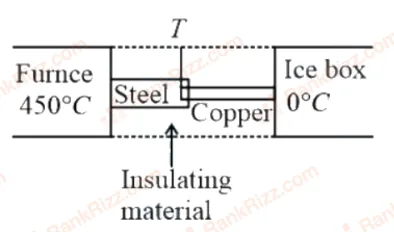
If and are the thermal conductivities, and are the lengths and and are the cross sectional areas of steel and copper rods respectively such that , , . Then, for the arrangement as shown in the figure, the value of temperature of the steel-copper junction in the steady state will be
- (A)
- (B)
- (C)
- (D)
rr2.rankrizz.com/jee-main/physics/thermal-properties-of-matter/q/27-jul-2022-s1-q7
- (A)
An ice cube of dimensions is placed in an insulation box of wall thickness . The box keeping the ice cube at of temperature is brought to a room of temperature . The rate of melting of ice is approximately: (Latent heat of fusion of ice is and thermal conductivity of insulation wall is )
- (A)
- (B)
- (C)
- (D)
rr2.rankrizz.com/jee-main/physics/thermal-properties-of-matter/q/26-jul-2022-s2-q7
- (A)
As per the given figure, two plates and of thermal conductivity and are joined together to form a compound plate. The thickness of plates are 4.0 cm and 2.5 cm respectively and the area of cross-section is 120 cm for each plate. The equivalent thermal conductivity of the compound plate is , then the value of will be ______.
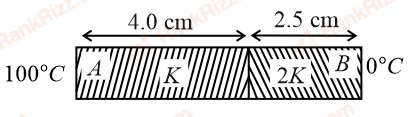
Answer: ____________
rr2.rankrizz.com/jee-main/physics/thermal-properties-of-matter/q/29-jun-2022-s1-q21
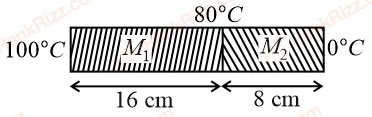
Two metallic blocks and of same area of cross-section are connected to each other (as shown in figure). If the thermal conductivity of is then the thermal conductivity of will be : [Assume steady state heat conduction]
- (A)
- (B)
- (C)
- (D)
rr2.rankrizz.com/jee-main/physics/thermal-properties-of-matter/q/24-jun-2022-s1-q8
- (A)
Two thin metallic spherical shells of radii and () are placed with their centres coinciding. A material of thermal conductivity is filled in the space between the shells. The inner shell is maintained at temperature and the outer shell at temperature (). The rate at which heat flows radially through the material is:
- (A)
- (B)
- (C)
- (D)
rr2.rankrizz.com/jee-main/physics/thermal-properties-of-matter/q/31-aug-2021-s2-q8
- (A)
A rod of thermal resistance KW is joined at the middle of an identical rod as shown in figure. The ends , and are maintained at 200°C, 100°C and 125°C respectively. The heat current in is _________ P W. The value of is _________.
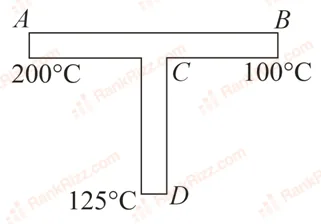
Answer: ____________
rr2.rankrizz.com/jee-main/physics/thermal-properties-of-matter/q/27-aug-2021-s1-q24
Two identical metal wires of thermal conductivities and respectively are connected in series. The effective thermal conductivity of the combination is:
- (A)
- (B)
- (C)
- (D)
rr2.rankrizz.com/jee-main/physics/thermal-properties-of-matter/q/17-mar-2021-s1-q7
- (A)
Three rods of identical cross-section and length are made of three different materials of thermal conductivity , and , respectively. They are joined together at their ends to make a long rod (see figure). One end of the long rod is maintained at and the other at (see figure). If the joints of the rod are at and in steady state and there is no loss of energy from the surface of the rod, the correct relationship between , and is:
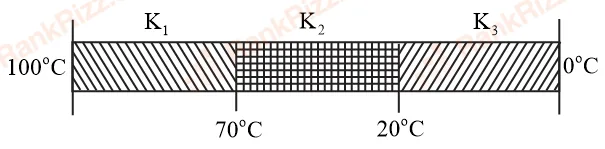
- (A)
;
- (B)
- (C)
;
- (D)
rr2.rankrizz.com/jee-main/physics/thermal-properties-of-matter/q/6-sep-2020-s2-q7
- (A)
Two materials having coefficients of thermal conductivity 3K and K and thickness d and 3d respectively, are joined to form a slab as shown in the figure. The temperatures of the outer surfaces are and respectively, . The temperature at the interface is:
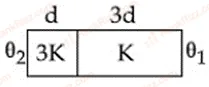
- (A)
- (B)
- (C)
- (D)
rr2.rankrizz.com/jee-main/physics/thermal-properties-of-matter/q/9-apr-2019-s2-q10
- (A)
A cylinder of radius R is surrounded by a cylindrical shell of inner radius R and outer radius 2R. The thermal conductivity of the material of the inner cylinder is and that of the outer cylinder is . Assuming no loss of heat, the effective thermal conductivity of the system for heat flowing along the length of the cylinder is:
- (A)
- (B)
- (C)
- (D)
rr2.rankrizz.com/jee-main/physics/thermal-properties-of-matter/q/12-jan-2019-s1-q8
- (A)
A heat source at K is connected to another heat reservoir at K by a copper slab which is 1 m thick. Given that the thermal conductivity of copper is 0.1 W K m, the energy flux through it in the steady-state is:
- (A)
65 W m
- (B)
120 W m
- (C)
90 W m
- (D)
200 W m
rr2.rankrizz.com/jee-main/physics/thermal-properties-of-matter/q/10-jan-2019-s1-q10
- (A)
Temperature difference of 120C is maintained between two ends of a uniform rod of length . Another bent rod , of same cross-section as and length , is connected across (See figure). In steady state, temperature difference between and will be close to:
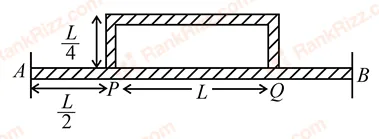
- (A)
45C
- (B)
35C
- (C)
60C
- (D)
75C
rr2.rankrizz.com/jee-main/physics/thermal-properties-of-matter/q/9-jan-2019-s1-q11
- (A)
Three rods of Copper, Brass and Steel are welded together to form a Y-shaped structure. Area of cross-section of each rod is 4 cm. End of copper rod is maintained at 100 °C. Where as ends of brass and steel are kept at 0 °C. Lengths of the copper, brass and steel rods are 46, 13 and 12 cms respectively. The rods are thermally insulated from surroundings except at ends. Thermal conductivities of copper, brass and steel are 0.92, 0.26 and 0.12 CGS units respectively. Rate of heat flow through copper rod is:
- (A)
1.2 Cal/s
- (B)
2.4 Cal/s
- (C)
4.8 Cal/s
- (D)
6.0 Cal/s
rr2.rankrizz.com/jee-main/physics/thermal-properties-of-matter/q/6-apr-2014-offline-q12
- (A)
A large cylindrical rod of length is made by joining two identical rods of copper and steel of length each. The rods are completely insulated from the surroundings. If the free end of copper rod is maintained at and that of steel at then the temperature of junction is (Thermal conductivity of copper is times that of steel)
- (A)
- (B)
- (C)
- (D)
rr2.rankrizz.com/jee-main/physics/thermal-properties-of-matter/q/2012-physics-499270
- (A)
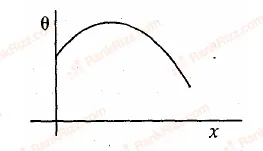
A long metallic bar is carrying heat from one of its ends to the other end under steady-state. The variation of temperature along the length of the bar from its hot end is best described by which of the following figure.
- (A)
- (B)
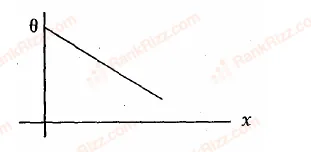
- (C)
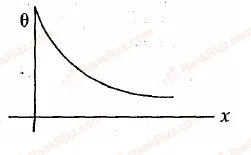
- (D)
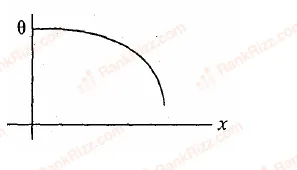
rr2.rankrizz.com/jee-main/physics/thermal-properties-of-matter/q/2009-physics-499564
- (A)
One end of a thermally insulated rod is kept at a temperature and the other at . The rod is composed of two sections of lengths and and thermal conductivities and respectively. The temperature at the interface of the two sections is
- (A)
- (B)
- (C)
- (D)
rr2.rankrizz.com/jee-main/physics/thermal-properties-of-matter/q/2007-physics-499750
- (A)
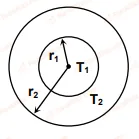
The figure shows a system of two concentric spheres of radii and and kept at temperatures and respectively. The radial rate of flow of heat in a substance between the two concentric sphere is proportional to
- (A)
- (B)
- (C)
- (D)
rr2.rankrizz.com/jee-main/physics/thermal-properties-of-matter/q/2005-physics-500154
- (A)
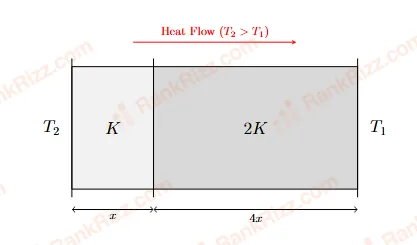
The temperature of two outer surfaces of a composite slab, consisting of two materials having coefficients of thermal conductivity and and thickness and , respectively are and . The rate of heat transfer through the slab, in a steady state is , with equal to
- (A)
- (B)
- (C)
- (D)
rr2.rankrizz.com/jee-main/physics/thermal-properties-of-matter/q/2004-physics-500191
- (A)
Change of state and latent heat 20
The heat extracted out of x gram of water initialy at C to cool it down to C is sufficient to evaporate gram of water also initialy at C. The value of (closest integer) is_______. (Take Latent heat of water kJ/kg K, specific heat capacity of water J/kg·K)
Answer: ____________
rr2.rankrizz.com/jee-main/physics/thermal-properties-of-matter/q/5-apr-2026-s2-q47
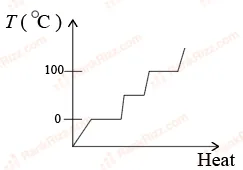
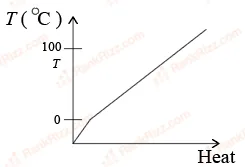
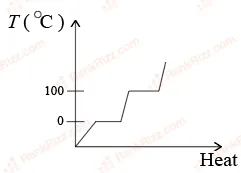
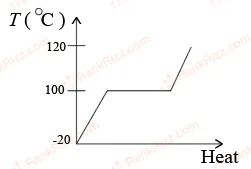
Which of the following best represents the temperature versus heat supplied graph for water, in the range of - 20 °C to 120 °C ?
- (A)
- (B)
- (C)
- (D)
rr2.rankrizz.com/jee-main/physics/thermal-properties-of-matter/q/28-jan-2026-s1-q31
- (A)
10 kg of ice at -10°C is added to 100 kg of water to lower its temperature from 25°C. Consider no heat exchange to surroundings. The decrement to the temperature of water is _____ °C.
(specific heat of ice= 2100 J/Kg.°C, specific heat of water= 4200 J/Kg.°C, latent heat of fusion of ice )- (A)
11.6
- (B)
10
- (C)
6.67
- (D)
15
rr2.rankrizz.com/jee-main/physics/thermal-properties-of-matter/q/28-jan-2026-s1-q35
- (A)
A gun fires a lead bullet of temperature 300 K into a wooden block. The bullet having melting temperature of 600 K penetrates into the block and melts down. If the total heat required for the process is 625 J , then the mass of the bullet is grams. (Latent heat of fusion of lead and specific heat capacity of lead
- (A)
10
- (B)
20
- (C)
5
- (D)
15
rr2.rankrizz.com/jee-main/physics/thermal-properties-of-matter/q/23-jan-2025-s1-q38
- (A)
An amount of ice of mass is transformed to vapour of temperature by applying heat. The total amount of work required for this conversion is, (Take, specific heat of ice specific heat of water specific heat of steam Latent heat of ice and Latent heat of steam
- (A)
3043 J
- (B)
3024 J
- (C)
3003 J
- (D)
3022 J
rr2.rankrizz.com/jee-main/physics/thermal-properties-of-matter/q/22-jan-2025-s1-q29
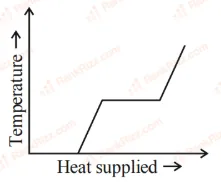
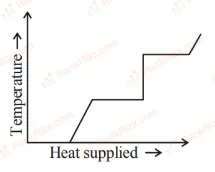
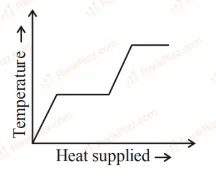
- (A)
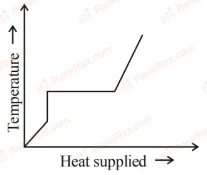
A block of ice at is slowly heated and converted to steam at . Which of the following curves represent the phenomenon qualitatively:
- (A)
- (B)
- (C)
- (D)
rr2.rankrizz.com/jee-main/physics/thermal-properties-of-matter/q/30-jan-2024-s2-q7
- (A)
Heat energy of kJ is given to ice of mass g at C, Specific heat of ice is J kg °C and latent heat of ice is kJ kg.
(A) Final temperature of system will be C
(B) Final temperature of the system will be greater than C
(C) The final system will have a mixture of ice and water in the ratio of
(D) The final system will have a mixture of ice and water in the ratio of
(E) The final system will have water only
Choose the correct answer from the options given below:- (A)
A and D only
- (B)
B and D only
- (C)
A and E only
- (D)
A and C only
rr2.rankrizz.com/jee-main/physics/thermal-properties-of-matter/q/29-jan-2023-s2-q8
- (A)
A block of ice of mass at temperature is put in of water at . The g of ice melts as the temperature of the water reaches . The value of is ______.
[Use: Specific heat capacity of water , Latent heat of ice ]Answer: ____________
rr2.rankrizz.com/jee-main/physics/thermal-properties-of-matter/q/25-jul-2022-s2-q23
A lead bullet penetrates into a solid object and melts. Assuming that of its kinetic energy is used to heat it, the initial speed of bullet is
(Given, initial temperature of the bullet C, Melting point of the bullet C, Latent heat of fusion of lead J kg, Specific heat capacity of lead J kg K)- (A)
m s
- (B)
m s
- (C)
m s
- (D)
m s
rr2.rankrizz.com/jee-main/physics/thermal-properties-of-matter/q/27-jun-2022-s2-q8
- (A)
A steam engine intakes g of steam at C per minute and cools it down to C. If latent heat of vaporization of steam is cal g, then the heat rejected by the steam engine per minute is ______ cal
(Given : specific heat capacity of water : cal g °C)Answer: ____________
rr2.rankrizz.com/jee-main/physics/thermal-properties-of-matter/q/25-jun-2022-s1-q25
A copper block of mass kg is heated to a temperature of C and is placed on a large ice block. What is the maximum amount of ice that can melt?
[Specific heat of copper : J g °C and latent heat of fusion of water : J g]- (A)
1.5 kg
- (B)
5.8 kg
- (C)
2.9 kg
- (D)
3.8 kg
rr2.rankrizz.com/jee-main/physics/thermal-properties-of-matter/q/25-jun-2022-s2-q6
- (A)
The specific heat of water = 4200 J kg K and the latent heat of ice = J kg. 100 grams of ice at 0°C is placed in 200 g of water at 25°C. The amount of ice that will melt as the temperature of water reaches 0°C is close to (in grams)
- (A)
61.7
- (B)
63.8
- (C)
69.3
- (D)
64.6
rr2.rankrizz.com/jee-main/physics/thermal-properties-of-matter/q/4-sep-2020-s1-q7
- (A)
A calorimeter of water equivalent 20 g contains 180 g of water at 25°C. 'm' grams of steam at 100°C is mixed in it till the temperature of the mixture is 31°C. The value of 'm' is close to (Latent heat of water = 540 cal g, specific heat of water = 1 cal g°C)
- (A)
2
- (B)
4
- (C)
3.2
- (D)
2.6
rr2.rankrizz.com/jee-main/physics/thermal-properties-of-matter/q/3-sep-2020-s2-q8
- (A)
M grams of steam at 100C is mixed with 200g of ice at its melting point in a thermally insulated container. If it produces liquid water at 40C [heat of vaporization of water is 540 cal/g and heat of fusion of ice is 80 cal/g], the value of M is
Answer: ____________
rr2.rankrizz.com/jee-main/physics/thermal-properties-of-matter/q/7-jan-2020-s2-q23
When M gram of ice at -10°C (specific heat = 0.5 cal g °C) is added to M gram of water at 50°C, finally no ice is left and the water is at 0°C. The value of latent heat of ice, in cal g is:
- (A)
- (B)
- (C)
- (D)
rr2.rankrizz.com/jee-main/physics/thermal-properties-of-matter/q/12-apr-2019-s1-q9
- (A)
1 kg of water, at 20°C is heated in an electric kettle whose heating element has a mean (temperature averaged) resistance of 20 Ω. The rms voltage in the mains is 200 V. Ignoring heat loss from the kettle, time taken for water to evaporate fully is close to
[Specific heat of water = 4200 J kg °C Latent heat of water = 2260 kJ kg]- (A)
3 min
- (B)
16 min
- (C)
22 min
- (D)
10 min
rr2.rankrizz.com/jee-main/physics/thermal-properties-of-matter/q/12-apr-2019-s2-q10
- (A)
A thermally insulated vessel contains 150 g of water at 0°C. Then the air from the vessel is pumped out adiabatically. A fraction of water turns into ice and the rest evaporates at 0°C itself. The mass of evaporated water will be closest to: (Latent heat of vaporization of water = J kg and Latent heat of Fusion of water = J kg)
- (A)
35 g
- (B)
20 g
- (C)
130 g
- (D)
150 g
rr2.rankrizz.com/jee-main/physics/thermal-properties-of-matter/q/8-apr-2019-s1-q11
- (A)
Ice at is added to 50 g of water at . When the temperature of the mixture reaches , it is found that 20 g of ice is still unmelted. The amount of ice added to the water was close to (Specific heat of water = 4.2 J/g/°C, Specific heat of Ice = 2.1 J/g/°C, Heat of fusion of water at = 334 J/g)
- (A)
50 g
- (B)
100 g
- (C)
60 g
- (D)
40 g
rr2.rankrizz.com/jee-main/physics/thermal-properties-of-matter/q/11-jan-2019-s1-q9
- (A)
An experiment takes 10 min to raise the temperature of water in a container from 0C to 100C and another 55 min to convert it totally into steam by a heater supplying heat at a uniform rate. Neglecting the specific heat of the container and taking specific heat of the water to be 1 cal (gC), the heat of vaporization according to this experiment will come out to be:
- (A)
530 cal g
- (B)
550 cal g
- (C)
540 cal g
- (D)
560 cal g
rr2.rankrizz.com/jee-main/physics/thermal-properties-of-matter/q/11-apr-2015-online-q10
- (A)
500 g of water and 100 g of ice at 0°C are in a calorimeter whose water equivalent is 40 g. 10 g of steam at 100°C is added to it. Then water in the calorimeter is : (Latent heat of ice = 80 cal/g, Latent heat of steam = 540 cal/g)
- (A)
580 g
- (B)
590 g
- (C)
600 g
- (D)
610 g
rr2.rankrizz.com/jee-main/physics/thermal-properties-of-matter/q/23-apr-2013-online-q11
- (A)
Newton's law of cooling 18
A cup of coffee cools from to in t minutes when the room temperature is . The time taken by the similar cup of coffee to cool from to at the same room temperature is :
- (A)
- (B)
- (C)
- (D)
rr2.rankrizz.com/jee-main/physics/thermal-properties-of-matter/q/29-jan-2025-s2-q40
- (A)
The temperature of a body in air falls from to in 4 minutes. The temperature of the air is . The temperature of the body in the next 4 minutes will be:
- (A)
- (B)
- (C)
- (D)
rr2.rankrizz.com/jee-main/physics/thermal-properties-of-matter/q/24-jan-2025-s2-q41
- (A)
A body cools from C to in minutes. The temperature for the surrounding is C. The time it takes to cool from C to C is
- (A)
s
- (B)
s
- (C)
s
- (D)
s
rr2.rankrizz.com/jee-main/physics/thermal-properties-of-matter/q/12-apr-2023-s1-q7
- (A)
A body cools in 7 minutes from 60°C to 40°C. The temperature of the surrounding is 10°C. The temperature of the body after the next 7 minutes will be
- (A)
30°C
- (B)
32°C
- (C)
34°C
- (D)
28°C
rr2.rankrizz.com/jee-main/physics/thermal-properties-of-matter/q/6-apr-2023-s2-q8
- (A)
A body cools from C to C in minutes. If, temperature of surroundings is C. Then, after the next 6 minutes, its temperature will be ______ °C.
Answer: ____________
rr2.rankrizz.com/jee-main/physics/thermal-properties-of-matter/q/29-jan-2023-s1-q23
A bowl filled with very hot soup cools from 98°C to 86°C in 2 minutes when the room temperature is 22°C. How long it will take to cool from 75°C to 69°C?
- (A)
2 minute
- (B)
1.4 minute
- (C)
0.5 minute
- (D)
1 minute
rr2.rankrizz.com/jee-main/physics/thermal-properties-of-matter/q/25-jan-2023-s1-q7
- (A)
Read the following statements:
A. When small temperature difference between a liquid and its surrounding is doubled the rate of loss of heat of the liquid becomes twice.
B. Two bodies P and Q having equal surface areas are maintained at temperature and . The thermal radiation emitted in a given time by P and Q are in the ratio .
C. A Carnot Engine working between and has an efficiency of .
D. When small temperature difference between a liquid and its surrounding is quadrupled, the rate of loss of heat of the liquid becomes twice.
Choose the correct answer from the options given below:- (A)
A, B, C only
- (B)
A, B only
- (C)
A, C only
- (D)
B, C, D only
rr2.rankrizz.com/jee-main/physics/thermal-properties-of-matter/q/27-jul-2022-s1-q8
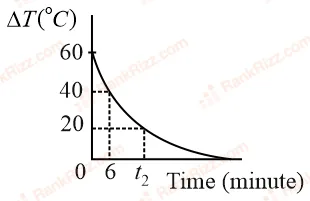
- (A)
In an experiment to verify Newton's law of cooling, a graph is plotted between the temperature difference of the water and surroundings and time as shown in figure. The initial temperature of water is taken as C. The value of as mentioned in the graph will be ______
Answer: ____________
rr2.rankrizz.com/jee-main/physics/thermal-properties-of-matter/q/24-jun-2022-s2-q22
A body takes 4 min to cool from 61°C to 59°C. If the temperature of the surroundings is 30°C, the time taken by the body to cool from 51°C to 49°C is:
- (A)
4 min.
- (B)
3 min.
- (C)
8 min.
- (D)
6 min.
rr2.rankrizz.com/jee-main/physics/thermal-properties-of-matter/q/27-jul-2021-s1-q7
- (A)
In 5 minutes, a body cools from 75 C to 65 C at room temperature of 25 C. The temperature of body at the end of next 5 minutes is ___ C.
Answer: ____________
rr2.rankrizz.com/jee-main/physics/thermal-properties-of-matter/q/22-jul-2021-s1-q26
A metallic sphere cools from 50°C to 40°C in 300 s. If atmospheric temperature around is 20°C, then the sphere's temperature after the next 5 minutes will be close to:
- (A)
31°C
- (B)
33°C
- (C)
28°C
- (D)
35°C
rr2.rankrizz.com/jee-main/physics/thermal-properties-of-matter/q/3-sep-2020-s2-q7
- (A)
Two identical beakers A and B contain equal volumes of two different liquids at 60°C each and left to cool down. Liquid in A has density of kg m and specific heat of 2000 J kgK while the liquid in B has density kg m and specific heat of 4000 J kgK. Which of the following best describes their temperature versus time graph schematically? (assume the emissivity of both the beakers to be the same)
- (A)
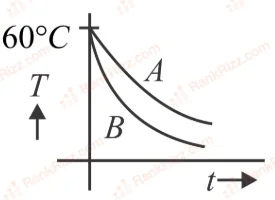
- (B)
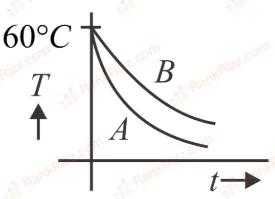
- (C)
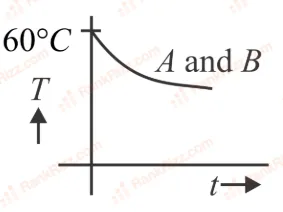
- (D)
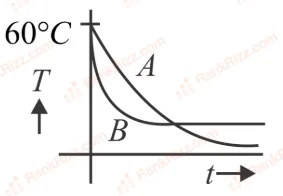
rr2.rankrizz.com/jee-main/physics/thermal-properties-of-matter/q/8-apr-2019-s1-q12
- (A)
A body takes 10 minutes to cool from 60C to 50C. The temperature of surroundings is constant at 25C. Then, the temperature of the body after next 10 minutes will be approximately
- (A)
43C
- (B)
47C
- (C)
41C
- (D)
45C
rr2.rankrizz.com/jee-main/physics/thermal-properties-of-matter/q/15-apr-2018-s2-q10
- (A)
Hot water cools from 60°C to 50°C in the first 10 minutes and to 42°C in the next 10 minutes. The temperature of the surroundings is:
- (A)
25°C
- (B)
10°C
- (C)
15°C
- (D)
20°C
rr2.rankrizz.com/jee-main/physics/thermal-properties-of-matter/q/12-apr-2014-online-q11
- (A)
A hot body, obeying Newton's law of cooling is cooling down from its peak value 80°C to an ambient temperature of 30°C. It takes 5 minutes in cooling down from 80°C to 40°C. How much time will it take to cool down from 62°C to 32°C? (Given ln 2 = 0.693, ln 5 = 1.609)
- (A)
3.75 minutes
- (B)
8.6 minutes
- (C)
9.6 minutes
- (D)
6.5 minutes
rr2.rankrizz.com/jee-main/physics/thermal-properties-of-matter/q/11-apr-2014-online-q11
- (A)
A mass of 50 g of water in a closed vessel, with surroundings at a constant temperature from 30°C to 25°C takes 2 minutes to cool. A mass of 100 g of another liquid in an identical vessel with identical surroundings takes the same time to cool from 30°C to 25°C. The specific heat of the liquid is : (The water equivalent of the vessel is 30 g.)
- (A)
2.0 kcal/kg
- (B)
7 kcal/kg
- (C)
3 kcal/kg
- (D)
0.5 kcal/kg
rr2.rankrizz.com/jee-main/physics/thermal-properties-of-matter/q/25-apr-2013-online-q7
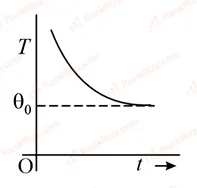
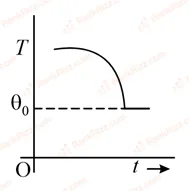
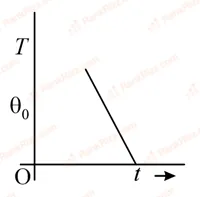
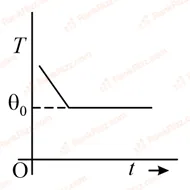
- (A)
If a piece of metal is heated to temperature and then allowed to cool in a room which is at temperature , the graph between the temperature T of the metal and time t will be closest to :
- (A)
- (B)
- (C)
- (D)
rr2.rankrizz.com/jee-main/physics/thermal-properties-of-matter/q/7-apr-2013-offline-q8
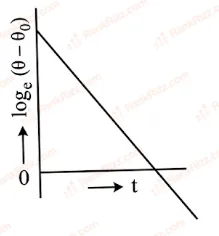
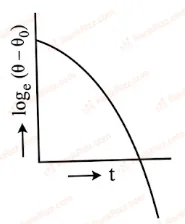
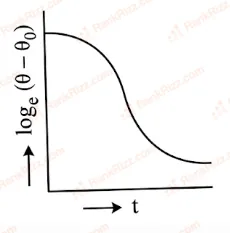
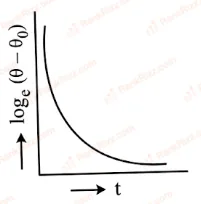
- (A)
A liquid in a beaker has temperature at time and is temperature of surroundings, then according to Newton's law of cooling the correct graph between and is
- (A)
- (B)
- (C)
- (D)
rr2.rankrizz.com/jee-main/physics/thermal-properties-of-matter/q/2012-physics-499027
- (A)
Thermal radiation: Stefan's law, Wien's law and Kirchhoff's law 6
A wire of length 10 cm and diameter 0.5 mm is used in a bulb. The temperature of the wire is 1727 degrees C and power radiated by the wire is 94.2 W. Its emissivity is where x = ______.
(Given W m K, and assume that the emissivity of wire material is same at all wavelength. )Answer: ____________
rr2.rankrizz.com/jee-main/physics/thermal-properties-of-matter/q/2025-apr-7-s1-q49
Two spherical bodies of same materials having radii 0.2 m and 0.8 m are placed in same atmosphere. The temperature of the smaller body is 800 K and temperature of the bigger body is 400 K . If the energy radiated from the smaller body is E, the energy radiated from the bigger body is (assume, effect of the surrounding temperature to be negligible),
- (A)
16 E
- (B)
E
- (C)
64 E
- (D)
256 E
rr2.rankrizz.com/jee-main/physics/thermal-properties-of-matter/q/22-jan-2025-s1-q41
- (A)
A black coloured solid sphere of radius R and mass M is inside a cavity with vacuum inside. The walls of the cavity are maintained at temperature . The initial temperature of the sphere is . If the specific heat of the material of the sphere varies as per unit mass with the temperature T of the sphere, where is a constant, then the time taken for the sphere to cool down to temperature will be ( is Stefan Boltzmann constant)
- (A)
- (B)
- (C)
- (D)
rr2.rankrizz.com/jee-main/physics/thermal-properties-of-matter/q/19-apr-2014-online-q11
- (A)
The heat radiated per unit area in 1 hour by a furnace whose temperature is 3000 K is ()
- (A)
J
- (B)
J
- (C)
J
- (D)
J
rr2.rankrizz.com/jee-main/physics/thermal-properties-of-matter/q/2012-physics-499119
- (A)
Assuming the sun to be a spherical body of radius at a temperature of , evaluate the total radiant power, incident on Earth, at a distance from the Sun.
- (A)
- (B)
- (C)
- (D)
rr2.rankrizz.com/jee-main/physics/thermal-properties-of-matter/q/2006-physics-499983
- (A)
If the temperature of the sun were to increase from to and its radius from to , then the ratio of the radiant energy received on earth to what it was previously will be
- (A)
- (B)
- (C)
- (D)
rr2.rankrizz.com/jee-main/physics/thermal-properties-of-matter/q/2004-physics-500189
- (A)
Answer key
- 01 D
- 02 C
- 03 A
- 04 D
- 05 C
- 06 C
- 07 C
- 08 313
- 09 B
- 10 12
- 11 12
- 12 60
- 13 D
- 14 B
- 15 D
- 16 B
- 17 A
- 18 20
- 19 A
- 20 60
- 21 A
- 22 A
- 23 C
- 24 C
- 25 B
- 26 C
- 27 A
- 28 D
- 29 D
- 30 300
- 31 42
- 32 A
- 33 C
- 34 D
- 35 B
- 36 A
- 37 50
- 38 A
- 39 C
- 40 D
- 41 A
- 42 B
- 43 D
- 44 A
- 45 C
- 46 D
- 47 A
- 48 A
- 49 C
- 50 C
- 51 360
- 52 D
- 53 40
- 54 40
- 55 C
- 56 B
- 57 21
- 58 B
- 59 D
- 60 2
- 61 A
- 62 A
- 63 D
- 64 D
- 65 C
- 66 A
- 67 C
- 68 A
- 69 B
- 70 C
- 71 C
- 72 D
- 73 922
- 74 C
- 75 B
- 76 A
- 77 A
- 78 D
- 79 A
- 80 90
- 81 B
- 82 31
- 83 C
- 84 A
- 85 A
- 86 40
- 87 D
- 88 C
- 89 B
- 90 D
- 91 B
- 92 B
- 93 D
- 94 D
- 95 C
- 96 D
- 97 28
- 98 B
- 99 A
- 100 16
- 101 D
- 102 57
- 103 B
- 104 B
- 105 A
- 106 B
- 107 B
- 108 D
- 109 A
- 110 A
- 111 5
- 112 B
- 113 B
- 114 A
- 115 C
- 116 D
Past questions are reproduced with their sitting. Not affiliated with NTA or the IITs. Every question, online and free: rr2.rankrizz.com/jee-main/physics/thermal-properties-of-matter