A galvanometer coil has 500 turns and each turn has an average area of m. If a torque of 1.5 Nm is required to keep this coil parallel to a magnetic field when a current of 0.5A is flowing through it, the strength of the field (in T) is __________.
Every Moving Charges & Magnetism question JEE Main has set from 2004–2026, grouped by the idea it tests rather than the order of the syllabus. 249 questions across 8 distinct ideas. Free to read, answer key on every one.
DATA UPDATED
Questions
249
Distinct ideas
8
Share of marks
3.8%
Difficulty
MEDIUM
A chapter is not one subject — it is a handful of procedures the examiner reuses. These are the ones Moving Charges & Magnetism questions actually test.
161–180 OF 249 · NEWEST FIRST
A galvanometer coil has 500 turns and each turn has an average area of m. If a torque of 1.5 Nm is required to keep this coil parallel to a magnetic field when a current of 0.5A is flowing through it, the strength of the field (in T) is __________.
A beam of protons with speed m s enters a uniform magnetic field of 0.3 T at an angle of 60 to the magnetic field, the pitch of the resulting helical path of protons is close to: (Mass of the proton kg, charge of the proton C)
2 cm
5 cm
12 cm
4 cm
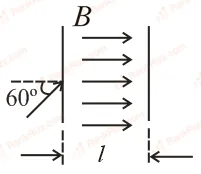
The figure shows a region of length 'l' with a uniform magnetic field of 0.3 T in it and a proton entering the region with velocity m s making an angle 60 with the field. If proton completes 10 revolution by the time it cross the region shown, 'l' is close to (mass of proton kg, charge of the proton C):

0.11 m
0.88 m
0.44 m
0.22 m
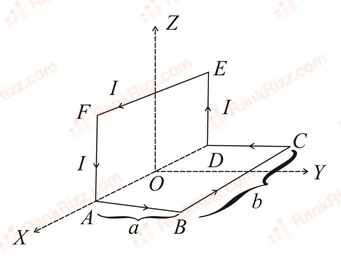
A wire carrying current I is bent in the shape ABCDEFA as shown, where rectangle ABCDA and ADEFA are perpendicular to each other. If the sides of the rectangles are of lengths a and b, then the magnitude and direction of magnetic moment of the loop ABCDEFA is:

along
along
along
along
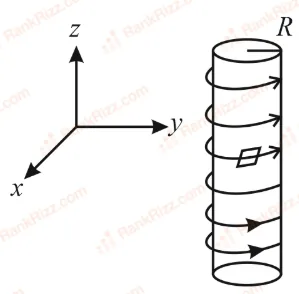
A long, straight wire of radius carries a current distributed uniformly over its cross-section. The ratio of the magnetic fields due to the wire at distance and , respectively from the axis of the wire is:
2
A charged particle of mass 'm' and charge 'q' moving under the influence of uniform electric field and a uniform magnetic field follows a trajectory from point P to Q as shown in figure. The velocities at P and Q are respectively, and . Then which of the following statements (A, B, C, D) are the correct? (Trajectory shown is schematic and not to scale)
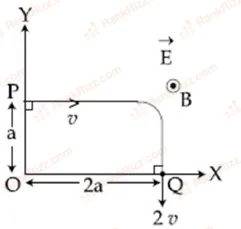
(A)
(B) Rate of work done by the electric field at P is
(C) Rate of work done by both the fields at Q is zero
(D) The difference between the magnitude of angular momentum of the particle at P and Q is .
A small circular loop of conducting wire has radius and carries current . It is placed in a uniform magnetic field perpendicular to its plane such that when rotated slightly about its diameter and released, it starts performing simple harmonic motion of time period . The mass of the loop is then:
An electron gun is placed inside a long solenoid of radius on its axis. The solenoid has turns/length and carries a current . The electron gun shoots an electron along the radius of the solenoid with speed . If the electron does not hit the surface of the solenoid, maximum possible value of is (all symbols have their standard meaning):

Proton with kinetic energy of 1 MeV moves from south to north. It gets an acceleration of m/s by an applied magnetic field (west to east). The value of magnetic field: (Rest mass of proton is kg)
0.71 mT
7.1 mT
0.071 mT
71 mT
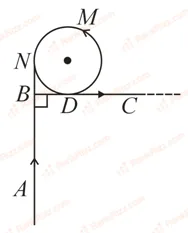
A very long wire ABDMNDC is shown in figure carrying current I. AB and BC parts are straight, long and at right angle. At D wire forms a circular turn DMND of radius R. AB, BC parts are tangential to circular turn at N and D. Magnetic field at the center of circle is:

A particle of mass and charge has an initial velocity . If an electric field and magnetic field act on the particle, its speed will double after a time
A thin ring of 10 cm radius carries a uniformly distributed charge. The ring rotates at a constant angular speed of rad s about its axis, perpendicular to its plane. If the magnetic field at its centre is T, then the charge carried by the ring is close to N/A.
C
C
C
C
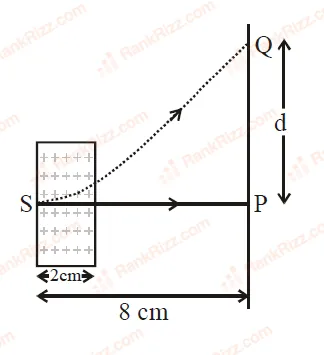
An electron, moving along the x-axis with an initial energy of 100 eV, enters a region of magnetic field T) at S (see figure). The field extends between x = 0 and x = 2 cm. The electron is detected at the point Q on a screen placed 8 cm away from the point S. The distance d between P and Q (on the screen) is:
(electron’s charge , mass of electron )

1.22 cm
12.87 cm
11.65 cm
2.25 cm
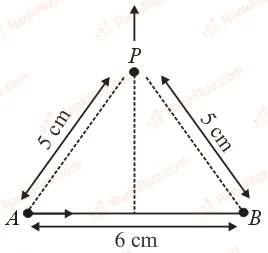
Find the magnetic field at point P due to a straight line segment AB of length 6 cm carrying a current of 5 A. (See figure) ( NA)

T
T
T
T
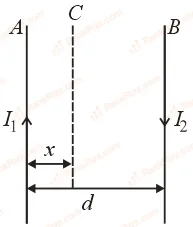
Two wires A & B are carrying currents I and I as shown in the figure. The separation between them is d. A third wire C carrying a current I is to be kept parallel to them at a distance x from A such that the net force acting on it is zero. The possible values of x are:

and
and
and
A proton, an electron, and a Helium nucleus, have the same energy. They are in circular orbits in a plane due to magnetic field perpendicular to the plane. Let , and be their respective radii, then,
A square loop is carrying a steady current I and the magnitude of its magnetic dipole moment is m. If this square loop is changed to a circular loop and it carries the same current, the magnitude of the magnetic dipole moment of circular loop will be:
The magnitude of the magnetic field at the centre of an equilateral triangular loop of side 1 m which is carrying a current of 10 A is:
[Take N A]
3 μT
1 μT
18 μT
9 μT
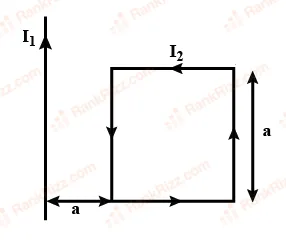
A rigid square loop of side 'a' and carrying current is lying on a horizontal surface near a long current carrying wire in the same plane as shown in figure. The net force on the loop due to the wire will be:

Attractive and equal to
Repulsive and equal to
Zero
A rectangular coil (Dimension 5 cm 2.5 cm) with 100 turns, carrying a current of 3 A in the clock-wise direction, is kept centered at the origin and in the X-Z plane. A magnetic field of 1 T is applied along X-axis. If the coil is tilted through 45° about Z-axis, then the torque on the coil is:
0.42 N m
0.55 N m
0.38 N m
0.27 N m
JEE Advanced has set 38 Moving Charges & Magnetism questions too. Moving Charges & Magnetism JEE Advanced PYQs →
OTHER PHYSICS CHAPTERS