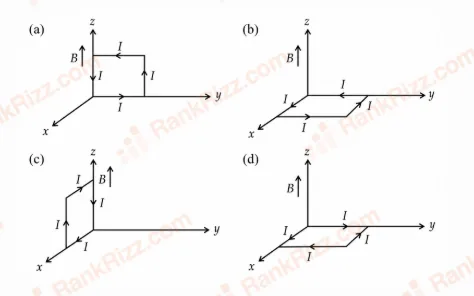
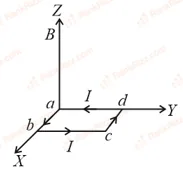
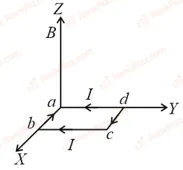
A uniform magnetic field of 0.3 T is along the positive Z-direction. A rectangular loop (abcd) of sides 10 cm 5 cm carries a current of 12 A. Out of the following different orientations which one corresponds to stable equilibrium?
- A
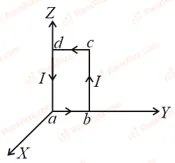
- B
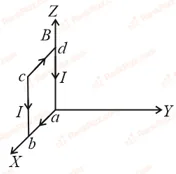
- C
- D
Every Moving Charges & Magnetism question JEE Main has set from 2004–2026, grouped by the idea it tests rather than the order of the syllabus. 249 questions across 8 distinct ideas. Free to read, answer key on every one.
DATA UPDATED
Questions
249
Distinct ideas
8
Share of marks
3.8%
Difficulty
MEDIUM
A chapter is not one subject — it is a handful of procedures the examiner reuses. These are the ones Moving Charges & Magnetism questions actually test.
201–220 OF 249 · NEWEST FIRST
A uniform magnetic field of 0.3 T is along the positive Z-direction. A rectangular loop (abcd) of sides 10 cm 5 cm carries a current of 12 A. Out of the following different orientations which one corresponds to stable equilibrium?


A magnetic dipole in a uniform magnetic field has: (Take zero potential energy when magnetic dipole is perpendicular to magnetic field)
Maximum potential energy when the torque is maximum
Zero potential energy when the torque is maximum
Zero potential energy when the torque is minimum
Minimum potential energy when the torque is maximum
In a certain region static electric and magnetic fields exist. The magnetic field is given by . If a test charge moving with a velocity experiences no force in that region, then the electric field in the region, in SI units, is:
A magnetic dipole is acted upon by two magnetic fields which are inclined to each other at an angle of 75°. One of the fields has a magnitude of 15 mT. The dipole attains stable equilibrium at an angle of 30° with this field. The magnitude of the other field (in mT) is close to
1
11
36
1060
Two identical wires A and B, each of length , carry the same current . Wire A is bent into a circle of radius R and wire B is bent to form a square of side . If and are the values of magnetic field at the centres of the circle and square respectively, then the ratio is
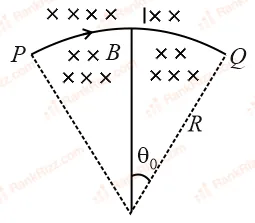
A wire carrying current is tied between points and and is in the shape of a circular arc of radius due to a uniform magnetic field (perpendicular to the plane of the paper, as shown in the figure) in the vicinity of the wire. If the wire subtends an angle at the center of the circle (of which it forms an arch) then the tension in the wire is:

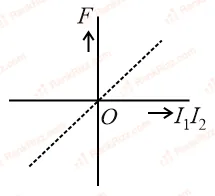
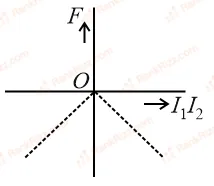
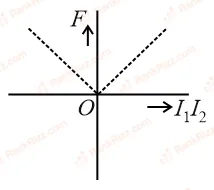
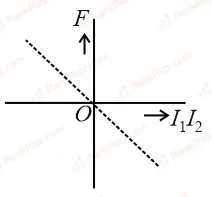
Two long straight parallel wires, carrying (adjustable) currents and , are kept at a distance apart. If the force between the two wires is taken as 'positive' when the wires repel each other and 'negative' when the wires attract each other, the graph showing the dependence of , on the product , would be:


A 25 cm long solenoid has the radius 2 cm and 500 turns. It carries a current of 15 A. If it is equivalent to a magnet of the same size and magnetization , then is:
A m
30000 A m
A m
300 A m
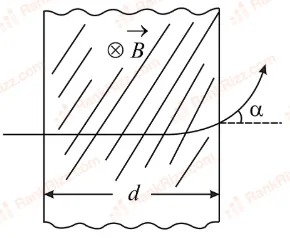
A proton (mass ), accelerated by a potential difference , flies through a uniform transverse magnetic field . The field occupies a region of the space by a width . Let be the angle of deviation of the proton from the initial direction of motion (see the figure), then the value of will be:

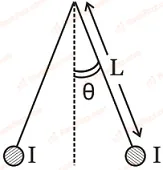
Two long currents carrying thin wires, both with current , are held by insulating threads of length L and are in equilibrium as shown in the figure, with threads making an angle with the vertical. If wires have a mass per unit length then the value of I is: ( = gravitational acceleration)
A rectangular loop of sides 10 cm and 5 cm, carrying a current of 12 A, is placed in different orientations as shown in the figures below.

If there is a uniform magnetic field of 0.3 T in the positive z direction, in which orientations the loop would be in (i) stable equilibrium and (ii) unstable equilibrium?
(b) and (c), respectively.
(a) and (b), respectively.
(a) and (c), respectively.
(b) and (d), respectively.
A positive charge 'q' of mass 'm' is moving along the +x axis. We wish to apply a uniform magnetic field B for time so that the charge reverses its direction crossing the y axis at a distance d. Then:
and
and
and
and
Consider two thin identical conducting wires covered with very thin insulating material. One of the wires is bent into a loop and produces magnetic field B, at its centre when a current I passes through it. The ratio B : B is:
1:1
1 : 3
1 : 9
9 : 1
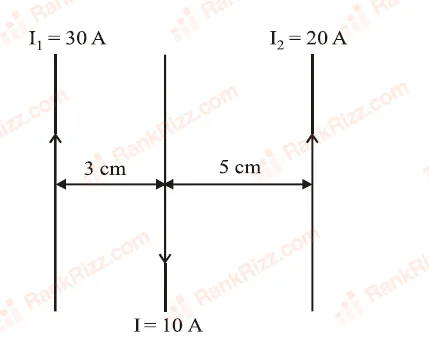
Three straight parallel current carrying conductors are shown in the figure. The force experienced by the middle conductor of length 25 cm is:

N toward right
N toward right
N toward right
Zero
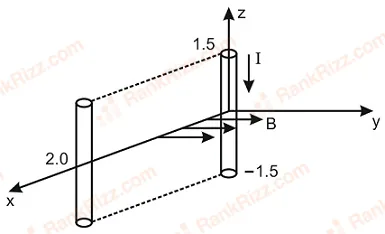
A conductor lies along the z-axis at m and carries a fixed current of 10.0 A in direction (see figure). For a field T, find the power required to move the conductor at constant speed to x = 2.0 m, y = 0 m in s. Assume parallel motion along the x-axis.

1.57 W
2.97 W
14.85 W
29.7 W
One of the two small circular coils, (none of them having any self-inductance) is suspended with a V-shaped copper wire, with plane horizontal. The other coil is placed just below the first one with plane horizontal. Both the coils are connected in series with a dc supply. The coils are found to attract each other with a force. Which one of the following statements is incorrect?
Both the coils carry currents in the same direction.
Coils will attract each other, even if the supply is an ac source.
Force is proportional to
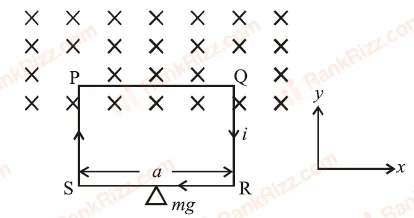
A rectangular loop of wire, supporting a mass m, hangs with one end in a uniform magnetic field pointing out of the plane of the paper. A clockwise current is set up such that , where a is the width of the loop. Then :

The weight rises due to a vertical force caused by the magnetic field and work is done on the system.
The weight do not rise due to vertical for caused by the magnetic field and work is done on the system.
The weight rises due to a vertical force caused by the magnetic field but no work is done on the system.
The weight rises due to a vertical force caused by the magnetic field and work is extracted from the magnetic field.
A particle of charge C moving with velocity 10 ms along x-axis enters a region where magnetic field of induction is along the y-axis and an electric field of magnitude Vm is along the negative z-axis. If the charged particle continues moving along x-axis, the magnitude of is :
Wb m
Wb m
Wb m
Wb m
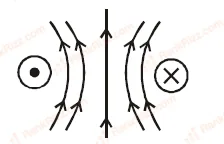
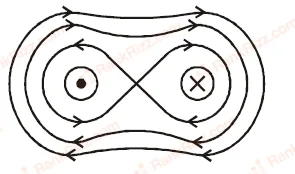
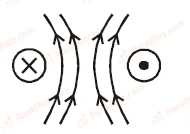
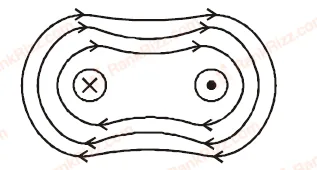
Choose the correct sketch of the magnetic field lines of a circular current loop shown by the dot and the cross .


A current is flowing in a straight conductor of length . The magnetic induction at a point on its axis at a distance from its centre will be :
Zero
JEE Advanced has set 38 Moving Charges & Magnetism questions too. Moving Charges & Magnetism JEE Advanced PYQs →
OTHER PHYSICS CHAPTERS