RankRizz

Moving Charges & Magnetism — JEE Main Previous Year Questions

Every Moving Charges & Magnetism question JEE Main has set from 2004–2026, grouped by the idea it tests rather than the order of the syllabus. 249 questions across 8 distinct ideas. Free to read, answer key on every one.

DATA UPDATED

Questions

249

Distinct ideas

8

Share of marks

3.8%

Difficulty

MEDIUM

The ideas inside Moving Charges & Magnetism

A chapter is not one subject — it is a handful of procedures the examiner reuses. These are the ones Moving Charges & Magnetism questions actually test.

01Biot-Savart law: straight wires and moving chargesset 75×
02Magnetic field of circular loops, arcs and coilsset 5×
03Ampere's circuital law: cylinders, solenoids and toroidsset 19×04Motion of charged particles in a magnetic fieldset 69×
05Charged particles in combined electric and magnetic fieldsset 6×
06Force on current-carrying conductors and between parallel wiresset 4×
07Magnetic dipole moment of current loops and torque on loopsset 61×08Moving coil galvanometerset 10×

Every Moving Charges & Magnetism question

181–200 OF 249 · NEWEST FIRST

JEE MAIN 2019 · 09 APR S2Moving coil galvanometer

A moving coil galvanometer has a coil with 175 turns and area 1 cm2^2. It uses a torsion band of torsion constant 10−610^{-6} N m/rad. The coil is placed in a magnetic field B parallel to its plane. The coil deflects by 1° for a current of 1 mA. The value of B (in tesla) is approximately:

  1. A

    10−210^{-2}

  2. B

    10−410^{-4}

  3. C

    10−310^{-3}

  4. D

    10−110^{-1}

JEE MAIN 2019 · 08 APR S1Magnetic dipole moment of current loops and torque on loops

A circular coil having N turns and radius r carries a current I. It is held in the XZ plane in a magnetic field Bi^B\hat{i}. The torque on the coil due to the magnetic field is:

  1. A

    Bπr2INB\pi r^{2}IN

  2. B

    Br2IπN\frac{Br^{2}I}{\pi N}

  3. C

    Bπr2IN\frac{B\pi r^{2}I}{N}

  4. D

    Zero

JEE MAIN 2019 · 08 APR S2Biot-Savart law: straight wires and moving charges

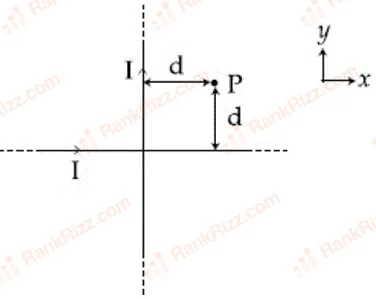
Two very long, straight, and insulated wires are kept at 90° angle from each other in xy-plane as shown in figure. These wires carry currents of equal magnitude I, whose direction are shown in the figure. The net magnetic field at point P will be:

Figure for JEE Main 2019 Physics question on Biot-Savart law: straight wires and moving charges
  1. A

    −μ0I2πd(x^+y^)-\frac{\mu_0 I}{2\pi d}(\hat{x} + \hat{y})

  2. B

    +μ0Iπdz^\frac{+\mu_0 I}{\pi d}\hat{z}

  3. C

    μ0I2πd(x^+y^)\frac{\mu_0 I}{2\pi d}(\hat{x} + \hat{y})

  4. D

    Zero

JEE MAIN 2019 · 12 JAN S1Motion of charged particles in a magnetic field

A proton and an α\alpha-particle (with their masses in the ratio of 1 : 4 and charges in the ratio of 1 : 2) are accelerated from rest through a potential difference V. If a uniform magnetic field (B) is set up perpendicular to their velocities, the ratio of the radii rp:rαr_p : r_{\alpha} of the circular paths described by them will be:

  1. A

    1 : 3

  2. B

    1:21 : \sqrt{2}

  3. C

    1 : 2

  4. D

    1:31 : \sqrt{3}

JEE MAIN 2019 · 12 JAN S1Biot-Savart law: straight wires and moving charges

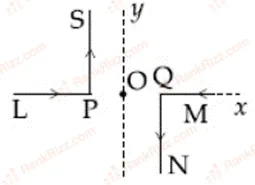
As shown in the figure, two infinitely long, identical wires are bent by 90° and placed in such a way that the segments LP and QM are along the x-axis, while segments PS and QN are parallel to the y-axis. If OP=OQ=4OP = OQ = 4 cm, and the magnitude of the magnetic field at O is 10−410^{-4} T, and the two wires carry equal currents (see figure), the magnitude of the current in each wire and the direction of the magnetic field at O will be (μ0=4π×10−7NA−2)\left(\mu_0 = 4\pi \times 10^{-7} NA^{-2}\right):

Figure for JEE Main 2019 Physics question on Biot-Savart law: straight wires and moving charges
  1. A

    20 A, perpendicular into the page

  2. B

    20 A, perpendicular out of the page

  3. C

    40 A, perpendicular into the page

  4. D

    40 A, perpendicular out of the page

JEE MAIN 2019 · 11 JAN S1Motion of charged particles in a magnetic field

In an experiment, electrons are accelerated, from rest, by applying a voltage of 500 V. Calculate the radius of the path if a magnetic field 100 mT is then applied. [Charge of the electron =1.6×10−19= 1.6 \times 10^{-19} C; Mass of the electron =9.1×10−31= 9.1 \times 10^{-31} kg]

  1. A

    7.5×10−37.5 \times 10^{-3} m

  2. B

    7.5×10−27.5 \times 10^{-2} m

  3. C

    7.5 m

  4. D

    7.5×10−47.5 \times 10^{-4} m

JEE MAIN 2019 · 11 JAN S2Motion of charged particles in a magnetic field

The region between y=0y = 0 and y=dy = d contains a magnetic field B⃗=Bz^\vec{B} = B\hat{z}. A particle of mass m and charge q enters the region with a velocity v⃗=vi^\vec{v} = v\hat{i}. If d=mv2qBd = \frac{mv}{2qB}, the acceleration of the charged particle at the point of its emergence at the other side is:

  1. A

    qvBm(12i^−32j^)\frac{qvB}{m}\left(\frac{1}{2}\hat{i} - \frac{\sqrt{3}}{2}\hat{j}\right)

  2. B

    qvBm(32i^+12j^)\frac{qvB}{m}\left(\frac{\sqrt{3}}{2}\hat{i} + \frac{1}{2}\hat{j}\right)

  3. C

    qvBm(−j^+i^2)\frac{qvB}{m}\left(\frac{-\hat{j}+\hat{i}}{\sqrt{2}}\right)

  4. D

    None of the above

JEE MAIN 2019 · 11 JAN S2Motion of charged particles in a magnetic field

A particle of mass m and charge q is in an electric and magnetic field given by E⃗=2i^+3j^\vec{E} = 2\hat{i} + 3\hat{j}; B⃗=4j^+6k^\vec{B} = 4\hat{j} + 6\hat{k}. The charged particle is shifted from the origin to the point P(x=1;y=1)(x = 1; y = 1) along a straight path. The magnitude of the total work done is:

  1. A

    (0.35)q

  2. B

    5q

  3. C

    (2.5) q

  4. D

    (0.15)q

JEE MAIN 2019 · 10 JAN S1Magnetic dipole moment of current loops and torque on loops

An insulating thin rod of length ll has a linear charge density ρ(x)=ρ0xl\rho(x) = \rho_0 \frac{x}{l} on it. The rod is rotated about an axis passing through the origin (x=0x = 0) and perpendicular to the rod. If the rod makes nn rotations per second, then the time averaged magnetic moment of the rod is:

  1. A

    π4nρ0l3\frac{\pi}{4} n \rho_0 l^3

  2. B

    nρ0l3n \rho_0 l^3

  3. C

    πnρ0l3\pi n \rho_0 l^3

  4. D

    π3nρ0l3\frac{\pi}{3} n \rho_0 l^3

JEE MAIN 2019 · 10 JAN S2Magnetic dipole moment of current loops and torque on loops

A hoop and a solid cylinder of same mass and radius are made of a permanent magnetic material with their respective axes. But the magnetic moment of hoop is twice of solid cylinder. They are placed in a uniform magnetic field in such a manner that their magnetic moments make a small angle with the field. If the oscillation periods of hoop and cylinder are ThT_h and TcT_c respectively, then:

  1. A

    Th=2TcT_h = 2T_c

  2. B

    Th=TcT_h = T_c

  3. C

    Th=0.5TcT_h = 0.5T_c

  4. D

    Th=1.5TcT_h = 1.5T_c

JEE MAIN 2019 · 09 JAN S1Biot-Savart law: straight wires and moving charges

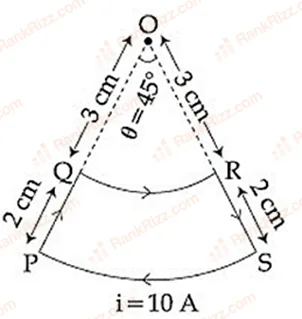
A current loop, having two circular arcs joined by two radial lines is shown in the figure. It carries a current of 10 A. The magnetic field at point O will be close to:

Figure for JEE Main 2019 Physics question on Biot-Savart law: straight wires and moving charges
  1. A

    1.5×10−71.5 \times 10^{-7} T

  2. B

    1.0×10−71.0 \times 10^{-7} T

  3. C

    1.5×10−51.5 \times 10^{-5} T

  4. D

    1.0×10−51.0 \times 10^{-5} T

JEE MAIN 2019 · 09 JAN S1Magnetic dipole moment of current loops and torque on loops

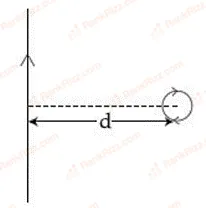
An infinitely long current carrying wire and a small current carrying loop are in the plane of the paper as shown. The radius of the loop is aa and distance of its centre from the wire is dd (d≫ad \gg a). If the loop applies a force FF on the wire then:

Figure for JEE Main 2019 Physics question on Magnetic dipole moment of current loops and torque on loops
  1. A

    F∝a2d2F \propto \frac{a^2}{d^2}

  2. B

    F=0F = 0

  3. C

    F∝a2d3F \propto \frac{a^2}{d^3}

  4. D

    F∝adF \propto \frac{a}{d}

JEE MAIN 2019 · 09 JAN S2Motion of charged particles in a magnetic field

A particle having the same charge as of electron moves in a circular path of radius 0.5 cm under the influence of a magnetic field of 0.5 T. If an electric field of 100 V/m makes it to move in a straight path, then the mass of the particle is (Given charge of electron =1.6×10−19= 1.6 \times 10^{-19} C)

  1. A

    9.1×10−319.1 \times 10^{-31} kg

  2. B

    1.6×10−271.6 \times 10^{-27} kg

  3. C

    2.0×10−242.0 \times 10^{-24} kg

  4. D

    1.6×10−191.6 \times 10^{-19} kg

JEE MAIN 2019 · 09 JAN S2Biot-Savart law: straight wires and moving charges

One of the two identical conducting wires of length LL is bent in the form of a circular loop and the other one into a circular coil of NN identical turns. If the same current is passed in both, the ratio of the magnetic field at the centre of the loop (BL)(B_L) to that at the centre of the coil (BC)(B_C), i.e. BLBC\frac{B_L}{B_C} will be:

  1. A

    1N2\frac{1}{N^2}

  2. B

    1N\frac{1}{N}

  3. C

    NN

  4. D

    N2N^2

JEE MAIN 2018 · 16 APR ONLINEMagnetic dipole moment of current loops and torque on loops

A charge q is spread uniformly over an insulated loop of radius r. If it is rotated with an angular velocity ω\omega with respect to normal axis then magnetic moment of the loop is:

  1. A

    32qωr2\frac{3}{2}q\omega r^2

  2. B

    12qωr2\frac{1}{2}q\omega r^2

  3. C

    qωr2q\omega r^2

  4. D

    43qωr2\frac{4}{3}q\omega r^2

JEE MAIN 2018 · 15 APR S1Biot-Savart law: straight wires and moving charges

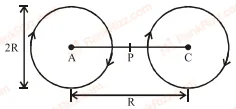
A Helmholtz coil has pair of loops, each with N turns and radius R. They are placed coaxially at distance R and the same current I flows through the loops in the same direction. The magnitude of magnetic field at P, midway between the centres A and C, is given by (Refer to figure):
Figure for JEE Main 2018 Physics question on Biot-Savart law: straight wires and moving charges

  1. A

    4Nμ0I53/2R\frac{4N\mu_0 I}{5^{3/2}R}

  2. B

    8Nμ0I53/2R\frac{8N\mu_0 I}{5^{3/2}R}

  3. C

    4Nμ0I51/2R\frac{4N\mu_0 I}{5^{1/2}R}

  4. D

    8Nμ0I51/2R\frac{8N\mu_0 I}{5^{1/2}R}

JEE MAIN 2018 · 15 APR S2Biot-Savart law: straight wires and moving charges

A current of 1 A is flowing on the sides of an equilateral triangle of side 4.5×10−24.5 \times 10^{-2} m. The magnetic field at the centre of the triangle will be:

  1. A

    4×10−54 \times 10^{-5} Wb/m2^2

  2. B

    Zero

  3. C

    2×10−52 \times 10^{-5} Wb/m2^2

  4. D

    8×10−58 \times 10^{-5} Wb/m2^2

JEE MAIN 2018 · 08 APR OFFLINEMagnetic dipole moment of current loops and torque on loops

The dipole moment of a circular loop carrying a current I, is m and the magnetic field at the centre of the loop is B1B_1. When the dipole moment is doubled by keeping the current constant, the magnetic field at the centre of the loop is B2B_2. The ratio B1B2\frac{B_1}{B_2} is:

  1. A

    12\frac{1}{\sqrt{2}}

  2. B

    2

  3. C

    3\sqrt{3}

  4. D

    2\sqrt{2}

JEE MAIN 2018 · 08 APR OFFLINEMagnetic dipole moment of current loops and torque on loops

An electron, a proton and an alpha particle having the same kinetic energy are moving in circular orbits of radii rer_e, rpr_p, rαr_\alpha respectively in a uniform magnetic field B. The relation between rer_e, rpr_p, rαr_\alpha is:

  1. A

    re<rα<rpr_e < r_\alpha < r_p

  2. B

    re>rP=rαr_e > r_P = r_\alpha

  3. C

    re<rp=rαr_e < r_p = r_\alpha

  4. D

    re<rp<rαr_e < r_p < r_\alpha

JEE MAIN 2017 · 09 APR ONLINEMagnetic dipole moment of current loops and torque on loops

A negative test charge is moving near a long straight wire carrying a current. The force acting on the test charge is parallel to the direction of the current. The motion of the charge is:

  1. A

    Away from the wire

  2. B

    Towards the wire

  3. C

    Parallel to the wire along the current

  4. D

    Parallel to the wire opposite to the current