RankRizz

Moving Charges & Magnetism — JEE Advanced Previous Year Questions

Moving Charges & Magnetism has been asked in 17 of the 20 JEE Advanced years from 2007 to 2026: 38 questions in all. In 2026 it averaged 1.0 questions per paper (2 across 2 papers), 5.9% of Physics questions, up from 3.1% in 2025. Across the last 20 papers it carried 5.1% of Physics questions. By type: 19 single-correct, 12 multiple-correct, 6 numerical and 1 match-the-list. Of the 38 with a difficulty tag, 8% are easy, 66% medium and 26% hard. Most asked: Motion of charged particles in a magnetic field (15, 39%), Magnetic field of circular loops, arcs and coils (7, 18%) and Force on current-carrying conductors and between parallel wires (5, 13%).

DATA UPDATED

Questions

38

Distinct ideas

7

Share of marks

5.1%

Difficulty

HARD

Moving Charges & Magnetism weightage, year by year

The share of each year’s Physics questions that came from Moving Charges & Magnetism, counted from the 19 papers we hold for the last 10 years, and paper by paper inside a year.

Rising: 6.0% of Physics questions in 2024–2026, up from 5.1% in 2017–2023. Its heaviest year was 2017, at 13.9%. Not asked at all in 2019, 2023.

Moving Charges & Magnetism questions per year, per paper, and as a share of Physics questions
YEARQSPER PAPERSHARE OF PHYSICSCHANGE
20262 / 341.05.9%+2.8 pts
20251 / 320.53.1%−5.7 pts
20243 / 341.58.8%+8.8 pts
20230 / 340.00.0%−5.6 pts
20222 / 361.05.6%+0.3 pts
20212 / 381.05.3%+2.5 pts
20201 / 360.52.8%+2.8 pts
20190 / 360.00.0%−11.1 pts
20182 / 182.011.1%−2.8 pts
20175 / 362.513.9%—

“QS” is Moving Charges & Magnetism questions out of all Physics questions that year; “per paper” is that count over the year’s papers, and “change” is the share against the year before. A year with more sittings asks more questions, which is why the share, not the count, is the number to compare.

The ideas inside Moving Charges & Magnetism

A chapter is not one subject — it is a handful of procedures the examiner reuses. These are the ones Moving Charges & Magnetism questions actually test.

01Biot-Savart law: straight wires and moving chargesset 1×
02Magnetic field of circular loops, arcs and coilsset 7×
03Ampere's circuital law: cylinders, solenoids and toroidsset 4×
04Motion of charged particles in a magnetic fieldset 15×
05Charged particles in combined electric and magnetic fieldsNot set in Advanced
06Force on current-carrying conductors and between parallel wiresset 5×
07Magnetic dipole moment of current loops and torque on loopsset 5×
08Moving coil galvanometerset 1×

All 38 Moving Charges & Magnetism questions, by topic

Every JEE Advanced Moving Charges & Magnetism question we hold, newest first inside each topic. Open one for its options, answer key and solution.

Motion of charged particles in a magnetic field15 QUESTIONS

  1. In a vacuum chamber, a particle of charge 1 μC and mass 1 mg is projected with a velocity (i+2j) ms⁻¹ from the XZ plane at time t=0 in an…2026 · PAPER 2
  2. A positive, singly ionized atom of mass number A_M is accelerated from rest by the voltage 192 V. Thereafter, it enters a rectangular…2024 · PAPER 2
  3. An α-particle (mass 4 amu) and a singly charged sulfur ion (mass 32 amu) are initially at rest. They are accelerated through a potential V…2021 · PAPER 1
  4. The relation between [ε₀] and [μ₀] is2018 · PAPER 1
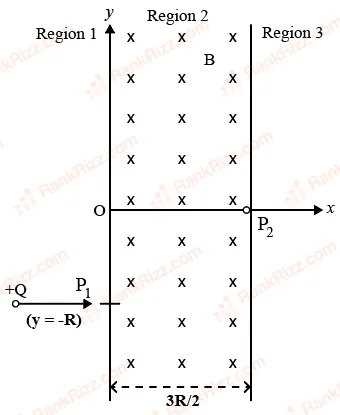
  5. A uniform magnetic field B exists in the region between x=0 and x=3R/2 (region 2 in the figure) pointing normally into the plane of the…2017 · PAPER 2
  6. In which case will the particle move in a straight line with constant velocity?2017 · PAPER 1
  7. In which case will the particle describe a helical path with axis along the positive z direction?2017 · PAPER 1
  8. In which case would the particle move in a straight line along the negative direction of y-axis (i.e., move along -y)?2017 · PAPER 1
  9. Consider two different metallic strips (1 and 2) of the same material. Their lengths are the same, widths are w₁ and w₂ and thicknesses are…2015 · PAPER 2
  10. Consider two different metallic strips (1 and 2) of same dimensions (length l, width w and thickness d) with carrier densities n₁ and n₂…2015 · PAPER 2
  11. Two parallel wires in the plane of the paper are distance X₀ apart. A point charge is moving with speed u between the wires in the same…2014 · PAPER 1
  12. A particle of mass M and positive charge Q, moving with a constant velocity u₁ = 4 i ms⁻¹, enters a region of uniform static magnetic field…2013 · PAPER 1
  13. Consider the motion of a positive point charge in a region where there are simultaneous uniform electric and magnetic fields E = E₀ j and B…2012 · PAPER 1
  14. An electron and a proton are moving on straight parallel paths with same velocity. They enter a semi-infinite region of uniform magnetic…2011 · PAPER 1
  15. A particle of mass m and charge q, moving with velocity V enters Region II normal to the boundary as shown in the figure. Region II has a…2008 · PAPER 1

FREE PDF

Moving Charges & Magnetism JEE Advanced PYQs with answer key

All 38 questions on A4, by topic, with the answer key at the end. No sign-up, no email: your browser saves it as a PDF.

Download free PDF

UNIQUE CONCEPTS

Moving Charges & Magnetism: one question per idea

8 ideas, each with the latest past question that tested it, drawn from 285 JEE Main and Advanced questions.

Moving Charges & Magnetism Unique Concepts sheet →

JEE MAIN

Moving Charges & Magnetism in JEE Main

JEE Main has set 249 Moving Charges & Magnetism questions, 2004–2026.

Moving Charges & Magnetism JEE Main PYQs →

Moving Charges & Magnetism: quick answers

Is Moving Charges & Magnetism asked every year in JEE Advanced?

Not every year. It has been asked in 17 of the 20 JEE Advanced years from 2007 to 2026; the years without a Moving Charges & Magnetism question were 2016, 2019 and 2023.

Which Moving Charges & Magnetism topic is asked most in JEE Advanced?

Motion of charged particles in a magnetic field: 15 of the 38 questions (39%). Next come Magnetic field of circular loops, arcs and coils (7) and Force on current-carrying conductors and between parallel wires (5).

What share of Physics questions does Moving Charges & Magnetism carry in JEE Advanced?

About 5.1% of Physics questions across the last 20 papers. In 2026 it was 5.9% (2 of 34 Physics questions).

When was Moving Charges & Magnetism last asked in JEE Advanced?

In JEE Advanced 2026 Paper 2, the latest sitting with a Moving Charges & Magnetism question.

How many Moving Charges & Magnetism questions has JEE Advanced asked?

38 from 2007 to 2026, across 7 topics. Every one is listed on this page by topic and links to its own page, with the answer key and solution wherever we have them. Free, no sign-up.

Every Moving Charges & Magnetism question

1–20 OF 38 · NEWEST FIRST

JEE ADVANCED 2026 · PAPER 2Motion of charged particles in a magnetic field

In a vacuum chamber, a particle of charge 1 μC1\,\mu\mathrm{C} and mass 1 mg1\,\mathrm{mg} is projected with a velocity (i^+2j^) ms−1(\hat{i}+2\hat{j})\,\mathrm{ms^{-1}} from the XZXZ plane at time t=0t=0 in an electric field of 1i^ Vm−11\hat{i}\,\mathrm{Vm^{-1}}. At t=0.2 st=0.2\,\mathrm{s}, the electric field is switched off and a magnetic field of 6j^ T6\hat{j}\,\mathrm{T} is switched on. The acceleration due to gravity is −10j^ ms−2-10\hat{j}\,\mathrm{ms^{-2}}. Correct option(s) is/are:

  1. A

    The vertical distance of the particle from the XZXZ plane at t=0.3 st=0.3\,\mathrm{s} is 15 cm15\,\mathrm{cm}.

  2. B

    The vertical distance of the particle from the XZXZ plane at t=0.4 st=0.4\,\mathrm{s} is 10 cm10\,\mathrm{cm}.

  3. C

    The radius of the trajectory of the particle for t>0.2 st>0.2\,\mathrm{s} is 20 cm20\,\mathrm{cm}.

  4. D

    The particle will be in the XZXZ plane at t=0.35 st=0.35\,\mathrm{s}.

JEE ADVANCED 2026 · PAPER 1Magnetic dipole moment of current loops and torque on loops

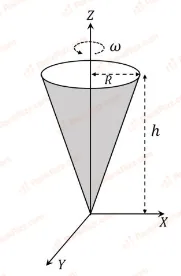
A hollow, right circular cone of base radius RR and height hh, with its tip at the origin is rotating about the ZZ-axis with an angular velocity ω\omega, as shown in the figure. The cone carries a total charge QQ uniformly distributed on its curved surface. The magnitude of magnetic field at a point (0,0,z)(0,0,z), where z≫Rz\gg R and z≫hz\gg h, is nμ04πQR2ωz3\dfrac{n\mu_0}{4\pi}\dfrac{QR^2\omega}{z^3}. The value of nn is:

Figure for JEE Advanced 2026 Physics question on Magnetic dipole moment of current loops and torque on loops
JEE ADVANCED 2025 · PAPER 2Magnetic dipole moment of current loops and torque on loops

A conducting solid sphere of radius RR and mass MM carries a charge QQ. The sphere is rotating about an axis passing through its center with a uniform angular speed ω\omega. The ratio of the magnitudes of the magnetic dipole moment to the angular momentum about the same axis is given as αQ2M\alpha \frac{Q}{2M}. The value of α\alpha is ______.

JEE ADVANCED 2024 · PAPER 1Ampere's circuital law: cylinders, solenoids and toroids

An infinitely long wire, located on the z-axis, carries a current II along the +z+z-direction and produces the magnetic field B⃗\vec{B}. The magnitude of the line integral ∫B⃗⋅dl⃗\int \vec{B} \cdot d\vec{l} along a straight line from the point (−3a,a,0)(-\sqrt{3}a, a, 0) to (a,a,0)(a, a, 0) is given by

[μ0\mu_0 is the magnetic permeability of free space.]

  1. A

    7μ0I24\frac{7\mu_0 I}{24}

  2. B

    7μ0I12\frac{7\mu_0 I}{12}

  3. C

    μ0I8\frac{\mu_0 I}{8}

  4. D

    μ0I6\frac{\mu_0 I}{6}

JEE ADVANCED 2024 · PAPER 2Magnetic dipole moment of current loops and torque on loops

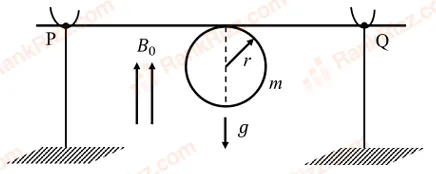
A thin stiff insulated metal wire is bent into a circular loop with its two ends extending tangentially from the same point of the loop. The wire loop has mass mm and radius rr and it is in a uniform vertical magnetic field B0B_0, as shown in the figure. Initially, it hangs vertically downwards, because of acceleration due to gravity gg, on two conducting supports at PP and QQ. When a current II is passed through the loop, the loop turns about the line PQPQ by an angle θ\theta given by: ( equilibrium position)

Figure for JEE Advanced 2024 Physics question on Magnetic dipole moment of current loops and torque on loops
  1. A

    tan⁡θ=πrIB0/(mg)\tan \theta = \pi r I B_0 / (mg)

  2. B

    tan⁡θ=2πrIB0/(mg)\tan \theta = 2\pi r I B_0 / (mg)

  3. C

    tan⁡θ=πrIB0/(2mg)\tan \theta = \pi r I B_0 / (2mg)

  4. D

    tan⁡θ=mg/(πrIB0)\tan \theta = mg / (\pi r I B_0)

JEE ADVANCED 2024 · PAPER 2Motion of charged particles in a magnetic field

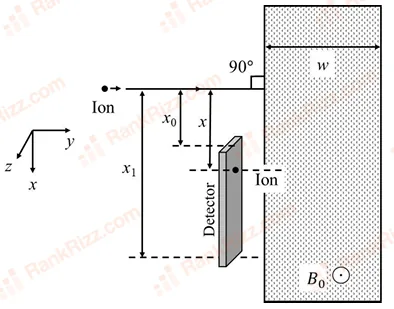
A positive, singly ionized atom of mass number AMA_M is accelerated from rest by the voltage 192 V. Thereafter, it enters a rectangular region of width ww with magnetic field B⃗0=0.1k^\vec{B}_0 = 0.1\hat{k} Tesla, as shown in the figure. The ion finally hits a detector at the distance xx below its starting trajectory.

[Given: Mass of neutron/proton =(5/3)×10−27= (5/3) \times 10^{-27} kg, charge of the electron =1.6×10−19= 1.6 \times 10^{-19} C.]

Figure for JEE Advanced 2024 Physics question on Motion of charged particles in a magnetic field

Which of the following option(s) is(are) correct?

  1. A

    The value of xx for H+H^+ ion is 4 cm.

  2. B

    The value of xx for an ion with AM=144A_M = 144 is 48 cm.

  3. C

    For detecting ions with 1≤AM≤1961 \leq A_M \leq 196, the minimum height (x1−x0)(x_1 - x_0) of the detector is 55 cm.

  4. D

    The minimum width ww of the region of the magnetic field for detecting ions with AM=196A_M = 196 is 56 cm.

JEE ADVANCED 2022 · PAPER 1Force on current-carrying conductors and between parallel wires

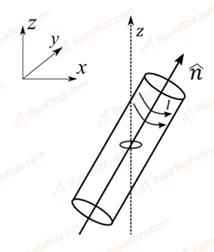
A small circular loop of area AA and resistance RR is fixed on a horizontal xyxy-plane with the center of the loop always on the axis n^\hat{n} of a long solenoid. The solenoid has mm turns per unit length and carries current II counterclockwise as shown in the figure. The magnetic field due to the solenoid is in n^\hat{n} direction. List-I gives time dependences of n^\hat{n} in terms of a constant angular frequency ω\omega.

List-II gives the torques experienced by the circular loop at time t=π6ωt = \frac{\pi}{6\omega}. Let α=A2μ02m2I2ω2R\alpha = \frac{A^2 \mu_0^2 m^2 I^2 \omega}{2R}.

Figure for JEE Advanced 2022 Physics question on Force on current-carrying conductors and between parallel wires
List-IList-II
(I) 12(sin⁡ωt j^+cos⁡ωt k^)\frac{1}{\sqrt{2}}(\sin \omega t \, \hat{j} + \cos \omega t \, \hat{k})(P) 0
(II) 12(sin⁡ωt i^+cos⁡ωt j^)\frac{1}{\sqrt{2}}(\sin \omega t \, \hat{i} + \cos \omega t \, \hat{j})(Q) −α4i^-\frac{\alpha}{4}\hat{i}
(III) 12(sin⁡ωt i^+cos⁡ωt k^)\frac{1}{\sqrt{2}}(\sin \omega t \, \hat{i} + \cos \omega t \, \hat{k})(R) 3α4i^\frac{3\alpha}{4}\hat{i}
(IV) 12(cos⁡ωt i^+sin⁡ωt k^)\frac{1}{\sqrt{2}}(\cos \omega t \, \hat{i} + \sin \omega t \, \hat{k})(S) α4j^\frac{\alpha}{4}\hat{j}
Which one of the following options is correct?(T) −3α4i^-\frac{3\alpha}{4}\hat{i}
  1. A

    I →\to Q, II →\to P, III →\to S, IV →\to T

  2. B

    I →\to S, II →\to T, III →\to Q, IV →\to P

  3. C

    I →\to Q, II →\to P, III →\to S, IV →\to R

  4. D

    I →\to T, II →\to Q, III →\to P, IV →\to R

JEE ADVANCED 2022 · PAPER 2Biot-Savart law: straight wires and moving charges

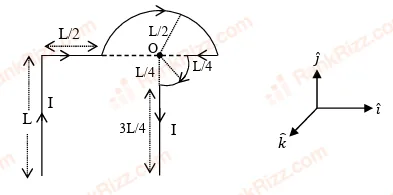
Which one of the following options represents the magnetic field B⃗\vec{B} at O due to the current flowing in the given wire segments lying on the xyxy plane?

Figure for JEE Advanced 2022 Physics question on Biot-Savart law: straight wires and moving charges
  1. A

    B⃗=−μ0IL(32+142π)k^\vec{B} = \dfrac{-\mu_0 I}{L}\left(\dfrac{3}{2} + \dfrac{1}{4\sqrt{2}\pi}\right)\hat{k}

  2. B

    B⃗=−μ0IL(32+122π)k^\vec{B} = -\dfrac{\mu_0 I}{L}\left(\dfrac{3}{2} + \dfrac{1}{2\sqrt{2}\pi}\right)\hat{k}

  3. C

    B⃗=−μ0IL(1+142π)k^\vec{B} = \dfrac{-\mu_0 I}{L}\left(1 + \dfrac{1}{4\sqrt{2}\pi}\right)\hat{k}

  4. D

    B⃗=−μ0IL(1+14π)k^\vec{B} = \dfrac{-\mu_0 I}{L}\left(1 + \dfrac{1}{4\pi}\right)\hat{k}

JEE ADVANCED 2021 · PAPER 2Magnetic field of circular loops, arcs and coils

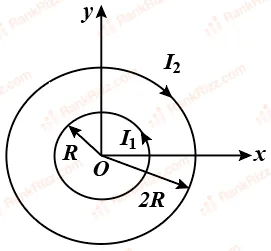
Two concentric circular loops, one of radius R and the other of radius 2R, lie in the xy-plane with the origin as their common center, as shown in the figure. The smaller loop carries current I1I_1 in the anti-clockwise direction and the larger loop carries current I2I_2 in the clockwise direction, with I2>2I1.B→(x,y)I_2 > 2I_1. \overrightarrow{B}(x, y) denotes the magnetic field at a point (x, y) in the xy-plane. Which of the following statement(s) is(are) correct?

Figure for JEE Advanced 2021 Physics question on Magnetic field of circular loops, arcs and coils
  1. A

    B→(x,y)\overrightarrow{B}(x, y) is perpendicular to the xy-plane at any point in the plane

  2. B

    ∣B→(x,y)∣\mid \overrightarrow{B}(x, y)\mid depends on x and y only through the radial distance r=x2+y2r = \sqrt{x^2 + y^2}

  3. C

    ∣B→(x,y)∣\mid \overrightarrow{B}(x, y)\mid is non-zero at all points for r < R

  4. D

    B→(x,y)\overrightarrow{B}(x, y) points normally outward from the xy-plane for all the points between the two loops

JEE ADVANCED 2021 · PAPER 1Motion of charged particles in a magnetic field

An α\alpha-particle (mass 4 amu) and a singly charged sulfur ion (mass 32 amu) are initially at rest. They are accelerated through a potential V and then allowed to pass into a region of uniform magnetic field which is normal to the velocities of the particles. Within this region, the α\alpha-particle and the sulfur ion move in circular orbits of radii rαr_{\alpha} and rSr_{S}, respectively. The ratio (rSrα)\left(\frac{r_S}{r_{\alpha}} \right) is ___.

JEE ADVANCED 2020 · PAPER 1Force on current-carrying conductors and between parallel wires

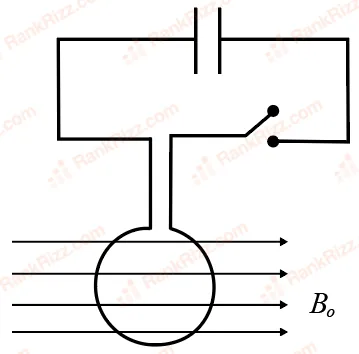
A circular coil of radius R and N turns has negligible resistance. As shown in the schematic figure, its two ends are connected to two wires and it is hanging by those wires with its plane being vertical. The wires are connected to a capacitor with charge Q through a switch. The coil is in a horizontal uniform magnetic field BoB_{o} parallel to the plane of the coil. When the switch is closed, the capacitor gets discharged through the coil in a very short time. By the time the capacitor is discharged fully, magnitude of the angular momentum gained by the coil will be (assume that the discharge time is so short that the coil has hardly rotated during this time)

Figure for JEE Advanced 2020 Physics question on Force on current-carrying conductors and between parallel wires
  1. A

    π2NQB0R2\frac{\pi}{2} NQB_{0}R^{2}

  2. B

    πNQB0R2\pi NQB_{0}R^{2}

  3. C

    2πNQB0R22\pi NQB_{0}R^{2}

  4. D

    4πNQB0R24\pi NQB_{0}R^{2}

JEE ADVANCED 2018 · PAPER 1Magnetic field of circular loops, arcs and coils

Two infinitely long straight wires lie in the 𝑥𝑦-plane along the lines 𝑥 =±\pm𝑅. The wire located at 𝑥 = ±\pm𝑅 carries a constant current I1I_{1} and the wire located at 𝑥 = −𝑅 carries a constant current I2I_{2}. A circular loop of radius 𝑅 is suspended with its centre at (0, 0, 3R\sqrt{3R}) and in a plane parallel to the 𝑥𝑦-plane. This loop carries a constant current 𝐼 in the clockwise direction as seen from above the loop. The current in the wire is taken to be positive if it is in the +J^\hat{J} direction. Which of the following statements regarding the magnetic field B→\overrightarrow{B} is (are) true?

  1. A

    If I1=I2I_{1}=I_{2}, then B→\overrightarrow{B} cannot be equal to zero at the origin (0, 0, 0)

  2. B

    If I1>0andI2<0I_{1}>0 and I_{2}<0, then B→\overrightarrow{B} can be equal to zero at the origin (0, 0, 0)

  3. C

    If I1<0andI2>0I_{1}<0 and I_{2}>0, then B→\overrightarrow{B} can be equal to zero at the origin (0, 0, 0)

  4. D

    If I1=I2I_{1}=I_{2}, then the z-component of the magnetic field at the centre of the loop is −μoI2R\frac{-\mu_{o}I}{2R}

JEE ADVANCED 2018 · PAPER 1Motion of charged particles in a magnetic field

The relation between [ϵ0][\epsilon_{0}] and [μ0][\mu_{0}] is

  1. A

    [μ0]=[ϵ0][L]2[T]−2[\mu_{0}]=[\epsilon_{0}][L]^{2}[T]^{-2}

  2. B

    [μ0]=[ϵ0][L]−2[T]2[\mu_{0}]=[\epsilon_{0}][L]^{-2}[T]^{2}

  3. C

    [μ0]=[ϵ0]−1[L]2[T]−2[\mu_{0}]=[\epsilon_{0}]^{-1}[L]^2[T]^{-2}

  4. D

    [μ0]=[ϵ0]−1[L]−2[T]2[\mu_{0}]=[\epsilon_{0}]^{-1}[L]^{-2}[T]^2

JEE ADVANCED 2017 · PAPER 2Magnetic field of circular loops, arcs and coils

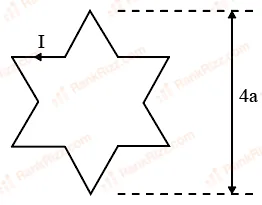
A symmetric star shaped conducting wire loop is carrying a steady state current I as shown in the figure. The distance between the diametrically opposite vertices of the star is 4a4a. The magnitude of the magnetic field at the center of the loop is

Figure for JEE Advanced 2017 Physics question on Magnetic field of circular loops, arcs and coils
  1. A

    μ0I4πa6[3−1]\frac{\mu_{0}I}{4 \pi a}6[\sqrt{3}-1]

  2. B

    μ0I4πa6[3+1]\frac{\mu_{0}I}{4 \pi a}6[\sqrt{3}+1]

  3. C

    μ0I4πa3[3−1]\frac{\mu_{0}I}{4 \pi a}3[\sqrt{3}-1]

  4. D

    μ0I4πa3[2−3]\frac{\mu_{0}I}{4 \pi a}3[2-\sqrt{3}]

JEE ADVANCED 2017 · PAPER 2Motion of charged particles in a magnetic field

A uniform magnetic field B exists in the region between x=0x=0 and x=3R2x=\frac{3R}{2} (region 2 in the figure) pointing normally into the plane of the paper. A particle with charge +Q+Q and momentum pp directed along x-axis enters region 2 from region 1 at point P1(Y=−R)P_{1}(Y=-R).Which of the following option(s) is/are correct?

Figure for JEE Advanced 2017 Physics question on Motion of charged particles in a magnetic field
  1. A

    For B>23PQRB>\frac{2}{3}\frac{P}{QR}, the particle will re-enter region 1

  2. B

    For B=813PQRB=\frac{8}{13}\frac{P}{QR}, the particle will enter region 3 through the point P2P_{2} on x-axis

  3. C

    When the particle re-enters region 1 through the longest possible path in region 2,the magnitude of the change in its linear momentum between point P1P_{1} and the farthest point from axis is P2\frac{P}{\sqrt{2}}

  4. D

    For a fixed B, particles of same charge Q and same velocity V, the distance between the point P1P_{1} and the point of re-entry into region 1 is inversely proportional to the mass of the particle

JEE ADVANCED 2017 · PAPER 1Motion of charged particles in a magnetic field

In which case will the particle move in a straight line with constant velocity?

  1. A

    (III) (ii) (R)

  2. B

    (IV) (i) (S)

  3. C

    (III) (iii) (P)

  4. D

    (II) (iii) (S)

JEE ADVANCED 2017 · PAPER 1Motion of charged particles in a magnetic field

In which case will the particle describe a helical path with axis along the positive z direction?

  1. A

    (IV) (i) (S)

  2. B

    (II) (ii) (R)

  3. C

    (III) (iii) (P)

  4. D

    (IV) (ii) (R)

JEE ADVANCED 2017 · PAPER 1Motion of charged particles in a magnetic field

In which case would the particle move in a straight line along the negative direction of y-axis (i.e., move along −y^-\hat{y})?

  1. A

    (II) (iii) (Q)

  2. B

    (III) (ii) (R)

  3. C

    (IV) (ii) (S)

  4. D

    (III) (ii) (P)

JEE ADVANCED 2015 · PAPER 1Force on current-carrying conductors and between parallel wires

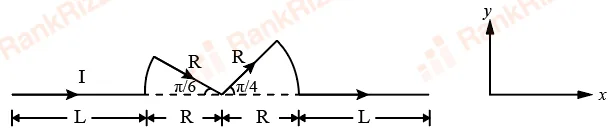
A conductor (shown in the figure) carrying constant current I is kept in the x-y plane in a uniform magnetic field B→\overrightarrow{B}. If F is the magnitude of the total magnetic force acting on the conductor, then the correct statement(s) is(are)

Figure for JEE Advanced 2015 Physics question on Force on current-carrying conductors and between parallel wires
  1. A

    If B→\overrightarrow{B} is along z^,F∝(L+R)\widehat{z}, F \propto (L + R)

  2. B

    If B→\overrightarrow{B} is along x^,F=0\widehat{x}, F = 0

  3. C

    If B→\overrightarrow{B} is along y^,F∝(L+R)\widehat{y}, F \propto (L + R)

  4. D

    If B→\overrightarrow{B} is along z^,F=0\widehat{z}, F = 0

JEE ADVANCED 2015 · PAPER 2Motion of charged particles in a magnetic field

Consider two different metallic strips (1 and 2) of the same material. Their lengths are the same, widths are w1w_1 and w2w_2 and thicknesses are d1d_1 and d2d_2, respectively. Two points K and M are symmetrically located on the opposite faces parallel to the x-y plane (see figure). V1V_1 and V2V_2 are the potential differences between K and M instrips 1 and 2, respectively. Then,for a given current I flowing through them in a given magnetic field strength B, the correct statement(s) is(are)

  1. A

    If w1=w2w_1 = w_2 and d1=2d2d_1 = 2d_2, then V2=2V1V_2 = 2V_1

  2. B

    If w1=w2w_1 = w_2 and d1=2d2d_1 = 2d_2, then V2=V1V_2 = V_1

  3. C

    If w1=2w2w_1 = 2w_2 and d1=d2d_1 = d_2, then V2=2V1V_2 = 2V_1

  4. D

    If w1=2w2w_1 = 2w_2 and d1=d2d_1 = d_2, then V2=V1V_2 = V_1