RankRizz

Waves — JEE Main Previous Year Questions

Every Waves question JEE Main has set from 2004–2026, grouped by the idea it tests rather than the order of the syllabus. 169 questions across 6 distinct ideas. Free to read, answer key on every one.

DATA UPDATED

Questions

169

Distinct ideas

6

Share of marks

2.2%

Difficulty

MEDIUM

The ideas inside Waves

A chapter is not one subject — it is a handful of procedures the examiner reuses. These are the ones Waves questions actually test.

Every Waves question

121–140 OF 169 · NEWEST FIRST

JEE MAIN 2019 · 09 JAN S1Progressive waves: wave equation, phase and intensity

A heavy ball of mass MM is suspended from the ceiling of a car by a light string of mass mm (m≪Mm \ll M). When the car is at rest, the speed of transverse waves in the string is 60 ms−1^{-1}. When the car has acceleration aa, the wave-speed increases to 60.5 ms−1^{-1}. The value of aa, in terms of gravitational acceleration gg, is closest to:

  1. A

    g10\frac{g}{10}

  2. B

    g20\frac{g}{20}

  3. C

    g5\frac{g}{5}

  4. D

    g30\frac{g}{30}

JEE MAIN 2019 · 09 JAN S2Doppler effect in sound

A musician using an open flute of length 50 cm produces second harmonic sound waves. A person runs towards the musician from another end of a hall at a speed of 10 km h−1^{-1}. If the wave speed is 330 m s−1^{-1}, the frequency heard by the running person shall be close to:

  1. A

    333 Hz

  2. B

    500 Hz

  3. C

    666 Hz

  4. D

    753 Hz

JEE MAIN 2018 · 16 APR ONLINEProgressive waves: wave equation, phase and intensity

The end correction of a resonance column is 1 cm. If the shortest length resonating with the tuning fork is 10 cm, the next resonating length should be:

  1. A

    32 cm

  2. B

    40 cm

  3. C

    28 cm

  4. D

    36 cm

JEE MAIN 2018 · 16 APR ONLINESuperposition, interference and beats

Two sitar strings, A and B playing the note 'Dha' are slightly out of tune and produce beats of frequency 5 Hz. The tension of the string B is slightly increased and the beat frequency is found to decrease by 3 Hz. If the frequency of A is 425 Hz. The original frequency of B is:

  1. A

    428 Hz

  2. B

    430 Hz

  3. C

    422 Hz

  4. D

    420 Hz

JEE MAIN 2018 · 15 APR S1Progressive waves: wave equation, phase and intensity

A tuning fork vibrates with frequency 256 Hz and gives one beat per second with the third normal mode of vibration of an open pipe. What is the length of the pipe? (Speed of sound in air is 340 ms−1^{-1})

  1. A

    190 cm

  2. B

    180 cm

  3. C

    220 cm

  4. D

    200 cm

JEE MAIN 2018 · 15 APR S2Superposition, interference and beats

5 beats/second are heard when a turning fork is sounded with a sonometer wire under tension, when the length of the sonometer wire is either 0.95 m or 1 m. The frequency of the fork will be:

  1. A

    195 Hz

  2. B

    251 Hz

  3. C

    150 Hz

  4. D

    300 Hz

JEE MAIN 2018 · 08 APR OFFLINEStanding waves on strings and rods

A granite rod of 60 cm length is clamped at its middle point and is set into longitudinal vibrations. The density of granite is 2.7×1032.7 \times 10^3 kg m−3^{-3} and its Young's modulus is 9.27×10109.27 \times 10^{10} Pa. What will be the fundamental frequency of the longitudinal vibrations?

  1. A

    7.5 kHz

  2. B

    5 kHz

  3. C

    2.5 kHz

  4. D

    10 kHz

JEE MAIN 2017 · 09 APR ONLINEProgressive waves: wave equation, phase and intensity

A standing wave is formed by the superposition of two waves travelling in opposite directions. The transverse displacement is given by, y(x,t)=0.5sin⁡(5π4x)cos⁡(200πt)y(x, t) = 0.5 \sin\left(\frac{5\pi}{4}x\right) \cos(200\pi t). What is the speed of the travelling wave moving in the positive xx direction? (xx and tt are in meter and second, respectively)

  1. A

    120 m s−1^{-1}

  2. B

    90 m s−1^{-1}

  3. C

    160 m s−1^{-1}

  4. D

    180 m s−1^{-1}

JEE MAIN 2017 · 08 APR ONLINEProgressive waves: wave equation, phase and intensity

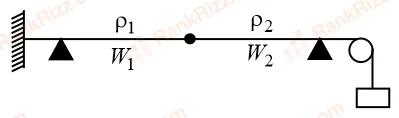
Two wires W1W_1 and W2W_2 have the same radius rr and respective densities ρ1\rho_1 and ρ2\rho_2, such that ρ2=4ρ1\rho_2 = 4\rho_1. They are joined together at the point OO, as shown in the figure. The combination is used as a sonometer wire and kept under tension TT. The point OO is midway between the two bridges. When a stationary wave is set up in the composite wire, the joint is found to be a node. The ratio of the number of antinodes formed in W1W_1 to W2W_2 is:

Figure for JEE Main 2017 Physics question on Progressive waves: wave equation, phase and intensity
  1. A

    4 : 1

  2. B

    1 : 2

  3. C

    1 : 1

  4. D

    1 : 3

JEE MAIN 2017 · 02 APR OFFLINEDoppler effect in sound

An observer is moving with half the speed of light towards a stationary microwave source emitting waves at frequency 10 GHz. What is the frequency of the microwave measured by the observer? (speed of light = 3×1083 \times 10^{8} m s−1^{-1})

  1. A

    15.3 GHz

  2. B

    10.1 GHz

  3. C

    12.1 GHz

  4. D

    17.3 GHz

JEE MAIN 2016 · 10 APR ONLINEDoppler effect in sound

A toy-car, blowing its horn, is moving with a steady speed of 5 m s−1^{-1}, away from a wall. An observer, towards whom the toy car is moving, is able to hear 5 beats per second. If the velocity of sound in air is 340 m s−1^{-1}, the frequency of the horn of the toy car is close to

  1. A

    680 Hz

  2. B

    510 Hz

  3. C

    340 Hz

  4. D

    170 Hz

JEE MAIN 2016 · 09 APR ONLINEDoppler effect in sound

Two engines pass each other moving in opposite directions with uniform speed of 30 m/s. One of them is blowing a whistle of frequency 540 Hz. Calculate the frequency heard by driver of second engine before they pass each other. Speed of sound is 330 m/sec:

  1. A

    450 Hz

  2. B

    540 Hz

  3. C

    270 Hz

  4. D

    648 Hz

JEE MAIN 2016 · 03 APR OFFLINESuperposition, interference and beats

A pipe open at both ends has a fundamental frequency ff in air. The pipe is dipped vertically in water so that half of it is in water. The fundamental frequency of the air column is now:

  1. A

    2ff

  2. B

    ff

  3. C

    f2\frac{f}{2}

  4. D

    3f4\frac{3f}{4}

JEE MAIN 2016 · 03 APR OFFLINEProgressive waves: wave equation, phase and intensity

A uniform string of length 20 m is suspended from a rigid support. A short wave pulse is introduced at its lowest end. It starts moving up the string. The time taken to reach the support is (Take, g=10g = 10 m s−2^{-2})

  1. A

    222\sqrt{2} s

  2. B

    2\sqrt{2} s

  3. C

    2π22\pi\sqrt{2} s

  4. D

    2 s

JEE MAIN 2015 · 11 APR ONLINEDoppler effect in sound

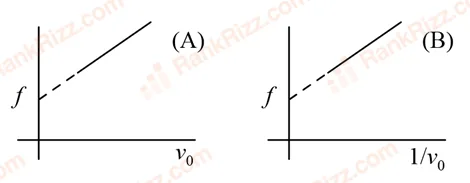
A source of sound emits sound waves at frequency f0f_0. It is moving towards an observer with fixed speed vsv_s (vs<v)(v_s < v), where vv is the speed of sound in air. If the observer were to move towards the source with speed v0v_0, one of the following two graphs (A and B) will give the correct variation of the frequency ff heard by the observer as v0v_0 is changed.

Figure for JEE Main 2015 Physics question on Doppler effect in sound

The variation of ff with v0v_0 is given correctly by:

  1. A

    Graph A with slope = f0(v−vs)\frac{f_0}{(v-v_s)}

  2. B

    Graph A with slope = f0(v+vs)\frac{f_0}{(v+v_s)}

  3. C

    Graph B with slope = f0(v−vs)\frac{f_0}{(v-v_s)}

  4. D

    Graph B with slope = f0(v+vs)\frac{f_0}{(v+v_s)}

JEE MAIN 2015 · 10 APR ONLINEDoppler effect in sound

A bat moving at 10 m s−1^{-1} towards a wall sends a sound signal of 8000 Hz towards it. On reflection, it hears a sound of frequency ff. The value of ff in Hz is close to (speed of sound = 320 m s−1^{-1})

  1. A

    8258

  2. B

    8424

  3. C

    8000

  4. D

    8516

JEE MAIN 2015 · 04 APR OFFLINEDoppler effect in sound

A train is moving on a straight track with speed 20 m s−1^{-1}. It is blowing its whistle at the frequency of 1000 Hz. The percentage change in the frequency heard by a person standing near the track as the train passes him is (speed of sound = 320 m s−1^{-1}) close to:

  1. A

    24%

  2. B

    6%

  3. C

    12%

  4. D

    18%

JEE MAIN 2014 · 19 APR ONLINESuperposition, interference and beats

The total length of a sonometer wire fixed between two bridges is 110 cm. Now, two more bridges are placed to divide the length of the wire in the ratio 6 : 3 : 2. If the tension in the wire is 400 N and the mass per unit length of the wire is 0.01 kg m−1^{-1}, then the minimum common frequency with which all the three parts can vibrate, is:

  1. A

    1000 Hz

  2. B

    1100 Hz

  3. C

    100 Hz

  4. D

    110 Hz

JEE MAIN 2014 · 12 APR ONLINEDoppler effect in sound

A source of sound A emitting waves of frequency 1800 Hz is falling towards ground with a terminal speed v. The observer B on the ground directly beneath the source receives waves of frequency 2150 Hz. The source A receives waves, reflected from ground of frequency nearly: (Speed of sound = 343 m/s)

  1. A

    2150 Hz

  2. B

    2500 Hz

  3. C

    1800 Hz

  4. D

    2400 Hz

JEE MAIN 2014 · 11 APR ONLINEDoppler effect in sound

Two factories are sounding their sirens at 800 Hz. A man goes from one factory to other at a speed of 2 m/s. The velocity of sound is 320 m/s. The number of beats heard by the person in one second will be:

  1. A

    2

  2. B

    4

  3. C

    8

  4. D

    10