A tuning fork of unknown frequency produces 5 beats s with a fork of known frequency 340 Hz. When fork is filed, the beat frequency decreases to 2 beats s. What is the frequency of fork ?
- A
335 Hz
- B
338 Hz
- C
345 Hz
- D
342 Hz
Every Waves question JEE Main has set from 2004–2026, grouped by the idea it tests rather than the order of the syllabus. 169 questions across 6 distinct ideas. Free to read, answer key on every one.
DATA UPDATED
Questions
169
Distinct ideas
6
Share of marks
2.2%
Difficulty
MEDIUM
A chapter is not one subject — it is a handful of procedures the examiner reuses. These are the ones Waves questions actually test.
81–100 OF 169 · NEWEST FIRST
A tuning fork of unknown frequency produces 5 beats s with a fork of known frequency 340 Hz. When fork is filed, the beat frequency decreases to 2 beats s. What is the frequency of fork ?
335 Hz
338 Hz
345 Hz
342 Hz
A student is performing the experiment of the resonance column. The diameter of the column tube is 6 cm. The frequency of the tuning fork is 504 Hz. Speed of the sound at the given temperature is 336 m s. The zero of the meter scale coincides with the top end of the resonance column tube. The reading of the water level in the column when the first resonance occurs is:
14.8 cm
18.4 cm
16.6 cm
13 cm
The percentage increase in the speed of transverse waves produced in a stretched string if the tension is increased by 4%, will be ______ %.
Which of the following equations represents a travelling wave?
Two cars are approaching each other at an equal speed of 7.2 km hr. When they see each other, both blow horns having a frequency of 676 Hz. The beat frequency heard by each driver will be ______ Hz. [Velocity of sound in air is 340 m s.]
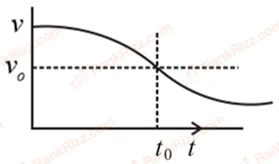
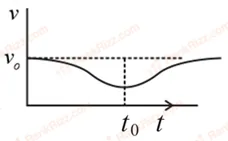
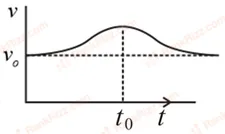
A sound source S is moving along a straight track with speed , and is emitting sound of frequency . An observer is standing at a finite distance, at the point O, from the track. The time variation of frequency heard by the observer is best represented by: ( represents the instant when the distance between the source and observer is minimum)


Assume that the displacement (s) of air is proportional to the pressure difference created by a sound wave. Displacement (s) further depends on the speed of sound (v), density of air () and the frequency (f). If , , , , then will be of the order of (take the multiplicative constant to be 1):
In a resonance tube experiment when the tube is filled with water up to a height of , from bottom, it resonates with a given tuning fork. When the water level is raised the next resonance with the same tuning fork occurs at a height of . If the velocity of sound in air is , the tuning fork frequency is:
A driver in a car, approaching a vertical wall notices that the frequency of his car horn has changed from Hz to Hz, when it gets reflected from the wall. If the speed of sound in air is , then the speed of the car is:
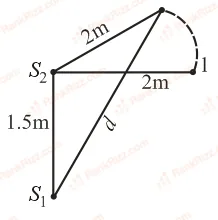
Two coherent sources of sound, and , produce sound waves of the same wavelength are in phase. and are placed apart (see fig). A listener, located at L, directly in front of , finds that the intensity is at a minimum when he is away from . The listener moves away from , keeping the distance from fixed. The adjacent maximum of intensity is observed when the listener is at a distance from . Then is:

12 m
5 m
2 m
3 m
For a transverse wave travelling along a straight line, the distance between two peaks (crests) is 5 m, while the distance between one crest and one trough is 1.5 m. The possible wavelengths (in m) of the waves are:
1, 3, 5
1, 2, 3, ....
The driver of bus approaching a big wall notices that the frequency of his bus's horn changes from 420 Hz to 490 Hz when he hears it after it gets reflected from the wall. Find the speed of the bus if speed of the sound is 330 ms:
91 kmh
81 kmh
61 kmh
71 kmh
A uniform thin rope of length 12 m and mass 6 kg hangs vertically from a rigid support and a block of mass 2 kg is attached to its free end. A transverse short wave train of wavelength 6 cm is produced at the lower end of the rope. What is the wavelength of the wave train (in cm) when it reaches the top of the rope?
3
6
12
9
Two identical strings X and Z made of same material have tension and in them. If their fundamental frequencies are 450 Hz and 300 Hz, respectively, then the ratio is:
2.25
0.44
1.25
1.5
A wire of density kg cm is stretched between two clamps 1 m apart. The resulting strain in the wire is . The lowest frequency of the transverse vibrations in the wire (Young's modulus of wire Nm), (to the nearest integer) is ___________.
Three harmonic waves having equal frequency and same intensity , have phase angles , and respectively. When they are superimposed the intensity of the resultant wave is close to:
A wire of length and mass per unit length kg m is put under tension of 540 N. Two consecutive frequencies that it resonates at are: 420 Hz and 490 Hz. Then in meters is:
2.1 m
1.1 m
8.1 m
5.1 m
A one metre long (both ends open) organ pipe is kept in a gas that has double the density of air at STP. Assuming the speed of sound in air at STP is 300 m/s, the frequency difference between the fundamental and second harmonic of this pipe is __________ Hz.
A transverse wave travels on a taut steel wire with a velocity of when tension in it is N. When the tension is changed to T, the velocity changed to . The value of T is close to:
N
N
N
N
Speed of a transverse wave on a straight wire (mass 6.0 g, length 60 cm and area of cross-section 1.0 mm) is 90 m s. If the Young's modulus of wire is N m, the extension of wire over its natural length is:
0.03 mm
0.02 mm
0.04 mm
0.01 mm
JEE Advanced has set 36 Waves questions too. Waves JEE Advanced PYQs →
OTHER PHYSICS CHAPTERS