RankRizz

Waves — JEE Main Previous Year Questions

Every Waves question JEE Main has set from 2004–2026, grouped by the idea it tests rather than the order of the syllabus. 169 questions across 6 distinct ideas. Free to read, answer key on every one.

DATA UPDATED

Questions

169

Distinct ideas

6

Share of marks

2.2%

Difficulty

MEDIUM

The ideas inside Waves

A chapter is not one subject — it is a handful of procedures the examiner reuses. These are the ones Waves questions actually test.

Every Waves question

101–120 OF 169 · NEWEST FIRST

JEE MAIN 2020 · 07 JAN S2Doppler effect in sound

A stationary observer receives sound from two identical tuning forks, one of which approaches and the other one recedes with the same speed (much less than the speed of sound). The observer hears 2 beats/sec. The oscillation frequency of each tuning fork is v0=1400v_0 = 1400 Hz and the velocity of sound in air is 350 m/s. The speed of each tuning fork is close to:

  1. A

    12\frac{1}{2} m/s

  2. B

    1 m/s

  3. C

    14\frac{1}{4} m/s

  4. D

    18\frac{1}{8} m/s

JEE MAIN 2019 · 12 APR S1Doppler effect in sound

A submarine A travelling at 18 km hr−1^{-1} is being chased along the line of its velocity by another submarine B travelling at 27 km hr−1^{-1}. B sends a sonar signal of 500 Hz to detect A and receives a reflected sound of frequency v. The value of v is close to (Speed of sound in water 1500 m s−1^{-1})

  1. A

    504 Hz

  2. B

    499 Hz

  3. C

    502 Hz

  4. D

    507 Hz

JEE MAIN 2019 · 12 APR S1Progressive waves: wave equation, phase and intensity

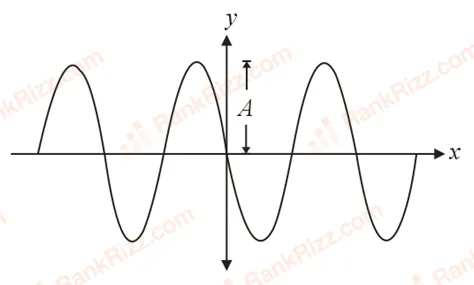
A progressive wave travelling along the positive x-direction is represented by y(x,t)=Asin⁡(kx−ωt+ϕ)y(x, t) = A\sin(kx - \omega t + \phi). Its snapshot at t = 0 is given in the figure.

Figure for JEE Main 2019 Physics question on Progressive waves: wave equation, phase and intensity

For this wave, the phase ϕ\phi is:

  1. A

    π2\frac{\pi}{2}

  2. B

    0

  3. C

    π\pi

  4. D

    −π2-\frac{\pi}{2}

JEE MAIN 2019 · 12 APR S2Progressive waves: wave equation, phase and intensity

A small speaker delivers 2 W of audio output. At what distance from the speaker will one detect 120 dB intensity sound? [Given reference intensity of sound as 10−1210^{-12} W/m2^2]

  1. A

    40 cm

  2. B

    20 cm

  3. C

    10 cm

  4. D

    30 cm

JEE MAIN 2019 · 12 APR S2Doppler effect in sound

Two sources of sound S1_1 and S2_2 produce sound waves of same frequency 660 Hz. A listener is moving from source S1_1 towards S2_2 with a constant speed u0_0 m/s and he hears 10 beats/s. The velocity of sound is 330 m/s. Then, u0_0 equals:

  1. A

    10.0 m/s

  2. B

    2.5 m/s

  3. C

    5.5 m/s

  4. D

    15.0 m/s

JEE MAIN 2019 · 12 APR S2Superposition, interference and beats

A tuning fork of frequency 480 Hz is used in an experiment for measuring speed of sound (v) in air by resonance tube method. Resonance is observed to occur at two successive lengths of the air column, l1_1 = 30 cm and l2_2 = 70 cm. Then, v is equal to:

  1. A

    384 m s−1^{-1}

  2. B

    332 m s−1^{-1}

  3. C

    338 m s−1^{-1}

  4. D

    379 m s−1^{-1}

JEE MAIN 2019 · 10 APR S1Doppler effect in sound

A stationary source emits sound waves of frequency 500 Hz. Two observers moving along a line passing through the source detect sound to be of frequencies 480 Hz and 530 Hz. Their respective speeds are, in m s−1^{-1},
(Given speed of sound = 300 m/s)

  1. A

    16, 14

  2. B

    12, 16

  3. C

    12, 18

  4. D

    8, 18

JEE MAIN 2019 · 10 APR S2Doppler effect in sound

A source of sound S is moving with a velocity of 50 m s−1^{-1} towards a stationary observer. The observer measures the frequency of the source as 1000 Hz. What will be the apparent frequency of the source when it is moving away from the observer after crossing him? (Take velocity of sound in air is 350 m s−1^{-1})

  1. A

    750 Hz

  2. B

    857 Hz

  3. C

    1143 Hz

  4. D

    807 Hz

JEE MAIN 2019 · 10 APR S2Organ pipes and resonance columns

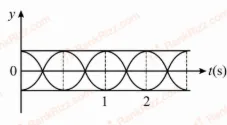
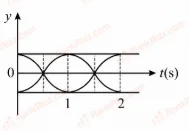
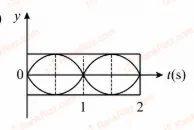
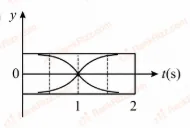
The correct figure that shows, schematically, the wave pattern produced by the superposition of two waves of frequencies 9 Hz and 11 Hz, is

  1. A
    Figure for JEE Main 2019 Physics question on Organ pipes and resonance columns
  2. B
    Figure for JEE Main 2019 Physics question on Organ pipes and resonance columns
  3. C
    Figure for JEE Main 2019 Physics question on Organ pipes and resonance columns
  4. D
    Figure for JEE Main 2019 Physics question on Organ pipes and resonance columns
JEE MAIN 2019 · 09 APR S1Superposition, interference and beats

A string is clamped at both the ends and it is vibrating in its 4th harmonic. The equation of the stationary wave is y=0.3sin⁡(0.157x)cos⁡(200πt)y = 0.3 \sin(0.157x) \cos(200\pi t). The length of the string is: (All quantities are in SI units.)

  1. A

    20 m

  2. B

    60 m

  3. C

    40 m

  4. D

    80 m

JEE MAIN 2019 · 09 APR S1Progressive waves: wave equation, phase and intensity

The pressure wave, P=0.01sin⁡[1000t−3x]P = 0.01 \sin[1000t - 3x] N m−2^{-2}, corresponds to the sound produced by a vibrating blade on a day when atmospheric temperature is 0°C. On some other day when temperature is T, the speed of sound produced by the same blade and at the same frequency is found to be 336 m s−1^{-1}. Approximate value of T is:

  1. A

    12°C

  2. B

    15°C

  3. C

    4°C

  4. D

    11°C

JEE MAIN 2019 · 09 APR S2Doppler effect in sound

Two cars A and B are moving away from each other in opposite directions. Both the cars are moving with speed of 20 m s−1^{-1} with respect to the ground. If an observer in car A detects a frequency 2000 Hz of the sound coming from car B, what is the natural frequency of the sound source in car B? (speed of sound in air = 340 m s−1^{-1})

  1. A

    2150 Hz

  2. B

    2300 Hz

  3. C

    2250 Hz

  4. D

    2060 Hz

JEE MAIN 2019 · 09 APR S2Superposition, interference and beats

A string 2.0 m long and fixed at its ends is driven by a 240 Hz vibrator. The string vibrates in its third harmonic mode. The speed of the wave and its fundamental frequency is:

  1. A

    320 m s−1^{-1}, 120 Hz

  2. B

    320 m s−1^{-1}, 80 Hz

  3. C

    180 m s−1^{-1}, 80 Hz

  4. D

    180 m s−1^{-1}, 120 Hz

JEE MAIN 2019 · 08 APR S1Superposition, interference and beats

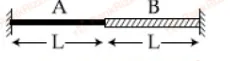
A wire of length 2L, is made by joining two wires A and B of same length but different radii r and 2r and made of the same material. It is vibrating at a frequency such that the joint of the two wires forms a node. If the number of antinodes in wire A is p and that in B is q then ratio p:q is:

Figure for JEE Main 2019 Physics question on Superposition, interference and beats
  1. A

    3 : 5

  2. B

    4 : 9

  3. C

    1 : 4

  4. D

    1 : 2

JEE MAIN 2019 · 12 JAN S1Progressive waves: wave equation, phase and intensity

A travelling harmonic wave is represented by the equation y(x,t)=10−3sin⁡(50t+2x)y(x, t) = 10^{-3} \sin(50t + 2x), where x and y are in meter and t is in seconds. Which of the following is a correct statement about the wave?

  1. A

    The wave is propagating along the positive x-axis with speed 25 m s−1^{-1}

  2. B

    The wave is propagating along the positive x-axis with speed 100 m s−1^{-1}

  3. C

    The wave is propagating along the negative x-axis with speed 25 m s−1^{-1}

  4. D

    The wave is propagating along the negative x-axis with speed 100 m s−1^{-1}

JEE MAIN 2019 · 12 JAN S2Superposition, interference and beats

A resonance tube is old and has a jagged end. It is still used in the laboratory to determine the velocity of sound in air. A tuning fork of frequency 512 Hz produces first resonance when the tube is filled with water to a mark 11 cm below a reference mark, near the open end of the tube. The experiment is repeated with another fork of frequency 256 Hz which produces first resonance when water reaches a mark 27 cm below the reference mark. The velocity of sound in air, obtained in the experiment, is close to

  1. A

    335 m s−1^{-1}

  2. B

    341 m s−1^{-1}

  3. C

    322 m s−1^{-1}

  4. D

    328 m s−1^{-1}

JEE MAIN 2019 · 11 JAN S1Progressive waves: wave equation, phase and intensity

Equation of travelling wave on a stretched string of linear density 5 g/m is y=0.03sin⁡(450t−9x)y = 0.03 \sin(450t - 9x) where distance and time are measured in SI units. The tension in the string is:

  1. A

    10 N

  2. B

    7.5 N

  3. C

    12.5 N

  4. D

    5 N

JEE MAIN 2019 · 10 JAN S1Doppler effect in sound

A train moves towards a stationary observer with speed 34 m/s. The train sounds a whistle and its frequency registered by the observer is f1f_1. If the speed of the train is reduced to 17 m/s, the frequency registered is f2f_2. If speed of sound is 340 m/s, then the ratio f1/f2f_1/f_2 is:

  1. A

    21/20

  2. B

    20/19

  3. C

    19/18

  4. D

    18/17

JEE MAIN 2019 · 10 JAN S1Progressive waves: wave equation, phase and intensity

A string of length 1 m and mass 5 g is fixed at both ends. The tension in the string is 8.0 N. The string is set into vibration using an external vibrator of frequency 100 Hz. The separation between successive nodes on the string is close to:

  1. A

    20.0 cm

  2. B

    10.0 cm

  3. C

    16.6 cm

  4. D

    33.3 cm

JEE MAIN 2019 · 10 JAN S2Superposition, interference and beats

A closed organ pipe has a fundamental frequency of 1.5 kHz. The number of overtones that can be distinctly heard by a person with this organ pipe will be (Assume that the highest frequency a person can hear is 20,000 Hz).

  1. A

    7

  2. B

    4

  3. C

    6

  4. D

    5