RankRizz

Centre of Mass, Momentum & Collisions — JEE Main Previous Year Questions

Every Centre of Mass, Momentum & Collisions question JEE Main has set from 2004–2026, grouped by the idea it tests rather than the order of the syllabus. 135 questions across 8 distinct ideas. Free to read, answer key on every one.

DATA UPDATED

Questions

135

Distinct ideas

8

Share of marks

1.4%

Difficulty

MEDIUM

The ideas inside Centre of Mass, Momentum & Collisions

A chapter is not one subject — it is a handful of procedures the examiner reuses. These are the ones Centre of Mass, Momentum & Collisions questions actually test.

Every Centre of Mass, Momentum & Collisions question

81–100 OF 135 · NEWEST FIRST

JEE MAIN 2020 · 08 JAN S1Head-on collisions and coefficient of restitution

A body A of mass m=0.1m = 0.1 kg has an initial velocity of 3i^3\hat{i} m s−1^{-1}. It collides elastically with another body B of the same mass which has an initial velocity of 5j^5\hat{j} m s−1^{-1}. After the collision, A moves with a velocity v⃗=4(i^+j^)\vec{v} = 4(\hat{i} + \hat{j}) m s−1^{-1}. The energy of B after the collision is written as x10\frac{x}{10} J. The value of xx is

JEE MAIN 2020 · 08 JAN S2Centre of mass of continuous bodies and cavities

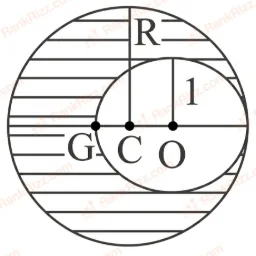
As shown in figure. When a spherical cavity (centred at O) of radius 1 is cut out of a uniform sphere of radius R (centred at C), the centre of mass of remaining (shaded part of sphere is at G, i.e., on the surface of the cavity. R can be determined by the equation:

Figure for JEE Main 2020 Physics question on Centre of mass of continuous bodies and cavities
  1. A

    (R2+R+1)(2−R)=1(R^2 + R + 1)(2 - R) = 1

  2. B

    (R2−R−1)(2−R)=1(R^2 - R - 1)(2 - R) = 1

  3. C

    (R2−R+1)(2−R)=1(R^2 - R + 1)(2 - R) = 1

  4. D

    (R2+R−1)(2−R)=1(R^2 + R - 1)(2 - R) = 1

JEE MAIN 2020 · 08 JAN S2Motion of centre of mass, momentum conservation and explosions

A particle of mass mm is dropped from a height hh above the ground. At the same time another particle of the same mass is thrown vertically upwards from the ground with a speed of 2gh\sqrt{2gh}. If they collide head-on completely inelastically, the time taken for the combined mass to reach the ground, in units of hg\sqrt{\frac{h}{g}} is

  1. A

    12\sqrt{\frac{1}{2}}

  2. B

    34\sqrt{\frac{3}{4}}

  3. C

    12\frac{1}{2}

  4. D

    32\sqrt{\frac{3}{2}}

JEE MAIN 2020 · 07 JAN S1Centre of mass of a system of particles

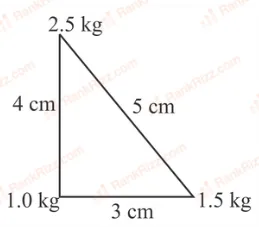
Three point particles of masses 1.0 kg, 1.5 kg and 2.5 kg are placed at three corners of a right angle triangle of sides 4.0 cm, 3.0 cm and 5.0 cm as shown in the figure. The centre of mass of the system is at a point:

Figure for JEE Main 2020 Physics question on Centre of mass of a system of particles
  1. A

    0.6 cm right and 2.0 cm above 1 kg mass.

  2. B

    1.5 cm right and 1.2 cm above 1 kg mass.

  3. C

    2.0 cm right and 0.9 cm above 1 kg mass.

  4. D

    0.9 cm right and 2.0 cm above 1 kg mass.

JEE MAIN 2019 · 12 APR S1Impulse and impulse-momentum theorem

A man (mass = 50 kg) and his son (mass = 20 kg) are standing on a frictionless surface facing each other. The man pushes his son so that he starts moving at a speed of 0.70 m s−1^{-1} with respect to the man. The speed of the man with respect to the surface is:

  1. A

    0.20 m s−1^{-1}

  2. B

    0.14 m s−1^{-1}

  3. C

    0.47 m s−1^{-1}

  4. D

    0.28 m s−1^{-1}

JEE MAIN 2019 · 12 APR S2Centre of mass of a system of particles

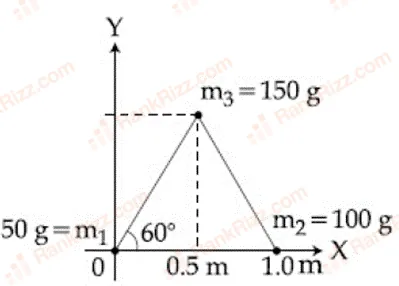
Three particles of masses 50 g, 100 g and 150 g are placed at the vertices of an equilateral triangle of side 1 m (as shown in the figure). The (x, y) coordinates of the centre of mass will be:

Figure for JEE Main 2019 Physics question on Centre of mass of a system of particles
  1. A

    (712 m,  34 m)\left(\frac{7}{12}\text{ m},\; \frac{\sqrt{3}}{4}\text{ m}\right)

  2. B

    (712 m,  38 m)\left(\frac{7}{12}\text{ m},\; \frac{\sqrt{3}}{8}\text{ m}\right)

  3. C

    (34 m,  512 m)\left(\frac{\sqrt{3}}{4}\text{ m},\; \frac{5}{12}\text{ m}\right)

  4. D

    (38 m,  712 m)\left(\frac{\sqrt{3}}{8}\text{ m},\; \frac{7}{12}\text{ m}\right)

JEE MAIN 2019 · 10 APR S1Head-on collisions and coefficient of restitution

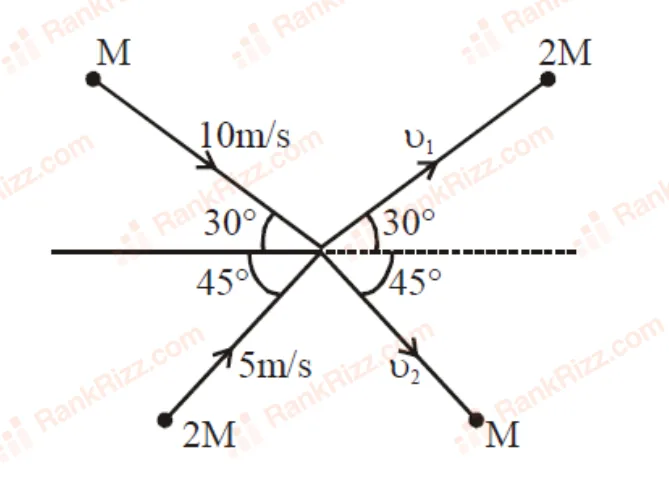
Two particles, of masses MM and 2M2M, moving, as shown, with speeds of 10m/s10m/s and 5m/s5m/s, collide elastically at the origin. After the collision, they move along the indicated directions with speeds υ1υ_1  and υ2υ_2​, respectively. The values of υ1υ_1 and υ2υ_2 are nearly : 

Figure for JEE Main 2019 Physics question on Head-on collisions and coefficient of restitution
  1. A

    6.5 m s−1^{-1} and 6.3 m s−1^{-1}

  2. B

    3.2 m s−1^{-1} and 12.6 m s−1^{-1}

  3. C

    13.02 m s−1^{-1} and 19.7 m s−1^{-1}

  4. D

    3.2 m s−1^{-1} and 6.3 m s−1^{-1}

JEE MAIN 2019 · 09 APR S1Impulse and impulse-momentum theorem

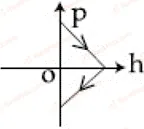
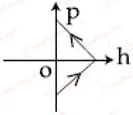
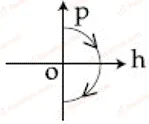
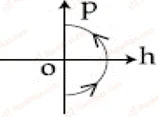
A ball is thrown vertically up (taken as +z-axis) from the ground. The correct momentum-height (p-h) diagram is:

  1. A
    Figure for JEE Main 2019 Physics question on Impulse and impulse-momentum theorem
  2. B
    Figure for JEE Main 2019 Physics question on Impulse and impulse-momentum theorem
  3. C
    Figure for JEE Main 2019 Physics question on Impulse and impulse-momentum theorem
  4. D
    Figure for JEE Main 2019 Physics question on Impulse and impulse-momentum theorem
JEE MAIN 2019 · 09 APR S1Head-on collisions and coefficient of restitution

A body of mass 2 kg makes an elastic collision with a second body at rest and continues to move in the original direction but with one fourth of its original speed. What is the mass of the second body?

  1. A

    1.8 kg

  2. B

    1.2 kg

  3. C

    1.0 kg

  4. D

    1.5 kg

JEE MAIN 2019 · 09 APR S2Motion of centre of mass, momentum conservation and explosions

A wedge of mass M=4mM = 4m lies on a frictionless plane. A particle of mass mm approaches the wedge with speed vv. There is no friction between the particle and the plane or between the particle and the wedge. The maximum height climbed by the particle on the wedge is given by:

  1. A

    v2g\frac{v^2}{g}

  2. B

    v22g\frac{v^2}{2g}

  3. C

    2v25g\frac{2v^2}{5g}

  4. D

    2v27g\frac{2v^2}{7g}

JEE MAIN 2019 · 09 APR S2Head-on collisions and coefficient of restitution

A particle of mass mm is moving with speed 2v2v and collides with a mass 2m2m moving with speed vv in the same direction. After the collision, the first mass is stopped completely while the second one splits into two particles each of mass mm, which move at an angle 45° with respect to the original direction. The speed of each of the moving particle will be:

  1. A

    2v\sqrt{2}v

  2. B

    v2\frac{v}{\sqrt{2}}

  3. C

    22v2\sqrt{2}v

  4. D

    v22\frac{v}{2\sqrt{2}}

JEE MAIN 2019 · 08 APR S1Motion of centre of mass, momentum conservation and explosions

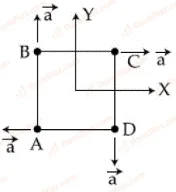
Four particles A, B, C and D with masses mA=mm_A = m, mB=2mm_B = 2m, mC=3mm_C = 3m and mD=4mm_D = 4m are at the corners of a square. They have accelerations of equal magnitude with directions as shown. The acceleration of the centre of mass of the particles is:

Figure for JEE Main 2019 Physics question on Motion of centre of mass, momentum conservation and explosions
  1. A

    a5(i^+j^)\frac{a}{5}(\hat{i} + \hat{j})

  2. B

    a5(i^−j^)\frac{a}{5}(\hat{i} - \hat{j})

  3. C

    a(i^+j^)a(\hat{i} + \hat{j})

  4. D

    Zero

JEE MAIN 2019 · 08 APR S2Centre of mass of continuous bodies and cavities

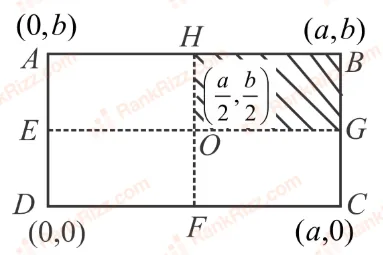
A uniform rectangular thin sheet ABCDABCD of mass MM has length aa and breadth bb, as shown in the figure. If the shaded portion HBGOHBGO is cut-off, the coordinates of the centre of mass of the remaining portion will be:

Figure for JEE Main 2019 Physics question on Centre of mass of continuous bodies and cavities
  1. A

    (5a12,5b12)\left(\frac{5a}{12}, \frac{5b}{12}\right)

  2. B

    (5a3,5b3)\left(\frac{5a}{3}, \frac{5b}{3}\right)

  3. C

    (2a3,2b3)\left(\frac{2a}{3}, \frac{2b}{3}\right)

  4. D

    (3a4,3b4)\left(\frac{3a}{4}, \frac{3b}{4}\right)

JEE MAIN 2019 · 08 APR S2Head-on collisions and coefficient of restitution

A body of mass m1m_1 moving with an unknown velocity of v1i^v_1 \hat{i}, undergoes a collinear collision with a body of mass m2m_2 moving with a velocity v2i^v_2 \hat{i}. After the collision, m1m_1 and m2m_2 move with velocities of v3i^v_3 \hat{i} and v4i^v_4 \hat{i}, respectively. If m2=0.5m1m_2 = 0.5 m_1 and v3=0.5v1v_3 = 0.5 v_1, then v1v_1 is:

  1. A

    v4−v24v_4 - \frac{v_2}{4}

  2. B

    v4−v22v_4 - \frac{v_2}{2}

  3. C

    v4+v2v_4 + v_2

  4. D

    v4−v2v_4 - v_2

JEE MAIN 2019 · 12 JAN S1Head-on collisions and coefficient of restitution

A simple pendulum, made of a string of length ll and a bob of mass mm, is released from a small angle θ0\theta_0. It strikes a block of mass MM, kept on horizontal surface at its lowest point of oscillations, elastically. It bounces back and goes up to an angle θ1\theta_1. Then M is given by:

  1. A

    m(θ0−θ1θ0+θ1)m\left(\frac{\theta_0 - \theta_1}{\theta_0 + \theta_1}\right)

  2. B

    m(θ0+θ1θ0−θ1)m\left(\frac{\theta_0 + \theta_1}{\theta_0 - \theta_1}\right)

  3. C

    m2(θ0+θ1θ0−θ1)\frac{m}{2}\left(\frac{\theta_0 + \theta_1}{\theta_0 - \theta_1}\right)

  4. D

    m2(θ0−θ1θ0+θ1)\frac{m}{2}\left(\frac{\theta_0 - \theta_1}{\theta_0 + \theta_1}\right)

JEE MAIN 2019 · 12 JAN S1Centre of mass of a system of particles

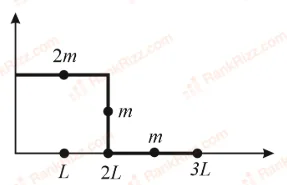
The position vector of the center of mass rcm⃗\vec{r_{cm}} of an asymmetric uniform bar of negligible area of cross-section as shown in figure is:

Figure for JEE Main 2019 Physics question on Centre of mass of a system of particles
  1. A

    rcm⃗=138Lx^+58Ly^\vec{r_{cm}} = \frac{13}{8}L\hat{x} + \frac{5}{8}L\hat{y}

  2. B

    rcm⃗=58Lx^+138Ly^\vec{r_{cm}} = \frac{5}{8}L\hat{x} + \frac{13}{8}L\hat{y}

  3. C

    rcm⃗=38Lx^+118Ly^\vec{r_{cm}} = \frac{3}{8}L\hat{x} + \frac{11}{8}L\hat{y}

  4. D

    rcm⃗=118Lx^+38Ly^\vec{r_{cm}} = \frac{11}{8}L\hat{x} + \frac{3}{8}L\hat{y}

JEE MAIN 2019 · 12 JAN S2Head-on collisions and coefficient of restitution

An alpha-particle of mass m suffers 1-dimensional elastic collision with a nucleus at rest of unknown mass. It is scattered directly backwards losing 64% of its initial kinetic energy. The mass of the nucleus is

  1. A

    1.5m

  2. B

    4m

  3. C

    3.5m

  4. D

    5m

JEE MAIN 2019 · 11 JAN S1Head-on collisions and coefficient of restitution

A body of mass 1 kg falls freely from a height of 100 m, on a platform of mass 3 kg which is mounted on a spring having spring constant k=1.25×10⁶k = 1.25 \times 10^6 N/m. The body sticks to the platform and the spring's maximum compression is found to be xx. Given that g=10 ms−2g = 10 \text{ ms}^{-2}, the value of xx will be close to:

  1. A

    40 cm

  2. B

    4 cm

  3. C

    80 cm

  4. D

    8 cm

JEE MAIN 2019 · 11 JAN S2Impulse and impulse-momentum theorem

A particle of mass m is moving in a straight line with momentum p. Starting at time t=0t = 0, a force F=ktF = kt acts in the same direction on the moving particle during time interval T so that its momentum changes from p to 3p. Here k is a constant. The value of T is

  1. A

    2kp2\sqrt{\frac{k}{p}}

  2. B

    2pk2\sqrt{\frac{p}{k}}

  3. C

    2kp\sqrt{\frac{2k}{p}}

  4. D

    2pk\sqrt{\frac{2p}{k}}

JEE MAIN 2019 · 10 JAN S1Head-on collisions and coefficient of restitution

A piece of wood of mass 0.03 kg is dropped from the top of a 100 m height building. At the same time, a bullet of mass 0.02 kg is fired vertically upward, with a velocity 100 ms−1^{-1}, from the ground. The bullet gets embedded in the wood. Then the maximum height to which the combined system reaches above the top of the building before falling below is: (g=10g = 10 ms−2^{-2})

  1. A

    40 m

  2. B

    20 m

  3. C

    10 m

  4. D

    30 m