RankRizz

Head-on collisions and coefficient of restitution — JEE Main Previous Year Questions

Head-on collisions and coefficient of restitution has been asked 48 times in JEE Main, in 16 different years between 2008 and 2026, and in all of the last five exam years (2022–2026), 12 questions in all. That is 36% of Centre of Mass, Momentum & Collisions, its most-asked topic. Last asked in JEE Main 23 Jan 2026, Shift 1. 41 are multiple choice and 7 numerical-value; 10 easy and 34 medium by our difficulty labels. All of them are below, newest first, free to read.

Questions

48

Years asked

16

Since

2008

Of the chapter

36%

When JEE Main asked it

Questions on Head-on collisions and coefficient of restitution in every year it was asked, newest first.

JEE Main questions on Head-on collisions and coefficient of restitution by year, 2008–2026
YearRelative frequencyQuestions
20262
20252
20242
20234
20222
20218
20208
20199
20182
20171
20152
20142
20131
20121
20101
20081
Total48

Every Head-on collisions and coefficient of restitution question

1–20 OF 48 · NEWEST FIRST

JEE MAIN 2026 · 23 JAN S1Head-on collisions and coefficient of restitution

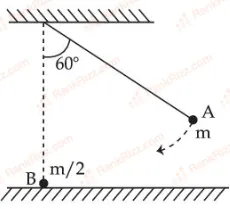
A small bob A of mass m is attached to a massless rigid rod of length 1 m pivoted at point P and kept at an angle of 60° with vertical as shown in figure. At distance of 1 m below point P, an identical bob B is kept at rest on a smooth horizontal surface that extends to a circular track of radius R as shown in figure. If bob B just manages to complete the circular path of radius R upto a point Q after being hit elastically by bob A, then radius R is ____ m.
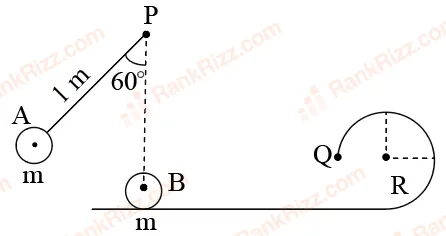
Figure for JEE Main 2026 Physics question on Head-on collisions and coefficient of restitution
  1. A

    2+35\frac{2+\sqrt{3}}{5}

  2. B

    2−35\frac{2-\sqrt{3}}{5}

  3. C

    35\frac{3}{5}

  4. D

    15\frac{1}{5}

JEE MAIN 2026 · 23 JAN S1Head-on collisions and coefficient of restitution

In a perfectly inelastic collision, two spheres made of the same material with masses 15 kg and 25 kg, moving in opposite directions with speeds of 10 m/s and 30 m/s, respectively, strike each other and stick together. The rise in temperature (in ∘C^{\circ}C), if all the heat produced during the collision is retained by these spheres, is :
(specific heat of sphere material 31 cal/kg.∘C^{\circ}C and 1 cal =4.2 J)

  1. A

    1.75

  2. B

    1.15

  3. C

    1.95

  4. D

    1.44

JEE MAIN 2025 · 29 JAN S1Head-on collisions and coefficient of restitution

As shown below, bob A of a pendulum having massless string of length 'R' is released from 60∘60^{\circ} to the vertical. It hits another bob B of half the mass that is at rest on a friction less table in the center. Assuming elastic collision, the magnitude of the velocity of bob A after the collision will be (take g as acceleration due to gravity.)

page4_img1
  1. A

    43Rg\frac{4}{3}\sqrt{Rg}

  2. B

    23Rg\frac{2}{3}\sqrt{Rg}

  3. C

    Rg\sqrt{Rg}

  4. D

    13Rg\frac{1}{3}\sqrt{Rg}

JEE MAIN 2025 · 29 JAN S2Head-on collisions and coefficient of restitution

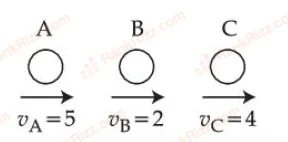
Given below are two statements. One is labelled as Assertion (A) and the other is labelled as Reason (R).

page3_img1


Assertion (A) :
Three identical spheres of same mass undergo one dimensional motion as shown in figure with initial velocities vA=5 m/s,  vB=2 m/s,  vC=4 m/sv_A = 5\,\text{m/s},\; v_B = 2\,\text{m/s},\; v_C = 4\,\text{m/s}. If we wait sufficiently long for elastic collision to happen, then vA=4 m/s,  vB=2 m/s,  vC=5 m/sv_A = 4\,\text{m/s},\; v_B = 2\,\text{m/s},\; v_C = 5\,\text{m/s}, will be the final velocities.
Reason (R): In an elastic collision between identical masses, two objects exchange their velocities. In the light of the above statements, choose the correct answer from the options given below :

  1. A

    (A) is false but (R) is true

  2. B

    Both (A) and (R) are true but (R) is NOT the correct explanation of (A)

  3. C

    Both (A) and (R) are true and (R) is the correct explanation of (A)

  4. D

    (A) is true but (R) is false

JEE MAIN 2024 · 08 APR S1Head-on collisions and coefficient of restitution

A stationary particle breaks into two parts of masses mAm_A and mBm_B which move with velocities vAv_A and vBv_B respectively. The ratio of their kinetic energies (KB:KA)(K_B : K_A) is :

  1. A

    vB:vAv_B : v_A

  2. B

    mB:mAm_B : m_A

  3. C

    mBvB:mAvAm_B v_B : m_A v_A

  4. D

    1:11 : 1

JEE MAIN 2024 · 01 FEB S1Head-on collisions and coefficient of restitution

A simple pendulum of length 11 m has a wooden bob of mass 11 kg. It is struck by a bullet of mass 10−210^{-2} kg moving with a speed of 2×10²² \times 10^{2} m s−1^{-1}. The bullet gets embedded into the bob. The height to which the bob rises before swinging back is. (use g=10g = 10 m s−2^{-2})

  1. A

    0.300.30 m

  2. B

    0.200.20 m

  3. C

    0.350.35 m

  4. D

    0.400.40 m

JEE MAIN 2023 · 10 APR S1Head-on collisions and coefficient of restitution

A particle of mass mm moving with velocity vv collides with a stationary particle of mass 2m2m. After collision, they stick together and continue to move together with velocity

  1. A

    v3\frac{v}{3}

  2. B

    v4\frac{v}{4}

  3. C

    vv

  4. D

    v2\frac{v}{2}

JEE MAIN 2023 · 31 JAN S2Head-on collisions and coefficient of restitution

A ball is dropped from a height of 20 m. If the coefficient of restitution for the collision between ball and floor is 0.5, after hitting the floor, the ball rebounds to a height of ______ m.

JEE MAIN 2023 · 30 JAN S1Head-on collisions and coefficient of restitution

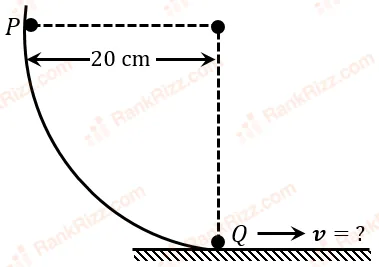
As per the given figure, a small ball PP slides down the quadrant of a circle and hits the other ball QQ of equal mass which is initially at rest. Neglecting the effect of friction and assume the collision to be elastic, the velocity of ball QQ after collision will be: (g=10g = 10 m s−2^{-2})

Figure for JEE Main 2023 Physics question on Head-on collisions and coefficient of restitution
  1. A

    00

  2. B

    0.250.25 m s−1^{-1}

  3. C

    22 m s−1^{-1}

  4. D

    44 m s−1^{-1}

JEE MAIN 2023 · 25 JAN S2Head-on collisions and coefficient of restitution

A body of mass 1 kg collides head on elastically with a stationary body of mass 3 kg. After collision, the smaller body reverses its direction of motion and moves with a speed of 2 m s−1^{-1}. The initial speed of the smaller body before collision is _____ m s−1^{-1}.

JEE MAIN 2022 · 25 JUL S2Head-on collisions and coefficient of restitution

Two billiard balls of mass 0.05 kg0.05 \text{ kg} each moving in opposite directions with 10 m s−110 \text{ m s}^{-1} collide and rebound with the same speed. If the time duration of contact is t=0.005 st = 0.005 \text{ s}, then what is the force exerted on the ball due to each other?

  1. A

    100 N100 \text{ N}

  2. B

    200 N200 \text{ N}

  3. C

    300 N300 \text{ N}

  4. D

    400 N400 \text{ N}

JEE MAIN 2022 · 27 JUN S1Head-on collisions and coefficient of restitution

What percentage of kinetic energy of a moving particle is transferred to a stationary particle when it strikes the stationary particle of 55 times its mass?
(Assume the collision to be head-on elastic collision)

  1. A

    50.0%50.0\%

  2. B

    66.6%66.6\%

  3. C

    55.6%55.6\%

  4. D

    33.3%33.3\%

JEE MAIN 2021 · 31 AUG S1Head-on collisions and coefficient of restitution

A body of mass MM moving at speed V0V_0 collides elastically with a mass mm at rest. After the collision, the two masses move at angles θ1\theta_1 and θ2\theta_2 with respect to the initial direction of motion of the body of mass MM. The largest possible value of the ratio Mm\frac{M}{m}, for which the angles θ1\theta_1 and θ2\theta_2 will be equal, is:

  1. A

    3

  2. B

    4

  3. C

    2

  4. D

    1

JEE MAIN 2021 · 31 AUG S1Head-on collisions and coefficient of restitution

A block moving horizontally on a smooth surface with a speed of 40 m s−1^{-1} splits into two equal parts. If one of the parts moves at 60 m s−1^{-1} in the same direction, then the fractional change in the kinetic energy will be x:4x : 4 where xx = _________.

JEE MAIN 2021 · 31 AUG S2Head-on collisions and coefficient of restitution

A block moving horizontally on a smooth surface with a speed of 40 m s−1^{-1} splits into two parts with masses in the ratio of 1 : 2. If the smaller part moves at 60 m s−1^{-1} in the same direction, then the fractional change in kinetic energy is:

  1. A

    13\frac{1}{3}

  2. B

    23\frac{2}{3}

  3. C

    14\frac{1}{4}

  4. D

    18\frac{1}{8}

JEE MAIN 2021 · 27 AUG S2Head-on collisions and coefficient of restitution

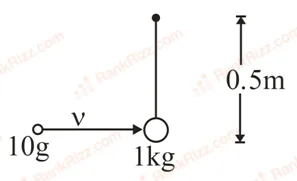
A bullet of 10 g, moving with velocity vv, collides head-on with the stationary bob of a pendulum and recoils with velocity 100 m s−1^{-1}. The length of the pendulum is 0.5 m and mass of the bob is 1 kg. The minimum value of vv in m s−1^{-1}, so that the pendulum describes a circle. (Assume the string to be inextensible and g = 10 m s−2^{-2})

Figure for JEE Main 2021 Physics question on Head-on collisions and coefficient of restitution
JEE MAIN 2021 · 27 JUL S1Head-on collisions and coefficient of restitution

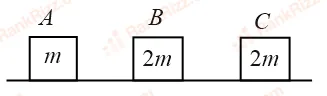
Three objects AA, BB and CC are kept in a straight line on a frictionless horizontal surface. The masses of AA, BB and CC are mm, 2m2m and 2m2m respectively. AA moves towards BB with a speed of 9 m s−1^{-1} and makes an elastic collision with it. Thereafter BB makes a completely inelastic collision with CC. All motions occur along the same straight line. The final speed of CC is:

Figure for JEE Main 2021 Physics question on Head-on collisions and coefficient of restitution
  1. A

    6 m s−1^{-1}

  2. B

    9 m s−1^{-1}

  3. C

    4 m s−1^{-1}

  4. D

    3 m s−1^{-1}

JEE MAIN 2021 · 18 MAR S2Head-on collisions and coefficient of restitution

An object of mass m1m_1 collides with another object of mass m2m_2, which is at rest. After the collision the objects move with equal speeds in opposite direction. The ratio of the masses m2:m1m_2 : m_1 is :

  1. A

    3 : 1

  2. B

    2 : 1

  3. C

    1 : 2

  4. D

    1 : 1

JEE MAIN 2021 · 16 MAR S2Head-on collisions and coefficient of restitution

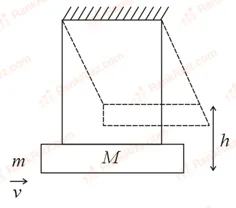
A large block of wood of mass M=5.99M = 5.99 kg is hanging from two long massless cords. A bullet of mass m=10m = 10 g is fired into the block and gets embedded in it. The (block + bullet) then swing upwards, their center of mass rising a vertical distance h=9.8h = 9.8 cm before the (block + bullet) pendulum comes momentarily to rest at the end of its arc. The speed of the bullet just before the collision is: (Take g=9.8g = 9.8 m s−2^{-2})

Figure for JEE Main 2021 Physics question on Head-on collisions and coefficient of restitution
  1. A

    841.4 m s−1^{-1}

  2. B

    811.4 m s−1^{-1}

  3. C

    831.4 m s−1^{-1}

  4. D

    821.4 m s−1^{-1}

JEE MAIN 2021 · 24 FEB S1Head-on collisions and coefficient of restitution

A ball with a speed of 9 m s−1^{-1} collides with another identical ball at rest. After the collision, the direction of each ball makes an angle of 30° with the original direction. If the ratio of the velocities of the balls after the collision is x:yx : y, then what is the value of xx?

Head-on collisions and coefficient of restitution: common questions

How many Head-on collisions and coefficient of restitution questions have come in JEE Main?
Head-on collisions and coefficient of restitution has been asked 48 times in JEE Main, in 16 different years between 2008 and 2026. It came up in all of the last five exam years (2022–2026), 12 questions in all.
Is Head-on collisions and coefficient of restitution important for JEE Main?
It is the most-asked topic in Centre of Mass, Momentum & Collisions: 48 of the chapter's 135 JEE Main questions (36%). It came up in all of the last five exam years (2022–2026), 12 questions in all.
When was Head-on collisions and coefficient of restitution last asked in JEE Main?
Most recently in JEE Main 23 Jan 2026, Shift 1. Questions on this page are newest first, so the latest ones are at the top.
What kind of Head-on collisions and coefficient of restitution questions does JEE Main ask?
41 are multiple choice and 7 numerical-value; 10 easy and 34 medium by our difficulty labels. Each question shows its answer key and worked solution where we have them.