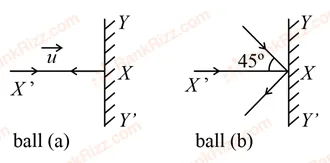
Two billiard balls of mass each moving in opposite directions with collide and rebound with the same speed. If the time duration of contact is , then what is the force exerted on the ball due to each other?
- A
- B
- C
- D
Every Centre of Mass, Momentum & Collisions question JEE Main has set from 2004–2026, grouped by the idea it tests rather than the order of the syllabus. 135 questions across 8 distinct ideas. Free to read, answer key on every one.
DATA UPDATED
Questions
135
Distinct ideas
8
Share of marks
1.4%
Difficulty
MEDIUM
A chapter is not one subject — it is a handful of procedures the examiner reuses. These are the ones Centre of Mass, Momentum & Collisions questions actually test.
41–60 OF 135 · NEWEST FIRST
Two billiard balls of mass each moving in opposite directions with collide and rebound with the same speed. If the time duration of contact is , then what is the force exerted on the ball due to each other?
Three identical spheres each of mass are placed at the corners of a right angled triangle with mutually perpendicular sides equal to each. Taking point of intersection of mutually perpendicular sides as origin, the magnitude of position vector of centre of mass of the system will be m. The value of is ______.
A body of mass at rest explodes into three pieces, in the ratio of masses 1 : 1 : 2. Two smaller pieces fly off perpendicular to each other with velocities of 30 m s and 40 m s respectively. The velocity of the third piece will be
35 m s
50 m s
25 m s
15 m s
A man of kg is running on the road and suddenly jumps into a stationary trolly car of mass kg. Then the trolly car starts moving with velocity m s. The velocity of the running man was ______ m s, when he jumps into the car.
Two blocks of masses kg and kg are placed on the same straight line with coordinates cm and cm respectively. The block of kg is moved on the same line through a distance of cm towards the other block. The distance through which the block of kg must be moved to keep the position of centre of mass of the system unchanged is
cm towards the kg block
cm away from the kg block
cm towards the kg block
cm away from the kg block
What percentage of kinetic energy of a moving particle is transferred to a stationary particle when it strikes the stationary particle of times its mass?
(Assume the collision to be head-on elastic collision)
An object is thrown vertically upwards. At its maximum height, which of the following quantity becomes zero?
Momentum
Potential energy
Acceleration
Force
A batsman hits back a ball of mass kg straight in the direction of the bowler without changing its initial speed of m s. The impulse imparted to the ball is ______ N s.
A body of mass moving at speed collides elastically with a mass at rest. After the collision, the two masses move at angles and with respect to the initial direction of motion of the body of mass . The largest possible value of the ratio , for which the angles and will be equal, is:
3
4
2
1
A block moving horizontally on a smooth surface with a speed of 40 m s splits into two equal parts. If one of the parts moves at 60 m s in the same direction, then the fractional change in the kinetic energy will be where = _________.
A block moving horizontally on a smooth surface with a speed of 40 m s splits into two parts with masses in the ratio of 1 : 2. If the smaller part moves at 60 m s in the same direction, then the fractional change in kinetic energy is:
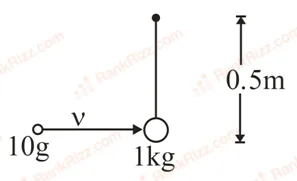
A bullet of 10 g, moving with velocity , collides head-on with the stationary bob of a pendulum and recoils with velocity 100 m s. The length of the pendulum is 0.5 m and mass of the bob is 1 kg. The minimum value of in m s, so that the pendulum describes a circle. (Assume the string to be inextensible and g = 10 m s)

The initial mass of a rocket is 1000 kg. Calculate at what rate the fuel should be burnt so that the rocket is given an acceleration of 20 m s. The gases come out at a relative speed of 500 m s, with respect to the rocket: [Use m s]
10 kg s
60 kg s
500 kg s
kg s
Three objects , and are kept in a straight line on a frictionless horizontal surface. The masses of , and are , and respectively. moves towards with a speed of 9 m s and makes an elastic collision with it. Thereafter makes a completely inelastic collision with . All motions occur along the same straight line. The final speed of is:

6 m s
9 m s
4 m s
3 m s
Two billiard balls of equal mass 30 g strike a rigid wall with same speed of 108 kmph (as shown) but at different angles. If the balls get reflected with the same speed, then the ratio of the magnitude of impulses imparted to ball a and ball b by the wall along X direction is:

1 : 1
: 1
2 : 1
1 :
A body of mass 2 kg moving with a speed of 4 m s makes an elastic collision with another body at rest and continues to move in the original direction but with one fourth of its initial speed. The speed of the two body centre of mass is . Find the value of x.
A bullet of 4 g mass is fired from a gun of mass 4 kg. If the bullet moves with the muzzle speed of 50 ms, the impulse imparted to the gun and velocity of recoil of gun are
0.4 kg m s, 0.1 m s
0.2 kg m s, 0.05 m s
0.2 kg m s, 0.1 m s
0.4 kg m s, 0.05 m s
The position of the centre of mass of a uniform semi-circular wire of radius placed in plane with its centre at the origin and the line joining its ends as -axis is given by . Then, the value of is ___.
An object of mass collides with another object of mass , which is at rest. After the collision the objects move with equal speeds in opposite direction. The ratio of the masses is :
3 : 1
2 : 1
1 : 2
1 : 1
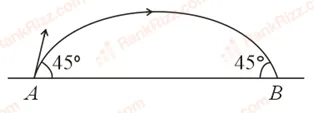
The projectile motion of a particle of mass 5 g is shown in the figure.
The initial velocity of the particle is ms and the air resistance is assumed to be negligible. The magnitude of the change in momentum between the points A and B is kgms. The value of , to the nearest integer, is ___.
JEE Advanced has set 12 Centre of Mass, Momentum & Collisions questions too. Centre of Mass, Momentum & Collisions JEE Advanced PYQs →
OTHER PHYSICS CHAPTERS