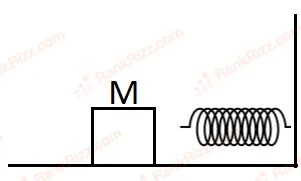
Two springs of force constants 300 N/m (Spring A) and 400 N/m (Spring B) are joined together in series. The combination is compressed by 8.75 cm. The ratio of energy stored in A and B is . Then is equal to:
- A
- B
- C
- D
Every Work, Energy & Power question JEE Main has set from 2004–2026, grouped by the idea it tests rather than the order of the syllabus. 160 questions across 5 distinct ideas. Free to read, answer key on every one.
DATA UPDATED
Questions
160
Distinct ideas
5
Share of marks
2.6%
Difficulty
MEDIUM
A chapter is not one subject — it is a handful of procedures the examiner reuses. These are the ones Work, Energy & Power questions actually test.
141–160 OF 160 · NEWEST FIRST
Two springs of force constants 300 N/m (Spring A) and 400 N/m (Spring B) are joined together in series. The combination is compressed by 8.75 cm. The ratio of energy stored in A and B is . Then is equal to:
This question has statement 1 and statement 2. Of the four choices given after the statements, choose the one that best describes the two statements. If two springs and of force constants and , respectively, are stretched by the same force, it is found that more work is done on spring than on spring . Statement 1: If stretched by the same amount, work done on , will be more than that on . Statement 2:
Statement 1 is false, Statement 2 is true
Statement 1 is true, Statement 2 is false
Statement 1 is true, Statement 2 is the correct explanation for statement 1
Statement 1 is true, Statement 2 is true, Statement 2 is not the correct explanation for statement 1.
A particle gets displaced by under the action of a force . The change in its kinetic energy is
38 J
70 J
52.5 J
126 J
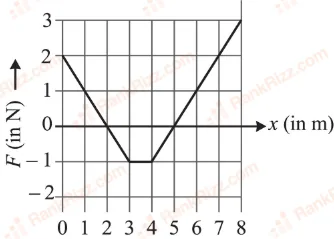
The force on a particle of mass 2 kg, moving along the -axis is given in the figure as a function of its position . The particle is moving with a velocity of 5 m/s along the -axis at . What is the kinetic energy of the particle at m?

34 J
34.5 J
4.5 J
29.4 J
The potential energy function for the force between two atoms in a diatomic molecule is approximately given by , where and are constants and is the distance between the atoms. If the dissociation energy of the molecule is , is
An athlete in the olympic games covers a distance of 100 m in 10 s. His kinetic energy can be estimated to be in the range
200 J 500 J
J J
20,000 J 50,000 J
2,000 J 5,000 J
A 2 kg block slides on a horizontal floor with a speed of 4 m/s. It strikes a uncompressed spring, and compresses it till the block is motionless. The kinetic friction force is 15 N and spring constant is 10,000 N/m. The spring compresses by
5.5 cm
2.5 cm
11.0 cm
8.5 cm
A mass of is suspended by a weightless string. The horizontal force that is required to displace it until the string makes an angle of with the initial vertical direction is
A particle of mass is thrown vertically upwards with a speed of . The work done by the force of gravity during the time the particle goes up is
0.5 J
1.25 J
A ball of mass is thrown vertically upwards by applying a force by hand. If the hand moves while applying the force and the ball goes upto height further, find the magnitude of the force. Consider
22 N
4 N
16 N
20 N
The potential energy of a particle free move along the x-axis is given by $) is
2
A bullet fired into a fixed target loses half of its velocity after penetrating cm. How much further it will penetrate before coming to rest assuming that it faces constant resistance to motion?
cm
cm
cm
cm
A spherical ball of mass kg is stationary at the top of a hill of height m. It rolls down a smooth surface to the ground, then climbs up another hill of height m and finally rolls down to a horizontal base at a height of m above the ground. The velocity attained by the ball is
m/s
m/s
m/s
m/s
A body of mass is accelerated uniformly from rest to a speed in a time . The instantaneous power delivered to the body as a function of time is given by
The block of mass moving on the frictionless horizontal surface collides with a spring of spring constant and compresses it by length . The maximum momentum of the block after collision is

zero
A particle moves in a straight line with retardation proportional to its displacement. Its loss of kinetic energy for any displacement is proportional to
A uniform chain of length m is kept on a table such that a length of cm hangs freely from the edge of the table. The total mass of the chain is kg. What is the work done in pulling the entire chain on the table?
J
J
J
J
A force is applied over a particle which displaces it from origin to the point m. The work done on the particle in joules is
A body of mass , accelerates uniformly from rest to in time . The instantaneous power delivered to the body as a function of time is
A particle is acted upon by a force of constant magnitude which is always perpendicular to the velocity of the particle, the motion of the particle takes place in a plane. It follows that
its velocity is constant
its acceleration is constant
its kinetic energy is constant
it moves in a straight line.
JEE Advanced has set 17 Work, Energy & Power questions too. Work, Energy & Power JEE Advanced PYQs →
OTHER PHYSICS CHAPTERS