Potential energy (V) versus distance (x) is given by the graph. Rank various regions as per the magnitudes of the force (F) acting on a particle from high lo low.
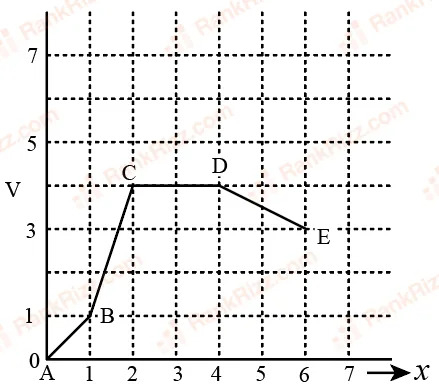
- A
- B
- C
- D
Potential energy, conservative forces and energy curves has been asked 9 times in JEE Main, in 7 different years between 2006 and 2026, and in 2 of the last five exam years (2022–2026), 2 questions in all. That is 6% of Work, Energy & Power. Last asked in JEE Main 21 Jan 2026, Shift 1. All 9 are multiple choice; 1 easy and 4 medium by our difficulty labels. All of them are below, newest first, free to read.
Questions
9
Years asked
7
Since
2006
Of the chapter
6%
Questions on Potential energy, conservative forces and energy curves in every year it was asked, newest first.
| Year | Relative frequency | Questions |
|---|---|---|
| 2026 | 1 | |
| 2022 | 1 | |
| 2018 | 3 | |
| 2015 | 1 | |
| 2013 | 1 | |
| 2010 | 1 | |
| 2006 | 1 | |
| Total | 9 |
1–9 OF 9 · NEWEST FIRST
Potential energy (V) versus distance (x) is given by the graph. Rank various regions as per the magnitudes of the force (F) acting on a particle from high lo low.

Potential energy as a function of is given by , where is the interatomic distance, and are positive constants. The equilibrium distance between the two atoms will be :
Two particles of the same mass m are moving in circular orbits because of force, given by . The first particle is at a distance r = 1, and the second, at r = 4. The best estimate for the ratio of kinetic energies of the first and the second particle is closest to:
A particle is moving in a circular path of radius a under the action of an attractive potential . Its total energy is:
Zero
In a collinear collision, a particle with an initial speed strikes a stationary particle of the same mass. If the final total kinetic energy is 50% greater than the original kinetic energy, the magnitude of the relative velocity between the two particles, after the collision, is:
A particle is moving in a circle of radius under the action of a force which is directed towards centre of the circle. Total mechanical energy (kinetic energy + potential energy) of the particle is (take potential energy = 0 for ):
Two springs of force constants 300 N/m (Spring A) and 400 N/m (Spring B) are joined together in series. The combination is compressed by 8.75 cm. The ratio of energy stored in A and B is . Then is equal to:
The potential energy function for the force between two atoms in a diatomic molecule is approximately given by , where and are constants and is the distance between the atoms. If the dissociation energy of the molecule is , is
The potential energy of a particle free move along the x-axis is given by $) is
2