RankRizz

Motion in a Plane — JEE Main Previous Year Questions

Every Motion in a Plane question JEE Main has set from 2004–2026, grouped by the idea it tests rather than the order of the syllabus. 103 questions across 5 distinct ideas. Free to read, answer key on every one.

DATA UPDATED

Questions

103

Distinct ideas

5

Share of marks

1.6%

Difficulty

EASY

The ideas inside Motion in a Plane

A chapter is not one subject — it is a handful of procedures the examiner reuses. These are the ones Motion in a Plane questions actually test.

Every Motion in a Plane question

81–100 OF 103 · NEWEST FIRST

JEE MAIN 2019 · 08 APR S1Kinematics in two dimensions using position vectors

Ship A is sailing towards north-east with velocity v⃗=30i^+50j^\vec{v} = 30\hat{i} + 50\hat{j} km h−1^{-1} where i^\hat{i} points east and j^\hat{j}, north. The ship B is at a distance of 80 km east and 150 km north of Ship A and is sailing towards the west at 10 km h−1^{-1}. A will be at the minimum distance from B in:

  1. A

    4.2 h

  2. B

    3.2 h

  3. C

    2.6 h

  4. D

    2.2 h

JEE MAIN 2019 · 12 JAN S1Relative velocity in two dimensions

A person standing on an open ground hears the sound of a jet aeroplane, coming from north at an angle 60°60° with ground level, but he finds the aeroplane right vertically above his position. If vv is the speed of sound, speed of the plane is:

  1. A

    2v3\frac{2v}{\sqrt{3}}

  2. B

    vv

  3. C

    v2\frac{v}{2}

  4. D

    32v\frac{\sqrt{3}}{2}v

JEE MAIN 2019 · 10 JAN S1Projectile motion from level ground

Two guns A and B can fire bullets at speeds 1 km/s and 2 km/s respectively. From a point on a horizontal ground, they are fired in all possible directions. The ratio of maximum areas covered by the bullets fired by the two guns, on the ground is:

  1. A

    1 : 16

  2. B

    1 : 2

  3. C

    1 : 4

  4. D

    1 : 8

JEE MAIN 2019 · 09 JAN S1Kinematics in two dimensions using position vectors

A particle is moving with a velocity v⃗=K(yi^+xj^)\vec{v} = K(y\hat{i} + x\hat{j}), where KK is a constant. The general equation for its path is:

  1. A

    y2=xy^2 = x + constant

  2. B

    xyxy = constant

  3. C

    y=x2y = x^2 + constant

  4. D

    y2=x2y^2 = x^2 + constant

JEE MAIN 2019 · 09 JAN S2Kinematics in two dimensions using position vectors

The position co-ordinates of a particle moving in a 3D coordinate system is given by
x=acos⁡ωtx = a\cos\omega t
y=asin⁡ωty = a\sin\omega t
and z=aωtz = a\omega t
The speed of the particle is:

  1. A

    2  aω\sqrt{2} \; a\omega

  2. B

    aωa\omega

  3. C

    2aω2a\omega

  4. D

    3  aω\sqrt{3} \; a\omega

JEE MAIN 2018 · 15 APR S2Kinematics in two dimensions using position vectors

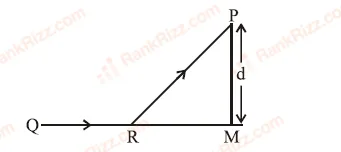
A man in a car at location Q on a straight highway is moving with speed v. He decides to reach a point P in a field at a distance d from highway (point M) as shown in the figure. Speed of the car in the field is half to that on the highway. What should be the distance RM, so that the time taken to reach P is minimum?

Figure for JEE Main 2018 Physics question on Kinematics in two dimensions using position vectors
  1. A

    d3\dfrac{d}{\sqrt{3}}

  2. B

    d2\dfrac{d}{2}

  3. C

    d2\dfrac{d}{\sqrt{2}}

  4. D

    dd

JEE MAIN 2014 · 11 APR ONLINEProjectile motion from level ground

The initial speed of a bullet fired from a rifle is 630 m/s. The rifle is fired at the centre of a target 700 m away at the same level as the target. How far above the centre of the target must the rifle be aimed in order to hit the target?

  1. A

    1.0 m

  2. B

    4.2 m

  3. C

    6.1 m

  4. D

    9.8 m

JEE MAIN 2014 · 09 APR ONLINEProjectile motion from level ground

The position of a projectile launched from the origin at t = 0 is given by r⃗=(40i^+50j^)\vec{r} = (40\hat{i} + 50\hat{j}) m at t = 2s. If the projectile was launched at an angle θ\theta from the horizontal, then θ\theta is (take g = 10 ms−2^{-2}).

  1. A

    tan⁡−132\tan^{-1}\frac{3}{2}

  2. B

    tan⁡−123\tan^{-1}\frac{2}{3}

  3. C

    tan⁡−174\tan^{-1}\frac{7}{4}

  4. D

    tan⁡−145\tan^{-1}\frac{4}{5}

JEE MAIN 2013 · 25 APR ONLINEProjectile motion from level ground

The maximum range of a bullet fired from a toy pistol mounted on a car at rest is R0=40R_0 = 40 m. What will be the acute angle of inclination of the pistol for maximum range when the car is moving in the direction of firing with uniform velocity v=20v = 20 m/s on a horizontal surface? (g=10g = 10 m/s2^2)

  1. A

    30°

  2. B

    60°

  3. C

    75°

  4. D

    45°

JEE MAIN 2013 · 22 APR ONLINEProjectile motion from level ground

A ball projected from ground at an angle of 45° just clears a wall in front. If point of projection is 4 m from the foot of wall and ball strikes the ground at a distance of 6 m on the other side of the wall, the height of the wall is :

  1. A

    4.4 m

  2. B

    2.4 m

  3. C

    3.6 m

  4. D

    1.6 m

JEE MAIN 2013 · 07 APR ONLINEProjectile motion from level ground

A projectile is given an initial velocity of (i^+2j^)(\hat{i} + 2\hat{j}) m s−1^{-1}, where i^\hat{i} is along the ground and j^\hat{j} is along the vertical upward. If g=10g = 10 m s−2^{-2}, the equation of its trajectory is :

  1. A

    4y=2x−5x24y = 2x - 5x^2

  2. B

    4y=2x−25x24y = 2x - 25x^2

  3. C

    y=x−5x2y = x - 5x^2

  4. D

    y=2x−5x2y = 2x - 5x^2

JEE MAIN 2012Projectile motion from level ground

A boy can throw a stone up to a maximum height of 1010 m. The maximum horizontal distance that the boy can throw the same stone up to will be

  1. A

    20220\sqrt{2} m

  2. B

    1010 m

  3. C

    10210\sqrt{2} m

  4. D

    2020 m

JEE MAIN 2011Projectile motion from level ground

A water fountain on the ground sprinkles water all around it. If the speed of water coming out of the fountain is vv, the total area around the fountain that gets wet is:

  1. A

    πv4g2\pi \dfrac{v^4}{g^2}

  2. B

    π2v4g2\dfrac{\pi}{2} \dfrac{v^4}{g^2}

  3. C

    πv2g2\pi \dfrac{v^2}{g^2}

  4. D

    πv4g\pi \dfrac{v^4}{g}

JEE MAIN 2010Kinematics in two dimensions using position vectors

A particle is moving with velocity v⃗=K(yi^+xj^)\vec{v} = K(y\hat{i} + x\hat{j}), where KK is a constant. The general equation for its path is

  1. A

    y=x2+y = x^2 + constant

  2. B

    y2=x+y^2 = x + constant

  3. C

    xy=xy = constant

  4. D

    y2=x2+y^2 = x^2 + constant

JEE MAIN 2009Kinematics in two dimensions using position vectors

A particle has an initial velocity 3i^+4j^3\hat{i} + 4\hat{j} and an acceleration of 0.4i^+0.3j^0.4\hat{i} + 0.3\hat{j}. Its speed after 1010 s is

  1. A

    1010 units

  2. B

    727\sqrt{2} units

  3. C

    77 units

  4. D

    8.58.5 units

JEE MAIN 2007Projectile motion from level ground

A particle is projected at 60∘60^\circ to the horizontal with a kinetic energy KK. The kinetic energy at the highest point is

  1. A

    KK

  2. B

    Zero

  3. C

    K/2K/2

  4. D

    K/4K/4

JEE MAIN 2007Projectile motion from level ground

A particle just clears a wall of height bb at distance aa and strikes the ground at a distance cc from the point of projection. The angle of projection is

  1. A

    tan⁡−1bac\tan^{-1} \frac{b}{ac}

  2. B

    45∘45^\circ

  3. C

    tan⁡−1bca(c−a)\tan^{-1} \frac{bc}{a(c-a)}

  4. D

    tan⁡−1bca\tan^{-1} \frac{bc}{a}

JEE MAIN 2005Kinematics in two dimensions using position vectors

A particle is moving eastwards with a velocity of 55 m/s. In 1010 seconds the velocity changes to 55 m/s northwards. The average acceleration in this time is

  1. A

    12\frac{1}{\sqrt{2}} m/s2^2 towards north-east

  2. B

    12\frac{1}{2} m/s2^2 towards north

  3. C

    zero

  4. D

    12\frac{1}{\sqrt{2}} m/s2^2 towards north-west

JEE MAIN 2005Projectile motion from level ground

A projectile can have the same range RR for two angles of projection. If t1t_1 and t2t_2 be the times of flights in the two cases, then the product of the two time of flights is proportional to

  1. A

    R2R^2

  2. B

    1/R21/R^2

  3. C

    1/R1/R

  4. D

    RR

JEE MAIN 2005Projectile motion from level ground

A particle is projected from a point OO with velocity uu at an angle of 60∘60^\circ with the horizontal. When it is moving in a direction at right angles to its direction at OO, its velocity then is given by

  1. A

    u3\frac{u}{3}

  2. B

    u2\frac{u}{2}

  3. C

    2u3\frac{2u}{3}

  4. D

    u3\frac{u}{\sqrt{3}}