RankRizz

Kinematics in two dimensions using position vectors — JEE Main Previous Year Questions

Kinematics in two dimensions using position vectors has been asked 15 times in JEE Main, in 10 different years between 2005 and 2025, and in 3 of the last five exam years (2022–2026), 3 questions in all. That is 15% of Motion in a Plane, one of its three most-asked topics. Last asked in JEE Main 24 Jan 2025, Shift 2. 14 are multiple choice and 1 numerical-value; 7 easy and 5 medium by our difficulty labels. All of them are below, newest first, free to read.

Questions

15

Years asked

10

Since

2005

Of the chapter

15%

When JEE Main asked it

Questions on Kinematics in two dimensions using position vectors in every year it was asked, newest first.

JEE Main questions on Kinematics in two dimensions using position vectors by year, 2005–2025
YearRelative frequencyQuestions
20251
20241
20221
20211
20204
20193
20181
20101
20091
20051
Total15

Every Kinematics in two dimensions using position vectors question

1–15 OF 15 · NEWEST FIRST

JEE MAIN 2025 · 24 JAN S2Kinematics in two dimensions using position vectors

The position vector of a moving body at any instant of time is given as r⃗=(5t2i^−5tj^) m.\vec r=(5t^2\hat i-5t\hat j)\,m. The magnitude and direction of velocity at t=2 st=2\,s is:

  1. A

    5 155\sqrt{\ 15}, m/s, making an angle of tan⁡−14\tan^{-1}4 with -ve YY -axis

  2. B

    5 155\sqrt{\ 15}, m/s, making an angle of tan⁡−14\tan^{-1}4 with +ve XX -axis

  3. C

    5 175\sqrt{\ 17}, m/s, making an angle of tan⁡−14\tan^{-1}4 with +ve XX -axis

  4. D

    5 175\sqrt{\ 17}, m/s, making an angle of tan⁡−14\tan^{-1}4 with -ve YY -axis

JEE MAIN 2024 · 27 JAN S1Kinematics in two dimensions using position vectors

Position of an ant (S in metres) moving in Y−ZY - Z plane is given by S=2t2j^+5k^S = 2t^2 \hat{j} + 5\hat{k} (where tt is in second). The magnitude and direction of velocity of the ant at t=1t = 1 s will be :

  1. A

    16 m s−116 \text{ m s}^{-1} in y-direction

  2. B

    4 m s−14 \text{ m s}^{-1} in x-direction

  3. C

    9 m s−19 \text{ m s}^{-1} in z-direction

  4. D

    4 m s−14 \text{ m s}^{-1} in y-direction

JEE MAIN 2022 · 28 JUL S2Kinematics in two dimensions using position vectors

At time t=0t = 0 a particle starts travelling from a height 7z^7\hat{z} cm in a plane keeping z coordinate constant. At any instant of time, it's position along the x and y directions are defined as 3t3t and 5t35t^3 respectively. At t=1t = 1 s acceleration of the particle will be

  1. A

    −30y^-30\hat{y}

  2. B

    30y^30\hat{y}

  3. C

    3x^+15y^3\hat{x} + 15\hat{y}

  4. D

    3x^+15y^+7z^3\hat{x} + 15\hat{y} + 7\hat{z}

JEE MAIN 2021 · 16 MAR S2Kinematics in two dimensions using position vectors

A mosquito is moving with a velocity v⃗=0.5t2i^+3tj^+9k^\vec{v} = 0.5t^2\hat{i} + 3t\hat{j} + 9\hat{k} m s−1^{-1} and accelerating in uniform conditions. What will be the direction of mosquitoes after 2 s?

  1. A

    tan⁡−1(23)\tan^{-1}\left(\frac{2}{3}\right) from xx-axis

  2. B

    tan⁡−1(856)\tan^{-1}\left(\frac{\sqrt{85}}{6}\right) from yy-axis

  3. C

    tan⁡−1(52)\tan^{-1}\left(\frac{5}{2}\right) from yy-axis

  4. D

    tan⁡−1(52)\tan^{-1}\left(\frac{5}{2}\right) from xx-axis

JEE MAIN 2020 · 05 SEP S1Kinematics in two dimensions using position vectors

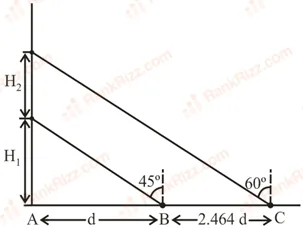
A balloon is moving up in air vertically above a point AA on the ground. When it is at a height h1h_1, a girl standing at a distance dd (point B) from AA (see figure) sees it at an angle 45∘45^\circ with respect to the vertical. When the balloon climbs up a further height h2h_2, it is seen at an angle 60∘60^\circ with respect to the vertical if the girl moves further by a distance 2.464 d2.464\,d (point C). Then the height h2h_2 is (given tan⁡30∘=0.5774\tan 30^\circ = 0.5774):

Figure for JEE Main 2020 Physics question on Kinematics in two dimensions using position vectors
  1. A

    1.464 dd

  2. B

    0.732 dd

  3. C

    0.464 dd

  4. D

    dd

JEE MAIN 2020 · 09 JAN S2Kinematics in two dimensions using position vectors

A particle starts from the origin at t=0t = 0 with an initial velocity of 3.0i^3.0\hat{i} m/s and moves in the x−yx - y plane with a constant acceleration (6.0i^+4.0j^)(6.0\hat{i} + 4.0\hat{j}) m/s2^2. The x−x- coordinate of the particle at the instant when its y−y- coordinate is 32m32m is DD meters. The value of DD is:

  1. A

    32

  2. B

    50

  3. C

    60

  4. D

    40

JEE MAIN 2020 · 08 JAN S1Kinematics in two dimensions using position vectors

A particle is moving along the xx-axis with its coordinate with time tt given by x(t)=10+8t−3t2x(t) = 10 + 8t - 3t^2. Another particle is moving along the yy-axis with its coordinate as a function of time given by y(t)=5−8t3y(t) = 5 - 8t^3. At t=1t = 1 s, the speed of the second particle as measured in the frame of the first particle is given as v\sqrt{v}. Then vv (in m s−1^{-1}) is

JEE MAIN 2020 · 08 JAN S2Kinematics in two dimensions using position vectors

A particle moves such that its position vector r⃗(t)=cos⁡ωt i^+sin⁡ωt j^\vec{r}(t) = \cos\omega t\,\hat{i} + \sin\omega t\,\hat{j} where ω\omega is a constant and tt is time. Then which of the following statements is true for the velocity v⃗(t)\vec{v}(t) and acceleration a⃗(t)\vec{a}(t) of the particle:

  1. A

    v⃗\vec{v} is perpendicular to r⃗\vec{r} and a⃗\vec{a} is directed away from the origin

  2. B

    v⃗\vec{v} and a⃗\vec{a} both are perpendicular to r⃗\vec{r}

  3. C

    v⃗\vec{v} and a⃗\vec{a} both are parallel to r⃗\vec{r}

  4. D

    v⃗\vec{v} is perpendicular to r⃗\vec{r} and a⃗\vec{a} is directed towards the origin

JEE MAIN 2019 · 08 APR S1Kinematics in two dimensions using position vectors

Ship A is sailing towards north-east with velocity v⃗=30i^+50j^\vec{v} = 30\hat{i} + 50\hat{j} km h−1^{-1} where i^\hat{i} points east and j^\hat{j}, north. The ship B is at a distance of 80 km east and 150 km north of Ship A and is sailing towards the west at 10 km h−1^{-1}. A will be at the minimum distance from B in:

  1. A

    4.2 h

  2. B

    3.2 h

  3. C

    2.6 h

  4. D

    2.2 h

JEE MAIN 2019 · 09 JAN S1Kinematics in two dimensions using position vectors

A particle is moving with a velocity v⃗=K(yi^+xj^)\vec{v} = K(y\hat{i} + x\hat{j}), where KK is a constant. The general equation for its path is:

  1. A

    y2=xy^2 = x + constant

  2. B

    xyxy = constant

  3. C

    y=x2y = x^2 + constant

  4. D

    y2=x2y^2 = x^2 + constant

JEE MAIN 2019 · 09 JAN S2Kinematics in two dimensions using position vectors

The position co-ordinates of a particle moving in a 3D coordinate system is given by
x=acos⁡ωtx = a\cos\omega t
y=asin⁡ωty = a\sin\omega t
and z=aωtz = a\omega t
The speed of the particle is:

  1. A

    2  aω\sqrt{2} \; a\omega

  2. B

    aωa\omega

  3. C

    2aω2a\omega

  4. D

    3  aω\sqrt{3} \; a\omega

JEE MAIN 2018 · 15 APR S2Kinematics in two dimensions using position vectors

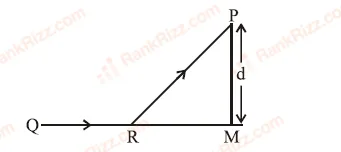
A man in a car at location Q on a straight highway is moving with speed v. He decides to reach a point P in a field at a distance d from highway (point M) as shown in the figure. Speed of the car in the field is half to that on the highway. What should be the distance RM, so that the time taken to reach P is minimum?

Figure for JEE Main 2018 Physics question on Kinematics in two dimensions using position vectors
  1. A

    d3\dfrac{d}{\sqrt{3}}

  2. B

    d2\dfrac{d}{2}

  3. C

    d2\dfrac{d}{\sqrt{2}}

  4. D

    dd

JEE MAIN 2010Kinematics in two dimensions using position vectors

A particle is moving with velocity v⃗=K(yi^+xj^)\vec{v} = K(y\hat{i} + x\hat{j}), where KK is a constant. The general equation for its path is

  1. A

    y=x2+y = x^2 + constant

  2. B

    y2=x+y^2 = x + constant

  3. C

    xy=xy = constant

  4. D

    y2=x2+y^2 = x^2 + constant

JEE MAIN 2009Kinematics in two dimensions using position vectors

A particle has an initial velocity 3i^+4j^3\hat{i} + 4\hat{j} and an acceleration of 0.4i^+0.3j^0.4\hat{i} + 0.3\hat{j}. Its speed after 1010 s is

  1. A

    1010 units

  2. B

    727\sqrt{2} units

  3. C

    77 units

  4. D

    8.58.5 units

JEE MAIN 2005Kinematics in two dimensions using position vectors

A particle is moving eastwards with a velocity of 55 m/s. In 1010 seconds the velocity changes to 55 m/s northwards. The average acceleration in this time is

  1. A

    12\frac{1}{\sqrt{2}} m/s2^2 towards north-east

  2. B

    12\frac{1}{2} m/s2^2 towards north

  3. C

    zero

  4. D

    12\frac{1}{\sqrt{2}} m/s2^2 towards north-west

Kinematics in two dimensions using position vectors: common questions

How many Kinematics in two dimensions using position vectors questions have come in JEE Main?
Kinematics in two dimensions using position vectors has been asked 15 times in JEE Main, in 10 different years between 2005 and 2025. It came up in 3 of the last five exam years (2022–2026), 3 questions in all.
Is Kinematics in two dimensions using position vectors important for JEE Main?
It is one of the three most-asked topics in Motion in a Plane: 15 of the chapter's 103 JEE Main questions (15%). It came up in 3 of the last five exam years (2022–2026), 3 questions in all.
When was Kinematics in two dimensions using position vectors last asked in JEE Main?
Most recently in JEE Main 24 Jan 2025, Shift 2. Questions on this page are newest first, so the latest ones are at the top.
What kind of Kinematics in two dimensions using position vectors questions does JEE Main ask?
14 are multiple choice and 1 numerical-value; 7 easy and 5 medium by our difficulty labels. Each question shows its answer key and worked solution where we have them.