RankRizz

Circular Motion — JEE Main Previous Year Questions

Every Circular Motion question JEE Main has set from 2004–2026, grouped by the idea it tests rather than the order of the syllabus. 75 questions across 5 distinct ideas. Free to read, answer key on every one.

DATA UPDATED

Questions

75

Distinct ideas

5

Share of marks

1.2%

Difficulty

MEDIUM

The ideas inside Circular Motion

A chapter is not one subject — it is a handful of procedures the examiner reuses. These are the ones Circular Motion questions actually test.

01Kinematics of uniform circular motionset 35×
02Non-uniform circular motion and radius of curvatureset 6×
03Dynamics of horizontal circular motion: conical pendulum, rotating drumsset 15×04Vertical circular motionset 14×
05Vehicles on curves: banking, friction and centrifugal forceset 5×

Every Circular Motion question

61–75 OF 75 · NEWEST FIRST

JEE MAIN 2020 · 09 JAN S2Dynamics of horizontal circular motion: conical pendulum, rotating drums

A spring mass system (mass mm, spring constant kk and natural length ll) rests in equilibrium on a horizontal disc. The free end of the spring is fixed at the centre of the disc. If the disc together with spring mass system rotates about it's axis with an angular velocity ω\omega, (k>>mω2)(k >> m\omega^2) the relative change in the length of the spring is best given by the option:

  1. A

    23(mω2k)\sqrt{\frac{2}{3}\left(\frac{m\omega^2}{k}\right)}

  2. B

    2mω2k\frac{2m\omega^2}{k}

  3. C

    mω2k\frac{m\omega^2}{k}

  4. D

    mω23k\frac{m\omega^2}{3k}

JEE MAIN 2020 · 08 JAN S1Kinematics of uniform circular motion

A particle of mass mm is fixed to one end of a light spring having force constant kk and unstretched length ll. The other end is fixed. The system is given an angular speed ω\omega about the fixed end of the spring such that it rotates in a circle in gravity free space. Then the stretch in the spring is:

  1. A

    mlω2k−ωm\frac{ml\omega^2}{k - \omega m}

  2. B

    mlω2k−mω2\frac{ml\omega^2}{k - m\omega^2}

  3. C

    mlω2k+mω2\frac{ml\omega^2}{k + m\omega^2}

  4. D

    mlω2k+mω\frac{ml\omega^2}{k + m\omega}

JEE MAIN 2019 · 12 APR S2Dynamics of horizontal circular motion: conical pendulum, rotating drums

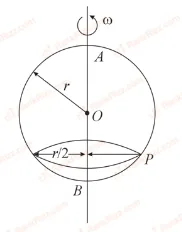
A smooth wire of length 2πr2\pi r is bent into a circle and kept in a vertical plane. A bead can slide smoothly on the wire. When the circle is rotating with angular speed ω\omega about the vertical diameter AB, as shown in figure, the bead is at rest with respect to the circular ring at position P as shown. Then the value of ω2\omega^2 is equal to:

Figure for JEE Main 2019 Physics question on Dynamics of horizontal circular motion: conical pendulum, rotating drums
  1. A

    2g/r2g/r

  2. B

    3g2r\frac{\sqrt{3}g}{2r}

  3. C

    2g/(r3)2g/(r\sqrt{3})

  4. D

    (g3)/r(g\sqrt{3})/r

JEE MAIN 2019 · 11 JAN S1Kinematics of uniform circular motion

A particle is moving along a circular path with a constant speed of 10 ms−110 \text{ ms}^{-1}. What is the magnitude of the change in velocity of the particle, when it moves through an angle of 60°60° around the centre of the circle?

  1. A

    10310\sqrt{3} m/s

  2. B

    zero

  3. C

    10210\sqrt{2} m/s

  4. D

    1010 m/s

JEE MAIN 2019 · 11 JAN S1Non-uniform circular motion and radius of curvature

A body is projected at t=0t = 0 with a velocity 10 ms−110 \text{ ms}^{-1} at an angle of 60°60° with the horizontal. The radius of curvature of its trajectory at t=1t = 1 s is RR. Neglecting air resistance and taking acceleration due to gravity g=10 ms−2g = 10 \text{ ms}^{-2}, the value of RR is:

  1. A

    10.3 m

  2. B

    2.8 m

  3. C

    2.5 m

  4. D

    5.1 m

JEE MAIN 2018 · 15 APR S2Dynamics of horizontal circular motion: conical pendulum, rotating drums

A disc rotates about its axis of symmetry in a horizontal plane at a steady rate of 3.5 revolutions per second. A coin placed at a distance of 1.25 cm from the axis of rotation remains at rest on the disc. The coefficient of friction between the coin and the disc is (g = 10 m/s2^2)

  1. A

    0.5

  2. B

    0.7

  3. C

    0.3

  4. D

    0.6

JEE MAIN 2017 · 09 APR ONLINEDynamics of horizontal circular motion: conical pendulum, rotating drums

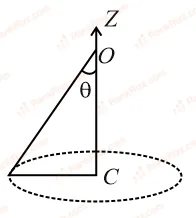
A conical pendulum of length ll makes an angle θ=45∘\theta = 45^\circ with respect to Z-axis and moves in a circle in the XY plane. The radius of the circle is 0.4 m and its center is vertically below O. The speed of the pendulum, in its circular path, will be - (Take g=10g = 10 m s−2^{-2})

Figure for JEE Main 2017 Physics question on Dynamics of horizontal circular motion: conical pendulum, rotating drums
  1. A

    0.2 m s−1^{-1}

  2. B

    0.4 m s−1^{-1}

  3. C

    2 m s−1^{-1}

  4. D

    4 m s−1^{-1}

JEE MAIN 2016 · 10 APR ONLINEVertical circular motion

Concrete mixture is made by mixing cement, stone and sand in a rotating cylindrical drum. If the drum rotates too fast, the ingredients remain stuck to the wall of the drum and proper mixing of ingredients does not take place. The maximum rotational speed of the drum in revolutions per minute (rpm) to ensure proper mixing is close to:
(Take the radius of the drum to be 1.25 m and its axle to be horizontal):

  1. A

    27.0

  2. B

    0.4

  3. C

    1.3

  4. D

    8.0

JEE MAIN 2015 · 10 APR ONLINEKinematics of uniform circular motion

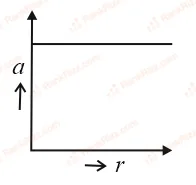
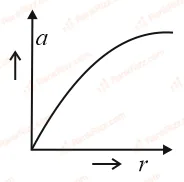
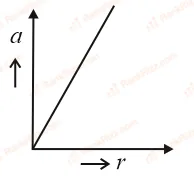
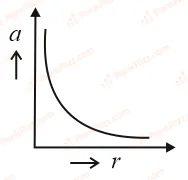
If a body moving in a circular path maintains constant speed of 10 m s−1^{-1}, then which of the following correctly describes the relation between acceleration and radius?

  1. A
    Figure for JEE Main 2015 Physics question on Kinematics of uniform circular motion
  2. B
    Figure for JEE Main 2015 Physics question on Kinematics of uniform circular motion
  3. C
    Figure for JEE Main 2015 Physics question on Kinematics of uniform circular motion
  4. D
    Figure for JEE Main 2015 Physics question on Kinematics of uniform circular motion
JEE MAIN 2014 · 19 APR ONLINEVertical circular motion

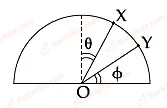
A particle is released on a vertical smooth semicircular track from point X so that, OX makes an angle θ\theta from the vertical (see the figure). The normal reaction of the track on the particle vanishes at point Y, where OY makes an angle ϕ\phi with the horizontal. Then:

Figure for JEE Main 2014 Physics question on Vertical circular motion
  1. A

    sin⁡ϕ=23cos⁡θ\sin\phi = \frac{2}{3}\cos\theta

  2. B

    sin⁡ϕ=34cos⁡θ\sin\phi = \frac{3}{4}\cos\theta

  3. C

    sin⁡ϕ=12cos⁡θ\sin\phi = \frac{1}{2}\cos\theta

  4. D

    sin⁡ϕ=cos⁡θ\sin\phi = \cos\theta

JEE MAIN 2013 · 23 APR ONLINEDynamics of horizontal circular motion: conical pendulum, rotating drums

A body of mass 'm' is tied to one end of a spring and whirled round in a horizontal plane with a constant angular velocity. The elongation in the spring is 1 cm. If the angular velocity is doubled, the elongation in the spring is 5 cm. The original length of the spring is :

  1. A

    15 cm

  2. B

    12 cm

  3. C

    16 cm

  4. D

    10 cm

JEE MAIN 2012Kinematics of uniform circular motion

Two cars of masses m1m_1 and m2m_2 are moving in circles of radii r1r_1 and r2r_2, respectively. Their speeds are such that they make complete circles in the same time tt. The ratio of their centripetal acceleration is

  1. A

    m1r1:m2r2m_1 r_1 : m_2 r_2

  2. B

    m1:m2m_1 : m_2

  3. C

    r1:r2r_1 : r_2

  4. D

    1:11 : 1

JEE MAIN 2010Non-uniform circular motion and radius of curvature

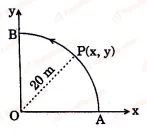
A point P moves in counter-clockwise direction on a circular path as shown in the figure. The movement of 'P' is such that it sweeps out a length s=t3+5s = t^3 + 5, where ss is in metres and tt is in seconds. The radius of the path is 2020 m. The acceleration of 'P' when t=2t = 2 s is nearly
Figure for JEE Main 2010 Physics question on Non-uniform circular motion and radius of curvature

  1. A

    1313 m/s2^2

  2. B

    1212 m/s2^2

  3. C

    7.27.2 m/s2^2

  4. D

    1414 m/s2^2

JEE MAIN 2010Kinematics of uniform circular motion

For a particle in uniform circular motion the acceleration a⃗\vec{a} at a point P(R,θ)P(R, \theta) on the circle of radius R is (here θ\theta is measured from the xx-axis)

  1. A

    −v2Rcos⁡θ i^+v2Rsin⁡θ j^-\frac{v^2}{R} \cos\theta \, \hat{i} + \frac{v^2}{R} \sin\theta \, \hat{j}

  2. B

    −v2Rsin⁡θ i^+v2Rcos⁡θ j^-\frac{v^2}{R} \sin\theta \, \hat{i} + \frac{v^2}{R} \cos\theta \, \hat{j}

  3. C

    −v2Rcos⁡θ i^−v2Rsin⁡θ j^-\frac{v^2}{R} \cos\theta \, \hat{i} - \frac{v^2}{R} \sin\theta \, \hat{j}

  4. D

    v2Ri^+v2Rj^\frac{v^2}{R} \hat{i} + \frac{v^2}{R} \hat{j}

JEE MAIN 2004Kinematics of uniform circular motion

Which of the following statements is false for a particle moving in a circle with a constant angular speed?

  1. A

    The velocity vector is tangent to the circle.

  2. B

    The acceleration vector is tangent to the circle.

  3. C

    The acceleration vector points to the centre of the circle.

  4. D

    The velocity and acceleration vectors are perpendicular to each other.