RankRizz
JEE MAIN 2010

JEE Main 2010 Physics question — Non-uniform circular motion and radius of curvature

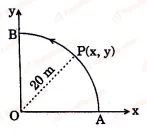
A point P moves in counter-clockwise direction on a circular path as shown in the figure. The movement of 'P' is such that it sweeps out a length s=t3+5s = t^3 + 5, where ss is in metres and tt is in seconds. The radius of the path is 2020 m. The acceleration of 'P' when t=2t = 2 s is nearly
Figure for JEE Main 2010 Physics question on Non-uniform circular motion and radius of curvature

SOLUTION

Key idea: In non-uniform circular motion, the total acceleration combines the tangential part dvdt\dfrac{dv}{dt} and the centripetal part v2R\dfrac{v^2}{R}, which are perpendicular.

  1. Speed: v=dsdt=3t2v = \dfrac{ds}{dt} = 3t^2, so v=12v = 12 m/s at t=2t = 2 s.
  2. Tangential acceleration: at=dvdt=6t=12 m/s2a_t = \dfrac{dv}{dt} = 6t = 12\ \text{m/s}^2.
  3. Centripetal acceleration: ac=v2R=14420=7.2 m/s2a_c = \dfrac{v^2}{R} = \dfrac{144}{20} = 7.2\ \text{m/s}^2.
  4. Total: a=122+7.22=144+51.84=195.84≈14 m/s2a = \sqrt{12^2 + 7.2^2} = \sqrt{144 + 51.84} = \sqrt{195.84} \approx 14\ \text{m/s}^2

Answer: (D) 14 m/s2^2

Topic: Non-uniform circular motion and radius of curvature

SubjectPhysics
TopicNon-uniform circular motion and radius of curvature
TypeMultiple choice
Report an error in this question
What is wrong?

QUESTION pyq:499622