RankRizz

Capacitance — JEE Main Previous Year Questions

Every Capacitance question JEE Main has set from 2005–2026, grouped by the idea it tests rather than the order of the syllabus. 174 questions across 7 distinct ideas. Free to read, answer key on every one.

DATA UPDATED

Questions

174

Distinct ideas

7

Share of marks

2.8%

Difficulty

MEDIUM

The ideas inside Capacitance

A chapter is not one subject — it is a handful of procedures the examiner reuses. These are the ones Capacitance questions actually test.

Every Capacitance question

161–174 OF 174 · NEWEST FIRST

JEE MAIN 2013 · 07 APR ONLINERC circuits: charging and discharging

In an LCR circuit shown below, both the switches are open initially. Now switch S1S_1 is closed, S2S_2 kept open. (q is charge on the capacitor and τ\tau = RC is capacitive time constant). Which of the following statement is correct?
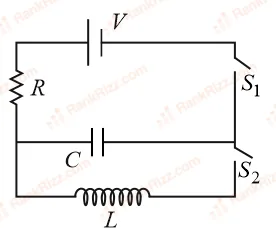
Figure for JEE Main 2013 Physics question on RC circuits: charging and discharging
  1. A

    At t=2τt = 2\tau, q=CV(1−e−2)q = CV(1 - e^{-2})

  2. B

    At t=τ2t = \frac{\tau}{2}, q=CV(1−e−1)q = CV(1 - e^{-1})

  3. C

    Work done by the battery is half of the energy dissipated in the resistor

  4. D

    At t=τt = \tau, q=CV/2q = CV/2

JEE MAIN 2013 · 07 APR ONLINESeries and parallel combinations of capacitors

Two capacitors C1C_1 and C2C_2 are charged to 120 V and 200 V respectively. It is found that by connecting them together the potential on each one can be made zero. Then:

  1. A

    3C1+5C2=03C_1 + 5C_2 = 0

  2. B

    9C1=4C29C_1 = 4C_2

  3. C

    5C1=3C25C_1 = 3C_2

  4. D

    3C1=5C23C_1 = 5C_2

JEE MAIN 2012RC circuits: charging and discharging

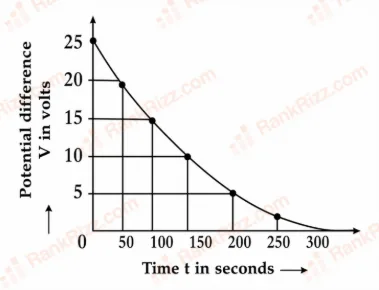
The figure shows an experimental plot for discharging of a capacitor in an R−CR-C circuit. The time constant τ\tau of this circuit lies between:

Figure for JEE Main 2012 Physics question on RC circuits: charging and discharging
  1. A

    150 sec150\ \text{sec} and 200 sec200\ \text{sec}

  2. B

    00 and 50 sec50\ \text{sec}

  3. C

    50 sec50\ \text{sec} and 100 sec100\ \text{sec}

  4. D

    100 sec100\ \text{sec} and 150 sec150\ \text{sec}

JEE MAIN 2012Capacitors in DC circuits (steady state)

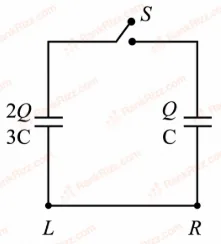
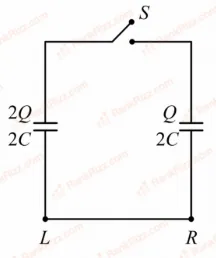
Two circuits (a) and (b) have charged capacitors of capacitance C, 2C and 3C with open switches. Charges on each of the capacitor are as shown in the figures. On closing the switches

Figure for JEE Main 2012 Physics question on Capacitors in DC circuits (steady state) Figure for JEE Main 2012 Physics question on Capacitors in DC circuits (steady state)


Circuit (a)    Circuit (b)

  1. A

    No charge flows in (a) but charge flows from RR to LL in (b)

  2. B

    Charges flow from LL to RR in both (a) and (b)

  3. C

    Charges flow from RR to LL in (a) and from LL to RR in (b)

  4. D

    No charge flows in (a) but charge flows from LL to RR in (b)

JEE MAIN 2012Capacitance of isolated conductors and spherical/cylindrical capacitors

This question has Statement 1 and Statement 2. Of the four choices given after the Statements, choose the one that best describes the two Statements. Statement 1: It is not possible to make a sphere of capacity 1 farad using a conducting material. Statement 2: It is possible for earth as its radius is 6.4×1066.4 \times 10^6 m.

  1. A

    Statement 1 is true, Statement 2 is true, Statement 2 is the correct explanation of Statement 1.

  2. B

    Statement 1 is false, Statement 2 is true.

  3. C

    Statement 1 is true, Statement 2 is true, Statement 2 is not the correct explanation of Statement 1.

  4. D

    Statement 1 is true, Statement 2 is false.

JEE MAIN 2012Energy stored, force between plates and charge sharing

A series combination of n1n_1 capacitors, each of capacity C1C_1 is charged by source of potential difference 4V4V. When another parallel combination of n2n_2 capacitors each of capacity C2C_2 is charged by a source of potential difference VV, it has the same total energy stored in it as the first combination has. The value of C2C_2 in terms of C1C_1 is then

  1. A

    16n2n1C116\dfrac{n_2}{n_1}C_1

  2. B

    2C1n1n2\dfrac{2C_1}{n_1 n_2}

  3. C

    2n2n1C12\dfrac{n_2}{n_1}C_1

  4. D

    16C1n1n2\dfrac{16C_1}{n_1 n_2}

JEE MAIN 2012RC circuits: charging and discharging

A resistance RR and a capacitance CC are connected in series to a battery of negligible internal resistance through a key. The key is closed at t=0t = 0. If after tt sec the voltage across the capacitance was seven times the voltage across RR, the value of tt is

  1. A

    3RCln⁡23RC\ln 2

  2. B

    2RCln⁡22RC\ln 2

  3. C

    2RCln⁡72RC\ln 7

  4. D

    3RCln⁡73RC\ln 7

JEE MAIN 2011RC circuits: charging and discharging

A resistor RR and 2μF2 \mu \text{F} capacitor in series is connected through a switch to 200 V200 \, \text{V} direct supply. Across the capacitor is a neon bulb that lights up at 120 V120 \, \text{V}. Calculate the value of RR to make the bulb light up 5 s5 \, \text{s} after the switch has been closed. (log⁡102.5=0.4\log_{10} 2.5 = 0.4)

  1. A

    1.7×10⁵ Ω1.7 \times 10^5 \, \Omega

  2. B

    2.7×10⁶ Ω2.7 \times 10^6 \, \Omega

  3. C

    3.3×10⁷ Ω3.3 \times 10^7 \, \Omega

  4. D

    1.3×10⁴ Ω1.3 \times 10^4 \, \Omega

JEE MAIN 2010RC circuits: charging and discharging

Let CC be the capacitance of a capacitor discharging through a resistor R. Suppose t1t_1 is the time taken for the energy stored in the capacitor to reduce to half its initial value and t2t_2 is the time taken for the charge to reduce to one-fourth its initial value. Then the ratio t1/t2t_1/t_2 will be

  1. A

    1

  2. B

    12\frac{1}{2}

  3. C

    14\frac{1}{4}

  4. D

    2

JEE MAIN 2008Capacitors with dielectrics

A parallel plate capacitor with air between the plates has a capacitance of 9 pF. The separation between its plates is 'dd'. The space between the plates is now filled with two dielectrics. One of the dielectrics has dielectric constant k1=3k_1 = 3 and thickness d3\frac{d}{3} while the other one has dielectric constant k2=6k_2 = 6 and thickness 2d3\frac{2d}{3}. Capacitance of the capacitor is now

  1. A

    1.8 pF

  2. B

    45 pF

  3. C

    40.5 pF

  4. D

    20.25 pF

JEE MAIN 2007Energy stored, force between plates and charge sharing

A battery is used to charge a parallel plate capacitor till the potential difference between the plates becomes equal to the electromotive force of the battery. The ratio of the energy stored in the capacitor and the work done by the battery will be

  1. A

    1

  2. B

    2

  3. C

    14\frac{1}{4}

  4. D

    12\frac{1}{2}

JEE MAIN 2007Capacitors with dielectrics

A parallel plate condenser with a dielectric of dielectric constant KK between the plates has a capacity CC and is charged to a potential VV volts. The dielectric slab is slowly removed from between the plates and then reinserted. The net work done by the system in this process is

  1. A

    1/2(K−1)CV21/2 (K - 1) CV^2

  2. B

    CV2(K−1)/KCV^2 (K - 1)/K

  3. C

    (K−1)CV2(K - 1) CV^2

  4. D

    zero

JEE MAIN 2005Energy stored, force between plates and charge sharing

A fully charged capacitor has a capacitance 'CC'. It is discharged through a small coil of resistance wire embedded in a thermally insulated block of specific heat capacity 'ss' and mass 'mm'. If the temperature of the block is raised by 'ΔT\Delta T'. The potential difference VV across the capacitance is

  1. A

    2mCΔTs\sqrt{\frac{2mC\Delta T}{s}}

  2. B

    mCΔTs\frac{mC\Delta T}{s}

  3. C

    msΔTC\frac{ms\Delta T}{C}

  4. D

    2msΔTC\sqrt{\frac{2ms\Delta T}{C}}

JEE MAIN 2005Series and parallel combinations of capacitors

A parallel plate capacitor is made by stacking nn equally spaced plates connected alternatively. If the capacitance between any two adjacent plates is CC then the resultant capacitance is

  1. A

    (n−1)C(n - 1)C

  2. B

    (n+1)C(n + 1)C

  3. C

    CC

  4. D

    nCnC