Energy stored, force between plates and charge sharing — JEE Main Previous Year Questions
Energy stored, force between plates and charge sharing has been asked 20 times in JEE Main, in 12 different years between 2005 and 2026, and in all of the last five exam years (2022–2026), 12 questions in all. That is 11% of Capacitance. Last asked in JEE Main 06 Apr 2026, Shift 2. 14 are multiple choice and 6 numerical-value; 7 easy and 10 medium by our difficulty labels. All of them are below, newest first, free to read.
Questions on Energy stored, force between plates and charge sharing in every year it was asked, newest first.
JEE Main questions on Energy stored, force between plates and charge sharing by year, 2005–2026
Year
Relative frequency
Questions
2026
2
2025
3
2024
2
2023
3
2022
2
2021
1
2020
2
2019
1
2017
1
2012
1
2007
1
2005
1
Total
20
Every Energy stored, force between plates and charge sharing question
1–20 OF 20 · NEWEST FIRST
JEE MAIN 2026 · 06 APR S2Energy stored, force between plates and charge sharing
A sphere of capacitance 100 pF is charged to a potential of 100 V. Another identical uncharged metal sphere is brought in contact with the charged sphere, then the change in the total energy stored on these spheres, when they touch is α×10−7 J. The value of α is __________. (combined capacitance of spheres is 200 pF)
JEE MAIN 2026 · 04 APR S1Energy stored, force between plates and charge sharing
A parallel plate air capacitor is connected to a battery. The plates are pulled apart at uniform speed v. If x is the separation between the plates at any instant, then the time rate of change of electrostatic energy of the capacitor is proportional to xα, where α is :
JEE MAIN 2025 · 28 JAN S1Energy stored, force between plates and charge sharing
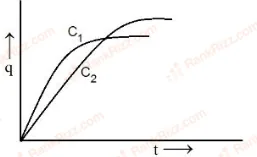
Two capacitors C1 and C2 are connected in parallel to a battery. Charge-time graph is shown below for the two capacitors. The energy stored with them are U1 and U2, respectively. Which of the given statements is true?
JEE MAIN 2025 · 28 JAN S2Energy stored, force between plates and charge sharing
A parallel plate capacitor of capacitance 1μF is charged to a potential difference of 20V. The distance between plates is 1μm. The energy density between plates of capacitor is.
JEE MAIN 2025 · 24 JAN S1Energy stored, force between plates and charge sharing
Consider a parallel plate capacitor of area A (of each plate) and separation d between the plates. If E is the electric field and ε0 is the permittivity of free space between the plates, then potential energy stored in the capacitor is:
JEE MAIN 2024 · 01 FEB S1Energy stored, force between plates and charge sharing
Two identical capacitors have same capacitance C. One of them is charged to the potential V and other to the potential 2V. The negative ends of both are connected together. When the positive ends are also joined together, the decrease in energy of the combined system is :
JEE MAIN 2024 · 29 JAN S1Energy stored, force between plates and charge sharing
A 16Ω wire is bend to form a square loop. A 9 V battery with internal resistance 1Ω is connected across one of its sides. If a 4μF capacitor is connected across one of its diagonals, the energy stored by the capacitor will be 2xμJ, where x= _______.
JEE MAIN 2023 · 11 APR S1Energy stored, force between plates and charge sharing
A parallel plate capacitor of capacitance 2 F is charged to a potential V. The energy stored in the capacitor is E1. The capacitor is now connected to another uncharged identical capacitor in parallel combination. The energy stored in the combination is E2. The ratio E1E2 is
JEE MAIN 2023 · 08 APR S2Energy stored, force between plates and charge sharing
A 600 pF capacitor is charged by 200 V supply. It is then disconnected from the supply and is connected to another uncharged 600 pF capacitor. Electrostatic energy lost in the process is _______ μJ.
JEE MAIN 2023 · 30 JAN S1Energy stored, force between plates and charge sharing
A capacitor of capacitance 900μF is charged by a 100 V battery. The capacitor is disconnected from the battery and connected to another uncharged identical capacitor such that one plate of uncharged capacitor connected to positive plate and another plate of uncharged capacitor connected to negative plate of the charged capacitor. The loss of energy in this process is measured as x×10−2 J. The value of x is ______.
JEE MAIN 2022 · 27 JUN S1Energy stored, force between plates and charge sharing
A capacitor of capacitance 50 pF is charged by 100 V source. It is then connected to another uncharged identical capacitor. Electrostatic energy loss in the process is ______ nJ.
JEE MAIN 2021 · 17 MAR S1Energy stored, force between plates and charge sharing
A parallel plate capacitor whose capacitance C is 14 pF is charged by a battery to a potential difference V=12 V between its plates. The charging battery is now disconnected and a porcelain plate with k=7 is inserted between the plates, then the plate would oscillate back and forth between the plates with a constant mechanical energy of ________ pJ. (Assume no friction)
JEE MAIN 2020 · 04 SEP S2Energy stored, force between plates and charge sharing
A capacitor C is fully charged with voltage V0. After disconnecting the voltage source, it is connected in parallel with another uncharged capacitor of capacitance 2C. The energy loss in the process after the charge is distributed between the two capacitors is:
JEE MAIN 2020 · 02 SEP S1Energy stored, force between plates and charge sharing
A 5 μF capacitor is charged fully by a 220 V supply. It is then disconnected from the supply and is connected in series to another uncharged 2.5 μF capacitor. If the energy change during the charge redistribution is 100X J then value of X to the nearest integer is:
JEE MAIN 2017 · 08 APR ONLINEEnergy stored, force between plates and charge sharing
The energy stored in the electric field produced by a metal sphere is 4.5 J. If the sphere contains 4 μC charge, its radius will be: [Take :4πϵ01=9×10⁹ N m2 C−2]
JEE MAIN 2012Energy stored, force between plates and charge sharing
A series combination of n1 capacitors, each of capacity C1 is charged by source of potential difference 4V. When another parallel combination of n2 capacitors each of capacity C2 is charged by a source of potential difference V, it has the same total energy stored in it as the first combination has. The value of C2 in terms of C1 is then
JEE MAIN 2007Energy stored, force between plates and charge sharing
A battery is used to charge a parallel plate capacitor till the potential difference between the plates becomes equal to the electromotive force of the battery. The ratio of the energy stored in the capacitor and the work done by the battery will be
JEE MAIN 2005Energy stored, force between plates and charge sharing
A fully charged capacitor has a capacitance 'C'. It is discharged through a small coil of resistance wire embedded in a thermally insulated block of specific heat capacity 's' and mass 'm'. If the temperature of the block is raised by 'ΔT'. The potential difference V across the capacitance is
Energy stored, force between plates and charge sharing: common questions
How many Energy stored, force between plates and charge sharing questions have come in JEE Main?
Energy stored, force between plates and charge sharing has been asked 20 times in JEE Main, in 12 different years between 2005 and 2026. It came up in all of the last five exam years (2022–2026), 12 questions in all.
Is Energy stored, force between plates and charge sharing important for JEE Main?
It is part of Capacitance: 20 of the chapter's 174 JEE Main questions (11%). It came up in all of the last five exam years (2022–2026), 12 questions in all.
When was Energy stored, force between plates and charge sharing last asked in JEE Main?
Most recently in JEE Main 06 Apr 2026, Shift 2. Questions on this page are newest first, so the latest ones are at the top.
What kind of Energy stored, force between plates and charge sharing questions does JEE Main ask?
14 are multiple choice and 6 numerical-value; 7 easy and 10 medium by our difficulty labels. Each question shows its answer key and worked solution where we have them.