RankRizz

Vectors & Basic Mathematics — JEE Main Previous Year Questions

Every Vectors & Basic Mathematics question JEE Main has set from 2015–2026, grouped by the idea it tests rather than the order of the syllabus. 49 questions across 3 distinct ideas. Free to read, answer key on every one.

DATA UPDATED

Questions

49

Distinct ideas

3

Share of marks

1.2%

Difficulty

EASY

The ideas inside Vectors & Basic Mathematics

A chapter is not one subject — it is a handful of procedures the examiner reuses. These are the ones Vectors & Basic Mathematics questions actually test.

Every Vectors & Basic Mathematics question

21–40 OF 49 · NEWEST FIRST

JEE MAIN 2023 · 24 JAN S1Dot and cross product of vectors

Vectors ai^+bj^+k^a\hat{i} + b\hat{j} + \hat{k} and 2i^−3j^+4k^2\hat{i} - 3\hat{j} + 4\hat{k} are perpendicular to each other when 3a+2b=73a + 2b = 7, the ratio of aa to bb is x2\frac{x}{2}. The value of xx is _____.

JEE MAIN 2023 · 24 JAN S1Dot and cross product of vectors

Vectors ai^+bj^+k^a\hat{i} + b\hat{j} + \hat{k} and 2i^−3j^+4k^2\hat{i} - 3\hat{j} + 4\hat{k} are perpendicular to each other when 3a+2b=73a + 2b = 7, the ratio of aa to bb is x2\frac{x}{2}. The value of xx is _____.

JEE MAIN 2023 · 24 JAN S2Dot and cross product of vectors

If two vectors P⃗=i^+2mj^+mk^\vec{P} = \hat{i} + 2m\hat{j} + m\hat{k} and Q⃗=4i^−2j^+mk^\vec{Q} = 4\hat{i} - 2\hat{j} + m\hat{k} are perpendicular to each other. Then, the value of mm will be

  1. A

    -1

  2. B

    2

  3. C

    3

  4. D

    1

JEE MAIN 2022 · 28 JUL S1Vectors: addition, subtraction, resolution and unit vectors

If the projection of 2i^+4j^−2k^2\hat{i} + 4\hat{j} - 2\hat{k} on i^+2j^+αk^\hat{i} + 2\hat{j} + \alpha\hat{k} is zero. Then, the value of α\alpha will be

JEE MAIN 2022 · 26 JUL S2Vectors: addition, subtraction, resolution and unit vectors

If A⃗=2i^+3j^−k^ m\vec{A} = 2\hat{i} + 3\hat{j} - \hat{k} \text{ m} and B⃗=i^+2j^+2k^ m\vec{B} = \hat{i} + 2\hat{j} + 2\hat{k} \text{ m}. The magnitude of component of vector A⃗\vec{A} along vector B⃗\vec{B} will be ______ m.

JEE MAIN 2022 · 29 JUN S1Vectors: addition, subtraction, resolution and unit vectors

Two vectors A⃗\vec{A} and B⃗\vec{B} have equal magnitudes. If magnitude of A⃗+B⃗\vec{A} + \vec{B} is equal to two times the magnitude of A⃗−B⃗\vec{A} - \vec{B}, then the angle between A⃗\vec{A} and B⃗\vec{B} will be

  1. A

    cos⁡−1(35)\cos^{-1}\left(\frac{3}{5}\right)

  2. B

    cos⁡−1(13)\cos^{-1}\left(\frac{1}{3}\right)

  3. C

    sin⁡−1(13)\sin^{-1}\left(\frac{1}{3}\right)

  4. D

    sin⁡−1(35)\sin^{-1}\left(\frac{3}{5}\right)

JEE MAIN 2022 · 25 JUN S1Dot and cross product of vectors

A⃗\vec{A} is a vector quantity such that ∣A⃗∣|\vec{A}| = non-zero constant. Which of the following expression is true for A⃗\vec{A}?

  1. A

    A⃗⋅A⃗=0\vec{A} \cdot \vec{A} = 0

  2. B

    A⃗×A⃗<0\vec{A} \times \vec{A} < 0

  3. C

    A⃗×A⃗=0\vec{A} \times \vec{A} = 0

  4. D

    A⃗×A⃗>0\vec{A} \times \vec{A} > 0

JEE MAIN 2022 · 25 JUN S1Vectors: addition, subtraction, resolution and unit vectors

Which of the following relations is true for two unit vectors A^\hat{A} and B^\hat{B} making an angle θ\theta to each other?

  1. A

    ∣A^+B^∣=∣A^−B^∣tan⁡θ2|\hat{A} + \hat{B}| = |\hat{A} - \hat{B}|\frac{\tan\theta}{2}

  2. B

    ∣A^−B^∣=∣A^+B^∣tan⁡θ2|\hat{A} - \hat{B}| = |\hat{A} + \hat{B}|\frac{\tan\theta}{2}

  3. C

    ∣A^+B^∣=∣A^−B^∣cos⁡θ2|\hat{A} + \hat{B}| = |\hat{A} - \hat{B}|\frac{\cos\theta}{2}

  4. D

    ∣A^−B^∣=∣A^+B^∣cos⁡θ2|\hat{A} - \hat{B}| = |\hat{A} + \hat{B}|\frac{\cos\theta}{2}

JEE MAIN 2021 · 31 AUG S2Vectors: addition, subtraction, resolution and unit vectors

Statement-I: Two forces P⃗+Q⃗\vec{P} + \vec{Q} and P⃗−Q⃗\vec{P} - \vec{Q} where P⃗⊥Q⃗\vec{P} \perp \vec{Q}, when act at an angle θ1\theta_1 each other, the magnitude of their resultant is 3P2+Q2\sqrt{3P^2 + Q^2}, when they act at an angle θ2\theta_2, the magnitude of their resultant becomes 2P2+Q2\sqrt{2P^2 + Q^2}. This is possible only when θ1<θ2\theta_1 < \theta_2.
Statement-II: In the situation given above. θ1=60°\theta_1 = 60° and θ2=90°\theta_2 = 90°
In the light of the above statement, choose the most appropriate answer from the options given below :

  1. A

    Statement I is false but Statement II is true.

  2. B

    Both Statement I and Statement II are true.

  3. C

    Both Statement I and Statement II are false.

  4. D

    Statement I is true but Statement II is false.

JEE MAIN 2021 · 27 AUG S1Vectors: addition, subtraction, resolution and unit vectors

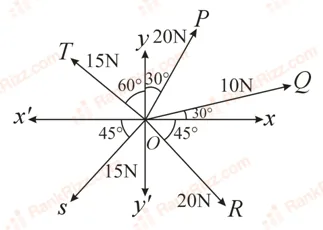
The resultant of these forces OP⃗,OQ⃗,OR⃗,OS⃗\vec{OP}, \vec{OQ}, \vec{OR}, \vec{OS} and OT⃗\vec{OT} is approximately ______ N.
[Take 3=1.7,2=1.4\sqrt{3} = 1.7, \sqrt{2} = 1.4. Given i^\hat{i} and j^\hat{j} unit vectors along x,yx, y axis]

Figure for JEE Main 2021 Physics question on Vectors: addition, subtraction, resolution and unit vectors
  1. A

    −1.5i^−15.5j^-1.5\hat{i} - 15.5\hat{j}

  2. B

    9.25i^+5j^9.25\hat{i} + 5\hat{j}

  3. C

    3i^+15j^3\hat{i} + 15\hat{j}

  4. D

    2.5i^−14.5j^2.5\hat{i} - 14.5\hat{j}

JEE MAIN 2021 · 26 AUG S1Vectors: addition, subtraction, resolution and unit vectors

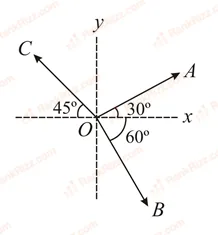
The magnitude of vectors OA→\overrightarrow{OA}, OB→\overrightarrow{OB} and OC→\overrightarrow{OC} in the given figure are equal. The direction of OA→+OB→−OC→\overrightarrow{OA} + \overrightarrow{OB} - \overrightarrow{OC} with x-axis will be:

Figure for JEE Main 2021 Physics question on Vectors: addition, subtraction, resolution and unit vectors
  1. A

    tan⁡−1(3−1+21+3−2)\tan^{-1}\left(\frac{\sqrt{3}-1+\sqrt{2}}{1+\sqrt{3}-\sqrt{2}}\right)

  2. B

    tan⁡−1(1−3−21+3+2)\tan^{-1}\left(\frac{1-\sqrt{3}-\sqrt{2}}{1+\sqrt{3}+\sqrt{2}}\right)

  3. C

    tan⁡−1(3−1+21−3+2)\tan^{-1}\left(\frac{\sqrt{3}-1+\sqrt{2}}{1-\sqrt{3}+\sqrt{2}}\right)

  4. D

    tan⁡−1(1+3−21−3−2)\tan^{-1}\left(\frac{1+\sqrt{3}-\sqrt{2}}{1-\sqrt{3}-\sqrt{2}}\right)

JEE MAIN 2021 · 26 AUG S2Vectors: addition, subtraction, resolution and unit vectors

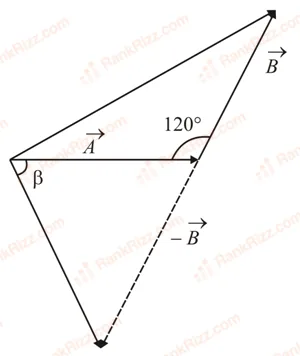
The angle between vector (A⃗)\left(\vec{A}\right) and (A⃗−B⃗)\left(\vec{A} - \vec{B}\right) is:

Figure for JEE Main 2021 Physics question on Vectors: addition, subtraction, resolution and unit vectors
  1. A

    tan⁡−1(Bcos⁡θA−Bsin⁡θ)\tan^{-1}\left(\frac{B\cos\theta}{A - B\sin\theta}\right)

  2. B

    tan⁡−1(3B2A−B)\tan^{-1}\left(\frac{\sqrt{3}B}{2A - B}\right)

  3. C

    tan⁡−1(−B2A−B32)\tan^{-1}\left(\frac{-\frac{B}{2}}{A - B\frac{\sqrt{3}}{2}}\right)

  4. D

    tan⁡−1(A0.7B)\tan^{-1}\left(\frac{A}{0.7B}\right)

JEE MAIN 2021 · 27 JUL S1Vectors: addition, subtraction, resolution and unit vectors

Assertion AA : If A,B,C,DA, B, C, D are four points on a semi-circular arc with a centre at OO such that ∣AB→∣=∣BC→∣=∣CD→∣\left|\overrightarrow{AB}\right| = \left|\overrightarrow{BC}\right| = \left|\overrightarrow{CD}\right|. Then, AB→+AC→+AD→=4AO→+OB→+OC→\overrightarrow{AB} + \overrightarrow{AC} + \overrightarrow{AD} = 4\overrightarrow{AO} + \overrightarrow{OB} + \overrightarrow{OC}
Reason RR : Polygon law of vector addition yields AB→+BC→+CD→=AD→=2AO→\overrightarrow{AB} + \overrightarrow{BC} + \overrightarrow{CD} = \overrightarrow{AD} = 2\overrightarrow{AO}
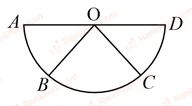
Figure for JEE Main 2021 Physics question on Vectors: addition, subtraction, resolution and unit vectors


In the light of the above statements, choose the most appropriate answer from the options given below.

  1. A

    AA is correct but RR is not correct.

  2. B

    AA is not correct but RR is correct.

  3. C

    Both AA and RR are correct and RR is the correct explanation of AA.

  4. D

    Both AA and RR are correct but RR is NOT the correct explanation of AA.

JEE MAIN 2021 · 25 JUL S1Vectors: addition, subtraction, resolution and unit vectors

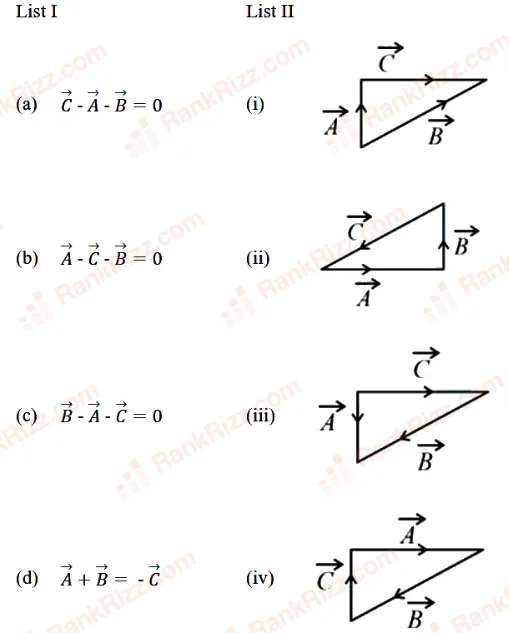
Match List I with List II.

Figure for JEE Main 2021 Physics question on Vectors: addition, subtraction, resolution and unit vectors

Choose the correct answer from the options given below:

  1. A

    (a) →\to (iv), (b) →\to (i), (c) →\to (iii), (d) →\to (ii)

  2. B

    (a) →\to (iv), (b) →\to (iii), (c) →\to (i), (d) →\to (ii)

  3. C

    (a) →\to (iii), (b) →\to (ii), (c) →\to (iv), (d) →\to (i)

  4. D

    (a) →\to (i), (b) →\to (iv), (c) →\to (ii), (d) →\to (iii)

JEE MAIN 2021 · 25 JUL S2Vectors: addition, subtraction, resolution and unit vectors

Two vectors X⃗\vec{X} and Y⃗\vec{Y} have equal magnitude. The magnitude of (X⃗−Y⃗)\left(\vec{X} - \vec{Y}\right) is nn times the magnitude of (X⃗+Y⃗)\left(\vec{X} + \vec{Y}\right). The angle between X⃗\vec{X} and Y⃗\vec{Y} is:

  1. A

    cos⁡−1(−n2−1n2−1)\cos^{-1}\left(\frac{-n^2 - 1}{n^2 - 1}\right)

  2. B

    cos⁡−1(n2−1−n2−1)\cos^{-1}\left(\frac{n^2 - 1}{-n^2 - 1}\right)

  3. C

    cos⁡−1(n2+1−n2−1)\cos^{-1}\left(\frac{n^2 + 1}{-n^2 - 1}\right)

  4. D

    cos⁡−1(n2+1n2−1)\cos^{-1}\left(\frac{n^2 + 1}{n^2 - 1}\right)

JEE MAIN 2021 · 22 JUL S1Vectors: addition, subtraction, resolution and unit vectors

What will be the projection of vector A⃗=i^+j^+k^\vec{A} = \hat{i} + \hat{j} + \hat{k} on vector B⃗=i^+j^\vec{B} = \hat{i} + \hat{j}?

  1. A

    2(i^+j^+k^)\sqrt{2}(\hat{i} + \hat{j} + \hat{k})

  2. B

    2(i^+j^+k^)2(\hat{i} + \hat{j} + \hat{k})

  3. C

    2(i^+j^)\sqrt{2}(\hat{i} + \hat{j})

  4. D

    (i^+j^)(\hat{i} + \hat{j})

JEE MAIN 2021 · 22 JUL S1Dot and cross product of vectors

Three particles P, Q and R are moving along the vectors A⃗=i^+j^\vec{A} = \hat{i} + \hat{j}, B⃗=j^+k^\vec{B} = \hat{j} + \hat{k} and C⃗=−i^+j^\vec{C} = -\hat{i} + \hat{j}, respectively. They strike on a point and start to move in different directions. Now particle P is moving normal to the plane which contains vector A⃗\vec{A} and B⃗\vec{B}. Similarly particle Q is moving normal to the plane which contains vector A⃗\vec{A} and C⃗\vec{C}. The angle between the direction of motion of P and Q is cos⁡−1(1x)\cos^{-1}\left(\dfrac{1}{\sqrt{x}}\right). Then the value of xx is ___.

JEE MAIN 2021 · 20 JUL S1Dot and cross product of vectors

If A⃗\vec{A} and B⃗\vec{B} are two vectors satisfying the relation A⃗⋅B⃗=∣A⃗×B⃗∣\vec{A} \cdot \vec{B} = |\vec{A} \times \vec{B}|. Then the value of ∣A⃗−B⃗∣|\vec{A} - \vec{B}| will be:

  1. A

    A2+B2\sqrt{A^2 + B^2}

  2. B

    A2+B2+2AB\sqrt{A^2 + B^2 + \sqrt{2}AB}

  3. C

    A2+B2+2AB\sqrt{A^2 + B^2 + 2AB}

  4. D

    A2+B2−2AB\sqrt{A^2 + B^2 - \sqrt{2}AB}

JEE MAIN 2021 · 20 JUL S2Vectors: addition, subtraction, resolution and unit vectors

Two vectors P⃗\vec{P} and Q⃗\vec{Q} have equal magnitudes. If the magnitude of P⃗+Q⃗\vec{P} + \vec{Q} is nn times the magnitude of P⃗−Q⃗\vec{P} - \vec{Q}, then angle between P⃗\vec{P} and Q⃗\vec{Q} is:

  1. A

    sin⁡−1(n−1n+1)\sin^{-1}\left(\frac{n-1}{n+1}\right)

  2. B

    cos⁡−1(n−1n+1)\cos^{-1}\left(\frac{n-1}{n+1}\right)

  3. C

    sin⁡−1(n2−1n2+1)\sin^{-1}\left(\frac{n^2-1}{n^2+1}\right)

  4. D

    cos⁡−1(n2−1n2+1)\cos^{-1}\left(\frac{n^2-1}{n^2+1}\right)

JEE MAIN 2021 · 16 MAR S1Vectors: addition, subtraction, resolution and unit vectors

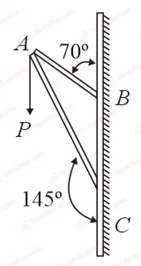
Consider a frame that is made up of two thin massless rods ABAB and ACAC as shown in the figure. A vertical force P⃗\vec{P} of magnitude 100 N is applied at point AA of the frame.

Figure for JEE Main 2021 Physics question on Vectors: addition, subtraction, resolution and unit vectors


Suppose the force P⃗\vec{P} is resolved parallel to the arms ABAB and ACAC of the frame. The magnitude of the resolved component along the arm ACAC is xx N. The value of xx, to the nearest integer, is ________.
[Given: sin⁡(35∘)=0.573,cos⁡(35∘)=0.819,sin⁡(110∘)=0.939,cos⁡(110∘)=−0.342\sin(35^\circ) = 0.573, \cos(35^\circ) = 0.819, \sin(110^\circ) = 0.939, \cos(110^\circ) = -0.342]