Magnetism & Matter — JEE Main Previous Year Questions
Every Magnetism & Matter question JEE Main has set from 2004–2026, grouped by the idea it tests rather than the order of the syllabus. 79 questions across 4 distinct ideas. Free to read, answer key on every one.
04Dia-, para- and ferromagnetic materials and hysteresisset 3×
Every Magnetism & Matter question
41–60 OF 79 · NEWEST FIRST
JEE MAIN 2021 · 25 JUL S1Magnetisation, magnetic intensity, susceptibility and permeability
The value of aluminium susceptibility is 2.2×10⁻⁵. The percentage increase in the magnetic field if space within a current carrying toroid is filled with aluminium is 104x. Then the value of x is ___.
JEE MAIN 2021 · 22 JUL S1Magnetisation, magnetic intensity, susceptibility and permeability
Statement I : The ferromagnetic property depends on temperature. At high temperature, ferromagnet becomes paramagnet. Statement II : At high temperature, the domain wall area of a ferromagnetic substance increases. In the light of the above statements, choose the most appropriate answer from the options given below:
JEE MAIN 2021 · 20 JUL S2Magnetisation, magnetic intensity, susceptibility and permeability
The magnetic susceptibility of a material of a rod is 499. Permeability in vacuum is 4π×10−7 Hm−1. Absolute permeability of the material of the rod is:
JEE MAIN 2021 · 18 MAR S2Magnetisation, magnetic intensity, susceptibility and permeability
Which of the following statements are correct? (A) Electric monopoles do not exist whereas magnetic monopoles exist. (B) Magnetic field lines due to a solenoid at its ends and outside cannot be completely straight and confined. (C) Magnetic field lines are completely confined within a toroid. (D) Magnetic field lines inside a bar magnet are not parallel. (E) χ=−1 is the condition for a perfect diamagnetic material, where χ is its magnetic susceptibility. Choose the correct answer from the options given below :
A bar magnet of length 14 cm is placed in the magnetic meridian with its north pole pointing towards the geographic north pole. A neutral point is obtained at a distance of 18 cm from the center of the magnet. If BH=0.4 G, the magnetic moment of the magnet is (1 G = 10−4 T):
JEE MAIN 2020 · 05 SEP S2Magnetisation, magnetic intensity, susceptibility and permeability
An iron rod of volume 10−3m3 and relative permeability 1000 is placed as core in a solenoid with 10 turns cm−1. If a current of 0.5A is passed through the solenoid, then the magnetic moment of the rod will be:
JEE MAIN 2020 · 04 SEP S1Bar magnet as a magnetic dipole
A small bar magnet is placed with its axis at 30° with an external magnetic field of 0.06 T experiences a torque of 0.018 Nm. The minimum work required to rotate it from its stable to unstable equilibrium position is:
JEE MAIN 2020 · 04 SEP S2Magnetisation, magnetic intensity, susceptibility and permeability
A paramagnetic sample shows a net magnetisation of 6 A/m when it is placed in an external magnetic field of 0.4 T at a temperature of 4 K. When the sample is placed in an external magnetic field of 0.3 T at a temperature of 24 K, then the magnetisation will be:
JEE MAIN 2020 · 03 SEP S2Magnetisation, magnetic intensity, susceptibility and permeability
A perfectly diamagnetic sphere has a small spherical cavity at its centre, which is filled with a paramagnetic substance. The whole system is placed in a uniform magnetic field B. Then the field inside the paramagnetic substance is:
JEE MAIN 2020 · 02 SEP S1Magnetisation, magnetic intensity, susceptibility and permeability
Magnetic materials used for making permanent magnets (P) and magnets in a transformer (T) have different properties of the following, which property best matches for the type of magnet required?
JEE MAIN 2020 · 07 JAN S2Magnetisation, magnetic intensity, susceptibility and permeability
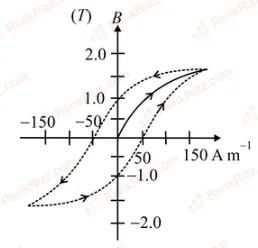
The figure gives experimentally measured B vs. H variation in a ferromagnetic material. The retentivity, coercivity and saturation, respectively, of the material are
A magnetic compass needle oscillates 30 times per minute at a place where the dip is 45° and 40 times per minute where the dip is 30°. If B1 and B2 are the net magnetic fields due to the earth at the two places respectively, then the ratio B1/B2 is approximately equal to
JEE MAIN 2019 · 08 APR S2Bar magnet as a magnetic dipole
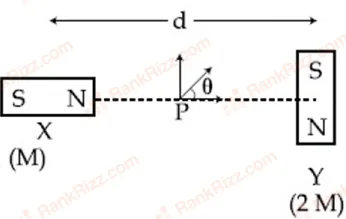
Two magnetic dipoles X and Y are placed at a separation d, with their axes perpendicular to each other. The dipole moment of Y is twice that of X. A particle of charge q is passing through their mid-point P, at angle θ=45° with the horizontal line, as shown in figure. What would be the magnitude of force on the particle at that instant? (d is much larger than the dimension of the dipole)
JEE MAIN 2019 · 11 JAN S2Magnetisation, magnetic intensity, susceptibility and permeability
A paramagnetic substance in the form of a cube with sides 1 cm has a magnetic dipole moment of 20×10−6 J/T when a magnetic intensity of 60×103 A/m is applied. Its magnetic susceptibility is:
JEE MAIN 2019 · 10 JAN S1Bar magnet as a magnetic dipole
A magnet of total magnetic moment 10−2i^ A m2 is placed in a time varying magnetic field, Bi^(cosωt) where B=1 Tesla and ω=0.125 rad s−1. The work done for reversing the direction of the magnetic moment at t=1 second, is: