A coil of cross-sectional area A having n turns is placed in a uniform magnetic field B. When it is rotated with an angular velocity , the maximum e.m.f. induced in the coil will be:
- A
- B
- C
- D
Every Electromagnetic Induction question JEE Main has set from 2004–2026, grouped by the idea it tests rather than the order of the syllabus. 178 questions across 6 distinct ideas. Free to read, answer key on every one.
DATA UPDATED
Questions
178
Distinct ideas
6
Share of marks
3.8%
Difficulty
MEDIUM
A chapter is not one subject — it is a handful of procedures the examiner reuses. These are the ones Electromagnetic Induction questions actually test.
141–160 OF 178 · NEWEST FIRST
A coil of cross-sectional area A having n turns is placed in a uniform magnetic field B. When it is rotated with an angular velocity , the maximum e.m.f. induced in the coil will be:
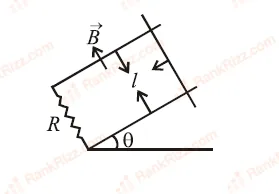
A copper rod of mass m slides under gravity on two smooth parallel rails, with separation l and set at an angle of with the horizontal. At the bottom, rails are joined by a resistance R. There is a uniform magnetic field B normal to the plane of the rails, as shown in the figure. The terminal speed of the copper rod is:

At the centre of a fixed large circular coil of radius R, a much smaller circular coil of radius r is placed. The two coils are concentric and are in the same plane. The larger coil carries a current I. The smaller coil is set to rotate with a constant angular velocity about an axis along their common diameter. Calculate the emf induced in the smaller coil after a time t of its start of rotation.
A small circular loop of wire of radius is located at the centre of a much larger circular wire loop of radius . The two loops are in the same plane. The outer loop of radius carries an alternating current . The emf induced in the smaller inner loop is nearly:
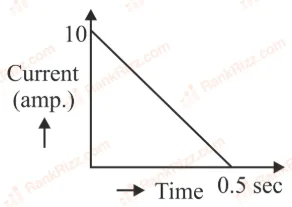
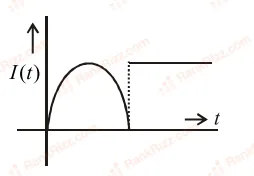
In a coil of resistance 100 Ω, a current is induced by changing the magnetic flux through it as shown in the figure. The magnitude of change in flux through the coil is:

275 Wb
200 Wb
225 Wb
250 Wb
A fighter plane of length 20 m, wing span (distance from tip of one wing to the tip of the other wing) of 15 m and height 5 m is flying towards east over Delhi. Its speed is 240 m s. The earth's magnetic field over Delhi is T with the declination angle ~0° and dip of such that . If the voltage developed is between the lower and upper side of the plane and between the tips of the wings then and are close to:
mV; mV with left side of pilot at higher voltage
mV; mV with right side of pilot at higher voltage
mV; mV with left side of pilot at higher voltage
A conducting metal circular-wire-loop of radius is placed perpendicular to a magnetic field which varies with time as , where and are constants at time . If the resistance of the loop is , then the heat generated in the loop after a long time is
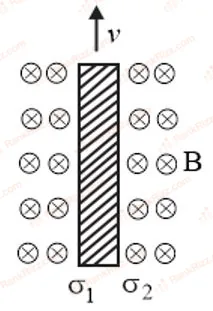
Consider a thin metallic sheet perpendicular to the plane of the paper moving with speed v in a uniform magnetic field B going into the plane of the paper (see the figure below). If the charge densities and are induced on the left and right surfaces respectively of the sheet, then (ignore fringe effects)

,
,
,
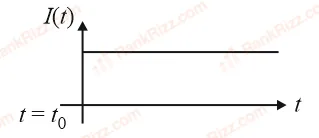
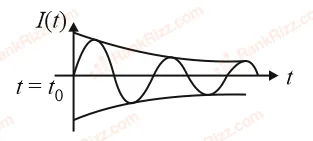
A series circuit is connected to a voltage source with . After a very large time, current behaves as :


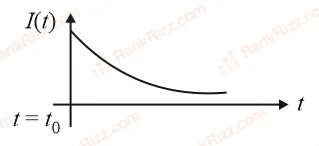
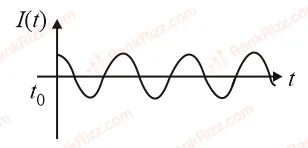
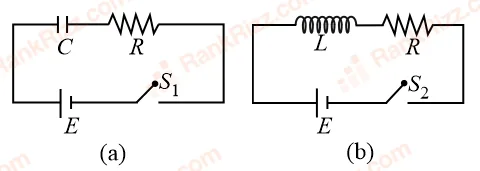
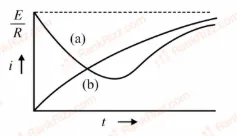
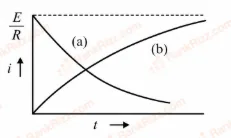
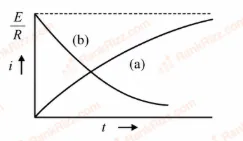
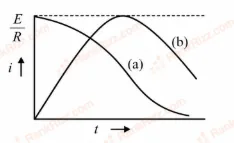
In the given circuits (a) and (b), switches and are closed at and kept close for a long time. The variation of currents in the two circuits for are shown in the options. (Figures are schematic and not drawn to scale.)


When the current in a coil changes from 5 A to 2 A in 0.1 s, an average voltage of 50 V is produced. The self-inductance of the coil is
1.67 H
6 H
3 H
0.67 H
Two coaxial solenoids of different radii carry current in the same direction. Let be the magnetic force on the inner solenoid due to the outer one and be the magnetic force on the outer solenoid due to the inner one. Then:
is radially outwards and
is radially inwards and is radially outwards
is radially inwards and
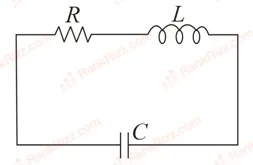
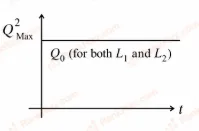
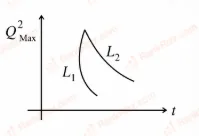
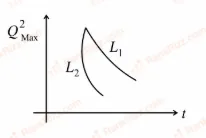
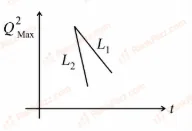
An LCR circuit is equivalent to a damped pendulum. In an LCR circuit the capacitor is charged to and then connected to the L and R as shown below:
If a student plots graphs of the square of maximum charge on the capacitor with time (t) for two different values and () of L then which of the following represents this graph correctly? (plots are schematic and not drawn to scale)


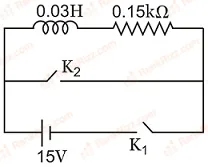
An inductor H and a resistor k are connected in series to a battery of 15 V E.M.F. in the circuit shown below. The key has been kept closed for a long time. Then at , is opened and key is closed simultaneously. At ms, the current in the circuit will be: (Take, )

0.67 mA
100 mA
67 mA
6.7 mA
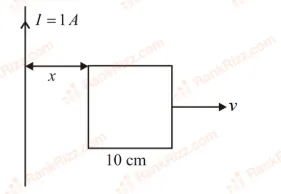
A square frame of side 10 cm and a long straight wire carrying current 1 A are in the plane of the paper. Starting from close to the wire, the frame moves towards the right with a constant speed of 10 m s (see figure). The e.m.f induced at the time the left arm of the frame is at x = 10 cm from the wire is:

0.75 V
1 V
2 V
0.5 V
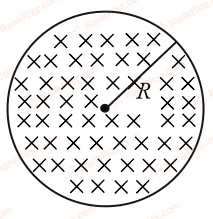
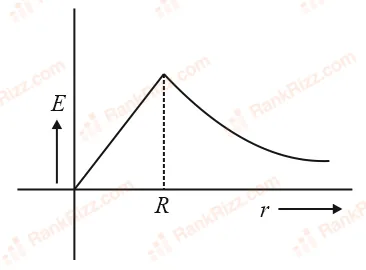
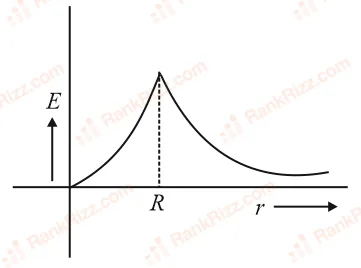
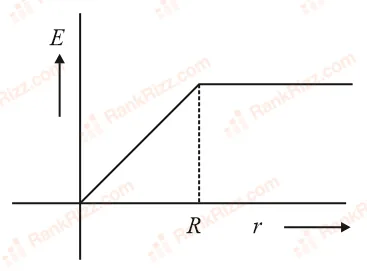
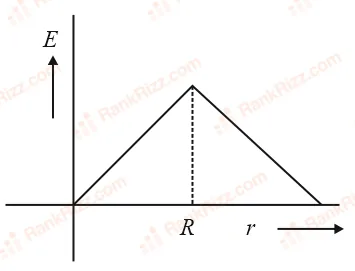
The figure shows a circular area of radius R where a uniform magnetic field is going into the plane of the paper and increasing in magnitude at a constant rate. In that case, which of the following graphs, drawn schematically, correctly shows the variation of the induced electric field E(r)?


A coil of circular cross-section having 1000 turns and 4 cm face area is placed with its axis parallel to a magnetic field which decreases by Wb m in 0.01 s. The e.m.f. induced in the coil is:
400 mV
200 mV
4 mV
0.4 mV
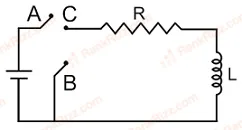
In the circuit shown here, the point 'C' is kept connected to point 'A' till the current flowing through the circuit becomes constant. Afterward, suddenly, point 'C' is disconnected from point 'A' and connected to point 'B' at time . Ratio of the voltage across resistance and the inductor at will be equal to:

1
-1
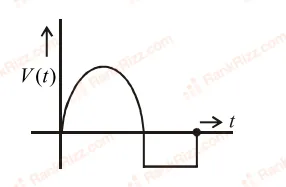
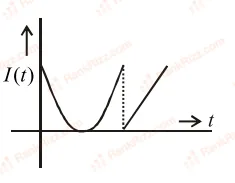
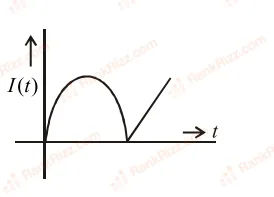
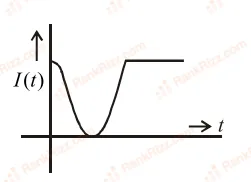
Two coils, X and Y, are kept in close vicinity of each other. When a varying current, , flows through coil X, the induced emf in coil Y, varies in the manner shown here. The variation of , with time, can then be represented by the graph labelled as graph :
(A)
(B)
(c)
(D)
A
C
B
D
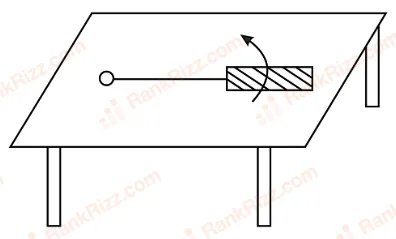
A metallic rod of length is tied to a string of length and made to rotate with angular speed on a horizontal table with one end of the string fixed. If there is a vertical magnetic field B in the region, the e.m.f. induced across the ends of the rod is:

JEE Advanced has set 27 Electromagnetic Induction questions too. Electromagnetic Induction JEE Advanced PYQs →
OTHER PHYSICS CHAPTERS