JEE MAIN 2019 · 11 JAN S2Modulation and demodulation
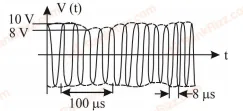
An amplitude modulated signal is plotted below. Which one of the following best describes the above signal?
- A
V
- B
V
- C
V
- D
V
Every Communication Systems (older syllabus) question JEE Main has set from 2011–2023, grouped by the idea it tests rather than the order of the syllabus. 106 questions across 2 distinct ideas. Free to read, answer key on every one.
DATA UPDATED
Questions
106
Distinct ideas
2
Share of marks
0%
Difficulty
EASY
A chapter is not one subject — it is a handful of procedures the examiner reuses. These are the ones Communication Systems (older syllabus) questions actually test.
81–100 OF 106 · NEWEST FIRST
An amplitude modulated signal is plotted below. Which one of the following best describes the above signal?
V
V
V
V
A TV transmission tower has a height of 140 m and the height of the receiving antenna is 40 m. What is the maximum distance upto which signals can be broadcasted from this tower in LOS (Line of Sight) mode? (Given: radius of earth m).
48 km
40 km
80 km
65 km
The modulation frequency of an AM radio station is 250 kHz, which is 10% of the carrier wave. If another AM station approaches you for license what broadcast frequency will you allot?
2750 kHz
2000 kHz
2250 kHz
2900 kHz
In a communication system operating at wavelength 800 nm, only one percent of source frequency is available as signal bandwidth. The number of channels accommodated for transmitting TV signals of band width 6 MHz are (Take velocity of light m/s, J-s)
A carrier wave of peak voltage 14 V is used for transmitting a message signal. The peak voltage of the modulating signal given to achieve a modulation index of 80% will be:
22.4 V
7 V
11.2 V
28 V
The number of amplitude modulated broadcast stations that can be accommodated in a 300 kHz band width for the highest modulating frequency 15 kHz will be:
20
10
8
15
The carrier frequency of a transmitter is provided by a tank circuit of a coil of inductance 49H and a capacitance of 2.5 nF. It is modulated by an audio signal of 12 kHz. The frequency range occupied by the side bands is:
18 kHz - 30 kHz
63 kHz - 75 kHz
442 kHz - 466 kHz
13482 kHz - 13494 kHz
A signal is to be transmitted through a wave of wavelength , using a linear antenna. The length of the antenna and effective power radiated will be given, respectively, as- ( is a constant of proportionality)
,
,
,
,
A signal of frequency 20 kHz and peak voltage of 5 Volt is used to modulate a carrier wave of frequency 1.2 MHz and peak voltage 25 Volts. Choose the correct statement.
Modulation index = 5, side frequency bands are at 1400 kHz and 1000 kHz.
Modulation index = 5, side frequency bands are at 21.2 kHz and 18.8 kHz.
Modulation index = 0.2, side frequency bands are at 1220 kHz and 1180 kHz.
Modulation index = 5, side frequency bands are at 24.2 kHz and 18.8 kHz.
In amplitude modulation, the sinusoidal carrier frequency used is denoted by and the signal frequency is denoted by . The bandwidth of the signal is such that . Which of the following frequencies is not contained in the modulated wave?
A modulated signal has the form . The carrier frequency , the modulating frequency (message frequency) and the modulation index are respectively given by:
Hz; Hz;
Hz; Hz;
Hz; Hz;
Hz; Hz;
An audio signal consists of two distinct sounds: one a human speech signal in the frequency band of 200 Hz to 2700 Hz, while the other is a high frequency music signal in the frequency band of 10200 Hz to 15200 Hz. The ratio of the AM signal band width required to send both the signals together to the AM signal band width required to send just the human speech is:
3
5
6
2
Choose the correct statement:
In frequency modulation the amplitude of the high frequency carrier wave is made to vary in proportion to the amplitude of the audio signal.
In frequency modulation the amplitude of the high frequency carrier wave is made to vary in proportion to the frequency of the audio signal.
In amplitude modulation the amplitude of the high frequency carrier wave is made to vary in proportion to the amplitude of the audio signal.
In amplitude modulation the frequency of the high frequency carrier wave is made to vary in proportion to the amplitude of the audio signal.
A signal of 5 kHz frequency is amplitude modulated on a carrier wave of frequency 2 MHz. The frequencies of the resultant signal is/are:
2000 kHz and 1995 kHz
2 MHz only
2005 kHz and 1995 kHz
2005 kHz, 2000 kHz and 1995 kHz
Long-range radio transmission is possible when the radio waves are reflected from the ionosphere. For this to happen the frequency of the radio waves must be in the range:
150 500 kHz
80 150 MHz
1 3 MHz
8 25 MHz
For sky wave propagation, the radio waves must have a frequency range in between:
1MHz to 2MHz
5MHz to 25MHz
35MHz to 40MHz
45MHz to 50MHz
A transmitting antenna at the top of a tower has a height 32 m and the height of the receiving antenna is 50 m. What is the maximum distance between them for satisfactory communication in line of sight (LOS) mode?
45.5 km
54.5 km
55.4 km
455 km
Which of the following modulated signal has the best noise-tolerance?
Long-wave
Short-wave
Medium-wave
Amplitude-modulated
Which of the following statement is NOT correct?
Ground wave signals are more stable than the sky wave signals.
The critical frequency of an ionospheric layer is the highest frequency that will be reflected back by the layer when it is vertically incident.
Electromagnetic waves of frequencies higher than about 30MHz cannot penetrate the ionosphere.
Sky wave signals in the broadcast frequency range are stronger at night than in the day time.
This question has Statement-1 and Statement-2. Of the four choices given after the Statements, choose the one that best describes the two Statements.
Statement-1: Short wave transmission is achieved due to the total internal reflection of the e-m wave from an appropriate height in the ionosphere.
Statement-2: Refractive index of a plasma is independent of the frequency of e-m waves.
Statement-1 is true, Statement-2 is false.
Statement-1 is false, Statement-2 is true.
Statement-1 is true, Statement-2 is true but Statement-2 is not the correct explanation of statement-1.
Statement-1 is true, Statement-2 is true and Statement-2 is the correct explanation of Statement-1.
OTHER PHYSICS CHAPTERS