RankRizz
JEE ADVANCED 2024 · PAPER 2+4MEDIUM

JEE Advanced 2024 Physics question — Refraction at plane surfaces, Snell's law and apparent depth

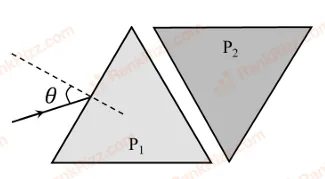
Two equilateral-triangular prisms P1P_1 and P2P_2 are kept with their sides parallel to each other, in vacuum, as shown in the figure. A light ray enters prism P1P_1 at an angle of incidence θ\theta such that the outgoing ray undergoes minimum deviation in prism P2P_2. If the respective refractive indices of P1P_1 and P2P_2 are 32\sqrt{\dfrac{3}{2}} and 3\sqrt{3}, θ=sin⁡−1[32sin⁡(πβ)]\theta = \sin^{-1}\left[\sqrt{\dfrac{3}{2}} \sin\left(\dfrac{\pi}{\beta}\right)\right], where the value of β\beta is ________.

Figure for JEE Advanced 2024 Physics question on Refraction at plane surfaces, Snell's law and apparent depth
SOLUTION

For each equilateral-triangular prism the refracting (apex) angle is A=60∘=π3A = 60^\circ = \dfrac{\pi}{3}.

Step 1: Condition for minimum deviation in prism P2P_2
For minimum deviation in any prism, the path of the ray is symmetrical, so r=r′=A2=30∘r = r' = \dfrac{A}{2} = 30^\circ inside the prism, and the angles of incidence and emergence are equal: i=ei = e.

Applying Snell’s law at the first face of P2P_2 (outside medium is vacuum, n=1n = 1):
sin⁡i=n2sin⁡r\sin i = n_2 \sin r

Given n2=3n_2 = \sqrt{3}, therefore
sin⁡i=3 sin⁡30∘=3(12)=32\sin i = \sqrt{3}\,\sin 30^\circ = \sqrt{3}\left(\dfrac{1}{2}\right)=\dfrac{\sqrt{3}}{2}
so i=60∘=π3i = 60^\circ = \dfrac{\pi}{3}.

Hence the light ray must strike the first face of P2P_2 with an incidence angle of 60∘60^\circ.

Step 2: This same ray is the emergent ray from prism P1P_1
The two prisms are arranged with their corresponding faces parallel; therefore the angle the ray makes with the normal when it leaves P1P_1 is the same 60∘60^\circ. Let that angle of emergence from P1P_1 be e1=60∘e_1 = 60^\circ.

Step 3: Ray path inside prism P1P_1
Let the angles of refraction at the two faces of P1P_1 be r1r_1 and r2r_2. For any prism
r1+r2=A=60∘−(1)r_1 + r_2 = A = 60^\circ \qquad -(1)

Snell’s law at the second face (emergence) of P1P_1:
n1sin⁡r2=sin⁡e1n_1 \sin r_2 = \sin e_1
Given e1=60∘e_1 = 60^\circ and n1=32n_1 = \sqrt{\dfrac{3}{2}}, we get
sin⁡r2=sin⁡60∘n1=3232=22=sin⁡45∘\sin r_2 = \dfrac{\sin 60^\circ}{n_1} = \dfrac{\dfrac{\sqrt{3}}{2}}{\sqrt{\dfrac{3}{2}}} = \dfrac{\sqrt{2}}{2} = \sin 45^\circ
so r2=45∘r_2 = 45^\circ.

Using (1)(1):
r1=60∘−45∘=15∘.r_1 = 60^\circ - 45^\circ = 15^\circ.

Step 4: Incidence angle θ\theta on the first face of P1P_1
Apply Snell’s law at the first face of P1P_1:
sin⁡θ=n1sin⁡r1=32  sin⁡15∘\sin \theta = n_1 \sin r_1 = \sqrt{\dfrac{3}{2}}\;\sin 15^\circ

Since 15∘=π1215^\circ = \dfrac{\pi}{12},
sin⁡θ=32  sin⁡ ⁣(π12).\sin \theta = \sqrt{\dfrac{3}{2}}\;\sin\!\left(\dfrac{\pi}{12}\right).

The question states this result as θ=sin⁡−1 ⁣[32  sin⁡ ⁣(πβ)].\theta = \sin^{-1}\!\left[\sqrt{\dfrac{3}{2}}\;\sin\!\left(\dfrac{\pi}{\beta}\right)\right]. Comparing, we must have πβ=π12⟹β=12.\dfrac{\pi}{\beta} = \dfrac{\pi}{12}\quad\Longrightarrow\quad \beta = 12.

Hence the required value is 12.

Topic: Refraction at plane surfaces, Snell's law and apparent depth

SubjectPhysics
TopicRefraction at plane surfaces, Snell's law and apparent depth
TypeNumerical answer
Report an error in this question
What is wrong?

QUESTION pyq:497251