Ray Optics & Optical Instruments JEE Advanced PYQs with answer key
PHYSICS · 61 PAST QUESTIONS · 6 TOPICS · 2007–2026
HOW TO USE THIS SHEET
Every JEE Advanced Ray Optics & Optical Instruments question we hold, grouped by topic, most-asked topic first and newest first inside each. The answer key is at the end (52 of 61 questions have a checked key); the worked solution is on each question’s page, printed beside it.
Prism: deviation and dispersion 26
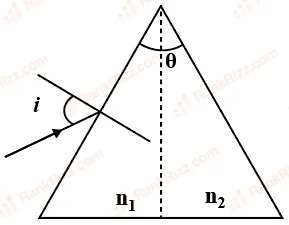
For a prism of prism angle , the refractive indices of the left half and the right half are, respectively, and as shown in the figure. The angle of incidence 𝑖 is chosen such that the incident light rays will have minimum deviation if . For the case of unequal refractive indices, and (where ), the angle of emergence . Which of the following statement(s) is(are) correct?
- (A)
The value of (in radians) is greater than that of
- (B)
is proportional to
- (C)
lies between 2.0 and 3.0 milliradians, if
- (D)
lies between 1.0 and 1.6 milliradians, if
rr2.rankrizz.com/jee-advanced/physics/ray-optics/q/2021-paper-2-q22
- (A)
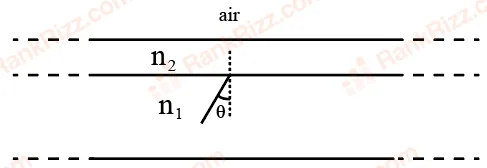
A wide slab consisting of two media of refractive indices and is placed in air as shown in the figure. A ray of light is incident from medium to at an angle , where is slightly larger than . Take refractive index of air as 1. Which of the following statement(s) is(are) correct?
- (A)
The light ray enters air if
- (B)
The light ray is finally reflected back into the medium of refractive index if
- (C)
The light ray is finally reflected back into the medium of refractive index if
- (D)
The light ray is reflected back into the medium of refractive index if
rr2.rankrizz.com/jee-advanced/physics/ray-optics/q/2021-paper-1-q31
- (A)
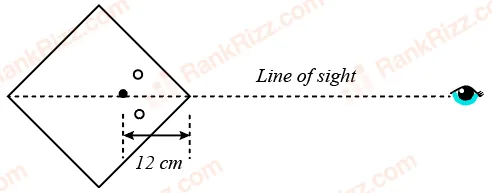
A large square container with thin transparent vertical walls and filled with water (refractive index ) is kept on a horizontal table. A student holds a thin straight wire vertically inside the water 12 cm from one of its corners, as shown schematically in the figure. Looking at the wire from this corner, another student sees two images of the wire, located symmetrically on each side of the line of sight as shown. The separation (in cm) between these images is ____________.
Answer: ____________
rr2.rankrizz.com/jee-advanced/physics/ray-optics/q/2020-paper-2-q1
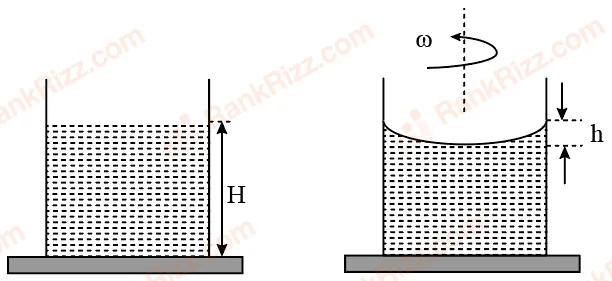
A beaker of radius 𝑟 is filled with water (refractive index ) up to a height 𝐻 as shown in the figure on the left. The beaker is kept on a horizontal table rotating with angular speed . This makes the water surface curved so that the difference in the height of water level at the center and at the circumference of the beaker is , as shown in the figure on the right. Take this surface to be approximately spherical with a radius of curvature 𝑅. Which of the following is/are correct? (g is the acceleration due to gravity)
- (A)
- (B)
- (C)
Apparent depth of the bottom of the beaker is close to
- (D)
Apparent depth of the bottom of the beaker is close to
rr2.rankrizz.com/jee-advanced/physics/ray-optics/q/2020-paper-2-q7
- (A)
Three glass cylinders of equal height H = 30 cm and same refractive index n = 1.5 are placed on a horizontal surface as shown in figure. Cylinder I has a flat top, cylinder II has a convex top and cylinder III has a concave top. The radu of curvature of the two curved tops are same (R = 3 m). If and are the apparent depths of a point_X on the bottom of the three cylinders, respectively, the correct statement(s) is/are:
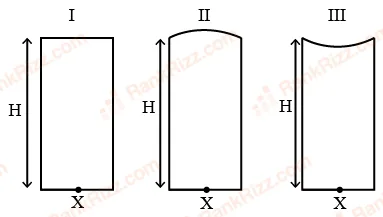
- (A)
- (B)
- (C)
- (D)
0.8 cm cm
rr2.rankrizz.com/jee-advanced/physics/ray-optics/q/2019-paper-2-q6
- (A)
A monochromatic light is incident from air on a refracting surface of a prism of angle and refractive index . The other refracting surface of the prism is coated by a thin film of material of refractive index n as shown in figure. The light suffers total internal reflection at the coated prism surface for an incidence angle of . The value of is ___________ .
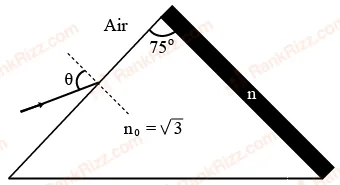
Answer: ____________
rr2.rankrizz.com/jee-advanced/physics/ray-optics/q/2019-paper-2-q11
A planar structure of length £ and width W is made of two different optical media of refractive indices as shown in figure. If , a ray entering from end AB will emerge from end CD only if the total internal reflection condition is met inside the structure. For L = 9.6 m, if the incident angle is varied, the maximum time taken by array to exit the plane CD is , where t is _______.
[ Speed of light ]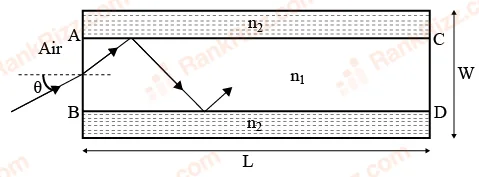
Answer: ____________
rr2.rankrizz.com/jee-advanced/physics/ray-optics/q/2019-paper-1-q18
For an isosceles prism of angle 𝐴 and refractive index , it is found that the angle of minimum deviation . Which of the following options is/are correct?
- (A)
For the angle of incidence , the ray inside the prism is parallel to the base of the prism
- (B)
For this prism, the refractive index and the angle of prism 𝐴 are related as
- (C)
At minimum deviation, the incident angle and the refracting angle at the first refracting surface are related by
- (D)
For this prism, the emergent ray at the second surface will be tangential to the surface when the angle of incidence at the first surface is
rr2.rankrizz.com/jee-advanced/physics/ray-optics/q/2017-paper-1-q7
- (A)
A monochromatic light is travelling in a medium of refractive index n = 1.6. It enters a stack of glass layers from the bottom side at an angle . The interfaces of the glass layers are parallel to each other. The refractive indices of different glass layers are monotonically decreasing as , where is the refractive index of the slab and (see the figure) The ray is refracted out parallel to the interface between the and slabs from the right side of the stack. What is the value of m?
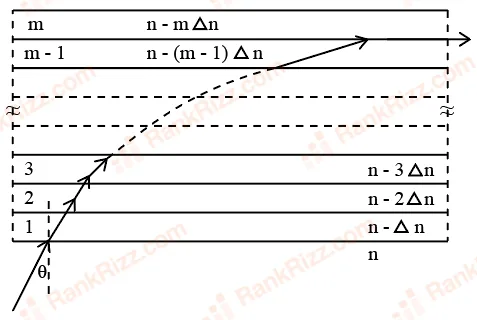
Answer: ____________
rr2.rankrizz.com/jee-advanced/physics/ray-optics/q/2017-paper-1-q10
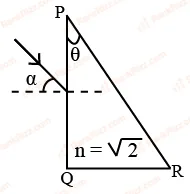
A parallel beam of light is incident from air at an angle a on the side PQ of a right angled triangular prism of refractive index . Light undergoes total internal reflection in the prism at the face PR when a has a minimum value of . The angle of the prism is
- (A)
- (B)
- (C)
- (D)
rr2.rankrizz.com/jee-advanced/physics/ray-optics/q/2016-paper-1-q4
- (A)
A transparent slab of thickness d has a refractive index n(z) that increases with z. Here z is the vertical distance inside the slab, measured from the top. The slab is placed between two media with uniform refractive indices and , as shown in the figure. A ray of light is incident with angle from medium 1 and emerges in medium 2 with refraction angle , with a lateral displacement l.
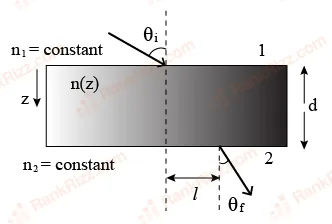
Which of the following statement(s) is(are) true?
- (A)
- (B)
- (C)
l is independentof
- (D)
l is dependenton n(z)
rr2.rankrizz.com/jee-advanced/physics/ray-optics/q/2016-paper-1-q13
- (A)
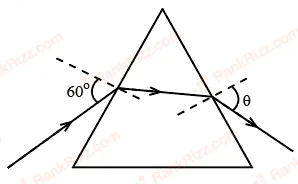
A monochromatic beam of light is incident at on one face of an equilateral prism of refractive index n and emerges from the opposite face making an angle with the normal (see the figure). For the value of is and . The value of m is
Answer: ____________
rr2.rankrizz.com/jee-advanced/physics/ray-optics/q/2015-paper-2-q6
For two structures namely with and , and with and and taking the refractive index of water to be and that of air to be 1, the correct option(s) is(are)
- (A)
NA of immersed in water is the sameas that of immersed in liquid of refractive index
- (B)
NA of immersed in liquid of refractive index is the same as that of immersed in water
- (C)
NA of placed in air is the same as that of immersed in liquid of refractive index
- (D)
NA of placed in air is the same as that of placed in water
rr2.rankrizz.com/jee-advanced/physics/ray-optics/q/2015-paper-2-q19
- (A)
If two structures of same cross-sectional area, but different numerical apertures and are joined longitudinally, the numerical aperture of the combined structure is
- (A)
- (B)
- (C)
- (D)
rr2.rankrizz.com/jee-advanced/physics/ray-optics/q/2015-paper-2-q20
- (A)
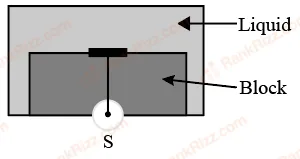
A point source S is placed at the bottom of a transparent block of height 10 mm and refractive index 2.72. It is immersed in a lower refractive index liquid as shown in the figure. It is found that the light emerging from the block to the liquid forms a circular bright spot of diameter 11.54 mm on the top of the block. The refractive index of the liquid is
- (A)
1.21
- (B)
1.30
- (C)
1.36
- (D)
1.42
rr2.rankrizz.com/jee-advanced/physics/ray-optics/q/2014-paper-2-q5
- (A)
A right angled prism of refractive index is placed in a rectangular block of refractive index , which is surrounded by a medium of refractive index , as Shown in the figure. A ray of light ‘e’ enters the rectangular block at normal incidence. Depending upon the relationships between and , it takes one of the four possible paths ‘ef’, ‘eg’, ‘eh’ or ‘ei’.
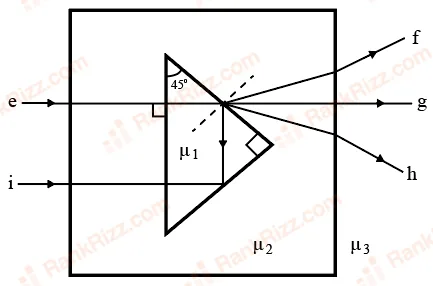
Match the paths in List I with conditions of refractive indices in List II and select the correct answer using the codes given below the lists: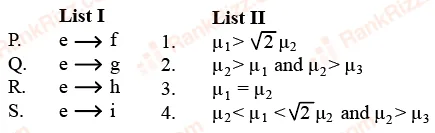
- (A)
P-2, Q-2, R-1, S-4
- (B)
P-1, Q-2, R-4, S-3
- (C)
P-4, Q-1, R-2, S-3
- (D)
P-2, Q-3, R-4, S-1
rr2.rankrizz.com/jee-advanced/physics/ray-optics/q/2013-paper-2-q18
- (A)
Choose the correct statement.
- (A)
The speed of light in the meta-material is
- (B)
The speed of light in the meta-material is
- (C)
The speed of light in the meta-material is v = c.
- (D)
The wavelength of the light in the meta-material is given by , where is the wavelength of the light in air
rr2.rankrizz.com/jee-advanced/physics/ray-optics/q/2012-paper-2-q11
- (A)
For light incident from air on a meta-material, the appropriate ray diagram is :
- (A)
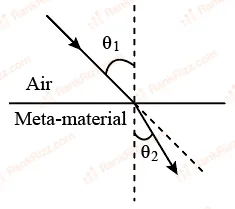
- (B)
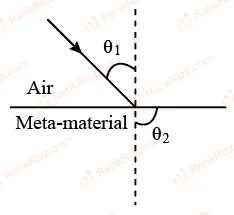
- (C)
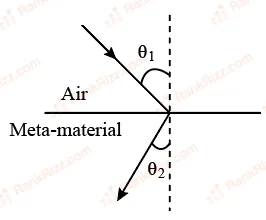
- (D)
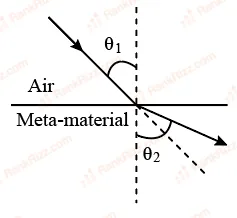
rr2.rankrizz.com/jee-advanced/physics/ray-optics/q/2012-paper-2-q12
- (A)
A light ray traveling in glass medium is incident on glass-air interface at an angle of incidence . The reflected ( R ) and transmitted ( T ) intensities, both as function of , are plotted. The correct sketch is
- (A)
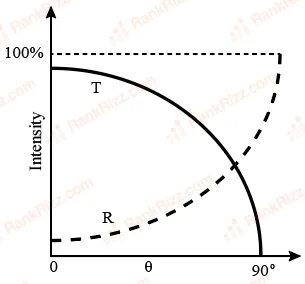
- (B)
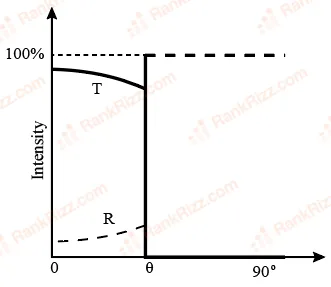
- (C)
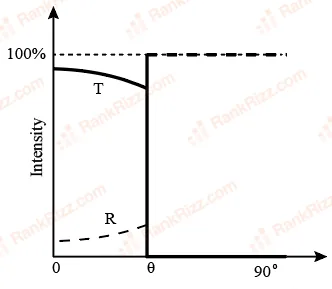
- (D)
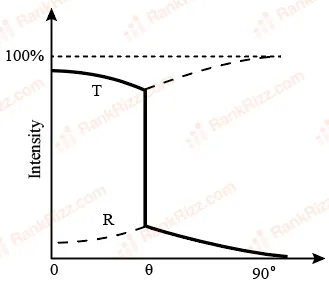
rr2.rankrizz.com/jee-advanced/physics/ray-optics/q/2011-paper-2-q21
- (A)
Water (with refractive index = ) in a tank is 18 cm deep. Oil of refractive index lies on water making a convex surface of radius of curvature ‘R = 6 cm’ as shown. Consider oil to act as a thin lens. An object ‘S’ is placed 24 cm above water surface. The location of its image is at ‘x’ cm above the bottom of the tank. Then ‘x’ is
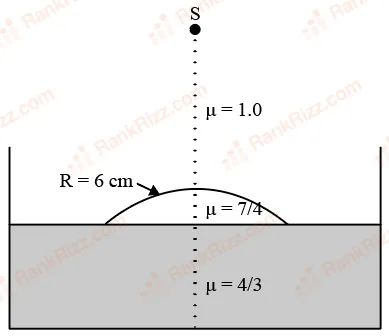
Answer: ____________
rr2.rankrizz.com/jee-advanced/physics/ray-optics/q/2011-paper-2-q36
A large glass slab of thickness 8 cm is placed over a point source of light on a plane surface. It is seen that light emerges out of the top surface of the slab from a circular area of radius R cm. What is the value of R?
Answer: ____________
rr2.rankrizz.com/jee-advanced/physics/ray-optics/q/2010-paper-2-q48
A ray OP of monochromatic light is incident on the face AB of prism ABCD near vertex B at an incident angle of (see figure). If the refractive index of the material of the prism is , which of the following is (are) correct ?
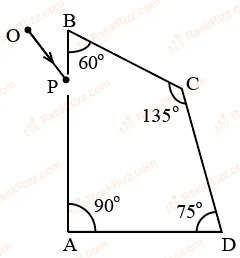
- (A)
The raygets totally internally reflected at face CD
- (B)
The ray comes out through face AD
- (C)
The angle between the incident ray and the emergent ray is
- (D)
The angle between the incident ray and the emergent ray is
rr2.rankrizz.com/jee-advanced/physics/ray-optics/q/2010-paper-1-q68
- (A)
A ball is dropped from a height of 20 m above the surface of water in a lake. The refractive index of water is . A fish inside the lake, in the line of fall of the ball, is looking at the ball. At an instant, when the ball is 12.8 m above the water surface, the fish sees the speed of ball as-
- (A)
9 m/s
- (B)
12 m/s
- (C)
16 m/s
- (D)
21.33 m/s
rr2.rankrizz.com/jee-advanced/physics/ray-optics/q/2009-paper-1-q47
- (A)
Two beams of red and violet colours are made to pass separately through a prism (angle of the prism is ). In the position of minimum deviation, the angle of refraction will be
- (A)
for both the colours
- (B)
greater for the violet colour
- (C)
greater for the red colour
- (D)
equal but not for both the colours
rr2.rankrizz.com/jee-advanced/physics/ray-optics/q/2008-paper-1-q27
- (A)
A light beam is traveling from Region I to Region IV (Refer Figure). The refractive index in Regions I, II, III and IV are and , respectively. The angle of incidence for which the beam just misses entering Region IV is
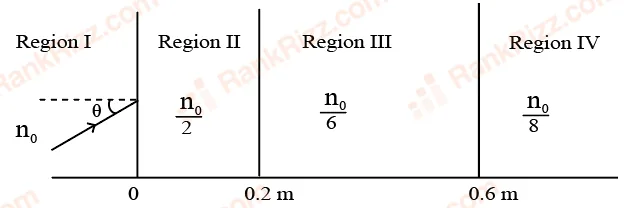
- (A)
- (B)
- (C)
- (D)
rr2.rankrizz.com/jee-advanced/physics/ray-optics/q/2008-paper-2-q31
- (A)
A ray of light traveling in wateris incident on its surface open to air. The angle of incidence is , which is less than the critical angle. Then there will be
- (A)
only reflected ray and no refracted ray
- (B)
only a refracted ray and no reflected ray
- (C)
a reflected ray and a refracted ray and the angle between them would be less than
- (D)
a reflected ray and a refracted ray and the angle between them would be greater than
rr2.rankrizz.com/jee-advanced/physics/ray-optics/q/2007-paper-1-q7
- (A)
Combinations of lenses and mirrors 15
An extended object is placed at point O, 10 cm in front of a convex lens and a concave lens is placed 10 cm behind it, as shown in the figure. The radii of curvature of all the curved surfaces in both the lenses are 20 cm. The refractive index of both the lenses is 1.5. The total magnification of this lens system is
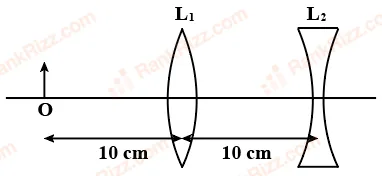
- (A)
0.4
- (B)
0.8
- (C)
1.3
- (D)
1.6
rr2.rankrizz.com/jee-advanced/physics/ray-optics/q/2021-paper-1-q22
- (A)
A thin convex lens is made of two materials with refractive indices as shown in figure. The radius of curvature of the left and right spherical surfaces are equal. f is the focal length of the lens when The focal length is when and . Assuming and 1 < n < 2, the correct statement(s) is/are
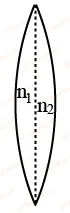
- (A)
- (B)
For and f = 20 cm,the value of will be 0.02 cm (round off to decimalplace).
- (C)
If
- (D)
The relation between remains unchanged if both the convex surfaces are replaced by concave surfaces of the same radius of curvature.
rr2.rankrizz.com/jee-advanced/physics/ray-optics/q/2019-paper-1-q10
- (A)
Sunlight of intensity 1.3 is incident normally on a thin convex lens of focal length 20 𝑐𝑚. Ignore the energy loss of light due to the lens and assume that the lens aperture size is much smaller than its focal length. The average intensity of light, in , at a distance 22 𝑐𝑚 from the lens on the other side is __________
Answer: ____________
rr2.rankrizz.com/jee-advanced/physics/ray-optics/q/2018-paper-1-q13
A small object is placed 50 cm to the left of a thin convex lens of focal length 30 cm. A convex spherical mirror of radius of curvature 100 cm is placed to the right of the lens at a distance of 50 cm. The mirror is tilted such that the axis of the mirror is at an angle to the axis of the lens, as shown in the figure.
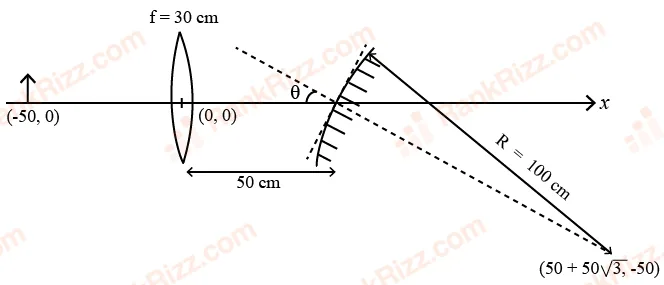
If the origin of the coordinate system is taken to be at the center of the lens, the coordinates (in cm) of the point (x,y) at which the image is formed are
- (A)
- (B)
- (C)
- (D)
rr2.rankrizz.com/jee-advanced/physics/ray-optics/q/2016-paper-2-q5
- (A)
A plano-convex lens is made ofa material of refractive index n. When a smallobject is placed 30 cm awayin front of the curved surface of the lens, an image of double the size of the object is produced. Dueto reflection from the convex surface of the lens, another faint image is observed at a distance of 10 cm away from the lens. Which of the following statement(s)
is(are) true?- (A)
The refractive index of the lens is 2.5
- (B)
The radius of curvature of the convex surface is 45 cm
- (C)
The faint image is erect and real
- (D)
The focal length of the lens is 20 cm
rr2.rankrizz.com/jee-advanced/physics/ray-optics/q/2016-paper-1-q9
- (A)
Consider a concave mirror and a convex lens (refractive index = 1.5) of focal length 10 cm each, separated by a distance of 50 cm in air (refractive index = 1) as shown in the figure. An object is placed at a distance of 15 cm from the mirror. Its erect image formed by this combination has magnification . When the set-up is kept in a medium of refractive index , the magnification becomes . The magnitude is
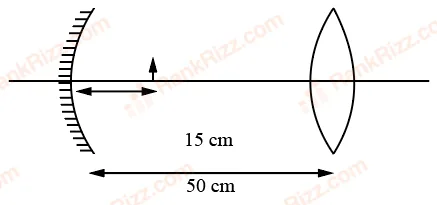
Answer: ____________
rr2.rankrizz.com/jee-advanced/physics/ray-optics/q/2015-paper-1-q8
Two identical glass rods and (refractive index = 1.5) have one convex end of radius of curvature 10 cm. They are placed with the curved surfaces at a distance d as shown in the figure, with their axes (shown by the dashed line) aligned. When a point source of light P is placed inside rod on its axis at a distance of 50 cm from the curved face, the light rays emanating from it are found to be parallel to the axis inside . The distance d is

- (A)
60 cm
- (B)
70 cm
- (C)
80 cm
- (D)
90 cm
rr2.rankrizz.com/jee-advanced/physics/ray-optics/q/2015-paper-1-q14
- (A)
A transparent thin film of uniform thickness and refractive index is coated on the convex spherical surface of radius Rat one end of a long solid glass cylinder of refractive index as shown in the figure. Rays of light parallel to the axis of the cylinder traversing through the film from air to glass get focused at distance from the film, while rays of light traversing from glass to air get focused at distance from the film. Then
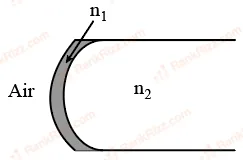
- (A)
- (B)
- (C)
- (D)
rr2.rankrizz.com/jee-advanced/physics/ray-optics/q/2014-paper-1-q9
- (A)
Four combinations of two thin lenses are given in List I. The radius of curvature of all curved surfaces is r and the refractive index of all the lenses is 1.5. Match lens combinations in List I with their focal length in List II and select the correct answer using the code given below the lists.
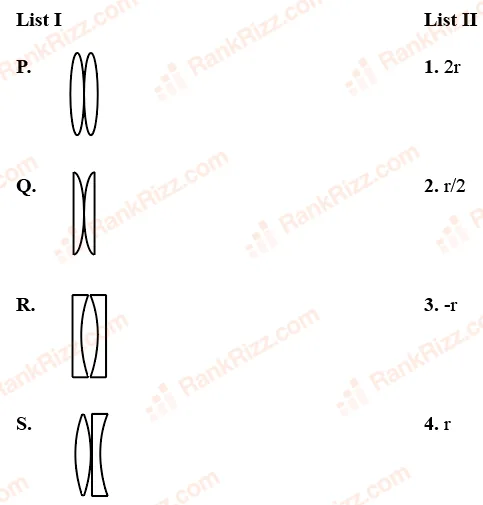
Choices:- (A)
P-1, Q-2, R-3, S-4
- (B)
P-2, Q-4, R-3, S-1
- (C)
P-4, Q-1, R-2, S-3
- (D)
P-2, Q-1, R-3, S-4
rr2.rankrizz.com/jee-advanced/physics/ray-optics/q/2014-paper-2-q18
- (A)
The image of an object, formed by a plano-convex lens at a distance of 8 m behind the lens, is real and is one-third the size of the object. The wavelength oflight inside the lens is times the wavelength in free space. The radius of the curved surface of the lens is
- (A)
1 m
- (B)
2 m
- (C)
3 m
- (D)
6 m
rr2.rankrizz.com/jee-advanced/physics/ray-optics/q/2013-paper-1-q10
- (A)
A bi-convex lens is formed with two thin plano-convex lenses as shown in the figure. Refractive index n of the first lens is 1.5 and that of the second lens is 1.2. Both the curved surfaces are of the same radius of curvature R = 14 cm. For this bi-convex lens, for an object distance of 40 cm, the image distance will be
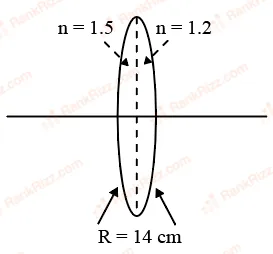
- (A)
-280.0 cm.
- (B)
40.0 cm.
- (C)
21.5 cm.
- (D)
13.3 cm.
rr2.rankrizz.com/jee-advanced/physics/ray-optics/q/2012-paper-1-q10
- (A)
A biconvex lens of focal length 15 cmis in front of a plane mirror. The distance between the lens and the mirror is 10 cm. A small object is kept at a distance of 30 cm from the lens. The final image is
- (A)
virtual and at a distance of 16 cm from the mirror
- (B)
real and at a distance of 16 cm from the mirror
- (C)
virtual and at a distance of 20 cm from the mirror
- (D)
real and at a distance of 20 cm from the mirror
rr2.rankrizz.com/jee-advanced/physics/ray-optics/q/2010-paper-2-q41
- (A)
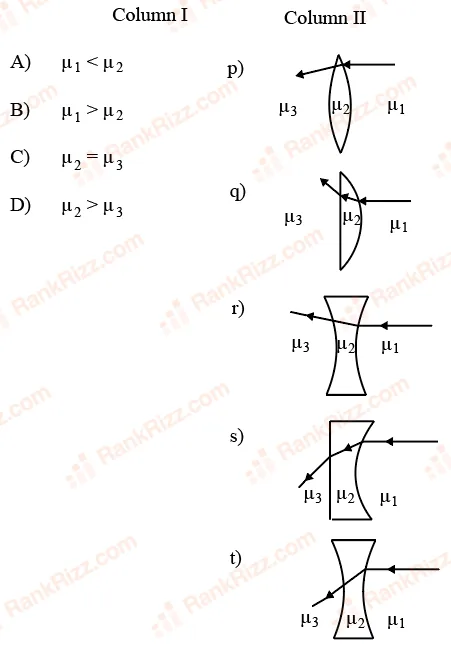
Two transparent media of refractive indices and have a solid lens shaped transper material of refractive index between them as shown in figures in Column II A: traversing these media is also shown in the figures. In Column different relations between and are given. Match them to the ray diagrams shown in Column
rr2.rankrizz.com/jee-advanced/physics/ray-optics/q/2010-paper-2-q56
The focal length of a thin biconvex lens is 20cm. When anobject is moved from a distance of 25cmin front of it to 50cm, the magnification of its image changes from to . The ratio is
Answer: ____________
rr2.rankrizz.com/jee-advanced/physics/ray-optics/q/2010-paper-1-q75
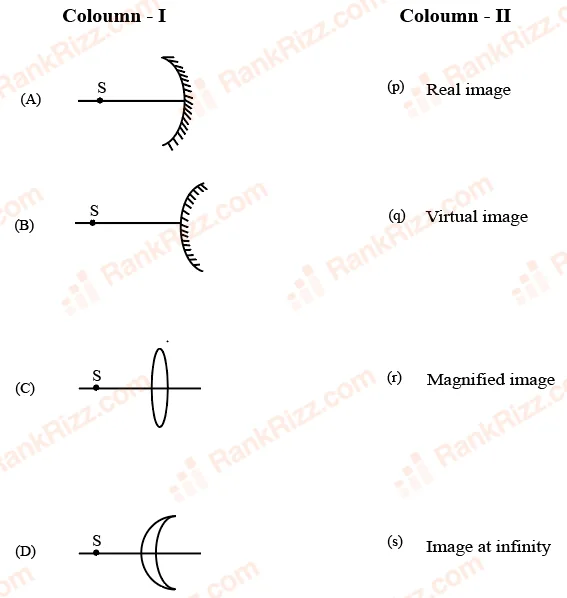
An optical component and an object S placed along its optic axis are given in Column I. The distance between the object and the component can be varied. The properties of images are given in Column II. Match all the properties of images from Column II with the appropriate components given in Column I. Indicate your answer by darkening the appropriate bubbles of the matrix given in the ORS.
rr2.rankrizz.com/jee-advanced/physics/ray-optics/q/2008-paper-2-q43
Refraction at plane surfaces, Snell's law and apparent depth 7
A beam of polychromatic light passes through a thin prism of prism angle . The refractive index of the material of the prism varies with wavelength as , where and . If is the wavelength at which the angle of minimum deviation is smallest, then the correct value of at is
- (A)
- (B)
- (C)
- (D)
rr2.rankrizz.com/jee-advanced/physics/ray-optics/q/2026-paper-2-q3
- (A)
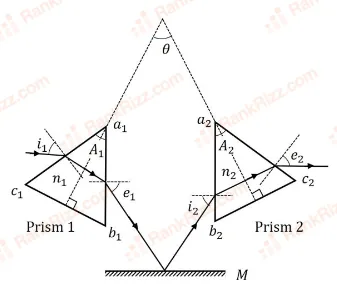
Consider two isosceles prisms 1 and 2 with prism angles and and refractive indices and , respectively, as shown in the figure. The faces and are parallel to each other and perpendicular to the mirror . If a ray of light is incident on the face and emerges from the face , then the correct statement(s) is/are:
- (A)
If both the prisms are at minimum deviation condition, then .
- (B)
If prism 2 is at minimum deviation condition, then is always true.
- (C)
If both the prisms 1 and 2 are at minimum deviation condition with angles of deviation and , respectively, then .
- (D)
If prism 1 is at minimum deviation condition, then is always true.
rr2.rankrizz.com/jee-advanced/physics/ray-optics/q/2026-paper-2-q5
- (A)
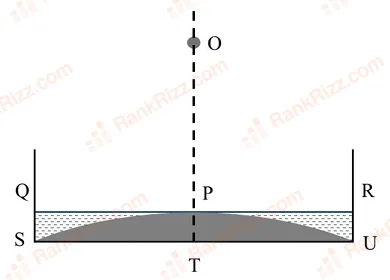
A glass beaker has a solid, plano-convex base of refractive index 1.60, as shown in the figure. The radius of curvature of the convex surface (SPU) is 9 cm, while the planar surface (STU) acts as a mirror. This beaker is filled with a liquid of refractive index up to the level . If the image of a point object at a height of ( in the figure) is formed onto itself, then, which of the following option(s) is (are) correct?
- (A)
For , cm
- (B)
For , cm
- (C)
For , cm
- (D)
For , cm
rr2.rankrizz.com/jee-advanced/physics/ray-optics/q/2024-paper-1-q24
- (A)
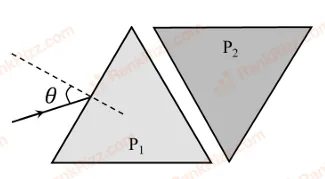
Two equilateral-triangular prisms and are kept with their sides parallel to each other, in vacuum, as shown in the figure. A light ray enters prism at an angle of incidence such that the outgoing ray undergoes minimum deviation in prism . If the respective refractive indices of and are and , , where the value of is ________.
Answer: ____________
rr2.rankrizz.com/jee-advanced/physics/ray-optics/q/2024-paper-2-q28
A light ray is incident on the surface of a sphere of refractive index at an angle of incidence . The ray partially refracts into the sphere with angle of refraction and then partly reflects from the back surface. The reflected ray then emerges out of the sphere after a partial refraction. The total angle of deviation of the emergent ray with respect to the incident ray is . Match the quantities mentioned in List-I with their values in List-II and choose the correct option.
List-I List-II (P) If and , then all the possible values of will be (1) and (Q) If and , then all the possible values of will be (2) and (R) If and , then all the possible values of will be (3) and (S) If and , then all the possible values of will be (4) (5) - (A)
P 5; Q 2; R 1; S 4
- (B)
P 5; Q 1; R 2; S 4
- (C)
P 3; Q 2; R 1; S 4
- (D)
P 3; Q 1; R 2; S 5
rr2.rankrizz.com/jee-advanced/physics/ray-optics/q/2024-paper-1-q33
- (A)
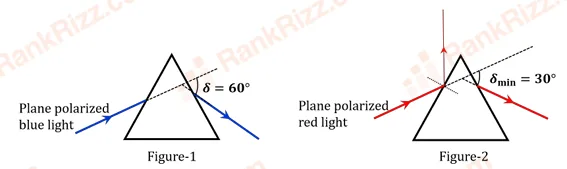
A plane polarized blue light ray is incident on a prism such that there is no reflection from the surface of the prism. The angle of deviation of the emergent ray is (see Figure-1). The angle of minimum deviation for red light from the same prism is (see Figure-2). The refractive index of the prism material for blue light is . Which of the following statement(s) is(are) correct?
- (A)
The blue light is polarized in the plane of incidence.
- (B)
The angle of the prism is 45°.
- (C)
The refractive index of the material of the prism for red light is .
- (D)
The angle of refraction for blue light in air at the exit plane of the prism is 60°.
rr2.rankrizz.com/jee-advanced/physics/ray-optics/q/2023-paper-1-q19
- (A)
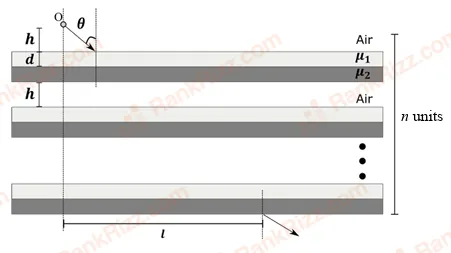
Consider a configuration of identical units, each consisting of three layers. The first layer is a column of air of height cm, and the second and third layers are of equal thickness cm, and refractive indices and , respectively. A light source O is placed on the top of the first unit as shown in the figure. A Ray of light from is incident on the second layer of the first unit at an angle of to the normal. For a specific value of , the ray of light emerges from the bottom of the configuration at a distance cm, as shown in the figure. The value of is _______.
Answer: ____________
rr2.rankrizz.com/jee-advanced/physics/ray-optics/q/2022-paper-2-q23
Reflection and plane mirrors 5
A ray oflight travelling in the direction is incident on a plane mirror. After reflection, it travels along the direction . The angle of incidence is
- (A)
- (B)
- (C)
- (D)
rr2.rankrizz.com/jee-advanced/physics/ray-optics/q/2013-paper-1-q2
- (A)
Image of an object approaching a convex mirror of radius of curvature 20 m along its optical axis is observed to move from to in 30 seconds. What is the speed of the object in km per hour ?
Answer: ____________
rr2.rankrizz.com/jee-advanced/physics/ray-optics/q/2010-paper-2-q47
A student performed the experiment of determination of focal length of a concave mirror by u-v method using an optical bench of length 1.5 meter. The focal length of the mirror used is 24 cm. The maximum error in the location of the image can be 0.2 cm. The 5 sets of (u, v) values recorded by the student (in cm) are : (42, 56), (48, 48), (60, 40), (66, 33), (78, 39). The data set(s) that cannot come from experiment and is(are) incorrectly recorded, is (are)
- (A)
(42, 56)
- (B)
(48, 48)
- (C)
(66, 33)
- (D)
(78, 39)
rr2.rankrizz.com/jee-advanced/physics/ray-optics/q/2009-paper-1-q51
- (A)
In an experiment to determine the focal length (f) of a concave mirror by the u-v method, a student places the object pin A on the principal axis at a distance x from the pole P. The student looks at the pin and its inverted image from a distance keeping his/her eye in line with PA. When the student shifts his/her eye towards left, the image appears to the right of the object pin. Then,
- (A)
x < f
- (B)
f < x < 2f
- (C)
x = 2f
- (D)
x > 2f
rr2.rankrizz.com/jee-advanced/physics/ray-optics/q/2007-paper-1-q2
- (A)
STATEMENT-1
The formula connecting u, v and f for a spherical mirror is valid only for mirrors whosesizes are very small compared to their radii of curvature.
because
STATEMENT-2
Lawsof reflection are strictly valid for plane surfaces, but not for large spherical surfaces.- (A)
Statement-1 is True, Statement-2 is True; Statement-2 is a correct explanation for Statement-1
- (B)
Statement-1 is True, Statement-2 is True; Statement-2 is NOT a correct explanation for Statement-1
- (C)
Statement-1 is True, Statement-2 is False
- (D)
Statement-1 is False, Statement-2 is True
rr2.rankrizz.com/jee-advanced/physics/ray-optics/q/2007-paper-1-q12
- (A)
Spherical mirrors: mirror formula and magnification 4
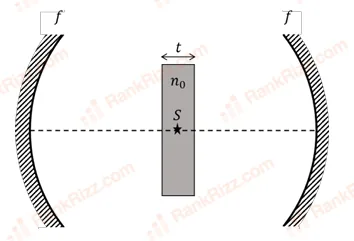
Two identical concave mirrors each of focal length are facing each other as shown in the schematic diagram. The focal length is much larger than the size of the mirrors. A glass slab of thickness and refractive index is kept equidistant from the mirrors and perpendicular to their common principal axis. A monochromatic point light source is embedded at the center of the slab on the principal axis, as shown in the schematic diagram. For the image to be formed on itself, which of the following distances between the two mirrors is/are correct:
- (A)
- (B)
- (C)
- (D)
rr2.rankrizz.com/jee-advanced/physics/ray-optics/q/2025-paper-2-q22
- (A)
A solid glass sphere of refractive index and radius contains a spherical air cavity of radius , as shown in the figure. A very thin glass layer is present at the point O so that the air cavity (refractive index ) remains inside the glass sphere. An unpolarized, unidirectional and monochromatic light source emits a light ray from a point inside the glass sphere towards the periphery of the glass sphere. If the light is reflected from the point O and is fully polarized, then the angle of incidence at the inner surface of the glass sphere is . The value of is ________.
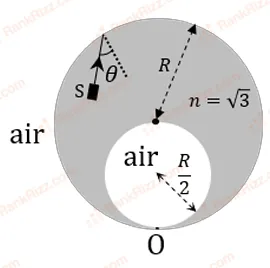
Answer: ____________
rr2.rankrizz.com/jee-advanced/physics/ray-optics/q/2025-paper-1-q27
An object and a concave mirror of focal length cm both move along the principal axis of the mirror with constant speeds. The object moves with speed cm s towards the mirror with respect to a laboratory frame. The distance between the object and the mirror at a given moment is denoted by . When cm, the speed of the mirror is such that the image is instantaneously at rest with respect to the laboratory frame, and the object forms a real image. The magnitude of is _______ cm s.
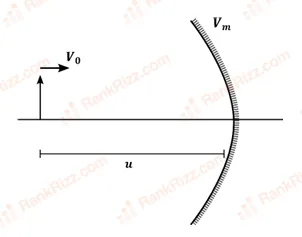
Answer: ____________
rr2.rankrizz.com/jee-advanced/physics/ray-optics/q/2022-paper-2-q26
Three plane mirrors form an equilateral triangle with each side of length . There is a small hole at a distance from one of the corners as shown in the figure. A ray of light is passed through the hole at an angle and can only come out through the same hole. The cross section of the mirror configuration and the ray of light lie on the same plane.
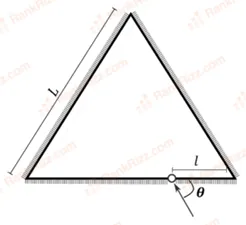
Which of the following statement(s) is(are) correct?
- (A)
The ray of light will come out for , for .
- (B)
There is an angle for at which the ray of light will come out after two reflections.
- (C)
The ray of light will NEVER come out for , and .
- (D)
The ray of light will come out for , and after six reflections.
rr2.rankrizz.com/jee-advanced/physics/ray-optics/q/2022-paper-1-q30
- (A)
Thin lenses: lens formula, lens maker's formula and power 4
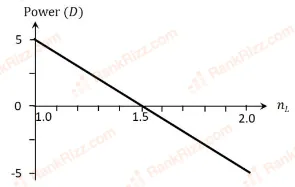
A double convex lens made of glass of refractive index and radii of curvature of the curved surfaces each is immersed in a liquid of refractive index . The correct plot showing the variation of the power, in the units of diopter (), as a function of is:
- (A)
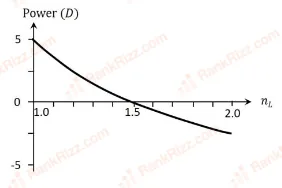
- (B)
- (C)
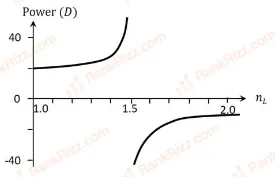
- (D)
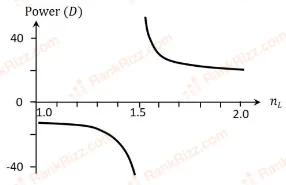
rr2.rankrizz.com/jee-advanced/physics/ray-optics/q/2026-paper-1-q4
- (A)
An optical arrangement consists of two concave mirrors M and M, and a convex lens L with a common principal axis, as shown in the figure. The focal length of L is 10 cm. The radii of curvature of M and M are 20 cm and 24 cm, respectively. The distance between L and M is 20 cm. A point object S is placed at the mid-point between L and M on the axis. When the distance between L and M is cm, one of the images coincides with S. The value of is ______.
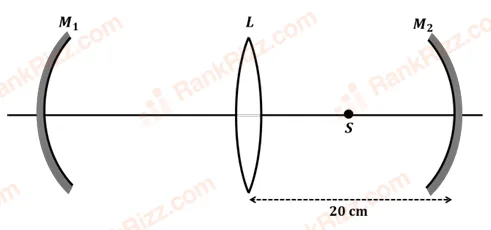
Answer: ____________
rr2.rankrizz.com/jee-advanced/physics/ray-optics/q/2023-paper-1-q26
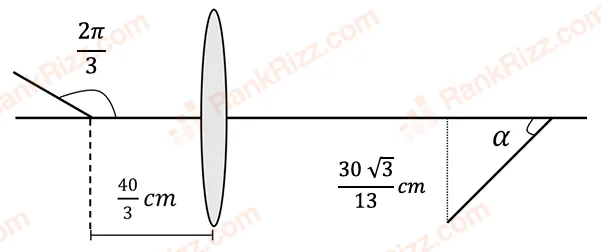
A rod of length 2 cm makes an angle rad with the principal axis of a thin convex lens. The lens has a focal length of 10 cm and is placed at a distance of cm from the object as shown in the figure. The height of the image is cm and the angle made by it with respect to the principal axis is rad. The value of is rad, where is ______.
Answer: ____________
rr2.rankrizz.com/jee-advanced/physics/ray-optics/q/2022-paper-1-q22
List I contains four combinations of two lenses (1 and 2) whose focal lengths (in cm) are indicated in the figures. In all cases, the object is placed 20 cm from the first lens on the left, and the distance between the two lenses is 5 cm. List II contains the positions of the final images.
List-I List-II (I) 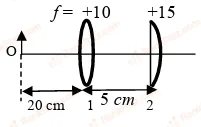
(P) Final image is formed at 7.5 cm on the right side of lens 2. (II) 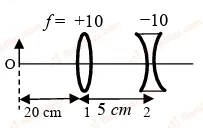
(Q) Final image is formed at 60.0 cm on the right side of lens 2. (III) 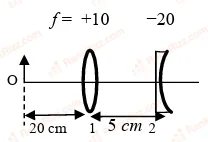
(R) Final image is formed at 30.0 cm on the left side of lens 2. (IV) 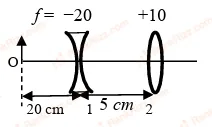
(S) Final image is formed at 6.0 cm on the right side of lens 2. (T) Final image is formed at 30.0 cm on the right side of lens 2. Which one of the following options is correct?
- (A)
I P, II R, III Q, IV T
- (B)
I Q, II P, III T, IV S
- (C)
I P, II T, III R, IV Q
- (D)
I T, II S, III Q, IV R
rr2.rankrizz.com/jee-advanced/physics/ray-optics/q/2022-paper-1-q36
- (A)
Answer key
- 01 B
- 02 B, C, D
- 03 —
- 04 A, D
- 05 A, D
- 06 —
- 07 —
- 08 A, C, D
- 09 8
- 10 A
- 11 A, C, D
- 12 2
- 13 A, C
- 14 D
- 15 C
- 16 D
- 17 B
- 18 C
- 19 C
- 20 2
- 21 6
- 22 A, B, C
- 23 C
- 24 A
- 25 B
- 26 C
- 27 B
- 28 A, B, D
- 29 —
- 30 C
- 31 A, D
- 32 7
- 33 B
- 34 A, C
- 35 B
- 36 C
- 37 B
- 38 B
- 39 A-PR, B-QST, C-PRT, D-QS
- 40 6
- 41 —
- 42 B
- 43 A, C, D
- 44 A, B
- 45 12
- 46 A
- 47 A, C, D
- 48 4
- 49 A
- 50 3
- 51 —
- 52 B
- 53 C
- 54 A, B
- 55 —
- 56 3
- 57 A, B
- 58 A
- 59 —
- 60 —
- 61 A
“—” marks a question whose key we have not checked yet; its page shows the latest on it.
Past questions are reproduced with their sitting. Not affiliated with NTA or the IITs. Every question, online and free: rr2.rankrizz.com/jee-advanced/physics/ray-optics