JEE Advanced 2023 Physics question — Refraction at plane surfaces, Snell's law and apparent depth
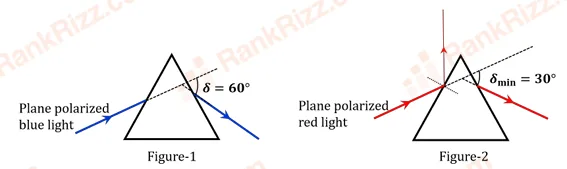
A plane polarized blue light ray is incident on a prism such that there is no reflection from the surface of the prism. The angle of deviation of the emergent ray is (see Figure-1). The angle of minimum deviation for red light from the same prism is (see Figure-2). The refractive index of the prism material for blue light is . Which of the following statement(s) is(are) correct?
SOLUTION
When a ray of a single, plane-polarised colour is incident on a glass surface and no part of it is reflected, the following two facts must hold simultaneously.
• The incident light has to be polarised in the plane of incidence (otherwise the perpendicular component would still be partially reflected).
• The angle of incidence must be the Brewster (polarising) angle, , defined by , where is the refractive index of the second medium with respect to air.
For the given prism , hence
(1)
Because the incident ray is already plane-polarised and the incidence is at the polarising angle, exactly zero reflection is possible only when the electric field vector lies in the plane of incidence. Therefore, statement A is correct.
No other statement can be asserted solely from the Brewster condition, so options B, C and D cannot be concluded as correct on the basis of the given information.
Hence the only correct statement is:
Option A - The blue light is polarised in the plane of incidence.
Topic: Refraction at plane surfaces, Snell's law and apparent depth