RankRizz
JEE ADVANCED 2024 · PAPER 1+4 / −2HARD

JEE Advanced 2024 Physics question — Refraction at plane surfaces, Snell's law and apparent depth

A glass beaker has a solid, plano-convex base of refractive index 1.60, as shown in the figure. The radius of curvature of the convex surface (SPU) is 9 cm, while the planar surface (STU) acts as a mirror. This beaker is filled with a liquid of refractive index nn up to the level QPRQPR. If the image of a point object OO at a height of hh (OTOT in the figure) is formed onto itself, then, which of the following option(s) is (are) correct?
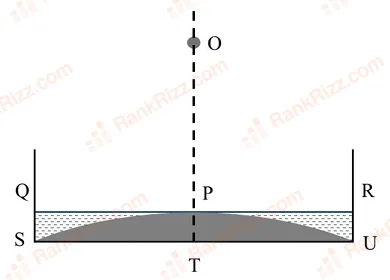
Figure for JEE Advanced 2024 Physics question on Refraction at plane surfaces, Snell's law and apparent depth
SOLUTION

Using the power of a combined silvered thin lens system:

1F=2(n−1R1+μg−nR2)+1fm\frac{1}{F} = 2\left(\frac{n - 1}{R_1} + \frac{\mu_g - n}{R_2}\right) + \frac{1}{f_m}

Given parameters: flat air-liquid interface (R1=∞R_1 = \infty), liquid-glass convex interface (R2=+9 cmR_2 = +9\text{ cm}), and flat mirror base (fm=∞f_m = \infty):

1F=2(0+1.60−n9)+0=2(1.60−n)9\frac{1}{F} = 2\left(0 + \frac{1.60 - n}{9}\right) + 0 = \frac{2(1.60 - n)}{9}

Using the coincidence condition where the image reflects back to the object position (u=−hu = -h, v=−hv = -h):

1−h+1−h=−1F  ⟹  2h=2(1.60−n)9\frac{1}{-h} + \frac{1}{-h} = -\frac{1}{F} \implies \frac{2}{h} = \frac{2(1.60 - n)}{9}

h=91.60−nh = \frac{9}{1.60 - n}

For Option (A): n=1.42  ⟹  h=91.60−1.42=90.18=50 cmn = 1.42 \implies h = \frac{9}{1.60 - 1.42} = \frac{9}{0.18} = 50\text{ cm}

For Option (B): n=1.35  ⟹  h=91.60−1.35=90.25=36 cmn = 1.35 \implies h = \frac{9}{1.60 - 1.35} = \frac{9}{0.25} = 36\text{ cm}

For Option (C): n=1.45  ⟹  h=91.60−1.45=90.15=60 cmn = 1.45 \implies h = \frac{9}{1.60 - 1.45} = \frac{9}{0.15} = 60\text{ cm}

For Option (D): n=1.48  ⟹  h=91.60−1.48=90.12=75 cmn = 1.48 \implies h = \frac{9}{1.60 - 1.48} = \frac{9}{0.12} = 75\text{ cm}

Topic: Refraction at plane surfaces, Snell's law and apparent depth

SubjectPhysics
TopicRefraction at plane surfaces, Snell's law and apparent depth
TypeMultiple correct
Report an error in this question
What is wrong?

QUESTION pyq:497185