RankRizz

Vector Algebra — JEE Advanced Previous Year Questions

Vector Algebra has been asked in every one of the 20 JEE Advanced years from 2007 to 2026: 40 questions in all. In 2026 it averaged 1.0 questions per paper (2 across 2 papers), 5.9% of Maths questions, down from 9.4% in 2025. Across the last 20 papers it carried 5.4% of Maths questions. By type: 19 single-correct, 14 numerical and 7 multiple-correct. Of the 40 with a difficulty tag, 13% are easy, 60% medium and 28% hard. Most asked: Scalar triple product and coplanarity (14, 35%), Scalar (dot) product (12, 30%) and Vector (cross) product and area (11, 28%).

DATA UPDATED

Questions

40

Distinct ideas

4

Share of marks

5.4%

Difficulty

MEDIUM

Vector Algebra weightage, year by year

The share of each year’s Maths questions that came from Vector Algebra, counted from the 19 papers we hold for the last 10 years, and paper by paper inside a year.

Rising: 7.0% of Maths questions in 2024–2026, up from 4.7% in 2017–2023. Its heaviest year was 2025, at 9.4%.

Vector Algebra questions per year, per paper, and as a share of Maths questions
YEARQSPER PAPERSHARE OF MATHSCHANGE
20262 / 341.05.9%−3.5 pts
20253 / 321.59.4%+3.5 pts
20242 / 341.05.9%level
20232 / 341.05.9%+3.1 pts
20221 / 360.52.8%−2.5 pts
20212 / 381.05.3%−0.3 pts
20202 / 361.05.6%+2.8 pts
20191 / 360.52.8%−2.8 pts
20181 / 181.05.6%level
20172 / 361.05.6%—

“QS” is Vector Algebra questions out of all Maths questions that year; “per paper” is that count over the year’s papers, and “change” is the share against the year before. A year with more sittings asks more questions, which is why the share, not the count, is the number to compare.

The ideas inside Vector Algebra

A chapter is not one subject — it is a handful of procedures the examiner reuses. These are the ones Vector Algebra questions actually test.

01Vector algebra, components and section formulaset 3×
02Scalar (dot) productset 12×
03Projection and resolution of vectorsNot set in Advanced
04Vector (cross) product and areaset 11×
05Scalar triple product and coplanarityset 14×
06Vector triple product and vector equationsNot set in Advanced
07Vectors in geometryNot set in Advanced

All 40 Vector Algebra questions, by topic

Every JEE Advanced Vector Algebra question we hold, newest first inside each topic. Open one for its options, answer key and solution.

Scalar triple product and coplanarity14 QUESTIONS

  1. For real numbers α,β,γ,δ and μ, consider the matrix M= α 1√2 - 1√2 [2pt] 1√3 β 1√3 [2pt]γ δ μ. Suppose that MM^(T)=I, where M^(T) is the…2026 · PAPER 1
  2. Consider the vectors x = i + 2j + 3k, y = 2i + 3j + k, and z = 3i + j + 2k. For two distinct positive real numbers α and β, define X = αx +…2025 · PAPER 2
  3. Let w = i + j - 2k, and u and v be two vectors, such that u × v = w and v × w = u. Let α, β, γ, and t be real numbers such that u = αi + βj…2025 · PAPER 1
  4. Let p = 2i + j + 3k and q = i - j + k. If for some real numbers α, β and γ, we have 15i + 10j + 6k = α(2p + q) + β(p - 2q) + γ(p × q), then…2024 · PAPER 2
  5. Let OP = (α - 1)/αi + j + k, OQ = i + (β - 1)/βj + k and OR = i + j + 1/2k be three vectors, where α, β ∈ ℝ - \0\ and O denotes the origin…2024 · PAPER 1
  6. Let P be the plane √3x + 2y + 3z = 16 and let S = \αi + βj + γk: α² + β² + γ² = 1 and the distance of (α, β, γ) from the plane P is 7/2 \…2023 · PAPER 1
  7. Let u, v and w be vectors in three-dimensional space, where u and v re unit vectors which are not perpendicular to each other and u. w = 1…2021 · PAPER 1
  8. Let x, y and z be three vectors each of magnitude √ 2 and the angle between each pair of them is π/3. If a is a nonzero vector…2014 · PAPER 1
  9. Let PR = 3 i + j - 2 k and SQ = i - 3 j - 4 k determine diagonals of a parallelogram PQRS and PT = i + 2 j + 3 k be another vector. Then…2013 · PAPER 1
  10. Match List - I with List - II and select the correct answer using the code given below the lists:2013 · PAPER 2
  11. The vector(s) which is/are coplanar with vectors i + j + 2k and i + 2j + k, and perpendicular to the vector i + j + k is/are2011 · PAPER 1
  12. If a and b are vectors in space given by a = i - 2 j√5 and b = 2i + j + 3k√14, then the value of (2 a + b). [(a × b) × (a - 2 b)] is2010 · PAPER 1
  13. The edges of a parallelopiped are of unit length andare parallel to non-coplanar unit vectors a, b, c such that a. b = b. c = c. a = 1/2…2008 · PAPER 1
  14. The number of distinct real values of λ, for which the vectors -λ² i + j + k, i - λ² j + k and i + j - λ² k are coplanar, is2007 · PAPER 1

Scalar (dot) product12 QUESTIONS

  1. Let the position vectors of the points P, Q, R and S be a = i + 2j - 5k, b = 3i + 6j + 3k, c = 17/5i + 16/5j + 7k and d = 2i + j + k…2023 · PAPER 2
  2. Let i, j and k be the unit vectors along the three positive coordinate axes. Let a = 3i + j - k, b = i + b₂j + b₃k, b₂, b₃ ∈ ℝ, c = c₁i +…2022 · PAPER 2
  3. Let 𝑎 and 𝑏 be positive real numbers. Suppose PQ = ai + bj and PS = ai - bj are adjacent sides of a parallelogram 𝑃𝑄𝑅𝑆. Let u and…2020 · PAPER 2
  4. In a triangle 𝑃𝑄𝑅, let a = QR, b = RP and c = PQ. If | a| = 3, | b| = 4 and a·(c- b) c·(a- b) = | a|| a| + | b|, then the value of | a ×…2020 · PAPER 1
  5. Let a = 2 i + j - k and b = i + 2 j + k be two vectors. Consider a vector c = α a + β b, α, β ∈ R. If the projection of c on the vector (a…2019 · PAPER 2
  6. Let O be the origin and let PQR be an arbitrary triangle. The point S is such that OP. OQ+ OR. OS= OR. OP+ OQ. OS= OQ. OR+ OP. OS Then the…2017 · PAPER 2
  7. Let PQR be a triangle. Let a = QR, b = RP and c = PQ. If | a| = 12, | b| = 4 √ 3 and b. c then which of the following is (are) true?2015 · PAPER 1
  8. Let a = i + j + k, b = i - j + k and c = i - j - k be three vectors. A vector v in the place of a and b, whose projection on c is 1√3, is…2011 · PAPER 1
  9. Let a = -i - k, b = -i + k and c = i + 2j + 3k be three given vectors. If r is a vector such that r × b = c × b and r. a = 0, then the…2011 · PAPER 2
  10. Two adjacent sides of a parallelogram ABCD are given by AB = 2i + 10j + 11k and AD = -i + 2j + 2k The side AD is rotated by an acute angle…2010 · PAPER 2
  11. Let P, Q, R and S be the points on the plane with position vectors -2i-j,4i,3i+3j and -3i+2j respectively. The quadrilateral PQRS must be a2010 · PAPER 1
  12. Let two non-collinear unit vectors a and b form an acute angle. A point P moves so that at any time t the position vector OP(where O is the…2008 · PAPER 2

FREE PDF

Vector Algebra JEE Advanced PYQs with answer key

All 40 questions on A4, by topic, with the answer key at the end. No sign-up, no email: your browser saves it as a PDF.

Download free PDF

UNIQUE CONCEPTS

Vector Algebra: one question per idea

7 ideas, each with the latest past question that tested it, drawn from 332 JEE Main and Advanced questions.

Vector Algebra Unique Concepts sheet →

JEE MAIN

Vector Algebra in JEE Main

JEE Main has set 294 Vector Algebra questions, 2004–2026.

Vector Algebra JEE Main PYQs →

Vector Algebra: quick answers

Is Vector Algebra asked every year in JEE Advanced?

Yes. It has been asked in every one of the 20 JEE Advanced years from 2007 to 2026, 40 questions in all.

Which Vector Algebra topic is asked most in JEE Advanced?

Scalar triple product and coplanarity: 14 of the 40 questions (35%). Next come Scalar (dot) product (12) and Vector (cross) product and area (11).

What share of Maths questions does Vector Algebra carry in JEE Advanced?

About 5.4% of Maths questions across the last 20 papers. In 2026 it was 5.9% (2 of 34 Maths questions).

When was Vector Algebra last asked in JEE Advanced?

In JEE Advanced 2026 Paper 2, the latest sitting with a Vector Algebra question.

How many Vector Algebra questions has JEE Advanced asked?

40 from 2007 to 2026, across 4 topics. Every one is listed on this page by topic and links to its own page, with the answer key and solution wherever we have them. Free, no sign-up.

Every Vector Algebra question

1–20 OF 40 · NEWEST FIRST

JEE ADVANCED 2026 · PAPER 2Vector (cross) product and area

Let a⃗,b⃗\vec{a},\vec{b} be two vectors, and let P,QP,Q and RR be the points with position vectors a⃗\vec{a}, b⃗\vec{b} and a⃗+b⃗\vec{a}+\vec{b}, respectively, with respect to the origin OO. If ∣a⃗+b⃗∣=21|\vec{a}+\vec{b}|=\sqrt{21}, ∣a⃗−b⃗∣=3|\vec{a}-\vec{b}|=3, and a⃗\vec{a} and (a⃗−b⃗)(\vec{a}-\vec{b}) are perpendicular to each other, then the area of the triangle OPROPR is

  1. A

    3\sqrt{3}

  2. B

    32\dfrac{\sqrt{3}}{2}

  3. C

    332\dfrac{3\sqrt{3}}{2}

  4. D

    32\dfrac{3}{2}

JEE ADVANCED 2026 · PAPER 1Scalar triple product and coplanarity

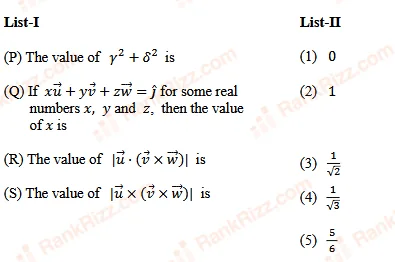
For real numbers α,β,γ,δ\alpha,\beta,\gamma,\delta and μ\mu, consider the matrix M=[α12−1213β13γδμ].M=\begin{bmatrix}\alpha&\tfrac{1}{\sqrt{2}}&-\tfrac{1}{\sqrt{2}}\\[2pt]\tfrac{1}{\sqrt{3}}&\beta&\tfrac{1}{\sqrt{3}}\\[2pt]\gamma&\delta&\mu\end{bmatrix}.

Suppose that MMT=IMM^{T}=I, where MTM^{T} is the transpose of MM and II is the 3×33\times 3 identity matrix. Let u⃗=αi^+13j^+γk^,v⃗=12i^+βj^+δk^,w⃗=−12i^+13j^+μk^.\vec{u}=\alpha\hat{i}+\tfrac{1}{\sqrt{3}}\hat{j}+\gamma\hat{k},\quad \vec{v}=\tfrac{1}{\sqrt{2}}\hat{i}+\beta\hat{j}+\delta\hat{k},\quad \vec{w}=-\tfrac{1}{\sqrt{2}}\hat{i}+\tfrac{1}{\sqrt{3}}\hat{j}+\mu\hat{k}.

Match each entry in List-I to the correct entry in List-II and choose the correct option.

Figure for JEE Advanced 2026 Mathematics question on Scalar triple product and coplanarity
  1. A

    (P)→\to(5), (Q)→\to(4), (R)→\to(2), (S)→\to(1)

  2. B

    (P)→\to(4), (Q)→\to(5), (R)→\to(1), (S)→\to(2)

  3. C

    (P)→\to(5), (Q)→\to(3), (R)→\to(2), (S)→\to(1)

  4. D

    (P)→\to(5), (Q)→\to(4), (R)→\to(1), (S)→\to(2)

JEE ADVANCED 2025 · PAPER 1Vector algebra, components and section formula

For any two points MM and NN in the XYXY-plane, let MN→\overrightarrow{MN} denote the vector from MM to NN, and 0⃗\vec{0} denote the zero vector. Let P,QP, Q and RR be three distinct points in the XYXY-plane. Let SS be a point inside the triangle △PQR\triangle PQR such that

SP→+5 SQ→+6 SR→=0⃗.\overrightarrow{SP} + 5\,\overrightarrow{SQ} + 6\,\overrightarrow{SR} = \vec{0}.

Let EE and FF be the mid-points of the sides PRPR and QRQR, respectively. Then the value of

length of the line segment EFlength of the line segment ES\frac{\text{length of the line segment } EF}{\text{length of the line segment } ES}

is ________.

JEE ADVANCED 2025 · PAPER 2Scalar triple product and coplanarity

Consider the vectors

x⃗=i^+2j^+3k^\vec{x} = \hat{i} + 2\hat{j} + 3\hat{k}, y⃗=2i^+3j^+k^\quad \vec{y} = 2\hat{i} + 3\hat{j} + \hat{k}, \quad and z⃗=3i^+j^+2k^\quad \vec{z} = 3\hat{i} + \hat{j} + 2\hat{k}.

For two distinct positive real numbers α\alpha and β\beta, define

X⃗=αx⃗+βy⃗−z⃗\vec{X} = \alpha\vec{x} + \beta\vec{y} - \vec{z}, Y⃗=αy⃗+βz⃗−x⃗\quad \vec{Y} = \alpha\vec{y} + \beta\vec{z} - \vec{x}, \quad and Z⃗=αz⃗+βx⃗−y⃗\quad \vec{Z} = \alpha\vec{z} + \beta\vec{x} - \vec{y}.

If the vectors X⃗\vec{X}, Y⃗\vec{Y}, and Z⃗\vec{Z} lie in a plane, then the value of α+β−3\alpha + \beta - 3 is ______.

JEE ADVANCED 2025 · PAPER 1Scalar triple product and coplanarity

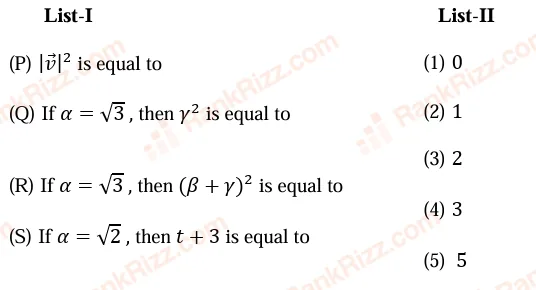
Let w⃗=i^+j^−2k^\vec{w} = \hat{i} + \hat{j} - 2\hat{k}, and u⃗\vec{u} and v⃗\vec{v} be two vectors, such that u⃗×v⃗=w⃗\vec{u} \times \vec{v} = \vec{w} and v⃗×w⃗=u⃗\vec{v} \times \vec{w} = \vec{u}. Let α,β,γ\alpha, \beta, \gamma, and tt be real numbers such that

u⃗=αi^+βj^+γk^,−tα+β+γ=0,α−tβ+γ=0,andα+β−tγ=0.\vec{u} = \alpha\hat{i} + \beta\hat{j} + \gamma\hat{k}, \quad -t\alpha + \beta + \gamma = 0, \quad \alpha - t\beta + \gamma = 0, \quad \text{and} \quad \alpha + \beta - t\gamma = 0.

Match each entry in List-I to the correct entry in List-II and choose the correct option.

Figure for JEE Advanced 2025 Mathematics question on Scalar triple product and coplanarity
  1. A

    (P)→\to(2), (Q)→\to(1), (R)→\to(4), (S)→\to(5)

  2. B

    (P)→\to(2), (Q)→\to(4), (R)→\to(3), (S)→\to(5)

  3. C

    (P)→\to(2), (Q)→\to(1), (R)→\to(4), (S)→\to(3)

  4. D

    (P)→\to(5), (Q)→\to(4), (R)→\to(1), (S)→\to(3)

JEE ADVANCED 2024 · PAPER 2Scalar triple product and coplanarity

Let p⃗=2i^+j^+3k^\vec{p} = 2\hat{i} + \hat{j} + 3\hat{k} and q⃗=i^−j^+k^\vec{q} = \hat{i} - \hat{j} + \hat{k}. If for some real numbers α\alpha, β\beta and γ\gamma, we have 15i^+10j^+6k^=α(2p⃗+q⃗)+β(p⃗−2q⃗)+γ(p⃗×q⃗)15\hat{i} + 10\hat{j} + 6\hat{k} = \alpha(2\vec{p} + \vec{q}) + \beta(\vec{p} - 2\vec{q}) + \gamma(\vec{p} \times \vec{q}), then the value of γ\gamma is ______.

JEE ADVANCED 2024 · PAPER 1Scalar triple product and coplanarity

Let OP→=α−1αi^+j^+k^\overrightarrow{OP} = \frac{\alpha - 1}{\alpha}\hat{i} + \hat{j} + \hat{k}, OQ→=i^+β−1βj^+k^\overrightarrow{OQ} = \hat{i} + \frac{\beta - 1}{\beta}\hat{j} + \hat{k} and OR→=i^+j^+12k^\overrightarrow{OR} = \hat{i} + \hat{j} + \frac{1}{2}\hat{k} be three vectors, where α,β∈R−{0}\alpha, \beta \in \mathbb{R} - \{0\} and OO denotes the origin. If (OP→×OQ→)⋅OR→=0(\overrightarrow{OP} \times \overrightarrow{OQ}) \cdot \overrightarrow{OR} = 0 and the point (α,β,2)(\alpha, \beta, 2) lies on the plane 3x+3y−z+l=03x + 3y - z + l = 0, then the value of ll is ________.

JEE ADVANCED 2023 · PAPER 2Scalar (dot) product

Let the position vectors of the points P, Q, R and S be a⃗=i^+2j^−5k^\vec{a} = \hat{i} + 2\hat{j} - 5\hat{k}, b⃗=3i^+6j^+3k^\vec{b} = 3\hat{i} + 6\hat{j} + 3\hat{k}, c⃗=175i^+165j^+7k^\vec{c} = \frac{17}{5}\hat{i} + \frac{16}{5}\hat{j} + 7\hat{k} and d⃗=2i^+j^+k^\vec{d} = 2\hat{i} + \hat{j} + \hat{k}, respectively. Then which of the following statements is true?

  1. A

    The points P, Q, R and S are NOT coplanar

  2. B

    b⃗+2d⃗3\frac{\vec{b} + 2\vec{d}}{3} is the position vector of a point which divides PR internally in the ratio 5 : 4

  3. C

    b⃗+2d⃗3\frac{\vec{b} + 2\vec{d}}{3} is the position vector of a point which divides PR externally in the ratio 5 : 4

  4. D

    The square of the magnitude of the vector b⃗×d⃗\vec{b} \times \vec{d} is 95

JEE ADVANCED 2023 · PAPER 1Scalar triple product and coplanarity

Let P be the plane 3x+2y+3z=16\sqrt{3}x + 2y + 3z = 16 and let S={αi^+βj^+γk^:α2+β2+γ2=1 and the distance of (α,β,γ) from the plane P is 72}S = \left\{\alpha\hat{i} + \beta\hat{j} + \gamma\hat{k} : \alpha^2 + \beta^2 + \gamma^2 = 1 \text{ and the distance of } (\alpha, \beta, \gamma) \text{ from the plane P is } \frac{7}{2}\right\}. Let u⃗\vec{u}, v⃗\vec{v} and w⃗\vec{w} be three distinct vectors in S such that ∣u⃗−v⃗∣=∣v⃗−w⃗∣=∣w⃗−u⃗∣|\vec{u} - \vec{v}| = |\vec{v} - \vec{w}| = |\vec{w} - \vec{u}|. Let V be the volume of the parallelepiped determined by vectors u⃗\vec{u}, v⃗\vec{v} and w⃗\vec{w}. Then the value of 803V\frac{80}{\sqrt{3}}V is

JEE ADVANCED 2022 · PAPER 2Scalar (dot) product

Let i^\hat{i}, j^\hat{j} and k^\hat{k} be the unit vectors along the three positive coordinate axes. Let

a⃗=3i^+j^−k^\vec{a} = 3\hat{i} + \hat{j} - \hat{k},

b⃗=i^+b2j^+b3k^\vec{b} = \hat{i} + b_2\hat{j} + b_3\hat{k},      b2,b3∈Rb_2, b_3 \in \mathbb{R},

c⃗=c1i^+c2j^+c3k^\vec{c} = c_1\hat{i} + c_2\hat{j} + c_3\hat{k},      c1,c2,c3∈Rc_1, c_2, c_3 \in \mathbb{R}

be three vectors such that b2b3>0b_2 b_3 > 0, a⃗⋅b⃗=0\vec{a} \cdot \vec{b} = 0 and (0−c3c2c30−c1−c2c10)(1b2b3)=(3−c11−c2−1−c3)\begin{pmatrix} 0 & -c_3 & c_2 \\ c_3 & 0 & -c_1 \\ -c_2 & c_1 & 0 \end{pmatrix} \begin{pmatrix} 1 \\ b_2 \\ b_3 \end{pmatrix} = \begin{pmatrix} 3 - c_1 \\ 1 - c_2 \\ -1 - c_3 \end{pmatrix}.

Then, which of the following is/are TRUE?

  1. A

    a⃗⋅c⃗=0\vec{a} \cdot \vec{c} = 0

  2. B

    b⃗⋅c⃗=0\vec{b} \cdot \vec{c} = 0

  3. C

    ∣b⃗∣>10|\vec{b}| > \sqrt{10}

  4. D

    ∣c⃗∣≤11|\vec{c}| \leq \sqrt{11}

JEE ADVANCED 2021 · PAPER 2Vector (cross) product and area

Let OO be the origin and OA→=2i^+2j^+k^,OB→=i^−2j^+2k^\overrightarrow{OA} = 2\hat{i} + 2\hat{j} + \hat{k}, \overrightarrow{OB} = \hat{i} − 2\hat{j} + 2\hat{k} and OC→=12(OB→−λOA→)\overrightarrow{OC} = \frac{1}{2}(\overrightarrow{OB} −\lambda\overrightarrow{OA}) for some λ>0\lambda > 0. If ∣OB→×OC→∣=92|\overrightarrow{OB} \times \overrightarrow{OC}| = \frac{9}{2}, then which of the following statements is (are) TRUE ?

  1. A

    Projection of OC→\overrightarrow{OC} on OA→\overrightarrow{OA} is −32-\frac{3}{2}

  2. B

    Area of the triangle OAB is 92\frac{9}{2}

  3. C

    Area of the triangle ABC is 92\frac{9}{2}

  4. D

    The acute angle between the diagonals of the parallelogram with adjacent sides OA→\overrightarrow{OA} and OC→\overrightarrow{OC} is π3\frac{\pi}{3}

JEE ADVANCED 2021 · PAPER 1Scalar triple product and coplanarity

Let u→,v→\overrightarrow{u},\overrightarrow{v} and w→\overrightarrow{w} be vectors in three-dimensional space, where u→\overrightarrow{u} and v→\overrightarrow{v} re unit vectors which are not perpendicular to each other and
u→.w→=1,v→.w→=1,w→w→=4\overrightarrow{u}.\overrightarrow{w} = 1, \overrightarrow{v}.\overrightarrow{w} = 1, \overrightarrow{w}\overrightarrow{w} = 4
If the volume of the parallelopiped, whose adjacent sides are represented by the vectors u→,v→\overrightarrow{u},\overrightarrow{v} and w→\overrightarrow{w}, is 2\sqrt{2}, then the value of ∣3u→+5v→∣\mid 3\overrightarrow{u} + 5 \overrightarrow{v} \mid is ___ .

JEE ADVANCED 2020 · PAPER 2Scalar (dot) product

Let 𝑎 and 𝑏 be positive real numbers. Suppose PQ→=ai^+bj^\overrightarrow{PQ} = a\hat{i} + b\hat{j} and PS→=ai^−bj^\overrightarrow{PS} = a\hat{i} - b\hat{j} are adjacent sides of a parallelogram 𝑃𝑄𝑅𝑆. Let u→\overrightarrow{u} and \overrightarrow{v} be the projection vectors of u→=i^+j^\overrightarrow{u} = \hat{i} + \hat{j} along PQ→\overrightarrow{PQ} and PS→\overrightarrow{PS}, respectively. If ∣u→∣+∣v→∣=∣w→∣\mid \overrightarrow{u}\mid + \mid \overrightarrow{v} \mid = \mid \overrightarrow{w} \mid and if the area of the parallelogram 𝑃𝑄𝑅𝑆 is 8, then which of the following statements is/are TRUE?

  1. A

    a + 𝑏 = 4

  2. B

    a - 𝑏 = 2

  3. C

    The length of the diagonal 𝑃𝑅 of the parallelogram 𝑃𝑄𝑅𝑆 is 4

  4. D

    w→\overrightarrow{w} is an angle bisector of the vectors PQ→\overrightarrow{PQ} and PS→\overrightarrow{PS}

JEE ADVANCED 2020 · PAPER 1Scalar (dot) product

In a triangle 𝑃𝑄𝑅, let a→=QR→,b→=RP→\overrightarrow{a} = \overrightarrow{QR}, \overrightarrow{b} = \overrightarrow{RP} and c→=PQ→\overrightarrow{c} = \overrightarrow{PQ}. If

∣a→∣=3,∣b→∣=4|\overrightarrow{a}| = 3, |\overrightarrow{b}| = 4 and a→⋅(c→−b→)c→⋅(a→−b→)=∣a→∣∣a→∣+∣b→∣\frac{\overrightarrow{a}\cdot(\overrightarrow{c}-\overrightarrow{b})}{\overrightarrow{c}\cdot(\overrightarrow{a}-\overrightarrow{b})} = \frac{|\overrightarrow{a}|}{|\overrightarrow{a}| + |\overrightarrow{b}|},

then the value of ∣a→×b→∣2\left|\overrightarrow{a} \times \overrightarrow{b}\right|^{2} is ___________

JEE ADVANCED 2019 · PAPER 2Scalar (dot) product

Let a→=2i^+j^−k^\overrightarrow{a} = 2\widehat{i} + \widehat{j} - \widehat{k} and b→=i^+2j^+k^\overrightarrow{b} = \widehat{i} + 2\widehat{j} + \widehat{k} be two vectors. Consider a vector c→=αa→+βb→,α,β∈R.\overrightarrow{c} = \alpha \overrightarrow{a} + \beta \overrightarrow{b}, \alpha, \beta \in R. If the projection of c→\overrightarrow{c} on the vector (a→+b→)\left(\overrightarrow{a} + \overrightarrow{b}\right) is 32,3\sqrt{2}, then the minimum value of (c→−(a→×b→)).c→\left(\overrightarrow{c} - \left(\overrightarrow{a} \times \overrightarrow{b}\right)\right) . \overrightarrow{c} equals _________ .

JEE ADVANCED 2018 · PAPER 1Vector (cross) product and area

let a→\overrightarrow{a} and b→\overrightarrow{b} be two unit vectors such that a→.b→\overrightarrow{a} .\overrightarrow{b} =0 For some X,y∈RX,y \in R let C→\overrightarrow{C}=Xa→\overrightarrow{a}+Yb→\overrightarrow{b}+(a→×a→)(\overrightarrow{a} \times \overrightarrow{a}).If ∣c→∣\mid \overrightarrow{c} \mid=2 and the c→\overrightarrow{c} is inclined at the same angle α\alpha to both a→\overrightarrow{a} and b→\overrightarrow{b},then the value of 8cos⁡2α8 \cos^{2} \alpha is .......

JEE ADVANCED 2017 · PAPER 2Scalar (dot) product

Let O be the origin and let PQR be an arbitrary triangle. The point S is such that OP→.OQ→+OR→.OS→=OR→.OP→+OQ→.OS→=OQ→.OR→+OP→.OS→\overrightarrow{OP}.\overrightarrow{OQ}+\overrightarrow{OR}.\overrightarrow{OS}=\overrightarrow{OR}.\overrightarrow{OP}+\overrightarrow{OQ}.\overrightarrow{OS}=\overrightarrow{OQ}.\overrightarrow{OR}+\overrightarrow{OP}.\overrightarrow{OS} Then the triangle PQR has S as its

  1. A

    centroid

  2. B

    circumcentre

  3. C

    incentre

  4. D

    orthocenter

JEE ADVANCED 2017 · PAPER 2Vector (cross) product and area

∣OX→×OY→∣=\mid\overrightarrow{OX}\times\overrightarrow{OY}\mid=

  1. A

    sin⁡(P+Q)\sin(P+Q)

  2. B

    sin⁡2R\sin2R

  3. C

    sin⁡(P+R)\sin(P+R)

  4. D

    sin⁡(Q+R)\sin(Q+R)

JEE ADVANCED 2016 · PAPER 2Vector (cross) product and area

Let u^=u1i^+u2j^+u3k^\hat{u} = u_1\hat{i} + u_2\hat{j} + u_3\hat{k} be a unit vector in R3R^3 and ω^=16(i^+j^+2k^)\hat{\omega} = \frac{1}{\sqrt{6}}(\hat{i} + \hat{j} + 2 \hat{k}). Given that there exists a vector v→\overrightarrow{v} in R3R^3 such that ∣u^×v→∣=1\mid \hat{u} \times \overrightarrow{v} \mid = 1 and ω→.(u^×v→)=1\overrightarrow{\omega} . (\hat{u} \times \overrightarrow{v}) = 1. Which of the following statement(s) is(are) correct?

  1. A

    There is exactly one choice for such v→\overrightarrow{v}

  2. B

    There are infinitely many choices for such v→\overrightarrow{v}

  3. C

    If u→\overrightarrow{u} lies in the xy-plane then ∣u1∣=∣u2∣\mid u_1 \mid = \mid u_2 \mid

  4. D

    If u→\overrightarrow{u} lies in the xz-plane then 2∣u1∣=∣u3∣2 \mid u_1 \mid = \mid u_3 \mid

JEE ADVANCED 2015 · PAPER 2Vector algebra, components and section formula

Suppose that p→,q→\overrightarrow{p}, \overrightarrow{q} and r→\overrightarrow{r} are three non-coplanar vectors in R3R^3. Let the components of a vector s→\overrightarrow{s} along p→,q→\overrightarrow{p}, \overrightarrow{q} and r→\overrightarrow{r} be 4, 3 and 5, respectively. If the components of this vector s→\overrightarrow{s} along (−p→+q→+r→),(p→−q→+r→)(-\overrightarrow{p} + \overrightarrow{q} + \overrightarrow{r}), (\overrightarrow{p} - \overrightarrow{q} + \overrightarrow{r}) and (−p→−q→+r→)(-\overrightarrow{p} - \overrightarrow{q} + \overrightarrow{r}) are x, y and z, respectively, then the value of 2x + y + z is