RankRizz

Quadratic Equations and Inequalities — JEE Advanced Previous Year Questions

Quadratic Equations and Inequalities has been asked in 17 of the 20 JEE Advanced years from 2007 to 2026: 23 questions in all. In 2026 it averaged 1.0 questions per paper (2 across 2 papers), 5.9% of Maths questions, up from 3.1% in 2025. Across the last 20 papers it carried 2.8% of Maths questions. By type: 14 single-correct, 5 numerical, 3 multiple-correct and 1 match-the-list. Of the 22 with a difficulty tag, 9% are easy, 73% medium and 18% hard. Most asked: Relation between roots and coefficients (12, 52%), Nature of roots and discriminant (3, 13%) and Cubic and higher degree polynomial equations (3, 13%).

DATA UPDATED

Questions

23

Distinct ideas

7

Share of marks

2.8%

Difficulty

MEDIUM

Quadratic Equations and Inequalities weightage, year by year

The share of each year’s Maths questions that came from Quadratic Equations and Inequalities, counted from the 19 papers we hold for the last 10 years, and paper by paper inside a year.

Rising: 4.0% of Maths questions in 2024–2026, up from 2.6% in 2017–2023. Its heaviest year was 2026, at 5.9%. Not asked at all in 2018, 2023.

Quadratic Equations and Inequalities questions per year, per paper, and as a share of Maths questions
YEARQSPER PAPERSHARE OF MATHSCHANGE
20262 / 341.05.9%+2.8 pts
20251 / 320.53.1%+0.2 pts
20241 / 340.52.9%+2.9 pts
20230 / 340.00.0%−2.8 pts
20221 / 360.52.8%+0.2 pts
20211 / 380.52.6%−0.2 pts
20201 / 360.52.8%level
20191 / 360.52.8%+2.8 pts
20180 / 180.00.0%−5.6 pts
20172 / 361.05.6%—

“QS” is Quadratic Equations and Inequalities questions out of all Maths questions that year; “per paper” is that count over the year’s papers, and “change” is the share against the year before. A year with more sittings asks more questions, which is why the share, not the count, is the number to compare.

The ideas inside Quadratic Equations and Inequalities

A chapter is not one subject — it is a handful of procedures the examiner reuses. These are the ones Quadratic Equations and Inequalities questions actually test.

01Relation between roots and coefficientsset 12×
02Forming equations and power sums of rootsNot set in Advanced
03Nature of roots and discriminantset 3×
04Common roots of equationsset 2×
05Location of rootsset 1×
06Sign and range of quadratic expressionsNot set in Advanced
07Equations with modulus and greatest integerset 1×
08Cubic and higher degree polynomial equationsset 3×
09Rational and polynomial inequalitiesset 1×

All 23 Quadratic Equations and Inequalities questions, by topic

Every JEE Advanced Quadratic Equations and Inequalities question we hold, newest first inside each topic. Open one for its options, answer key and solution.

Relation between roots and coefficients12 QUESTIONS

  1. Let a, b, c be positive integers in arithmetic progression such that the equation ax²+bx+c=0 has only integer solutions. Then which of the…2026 · PAPER 2
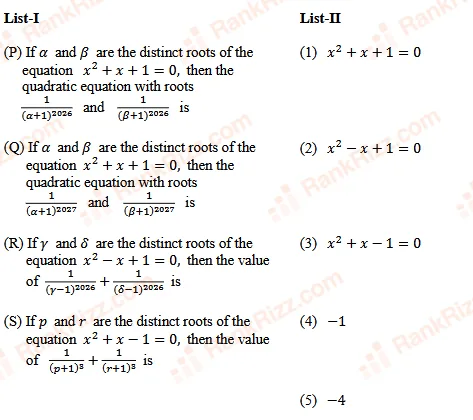
  2. Match each entry in List-I to the correct entry in List-II and choose the correct option.2026 · PAPER 1
  3. Suppose a, b denote the distinct real roots of the quadratic polynomial x² + 20x − 2020 and suppose c, d denote the distinct complex roots…2020 · PAPER 1
  4. Let α and β be the roots of x² — x — 1 = 0, with \alpha > \beta. For all positive integers n, define a_n = \frac{\alpha^n - \beta^n}{\alpha…2019 · PAPER 1
  5. a₁₂=2017 · PAPER 2
  6. If a₄=28, then p+2q=2017 · PAPER 2
  7. Let -π/6 < θ < π/12 Suppose α₁ and β₁ are the roots of the equation x² - 2x sec θ + 1 and α₂ and β₂ are the roots of the equation x² + 2x…2016 · PAPER 1
  8. Let α(a) and β(a) be the roots of the equation (∛1 + a - 1)x² + (√1 + a - 1)x + (√[6]1 + a - 1) = 0 where a > -1. Then lim _(a → 0⁺)α(a)…2012 · PAPER 2
  9. Let α and β be the roots of x² - 6x - 2 = 0, with α > β. If aₙ = αⁿ - βⁿ for n ≥ 1, then the value of a₁₀ - 2a₈2a₉ is2011 · PAPER 1
  10. Let p and q be real numbers such that p≠ 0,p³≠ q and p³≠ -q. If α and β are nonzero complex numbers satisfying α+β=-p and α³+β³=q, then a…2010 · PAPER 1
  11. Let a, b, c, p, q be real numbers. Suppose α, β are the roots of the equation x² + 2px + q = 0 and α, 1/β are the roots of the equation ax²…2008 · PAPER 2
  12. Let α, β be the roots of the equation x² - px + r = 0 and α/2, 2 β be the roots of the equation x² - qx + r = 0. Then the value of r is2007 · PAPER 1

Equations with modulus and greatest integer1 QUESTION

  1. For x ∈ R, the number of real roots of the equation 3x² - 4 x² - 1 + x - 1 = 0 is.........2021 · PAPER 1

FREE PDF

Quadratic Equations and Inequalities JEE Advanced PYQs with answer key

All 23 questions on A4, by topic, with the answer key at the end. No sign-up, no email: your browser saves it as a PDF.

Download free PDF

UNIQUE CONCEPTS

Quadratic Equations and Inequalities: one question per idea

9 ideas, each with the latest past question that tested it, drawn from 208 JEE Main and Advanced questions.

Quadratic Equations and Inequalities Unique Concepts sheet →

JEE MAIN

Quadratic Equations and Inequalities in JEE Main

JEE Main has set 186 Quadratic Equations and Inequalities questions, 2004–2026.

Quadratic Equations and Inequalities JEE Main PYQs →

Quadratic Equations and Inequalities: quick answers

Is Quadratic Equations and Inequalities asked every year in JEE Advanced?

Not every year. It has been asked in 17 of the 20 JEE Advanced years from 2007 to 2026; the years without a Quadratic Equations and Inequalities question were 2013, 2018 and 2023.

Which Quadratic Equations and Inequalities topic is asked most in JEE Advanced?

Relation between roots and coefficients: 12 of the 23 questions (52%). Next come Nature of roots and discriminant (3) and Cubic and higher degree polynomial equations (3).

What share of Maths questions does Quadratic Equations and Inequalities carry in JEE Advanced?

About 2.8% of Maths questions across the last 20 papers. In 2026 it was 5.9% (2 of 34 Maths questions).

When was Quadratic Equations and Inequalities last asked in JEE Advanced?

In JEE Advanced 2026 Paper 2, the latest sitting with a Quadratic Equations and Inequalities question.

How many Quadratic Equations and Inequalities questions has JEE Advanced asked?

23 from 2007 to 2026, across 7 topics. Every one is listed on this page by topic and links to its own page, with the answer key and solution wherever we have them. Free, no sign-up.

Every Quadratic Equations and Inequalities question

1–20 OF 23 · NEWEST FIRST

JEE ADVANCED 2026 · PAPER 2Relation between roots and coefficients

Let a, b, ca,\,b,\,c be positive integers in arithmetic progression such that the equation

ax2+bx+c=0ax^2+bx+c=0

has only integer solutions.

Then which of the following statements is (are) TRUE?

  1. A

    c−bc-b is an integer multiple of aa

  2. B

    Both the roots of the equation ax2+bx+c=0ax^2+bx+c=0 are odd integers

  3. C

    If c=15c=15, then ab=8ab=8

  4. D

    If b=8b=8, then x=3x=3 is a root of the equation ax2+bx+c=0ax^2+bx+c=0

JEE ADVANCED 2026 · PAPER 1Relation between roots and coefficients

Match each entry in List-I to the correct entry in List-II and choose the correct option.

Figure for JEE Advanced 2026 Mathematics question on Relation between roots and coefficients
  1. A

    (P)→\to(1), (Q)→\to(2), (R)→\to(5), (S)→\to(4)

  2. B

    (P)→\to(3), (Q)→\to(1), (R)→\to(4), (S)→\to(5)

  3. C

    (P)→\to(1), (Q)→\to(2), (R)→\to(4), (S)→\to(5)

  4. D

    (P)→\to(2), (Q)→\to(3), (R)→\to(5), (S)→\to(4)

JEE ADVANCED 2025 · PAPER 1Cubic and higher degree polynomial equations

Let R\mathbb{R} denote the set of all real numbers. Let ai,bi∈Ra_i, b_i \in \mathbb{R} for i∈{1,2,3}i \in \{1, 2, 3\}. Define the functions f:R→Rf: \mathbb{R} \to \mathbb{R}, g:R→Rg: \mathbb{R} \to \mathbb{R}, and h:R→Rh: \mathbb{R} \to \mathbb{R} by

f(x)=a1+10x+a2x2+a3x3+x4,f(x) = a_1 + 10x + a_2 x^2 + a_3 x^3 + x^4,

g(x)=b1+3x+b2x2+b3x3+x4,g(x) = b_1 + 3x + b_2 x^2 + b_3 x^3 + x^4,

h(x)=f(x+1)−g(x+2).h(x) = f(x+1) - g(x+2).

If f(x)≠g(x)f(x) \neq g(x) for every x∈Rx \in \mathbb{R}, then the coefficient of x3x^3 in h(x)h(x) is

  1. A

    88

  2. B

    22

  3. C

    −4-4

  4. D

    −6-6

JEE ADVANCED 2024 · PAPER 1Cubic and higher degree polynomial equations

Let a=32a = 3\sqrt{2} and b=151/66b = \frac{1}{5^{1/6}\sqrt{6}}. If x,y∈Rx, y \in \mathbb{R} are such that 3x+2y=log⁡a(18)5/43x + 2y = \log_a (18)^{5/4} and 2x−y=log⁡b(1080)2x - y = \log_b (\sqrt{1080}), then 4x+5y4x + 5y is equal to ________.

JEE ADVANCED 2022 · PAPER 2Cubic and higher degree polynomial equations

The product of all positive real values of xx satisfying the equation x(16(log⁡5x)3−68log⁡5x)=5−16x^{(16(\log_5 x)^3 - 68\log_5 x)} = 5^{-16} is _______.

JEE ADVANCED 2021 · PAPER 1Equations with modulus and greatest integer

For x∈Rx \in R, the number of real roots of the equation
3x2−4∣x2−1∣+x−1=03x^2 - 4 \mid x^2 - 1 \mid + x - 1 = 0 is .........

JEE ADVANCED 2020 · PAPER 1Relation between roots and coefficients

Suppose a, b denote the distinct real roots of the quadratic polynomial x2+20x−2020x^{2} + 20x − 2020 and
suppose c, d denote the distinct complex roots of the quadratic polynomial x2−20x+2020x^{2} − 20x + 2020. Then the value of
ac(a - c) + ad(a - d) + bc(b - c) + bd(b + d)
is

  1. A

    0

  2. B

    800

  3. C

    8080

  4. D

    1600

JEE ADVANCED 2019 · PAPER 1Relation between roots and coefficients

Let αandβ\alpha and \beta be the roots of x2—x—1=0,x^2 — x — 1 = 0, with \alpha > \beta.Forallpositiveintegersn,define<br/>. For all positive integers n, define<br />a_n = \frac{\alpha^n - \beta^n}{\alpha - \beta},n \geq 1,<br/><br />b_1 = 1andandb_n = a_{n - 1} + a_{n + 1},n \geq 2.$$
Then which of the following options is/are correct?

  1. A

    a1+a2+a3+...+an=an+2−1a_1 + a_2 + a_3 + ... + a_n = a_{n + 2} - 1 for all n≥1n \geq 1

  2. B

    ∑n=1∞an10n=1089\sum_{n = 1}^\infty \frac{a_n}{10^n} = \frac{10}{89}

  3. C

    bn=αn+βnb_n = \alpha^n + \beta^n for all n≥1n \geq 1

  4. D

    ∑n=1∞bn10n=889\sum_{n = 1}^\infty \frac{b_n}{10^n} = \frac{8}{89}

JEE ADVANCED 2017 · PAPER 2Relation between roots and coefficients

a12=a_{12}=

  1. A

    a11−a10a_{11}-a_{10}

  2. B

    a11+a10a_{11}+a_{10}

  3. C

    2a11+a102a_{11}+a_{10}

  4. D

    a11+2a10a_{11}+2a_{10}

JEE ADVANCED 2017 · PAPER 2Relation between roots and coefficients

If a4=28a_{4}=28, then p+2q=p+2q=

  1. A

    21

  2. B

    14

  3. C

    7

  4. D

    12

JEE ADVANCED 2016 · PAPER 1Relation between roots and coefficients

Let −π6<θ<π12-\frac{\pi}{6} < \theta < \frac{\pi}{12} Suppose α1\alpha_1 and β1\beta_1 are the roots of the equation x2−2xsec⁡θ+1x^2 - 2x \sec \theta + 1 and α2\alpha_2 and β2\beta_2 are the roots of the equation x2+2xtan⁡θ−1=0x^2 + 2x \tan \theta - 1 = 0. If α1>β1\alpha_1 > \beta_1 and α2>β2\alpha_2 > \beta_2 then α1+β2\alpha_1 + \beta_2 equals

  1. A

    2(sec⁡θ−tan⁡θ)2(\sec \theta - \tan \theta)

  2. B

    2sec⁡θ2 \sec \theta

  3. C

    −2tan⁡θ-2 \tan \theta

  4. D

    00

JEE ADVANCED 2015 · PAPER 2Nature of roots and discriminant

Let S be the set of all non-zero real numbers α\alpha such that the quadratic equation ax2−x+a=0ax^2 - x + a = 0 has two distinct real roots x1x_1 and x2x_2 satisfying the inequality ∣x1−x2∣<1.|x_1 - x_2| < 1. Which of the following intervals is(are) a subset(s) of S?

  1. A

    (−12,−15)\left(-\frac {1}{2}, -\frac{1}{\sqrt 5}\right)

  2. B

    (−15,0)\left(-\frac{1}{\sqrt 5}, 0\right)

  3. C

    (0,15)\left(0, \frac{1}{\sqrt 5}\right)

  4. D

    (15,12)\left(\frac{1}{\sqrt 5}, \frac {1}{2}\right)

JEE ADVANCED 2014 · PAPER 2Nature of roots and discriminant

The quadratic equation p(x) = 0 with real coefficients has purely imaginary roots. Then the equation p(p(x)) = 0 has

  1. A

    only purely imaginary roots

  2. B

    all real roots

  3. C

    two real and two purely imaginary roots

  4. D

    neither real nor purely imaginary roots

JEE ADVANCED 2012 · PAPER 2Relation between roots and coefficients

Let α(a)\alpha(a) and β(a)\beta(a) be the roots of the equation (1+a3−1)x2+(1+a−1)x+(1+a6−1)=0\left(\sqrt[3]{1 + a} - 1\right)x^2 + \left(\sqrt{1 + a} - 1\right)x + \left(\sqrt[6]{1 + a} - 1\right) = 0 where a > -1. Then lim⁡a→0+α(a)\lim_{a \rightarrow 0^+}\alpha(a) and lim⁡a→0+β(a)\lim_{a \rightarrow 0^+}\beta(a) are

  1. A

    −52-\frac{5}{2} and 1

  2. B

    −12-\frac{1}{2} and -1

  3. C

    −72-\frac{7}{2} and 2

  4. D

    −92-\frac{9}{2} and 3

JEE ADVANCED 2011 · PAPER 2Common roots of equations

A value of b for which the equations
x2+bx−1=0x^2 + bx - 1 = 0
x2+x+b=0x^2 + x + b = 0,
have one root in common is

  1. A

    −2-\sqrt{2}

  2. B

    −i3-i\sqrt{3}

  3. C

    i5i\sqrt{5}

  4. D

    2\sqrt{2}

JEE ADVANCED 2011 · PAPER 1Common roots of equations

Let (x0,y0)(x_0, y_0) be the solution of the following equations
(2x)ln⁡2=(3y)ln⁡3(2x)^{\ln 2} = (3y)^{\ln 3}
3ln⁡x=2ln⁡y3^{\ln x} = 2^{\ln y}
Then x0x_0 is

  1. A

    16\frac{1}{6}

  2. B

    13\frac{1}{3}

  3. C

    12\frac{1}{2}

  4. D

    66

JEE ADVANCED 2011 · PAPER 1Relation between roots and coefficients

Let α\alpha and β\beta be the roots of x2−6x−2=0x^2 - 6x - 2 = 0, with α>β\alpha > \beta. If an=αn−βna_n = \alpha^n - \beta^n for n≥1n \geq 1, then the value of a10−2a82a9\frac{a_{10} - 2a_8}{2a_9} is

  1. A

    1

  2. B

    2

  3. C

    3

  4. D

    4

JEE ADVANCED 2011 · PAPER 2Nature of roots and discriminant

The number of distinct real roots of x4−4x3+12x2+x−1=0x^4 - 4x^3 + 12 x^2 + x - 1 = 0 is

JEE ADVANCED 2010 · PAPER 1Relation between roots and coefficients

Let p and q be real numbers such that p≠0,p3≠qp\neq 0,p^{3}\neq q and p3≠−qp^{3}\neq -q. If α\alpha and β\beta are nonzero complex numbers satisfying α+β=−p\alpha+\beta=-p and α3+β3=q\alpha^{3}+\beta^{3}=q, then a quadratic equation having αβ\frac{\alpha}{\beta} and βα\frac{\beta}{\alpha} as its roots is

  1. A

    (p3+q)x2−(p3+2q)x+(p3+q)=0(p^{3}+q)x^{2}-(p^{3}+2q)x+(p^{3}+q)=0

  2. B

    (p3+q)x2−(p3−2q)x+(p3+q)=0(p^{3}+q)x^{2}-(p^{3}-2q)x+(p^{3}+q)=0

  3. C

    (p3−q)x2−(5p3−2q)x+(p3−q)=0(p^{3}-q)x^{2}-(5p^{3}-2q)x+(p^{3}-q)=0

  4. D

    (p3−q)x2−(5p3+2q)x+(p3−q)=0(p^{3}-q)x^{2}-(5p^{3}+2q)x+(p^{3}-q)=0

JEE ADVANCED 2009 · PAPER 2Location of roots

The smallest value of k, for which both the roots of the equation
x2−8kx+16(k2−k+1)=0x^2 - 8kx + 16(k^2 - k + 1) = 0
are real, distinct and have values at least 4, is