RankRizz

Continuity and Differentiability — JEE Advanced Previous Year Questions

Continuity and Differentiability has been asked in 14 of the 20 JEE Advanced years from 2007 to 2026: 30 questions in all. In 2026 it averaged 1.5 questions per paper (3 across 2 papers), 8.8% of Maths questions, down from 12.5% in 2025. Across the last 20 papers it carried 5.1% of Maths questions. By type: 16 multiple-correct, 8 single-correct, 5 numerical and 1 match-the-list. Of the 30 with a difficulty tag, 3% are easy, 50% medium and 47% hard. Most asked: Differentiability at a point (20, 67%), Continuity at a point (9, 30%) and Differentiability via functional equations (1, 3%).

DATA UPDATED

Questions

30

Distinct ideas

3

Share of marks

5.1%

Difficulty

HARD

Continuity and Differentiability weightage, year by year

The share of each year’s Maths questions that came from Continuity and Differentiability, counted from the 19 papers we hold for the last 10 years, and paper by paper inside a year.

Rising: 8.0% of Maths questions in 2024–2026, up from 3.4% in 2017–2023. Its heaviest year was 2025, at 12.5%. Not asked at all in 2018, 2021, 2022.

Continuity and Differentiability questions per year, per paper, and as a share of Maths questions
YEARQSPER PAPERSHARE OF MATHSCHANGE
20263 / 341.58.8%−3.7 pts
20254 / 322.012.5%+9.6 pts
20241 / 340.52.9%level
20231 / 340.52.9%+2.9 pts
20220 / 360.00.0%level
20210 / 380.00.0%−8.3 pts
20203 / 361.58.3%+2.7 pts
20192 / 361.05.6%+5.6 pts
20180 / 180.00.0%−5.6 pts
20172 / 361.05.6%—

“QS” is Continuity and Differentiability questions out of all Maths questions that year; “per paper” is that count over the year’s papers, and “change” is the share against the year before. A year with more sittings asks more questions, which is why the share, not the count, is the number to compare.

The ideas inside Continuity and Differentiability

A chapter is not one subject — it is a handful of procedures the examiner reuses. These are the ones Continuity and Differentiability questions actually test.

01Continuity at a pointset 9×
02Types of discontinuity, composite functions and IVTNot set in Advanced
03Differentiability at a pointset 20×
04Points of non-differentiabilityNot set in Advanced
05Differentiability via functional equationsset 1×

All 30 Continuity and Differentiability questions, by topic

Every JEE Advanced Continuity and Differentiability question we hold, newest first inside each topic. Open one for its options, answer key and solution.

Differentiability at a point20 QUESTIONS

  1. Let ℝ denote the set of all real numbers. Let f:ℝ→ℝ be an arbitrary function and let g:ℝ→ℝ be the function defined by g(x)=x f(x), all x∈ℝ…2026 · PAPER 1
  2. Consider the function f: (-π/2,π/2)→(-∞,∞) defined by f(x)=(|x|+|x-1|) sin x+[x sin x], where [x sin x] is the greatest integer less than…2026 · PAPER 1
  3. Let x₀ be the real number such that e^(x₀) + x₀ = 0. For a given real number α, define g(x) = (3xe^x + 3x - ae^x - ax)/(3(e^x + 1)) for all…2025 · PAPER 2
  4. Let ℝ denote the set of all real numbers. Define the function f: ℝ → ℝ by f(x) = 2 - 2x² - x² sin 1/x if x ≠ 0, 2 if x = 0. Then which one…2025 · PAPER 1
  5. Let ℝ denote the set of all real numbers. For a real number x, let [x] denote the greatest integer less than or equal to x. Let n denote a…2025 · PAPER 1
  6. Let f: (0,1) → ℝ be the function defined as f(x) = [4x] (x - 1/4)² (x - 1/2), where [x] denotes the greatest integer less than or equal to…2023 · PAPER 2
  7. Let the function f: R → R be defined by f(x) = x³ − x² + (x − 1) sin x and let g: R → R be an arbitrary function. Let fg: R → R be the…2020 · PAPER 1
  8. Let f:R → R and g:R → R be functions satisfying f(x + y)=f(x)+f(y)+f(x)f(y) and f(x) = xg(x) for all 𝑥, 𝑦 ∈ R. If lim _(x → 0) g(x) = 1…2020 · PAPER 2
  9. Let f: R → R bea function. We say that f has PROPERTY 1 if lim _(h → 0) f(h) - f(0)√|h| exists and is finite, and PROPERTY 2 if lim _(h →…2019 · PAPER 2
  10. Let a, b ε R and f: R → R be bedefined by f(x) = a cos (x³ - x) + b x sin (x³ + x). Then f is2016 · PAPER 2
  11. Let g: R → R be a differentiable function with g(0) = 0, g'(0) = 0 and g’(1) ≠ 0. Let f(x) = x/(|x|)g(x) x ≠ 0 0 x = 0 and h(x) = e^(|x|)…2015 · PAPER 1
  12. Let f: [a, b] → [1, ∞) be a continuous function and let g: R → R be defined as g(x) = 0 if x < a, ∫ₐ^(x)f(t)dt if a≤ x ≤ b, ∫ₐ^(b)f(t)dt if…2014 · PAPER 1
  13. Let f: R → R and g: R → R be respectively given by f(x) = |x| + 1 and g(x) = x² + 1. Define h:R → R by h(x) = max \f(x), g(x) \ if x ≤ 0…2014 · PAPER 1
  14. Let f(x) = x² cos π/x x ≠ 0 0, x = 0, x ∈ R, then f is2012 · PAPER 1
  15. If f(x) = -x-π/2, x ≤ -π/2 - cos x, -π/2<x ≤ 0 -1, 0 < x ≤ 1 ln x, x > 1, then2011 · PAPER 2
  16. Let f: R → R be a function such that f(x + y) = f(x) + f(y), ∀ x, y ∈ R If f(x) is differentiable at x = 0, Then2011 · PAPER 1
  17. Let g(x) = ((x - 1)ⁿ)/(log cos ^m (x - 1));0 < x < 2, m and n are integers, m ≠ 0, n > 0, and let p be the left hand derivative of x - 1 at…2008 · PAPER 1
  18. Let f(x) be a non-constant twice differentiable function defined on (-∞, ∞) such that f(x) = f(1 - x) and f' (1/4) = 0. Then,2008 · PAPER 1
  19. Let f(x) = 2 + cos x for all real x. STATEMENT-1: For each real t, there exists a point c in [t, t + π] such that f'(c) = 0. because…2007 · PAPER 2
  20. In the following [x] denotes the greatest integer less than or equal to x. Match the functions in Column I with the properties in Column II…2007 · PAPER 1

FREE PDF

Continuity and Differentiability JEE Advanced PYQs with answer key

All 30 questions on A4, by topic, with the answer key at the end. No sign-up, no email: your browser saves it as a PDF.

Download free PDF

UNIQUE CONCEPTS

Continuity and Differentiability: one question per idea

5 ideas, each with the latest past question that tested it, drawn from 177 JEE Main and Advanced questions.

Continuity and Differentiability Unique Concepts sheet →

JEE MAIN

Continuity and Differentiability in JEE Main

JEE Main has set 148 Continuity and Differentiability questions, 2004–2026.

Continuity and Differentiability JEE Main PYQs →

Continuity and Differentiability: quick answers

Is Continuity and Differentiability asked every year in JEE Advanced?

Not every year. It has been asked in 14 of the 20 JEE Advanced years from 2007 to 2026; the years without a Continuity and Differentiability question were 2009, 2010, 2013, 2018, 2021 and 2022.

Which Continuity and Differentiability topic is asked most in JEE Advanced?

Differentiability at a point: 20 of the 30 questions (67%). Next come Continuity at a point (9) and Differentiability via functional equations (1).

What share of Maths questions does Continuity and Differentiability carry in JEE Advanced?

About 5.1% of Maths questions across the last 20 papers. In 2026 it was 8.8% (3 of 34 Maths questions).

When was Continuity and Differentiability last asked in JEE Advanced?

In JEE Advanced 2026 Paper 2, the latest sitting with a Continuity and Differentiability question.

How many Continuity and Differentiability questions has JEE Advanced asked?

30 from 2007 to 2026, across 3 topics. Every one is listed on this page by topic and links to its own page, with the answer key and solution wherever we have them. Free, no sign-up.

Every Continuity and Differentiability question

1–20 OF 30 · NEWEST FIRST

JEE ADVANCED 2026 · PAPER 1Differentiability at a point

Let R\mathbb{R} denote the set of all real numbers. Let f:R→Rf:\mathbb{R}\to\mathbb{R} be an arbitrary function and let g:R→Rg:\mathbb{R}\to\mathbb{R} be the function defined by

g(x)=x f(x),for all x∈R.g(x)=x\,f(x),\quad\text{for all }x\in\mathbb{R}.

Then which of the following statements is (are) TRUE?

  1. A

    The function gg is always continuous at x=0x=0

  2. B

    If ff is continuous at x=0x=0, then gg is differentiable at x=0x=0

  3. C

    If gg is differentiable at x=0x=0, then ff is continuous at x=0x=0

  4. D

    If gg is differentiable at x=0x=0, then lim⁡x→0f(x)\lim_{x\to 0}f(x) exists

JEE ADVANCED 2026 · PAPER 1Differentiability at a point

Consider the function f:(−π2,π2)→(−∞,∞)f:\left(-\tfrac{\pi}{2},\tfrac{\pi}{2}\right)\to(-\infty,\infty) defined by

f(x)=(∣x∣+∣x−1∣)sin⁡x+[xsin⁡x],f(x)=(|x|+|x-1|)\sin x+[x\sin x],

where [xsin⁡x][x\sin x] is the greatest integer less than or equal to xsin⁡xx\sin x.

Let α\alpha be the total number of points in the interval (−π2,π2)\left(-\tfrac{\pi}{2},\tfrac{\pi}{2}\right) at which ff is NOT continuous, and let β\beta be the total number of points in the interval (−π2,π2)\left(-\tfrac{\pi}{2},\tfrac{\pi}{2}\right) at which ff is NOT differentiable. Then the value of α+β\alpha+\beta is ___.

JEE ADVANCED 2026 · PAPER 2Continuity at a point

For a real number α\alpha, let [α][\alpha] denote the greatest integer less than or equal to α\alpha. For a finite set SS, let ∣S∣|S| denote the number of elements in the set SS.

Consider the functions f:(−3,3)→(−∞, ∞)f:(-3,3)\to(-\infty,\,\infty) and g:(−3,3)→(−∞, ∞)g:(-3,3)\to(-\infty,\,\infty) defined by

f(x)=[x3]log⁡e(1+sin⁡2(π(x−[x]))))f(x)=[x^3]\log_e\big(1+\sin^2(\pi(x-[x])))\big)

and

g(x)=x3sin⁡2(πlog⁡e(1+x−[x])).g(x)=x^3\sin^2(\pi\log_e(1+x-[x])).

Let

A={x∈(−3,3):f is discontinuous at x}A=\{x\in(-3,3):f\text{ is discontinuous at }x\}

and

B={x∈(−3,3):g is discontinuous at x}.B=\{x\in(-3,3):g\text{ is discontinuous at }x\}.

Then the value of ∣A∣+2∣B∣−∣A∩B∣|A|+2|B|-|A\cap B| is ___.

JEE ADVANCED 2025 · PAPER 2Differentiability at a point

Let x0x_0 be the real number such that ex0+x0=0e^{x_0} + x_0 = 0. For a given real number α\alpha, define

g(x)=3xex+3x−aex−ax3(ex+1)g(x) = \frac{3xe^x + 3x - ae^x - ax}{3(e^x + 1)}

for all real numbers xx.

Then which one of the following statements is TRUE?

  1. A

    For α=2\alpha = 2, lim⁡x→x0∣g(x)+ex0x−x0∣=0\displaystyle\lim_{x \to x_0} \left| \frac{g(x) + e^{x_0}}{x - x_0} \right| = 0

  2. B

    For α=2\alpha = 2, lim⁡x→x0∣g(x)+ex0x−x0∣=1\displaystyle\lim_{x \to x_0} \left| \frac{g(x) + e^{x_0}}{x - x_0} \right| = 1

  3. C

    For α=3\alpha = 3, lim⁡x→x0∣g(x)+ex0x−x0∣=0\displaystyle\lim_{x \to x_0} \left| \frac{g(x) + e^{x_0}}{x - x_0} \right| = 0

  4. D

    For α=3\alpha = 3, lim⁡x→x0∣g(x)+ex0x−x0∣=23\displaystyle\lim_{x \to x_0} \left| \frac{g(x) + e^{x_0}}{x - x_0} \right| = \frac{2}{3}

JEE ADVANCED 2025 · PAPER 1Differentiability at a point

Let R\mathbb{R} denote the set of all real numbers. Define the function f:R→Rf: \mathbb{R} \to \mathbb{R} by

f(x)={2−2x2−x2sin⁡1xif x≠0,2if x=0.f(x) = \begin{cases} 2 - 2x^2 - x^2 \sin \frac{1}{x} & \text{if } x \neq 0, \\ 2 & \text{if } x = 0. \end{cases}

Then which one of the following statements is TRUE?

  1. A

    The function ff is NOT differentiable at x=0x = 0

  2. B

    There is a positive real number δ\delta, such that ff is a decreasing function on the interval (0,δ)(0, \delta)

  3. C

    For any positive real number δ\delta, the function ff is NOT an increasing function on the interval (−δ,0)(-\delta, 0)

  4. D

    x=0x = 0 is a point of local minima of ff

JEE ADVANCED 2025 · PAPER 1Differentiability via functional equations

Let R\mathbb{R} denote the set of all real numbers. Let f:R→Rf: \mathbb{R} \to \mathbb{R} be a function such that f(x)>0f(x) > 0 for all x∈Rx \in \mathbb{R}, and f(x+y)=f(x)f(y)f(x + y) = f(x)f(y) for all x,y∈Rx, y \in \mathbb{R}.

Let the real numbers a1,a2,…,a50a_1, a_2, \ldots, a_{50} be in an arithmetic progression. If f(a31)=64f(a25)f(a_{31}) = 64f(a_{25}), and

∑i=150f(ai)=3(225+1),\sum_{i=1}^{50} f(a_i) = 3(2^{25} + 1),

then the value of

∑i=630f(ai)\sum_{i=6}^{30} f(a_i)

is ________.

JEE ADVANCED 2025 · PAPER 1Differentiability at a point

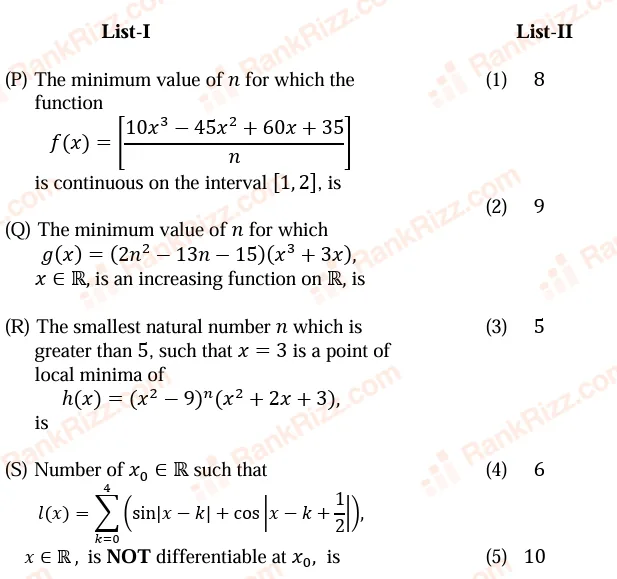
Let R\mathbb{R} denote the set of all real numbers. For a real number xx, let [x][x] denote the greatest integer less than or equal to xx. Let nn denote a natural number.

Match each entry in List-I to the correct entry in List-II and choose the correct option.

Figure for JEE Advanced 2025 Mathematics question on Differentiability at a point
  1. A

    (P)→\to(1), (Q)→\to(3), (R)→\to(2), (S)→\to(5)

  2. B

    (P)→\to(2), (Q)→\to(1), (R)→\to(4), (S)→\to(3)

  3. C

    (P)→\to(5), (Q)→\to(1), (R)→\to(4), (S)→\to(3)

  4. D

    (P)→\to(2), (Q)→\to(3), (R)→\to(1), (S)→\to(5)

JEE ADVANCED 2024 · PAPER 1Continuity at a point

Let f:R→Rf : \mathbb{R} \to \mathbb{R} and g:R→Rg : \mathbb{R} \to \mathbb{R} be functions defined by f(x)={x∣x∣sin⁡(1x),x≠0,0,x=0,f(x) = \begin{cases} x|x|\sin\left(\frac{1}{x}\right), & x \neq 0, \\ 0, & x = 0, \end{cases} and g(x)={1−2x,0≤x≤12,0,otherwise.g(x) = \begin{cases} 1 - 2x, & 0 \leq x \leq \frac{1}{2}, \\ 0, & \text{otherwise}. \end{cases}

Let a,b,c,d∈Ra, b, c, d \in \mathbb{R}. Define the function h:R→Rh : \mathbb{R} \to \mathbb{R} by h(x)=af(x)+b(g(x)+g(12−x))+c(x−g(x))+d⋅g(x)h(x) = af(x) + b\left(g(x) + g\left(\frac{1}{2} - x\right)\right) + c(x - g(x)) + d \cdot g(x), x∈Rx \in \mathbb{R}.

Match each entry in List-I to the correct entry in List-II.

List-IList-II
(P)If a=0,b=1,c=0a = 0, b = 1, c = 0 and d=0d = 0, then(1)hh is one-one
(Q)If a=1,b=0,c=0a = 1, b = 0, c = 0 and d=0d = 0, then(2)hh is onto
(R)If a=0,b=0,c=1a = 0, b = 0, c = 1 and d=0d = 0, then(3)hh is differentiable on R\mathbb{R}
(S)If a=0,b=0,c=0a = 0, b = 0, c = 0 and d=1d = 1, then(4)the range of hh is [0,1][0, 1]
(5)the range of hh is {0,1}\{0, 1\}
  1. A

    (P) →\to (4), (Q) →\to (3), (R) →\to (1), (S) →\to (2)

  2. B

    (P) →\to (5), (Q) →\to (2), (R) →\to (4), (S) →\to (3)

  3. C

    (P) →\to (5), (Q) →\to (3), (R) →\to (2), (S) →\to (4)

  4. D

    (P) →\to (4), (Q) →\to (2), (R) →\to (1), (S) →\to (3)

JEE ADVANCED 2023 · PAPER 2Differentiability at a point

Let f:(0,1)→Rf : (0,1) \to \mathbb{R} be the function defined as f(x)=[4x](x−14)2(x−12)f(x) = [4x]\left(x - \frac{1}{4}\right)^2\left(x - \frac{1}{2}\right), where [x][x] denotes the greatest integer less than or equal to xx. Then which of the following statements is(are) true?

  1. A

    The function ff is discontinuous exactly at one point in (0,1)(0,1)

  2. B

    There is exactly one point in (0,1)(0,1) at which the function ff is continuous but NOT differentiable

  3. C

    The function ff is NOT differentiable at more than three points in (0,1)(0,1)

  4. D

    The minimum value of the function ff is −1512-\frac{1}{512}

JEE ADVANCED 2020 · PAPER 2Continuity at a point

Let the functions f:(−1,1)→Rf:(-1, 1) \rightarrow R and g:(−1,1)→(−1,1)g:(-1, 1) \rightarrow (-1, 1) be defined by
f(x)=∣2x−1∣+∣2x+1∣f(x) = \mid 2x - 1 \mid + \mid 2x + 1 \mid and g(x)=x−[x]g(x) = x - [x],
where [x][x] denotes the greatest integer less than or equal to 𝑥. Let f∘g:(−1,1)→Rf \circ g :(−1, 1) \rightarrow R be the composite function defined by (f∘g)(x)=f(g(x))(f \circ g)(x) = f(g(x)). Suppose c is the number of points in the interval (-1, 1) at which f∘gf \circ g is NOT continuous, and suppose d is the number of points in the interval(-1, 1) at which f∘gf \circ g is NOT differenciable. Then the value of c + d is ____________

JEE ADVANCED 2020 · PAPER 1Differentiability at a point

Let the function f:R→Rf: R \rightarrow R be defined by f(x)=x3−x2+(x−1)sin⁡xf(x) = x^{3} − x^{2} + (x − 1) \sin x and let g:R→Rg: R \rightarrow R be an arbitrary function. Let fg:R→Rfg: R \rightarrow R be the product function defined by (fg)(x)=f(x)g(x)(fg)(x) = f(x)g(x). Then which of the following statements is/are TRUE?

  1. A

    If g is continuous at x=1x = 1, then fg is differentiable at x=1x = 1

  2. B

    If fg is differentiable at x=1x = 1, then 𝑔 is continuous at x=1x = 1

  3. C

    If g is differentiable at x=1x = 1, then 𝑓𝑔 is differentiable at x=1x = 1

  4. D

    If fg is differentiable at x=1x = 1, then 𝑔 is differentiable at x=1x = 1

JEE ADVANCED 2020 · PAPER 2Differentiability at a point

Let f:R→Rf:R \rightarrow R and g:R→Rg:R \rightarrow R be functions satisfying
f(x+y)=f(x)+f(y)+f(x)f(y)f(x + y)=f(x)+f(y)+f(x)f(y) and f(x)=xg(x)f(x) = xg(x)
for all 𝑥,𝑦∈R𝑥, 𝑦 \in R. If lim⁡x→0g(x)=1\lim_{x \rightarrow 0} g(x) = 1, then which of the following statements is/are TRUE?

  1. A

    f is differentiable at every x∈Rx \in R

  2. B

    If g(0) = 1, then g is differentiable at every x∈Rx \in R

  3. C

    The derivative f′(1)f′(1) is equal to 1

  4. D

    The derivative f′(0)f′(0) is equal to 1

JEE ADVANCED 2019 · PAPER 2Differentiability at a point

Let f:R→Rf: R \rightarrow R bea function. We say that f has
PROPERTY 1 if lim⁡h→0f(h)−f(0)∣h∣\lim_{h \rightarrow 0} \frac{f(h) - f(0)}{\sqrt{|h|}} exists and is finite, and
PROPERTY 2 if lim⁡h→0f(h)−f(0)h2\lim_{h \rightarrow 0} \frac{f(h) - f(0)}{h^2} exists and is finite.
Then which of the following options is/are correct?

  1. A

    f(x)=∣x∣f(x) = |x| has PROPERTY 1

  2. B

    f(x)=x23f(x) = x^{\frac{2}{3}} has PROPERTY 1

  3. C

    f(x)=x∣x∣f(x) = x|x| has PROPERTY 2

  4. D

    f(x)=sin⁡xf(x) = \sin x has PROPERTY 2

JEE ADVANCED 2019 · PAPER 1Continuity at a point

Let f:R→Rf:R \rightarrow R be given by
f(x)={x5+5x4+10x3+10x2+3x+1x<0;x2−x+1,0≤x≤1;23x3−4x2+7x−83,1≤x<3;(x−2)log⁡e(x−2)−x+103,x≥3.f(x) = \begin{cases}x^5 + 5x^4 + 10x^3 + 10x^2 + 3x +1 & x < 0;\\x^2 - x + 1, & 0 \leq x \leq 1; \\\frac{2}{3}x^3 - 4x^2 + 7x - \frac{8}{3}, & 1 \leq x < 3;\\ (x - 2) \log_e(x - 2) - x + \frac{10}{3}, & x \geq 3. \end{cases}
Then which of the following options is/are correct?

  1. A

    f is increasing on (−∞,0)(-\infty, 0)

  2. B

    f' has a local maximum at x = 1

  3. C

    f is onto

  4. D

    f' is NOT differentiable at x = 1

JEE ADVANCED 2017 · PAPER 1Continuity at a point

Let [x] be the greatest integer less than or equals to x. Then, at which of the following point(s) the function f(x)=xcos⁡(π(x+[x]))f(x) = x \cos (\pi(x + [x])) is discontinuous?

  1. A

    x = -1

  2. B

    x = 0

  3. C

    x = 1

  4. D

    x = 2

JEE ADVANCED 2017 · PAPER 1Continuity at a point

Let f:R→(0,1)f:R \rightarrow (0, 1) be a continuous function. Then, which of the following function(s) has (have) the value zero at some point in the interval (0, 1)?

  1. A

    x9−f(x)x^9 - f(x)

  2. B

    x−∫0π2−xf(t)cos⁡tdtx - \int_{0}^{\frac{\pi}{2}-x}f(t) \cos t dt

  3. C

    ex−∫0xf(t)sin⁡tdte^x - \int_{0}^{x}f(t) \sin t dt

  4. D

    f(x)+∫0π2f(t)sin⁡tdtf(x) + \int_{0}^{\frac{\pi}{2}}f(t) \sin t dt

JEE ADVANCED 2016 · PAPER 2Differentiability at a point

Let a,bϵRa, b \epsilon R and f:R→Rf: R \rightarrow R be bedefined by f(x)=acos⁡(∣x3−x∣)+b∣x∣sin⁡(∣x3+x∣)f(x) = a \cos (\mid x^3 - x \mid) + b \mid x \mid \sin(\mid x^3 + x \mid). Then f is

  1. A

    differentiable at x = 0 if a = 0 and b = 1

  2. B

    differentiable at x = 1 if a = 1 and b = 0

  3. C

    NOT differentiable at x = 0 if a = 1 and b = 0

  4. D

    NOT differentiable at x = 1 if a = 1 and b = 1

JEE ADVANCED 2016 · PAPER 2Continuity at a point

Let f:[−12,2]→Rf:\left[-\frac{1}{2}, 2\right] \rightarrow R and g:[−12,2]→Rg:\left[-\frac{1}{2}, 2\right] \rightarrow R be functions defined by f(x)=[x2−3]f(x) = [x^2 - 3] and g(x)=∣x∣f(x)+∣4x−7∣f(x)g(x) = \mid x \mid f(x) + \mid 4x - 7 \mid f(x), where [y][y] denotes the greatest integer less than or equal to y for yϵRy \epsilon R. Then

  1. A

    f is discontinuous exactly at three points in [−12,2]\left[-\frac{1}{2}, 2\right]

  2. B

    f is discontinuous exactly at four points in [−12,2]\left[-\frac{1}{2}, 2\right]

  3. C

    g is NOT differentiable exactly at four points in [−12,2]\left[-\frac{1}{2}, 2\right]

  4. D

    g is NOT differentiable exactly at five points in [−12,2]\left[-\frac{1}{2}, 2\right]

JEE ADVANCED 2015 · PAPER 1Differentiability at a point

Let g: R→RR \rightarrow R be a differentiable function with g(0) = 0, g'(0) = 0 and g’(1)≠0g’(1) \neq 0. Let
f(x)={x∣x∣g(x)x≠00x=0f(x) = \begin{cases}\frac{x}{|x|}g(x) & x \neq 0\\0 & x = 0\end{cases}
and h(x)=e∣x∣h(x) = e^{|x|} for all x∈Rx \in R. Let (f o h) (x) denote f(h(x)) and (h o f) (x) denote h(f(x)). Then which of the following is (are) true?

  1. A

    f is differentiable at x = 0

  2. B

    h is differentiable at x = 0

  3. C

    f o h is differentiable at x = 0

  4. D

    h o f is differentiable at x = 0

JEE ADVANCED 2014 · PAPER 1Continuity at a point

For every pair of continuous functions f,g:[0,1]→Rf, g: [0, 1] \rightarrow R such that
max{f(x):x∈[0,1]}=max{g(x):x∈[0,1]}max \left\{f(x) : x \in [0, 1]\right\} = max \left\{{g(x) : x \in [0, 1]}\right\}
the correct statement(s) is(are) :

  1. A

    (f(c))2+3f(c)=(g(c))2+3g(c)(f(c))^2 + 3f(c) = (g(c))^2 + 3g(c) for some c∈[0,1]c \in [0, 1]

  2. B

    (f(c))2+f(c)=(g(c))2+3g(c)(f(c))^2 + f(c) = (g(c))^2 + 3g(c) for some c∈[0,1]c \in [0, 1]

  3. C

    (f(c))2+3f(c)=(g(c))2+g(c)(f(c))^2 + 3f(c) = (g(c))^2 + g(c) for some c∈[0,1]c \in [0, 1]

  4. D

    (f(c))2=(g(c))2(f(c))^2 = (g(c))^2 for some c∈[0,1]c \in [0, 1]