RankRizz

Inverse Trigonometric Functions — JEE Advanced Previous Year Questions

Inverse Trigonometric Functions has been asked in 13 of the 20 JEE Advanced years from 2007 to 2026: 16 questions in all. In 2026 it averaged 0.5 questions per paper (1 across 2 papers), 2.9% of Maths questions, down from 3.1% in 2025. Across the last 20 papers it carried 2.6% of Maths questions. By type: 8 single-correct, 5 numerical, 2 multiple-correct and 1 match-the-list. Of the 16 with a difficulty tag, 13% are easy, 50% medium and 38% hard. Most asked: Domain, range and principal values (7, 44%), Properties and simplification of inverse trigonometric functions (5, 31%) and Series of inverse trigonometric functions (3, 19%).

DATA UPDATED

Questions

16

Distinct ideas

4

Share of marks

2.6%

Difficulty

HARD

Inverse Trigonometric Functions weightage, year by year

The share of each year’s Maths questions that came from Inverse Trigonometric Functions, counted from the 19 papers we hold for the last 10 years, and paper by paper inside a year.

Steady: 3.0% of Maths questions in 2024–2026 against 2.6% in 2017–2023, and between 0.0% and 5.9% in every year shown. Not asked at all in 2017, 2020.

Inverse Trigonometric Functions questions per year, per paper, and as a share of Maths questions
YEARQSPER PAPERSHARE OF MATHSCHANGE
20261 / 340.52.9%−0.2 pts
20251 / 320.53.1%+0.2 pts
20241 / 340.52.9%−3.0 pts
20232 / 341.05.9%+3.1 pts
20221 / 360.52.8%+0.2 pts
20211 / 380.52.6%+2.6 pts
20200 / 360.00.0%−2.8 pts
20191 / 360.52.8%−2.8 pts
20181 / 181.05.6%+5.6 pts
20170 / 360.00.0%—

“QS” is Inverse Trigonometric Functions questions out of all Maths questions that year; “per paper” is that count over the year’s papers, and “change” is the share against the year before. A year with more sittings asks more questions, which is why the share, not the count, is the number to compare.

The ideas inside Inverse Trigonometric Functions

A chapter is not one subject — it is a handful of procedures the examiner reuses. These are the ones Inverse Trigonometric Functions questions actually test.

01Domain, range and principal valuesset 7×
02Properties and simplification of inverse trigonometric functionsset 5×
03Sum and difference formulasset 1×
04Inverse trigonometric equations and inequalitiesNot set in Advanced
05Series of inverse trigonometric functionsset 3×

All 16 Inverse Trigonometric Functions questions, by topic

Every JEE Advanced Inverse Trigonometric Functions question we hold, newest first inside each topic. Open one for its options, answer key and solution.

FREE PDF

Inverse Trigonometric Functions JEE Advanced PYQs with answer key

All 16 questions on A4, by topic, with the answer key at the end. No sign-up, no email: your browser saves it as a PDF.

Download free PDF

UNIQUE CONCEPTS

Inverse Trigonometric Functions: one question per idea

5 ideas, each with the latest past question that tested it, drawn from 125 JEE Main and Advanced questions.

Inverse Trigonometric Functions Unique Concepts sheet →

JEE MAIN

Inverse Trigonometric Functions in JEE Main

JEE Main has set 110 Inverse Trigonometric Functions questions, 2005–2026.

Inverse Trigonometric Functions JEE Main PYQs →

Inverse Trigonometric Functions: quick answers

Is Inverse Trigonometric Functions asked every year in JEE Advanced?

Not every year. It has been asked in 13 of the 20 JEE Advanced years from 2007 to 2026; the years without a Inverse Trigonometric Functions question were 2009, 2010, 2011, 2012, 2016, 2017 and 2020.

Which Inverse Trigonometric Functions topic is asked most in JEE Advanced?

Domain, range and principal values: 7 of the 16 questions (44%). Next come Properties and simplification of inverse trigonometric functions (5) and Series of inverse trigonometric functions (3).

What share of Maths questions does Inverse Trigonometric Functions carry in JEE Advanced?

About 2.6% of Maths questions across the last 20 papers. In 2026 it was 2.9% (1 of 34 Maths questions).

When was Inverse Trigonometric Functions last asked in JEE Advanced?

In JEE Advanced 2026 Paper 1, the latest sitting with a Inverse Trigonometric Functions question.

How many Inverse Trigonometric Functions questions has JEE Advanced asked?

16 from 2007 to 2026, across 4 topics. Every one is listed on this page by topic and links to its own page, with the answer key and solution wherever we have them. Free, no sign-up.

Every Inverse Trigonometric Functions question

1–16 OF 16 · NEWEST FIRST

JEE ADVANCED 2026 · PAPER 1Domain, range and principal values

Considering only the principal values of the inverse trigonometric functions, the value of

cot⁡−1(cot⁡(−11))+10 sin⁡ ⁣(2cos⁡−1 ⁣(12))+10sin⁡(2tan⁡−1(2))\cot^{-1}(\cot(-11))+10\,\sin\!\left(2\cos^{-1}\!\left(\tfrac{1}{\sqrt{2}}\right)\right)+10\sin(2\tan^{-1}(2))

is

  1. A

    3π+73\pi+7

  2. B

    77

  3. C

    4π+74\pi+7

  4. D

    3π−53\pi-5

JEE ADVANCED 2025 · PAPER 2Domain, range and principal values

The total number of real solutions of the equation

θ=tan⁡−1(2tan⁡θ)−12sin⁡−1(6tan⁡θ9+tan⁡2θ)\theta = \tan^{-1}(2\tan\theta) - \frac{1}{2}\sin^{-1}\left(\frac{6\tan\theta}{9 + \tan^2\theta}\right)

is

(Here, the inverse trigonometric functions sin⁡−1x\sin^{-1} x and tan⁡−1x\tan^{-1} x assume values in [−π2,π2]\left[-\frac{\pi}{2}, \frac{\pi}{2}\right] and (−π2,π2)\left(-\frac{\pi}{2}, \frac{\pi}{2}\right), respectively.)

  1. A

    11

  2. B

    22

  3. C

    33

  4. D

    55

JEE ADVANCED 2024 · PAPER 2Domain, range and principal values

Considering only the principal values of the inverse trigonometric functions, the value of tan⁡(sin⁡−1(35)−2cos⁡−1(25))\tan\left(\sin^{-1}\left(\frac{3}{5}\right) - 2\cos^{-1}\left(\frac{2}{\sqrt{5}}\right)\right) is

  1. A

    724\frac{7}{24}

  2. B

    −724\frac{-7}{24}

  3. C

    −524\frac{-5}{24}

  4. D

    524\frac{5}{24}

JEE ADVANCED 2023 · PAPER 2Properties and simplification of inverse trigonometric functions

For any y∈Ry \in \mathbb{R}, let cot⁡−1(y)∈(0,π)\cot^{-1}(y) \in (0, \pi) and tan⁡−1(y)∈(−π2,π2)\tan^{-1}(y) \in \left(-\frac{\pi}{2}, \frac{\pi}{2}\right). Then the sum of all the solutions of the equation tan⁡−1(6y9−y2)+cot⁡−1(9−y26y)=2π3\tan^{-1}\left(\frac{6y}{9 - y^2}\right) + \cot^{-1}\left(\frac{9 - y^2}{6y}\right) = \frac{2\pi}{3} for 0<∣y∣<30 < |y| < 3, is equal to

  1. A

    23−32\sqrt{3} - 3

  2. B

    3−233 - 2\sqrt{3}

  3. C

    43−64\sqrt{3} - 6

  4. D

    6−436 - 4\sqrt{3}

JEE ADVANCED 2023 · PAPER 1Properties and simplification of inverse trigonometric functions

Let tan⁡−1(x)∈(−π2,π2)\tan^{-1}(x) \in \left(-\frac{\pi}{2}, \frac{\pi}{2}\right), for x∈Rx \in \mathbb{R}. Then the number of real solutions of the equation 1+cos⁡(2x)=2tan⁡−1(tan⁡x)\sqrt{1 + \cos(2x)} = \sqrt{2} \tan^{-1}(\tan x) in the set (−3π2,π2)∪(−π2,π2)∪(π2,3π2)\left(-\frac{3\pi}{2}, \frac{\pi}{2}\right) \cup \left(-\frac{\pi}{2}, \frac{\pi}{2}\right) \cup \left(\frac{\pi}{2}, \frac{3\pi}{2}\right) is equal to

JEE ADVANCED 2022 · PAPER 1Domain, range and principal values

Considering only the principal values of the inverse trigonometric functions, the value of

32cos⁡−122+π2+14sin⁡−122π2+π2+tan⁡−12π\frac{3}{2} \cos^{-1} \sqrt{\frac{2}{2+\pi^2}} + \frac{1}{4} \sin^{-1} \frac{2\sqrt{2}\pi}{2+\pi^2} + \tan^{-1} \frac{\sqrt{2}}{\pi}

is ______.

JEE ADVANCED 2021 · PAPER 1Series of inverse trigonometric functions

For any positive integer n, let Sn:(0,∞)→RS_n : (0, \infty) \rightarrow R be defined by
Sn(x)=∑k=1ncot⁡−1(1+k(k+1)x2x)S_n(x) = \sum_{k=1}^n \cot^{-1}\left(\frac{1 + k(k + 1)x^2}{x}\right),
where for any x∈R,cot⁡−1(x)∈(0,π)x \in R, \cot^{-1}(x) \in (0, \pi) and tan⁡−1(x)∈(−π2,π2)\tan^{-1}(x) \in \left(-\frac{\pi}{2}, \frac{\pi}{2}\right). Then which of the following statements is (are) TRUE ?

  1. A

    S10(x)=π2−tan⁡−1(1+11x210x)S_{10}(x) = \frac{\pi}{2} - \tan^{-1}\left(\frac{1 + 11 x^2}{10 x}\right), for all x>0x > 0

  2. B

    lim⁡n→∞cot⁡(Sn(x))=x\lim_{n \rightarrow \infty} \cot(S_n(x)) = x, for all x > 0

  3. C

    The equation S3(x)=π4S_3(x) = \frac{\pi}{4} has a root in (0,∞)(0, \infty)

  4. D

    tan⁡(Sn(x))≤12\tan(S_n(x)) \leq \frac{1}{2}, for all n≥1n \geq 1 and x>0x > 0

JEE ADVANCED 2019 · PAPER 2Domain, range and principal values

The value of
sec⁡−1(14∑k=010sec⁡(7π12+kπ2)sec⁡(7π12+(k+1)π2))\sec^{-1} \left(\frac{1}{4}\sum_{k = 0}^{10} \sec \left(\frac{7\pi}{12} + \frac{k\pi}{2}\right) \sec \left(\frac{7\pi}{12} + \frac{\left(k + 1\right)\pi}{2}\right) \right)
in the interval [−π4,3π4]\begin{bmatrix}-\frac {\pi}{4}, & \frac{3\pi}{4} \end{bmatrix} equals _______

JEE ADVANCED 2018 · PAPER 1Series of inverse trigonometric functions

The number of real solutions of the equation
sin⁡−1(∑i=1∞Xi+1−x∑i=1∞(x2)i)=π2−cos⁡−1(∑i=1∞(−x2)i−∑i=1∞(−x)i)\sin^{-1}\left(\sum_{i=1}^\infty X^{i+1} -x\sum_{i=1}^\infty \left(\frac{x}{2}\right)^{i} \right )=\frac{\pi}{2}-\cos^{-1}\left(\sum_{i=1}^\infty \left(\frac{-x}{2}\right)^{i}-\sum_{i=1}^\infty \left(-x\right)^{i}\right) lying in the interval (−12,12)(- \frac{1}{2},\frac{1}{2})(Here, the inverse trigonometric functions sin⁡−1xandcos⁡−1x\sin^{−1}x and \cos^{−1}x assume values in [−π2,π2- \frac{\pi}{2},\frac{\pi}{2}] and and [0,π][0, \pi], respectively.)

JEE ADVANCED 2015 · PAPER 2Domain, range and principal values

If α=3sin⁡−1(611)\alpha = 3 \sin^{-1} \left(\frac{6}{11}\right) and $$\beta = 3 \cos^{-1} \left(\frac{4}{9}\right) where the inverse trigonometric functions take only the principal values, then the correct option(s) is(are)

  1. A

    cos⁡β>0\cos \beta > 0

  2. B

    sin⁡β<0\sin \beta < 0

  3. C

    cos⁡(α+β)>0\cos (\alpha + \beta) > 0

  4. D

    cos⁡α<0\cos \alpha < 0

JEE ADVANCED 2014 · PAPER 1Domain, range and principal values

Let f:[0,4π]→[0,π]f: [0, 4 \pi] \rightarrow [0, \pi] be defined by f(x)=cos⁡−1(cos⁡x).f(x) = \cos^{-1} (\cos x). The number of points x∈[0,4π]x \in [0, 4 \pi] satisfying the equation f(x)=10−x10f(x) = \frac{10 - x}{10} is

JEE ADVANCED 2013 · PAPER 1Series of inverse trigonometric functions

The value of cot⁡(∑n=123cot⁡−1(1+∑k=1n2k))\cot \left(\sum_{n = 1}^{23}\cot^{-1} \left(1 + \sum_{k = 1}^n 2k\right)\right) is

  1. A

    2325\frac{23}{25}

  2. B

    2523\frac{25}{23}

  3. C

    2324\frac{23}{24}

  4. D

    2423\frac{24}{23}

JEE ADVANCED 2013 · PAPER 2Properties and simplification of inverse trigonometric functions

Match List I with List II and select the correct answer using the code given below the lists:
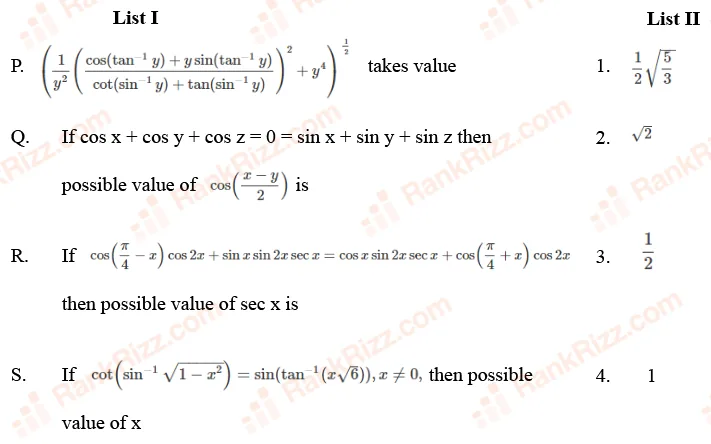
Figure for JEE Advanced 2013 Mathematics question on Properties and simplification of inverse trigonometric functions
  1. A

    P-4, Q-3, R-1, S-2

  2. B

    P-4, Q-3, R-2, S-1

  3. C

    P-3, Q-4, R-2, S-1

  4. D

    P-3, Q-4, R-1, S-2

JEE ADVANCED 2008 · PAPER 1Properties and simplification of inverse trigonometric functions

If 0<x<10 < x < 1, then
1+x2[{xcos⁡(cot⁡−1x)+sin⁡(cot⁡−1x)}2−1]12=\sqrt{1 + x^2}[\left\{x \cos (\cot^{-1} x) + \sin(\cot^{-1} x)\right\}^2 - 1]^{\frac{1}{2}}=

  1. A

    x1+x2\frac{x}{\sqrt{1 + x^2}}

  2. B

    xx

  3. C

    x1+x2x\sqrt{1 + x^2}

  4. D

    1+x2\sqrt{1 + x^2}

JEE ADVANCED 2007 · PAPER 1Sum and difference formulas

Let F(x)F(x) be an indefinite integral of sin⁡2x\sin^2 x.
STATEMENT-1 : The function F(x)F(x) satisfies F(x+π)=F(x)F(x + \pi) = F(x) for all real x.
because
STATEMENT-2: sin⁡2(x+π)=sin⁡2x\sin^2 (x + \pi) = \sin^2 x for all real x.

  1. A

    Statement-1 is True, Statement-2 is True; Statement-2 is a correct explanation for Statement-1

  2. B

    Statement-1 is True, Statement-2 is True; Statement-2 is NOT a correct explanation for Statement-1

  3. C

    Statement-1 is True, Statement-2 is False

  4. D

    Statement-1 is False, Statement-2 is True

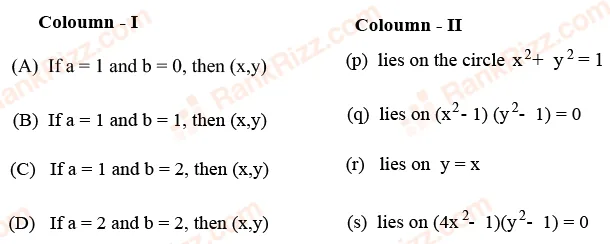
JEE ADVANCED 2007 · PAPER 2Properties and simplification of inverse trigonometric functions

Let (x, y) be such that sin⁡−1(ax)+cos⁡−1(y)+cos⁡−1(bxy)=π2.\sin^{-1}(ax) + \cos^{-1}(y) + \cos^{-1}(bxy) = \frac{\pi}{2}.
Match the statements in Column I with statements in Column II and indicate your answer by darkening the appropriate bubbles in the 4×44 \times 4 matrix given in the ORS.

Figure for JEE Advanced 2007 Mathematics question on Properties and simplification of inverse trigonometric functions