In the print dialog choose “Save as PDF”. Turn off the browser’s own headers and footers; the chapter has its own.

RankRizzFREE PDF

Vector Algebra JEE Advanced PYQs with answer key

MATHS · 40 PAST QUESTIONS · 4 TOPICS · 2007–2026

HOW TO USE THIS SHEET

Every JEE Advanced Vector Algebra question we hold, grouped by topic, most-asked topic first and newest first inside each. The answer key is at the end (36 of 40 questions have a checked key); the worked solution is on each question’s page, printed beside it.

Scalar triple product and coplanarity 14

  1. 01 · JEE ADVANCED 2026 · PAPER 1

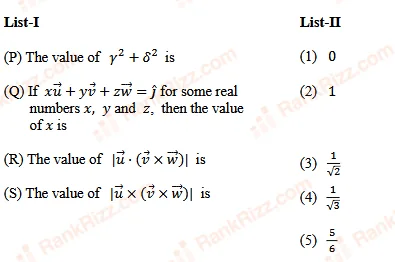
    For real numbers α,β,γ,δ\alpha,\beta,\gamma,\delta and μ\mu, consider the matrix M=[α12−1213β13γδμ].M=\begin{bmatrix}\alpha&\tfrac{1}{\sqrt{2}}&-\tfrac{1}{\sqrt{2}}\\[2pt]\tfrac{1}{\sqrt{3}}&\beta&\tfrac{1}{\sqrt{3}}\\[2pt]\gamma&\delta&\mu\end{bmatrix}.

    Suppose that MMT=IMM^{T}=I, where MTM^{T} is the transpose of MM and II is the 3×33\times 3 identity matrix. Let u⃗=αi^+13j^+γk^,v⃗=12i^+βj^+δk^,w⃗=−12i^+13j^+μk^.\vec{u}=\alpha\hat{i}+\tfrac{1}{\sqrt{3}}\hat{j}+\gamma\hat{k},\quad \vec{v}=\tfrac{1}{\sqrt{2}}\hat{i}+\beta\hat{j}+\delta\hat{k},\quad \vec{w}=-\tfrac{1}{\sqrt{2}}\hat{i}+\tfrac{1}{\sqrt{3}}\hat{j}+\mu\hat{k}.

    Match each entry in List-I to the correct entry in List-II and choose the correct option.
    image
    1. (A)

      (P)→\to(5), (Q)→\to(4), (R)→\to(2), (S)→\to(1)

    2. (B)

      (P)→\to(4), (Q)→\to(5), (R)→\to(1), (S)→\to(2)

    3. (C)

      (P)→\to(5), (Q)→\to(3), (R)→\to(2), (S)→\to(1)

    4. (D)

      (P)→\to(5), (Q)→\to(4), (R)→\to(1), (S)→\to(2)

    rr2.rankrizz.com/jee-advanced/maths/vector-algebra/q/2026-paper-1-q47

  2. 02 · JEE ADVANCED 2025 · PAPER 2

    Consider the vectors

    x⃗=i^+2j^+3k^\vec{x} = \hat{i} + 2\hat{j} + 3\hat{k}, y⃗=2i^+3j^+k^\quad \vec{y} = 2\hat{i} + 3\hat{j} + \hat{k}, \quad and z⃗=3i^+j^+2k^\quad \vec{z} = 3\hat{i} + \hat{j} + 2\hat{k}.

    For two distinct positive real numbers α\alpha and β\beta, define

    X⃗=αx⃗+βy⃗−z⃗\vec{X} = \alpha\vec{x} + \beta\vec{y} - \vec{z}, Y⃗=αy⃗+βz⃗−x⃗\quad \vec{Y} = \alpha\vec{y} + \beta\vec{z} - \vec{x}, \quad and Z⃗=αz⃗+βx⃗−y⃗\quad \vec{Z} = \alpha\vec{z} + \beta\vec{x} - \vec{y}.

    If the vectors X⃗\vec{X}, Y⃗\vec{Y}, and Z⃗\vec{Z} lie in a plane, then the value of α+β−3\alpha + \beta - 3 is ______.

    Answer: ____________

    rr2.rankrizz.com/jee-advanced/maths/vector-algebra/q/2025-paper-2-q12

  3. 03 · JEE ADVANCED 2025 · PAPER 1

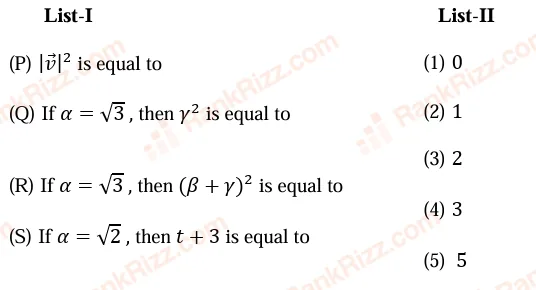
    Let w⃗=i^+j^−2k^\vec{w} = \hat{i} + \hat{j} - 2\hat{k}, and u⃗\vec{u} and v⃗\vec{v} be two vectors, such that u⃗×v⃗=w⃗\vec{u} \times \vec{v} = \vec{w} and v⃗×w⃗=u⃗\vec{v} \times \vec{w} = \vec{u}. Let α,β,γ\alpha, \beta, \gamma, and tt be real numbers such that

    u⃗=αi^+βj^+γk^,−tα+β+γ=0,α−tβ+γ=0,andα+β−tγ=0.\vec{u} = \alpha\hat{i} + \beta\hat{j} + \gamma\hat{k}, \quad -t\alpha + \beta + \gamma = 0, \quad \alpha - t\beta + \gamma = 0, \quad \text{and} \quad \alpha + \beta - t\gamma = 0.

    Match each entry in List-I to the correct entry in List-II and choose the correct option.
    image
    1. (A)

      (P)→\to(2), (Q)→\to(1), (R)→\to(4), (S)→\to(5)

    2. (B)

      (P)→\to(2), (Q)→\to(4), (R)→\to(3), (S)→\to(5)

    3. (C)

      (P)→\to(2), (Q)→\to(1), (R)→\to(4), (S)→\to(3)

    4. (D)

      (P)→\to(5), (Q)→\to(4), (R)→\to(1), (S)→\to(3)

    rr2.rankrizz.com/jee-advanced/maths/vector-algebra/q/2025-paper-1-q16

  4. 04 · JEE ADVANCED 2024 · PAPER 2

    Let p⃗=2i^+j^+3k^\vec{p} = 2\hat{i} + \hat{j} + 3\hat{k} and q⃗=i^−j^+k^\vec{q} = \hat{i} - \hat{j} + \hat{k}. If for some real numbers α\alpha, β\beta and γ\gamma, we have 15i^+10j^+6k^=α(2p⃗+q⃗)+β(p⃗−2q⃗)+γ(p⃗×q⃗)15\hat{i} + 10\hat{j} + 6\hat{k} = \alpha(2\vec{p} + \vec{q}) + \beta(\vec{p} - 2\vec{q}) + \gamma(\vec{p} \times \vec{q}), then the value of γ\gamma is ______.

    Answer: ____________

    rr2.rankrizz.com/jee-advanced/maths/vector-algebra/q/2024-paper-2-q11

  5. 05 · JEE ADVANCED 2024 · PAPER 1

    Let OP→=α−1αi^+j^+k^\overrightarrow{OP} = \frac{\alpha - 1}{\alpha}\hat{i} + \hat{j} + \hat{k}, OQ→=i^+β−1βj^+k^\overrightarrow{OQ} = \hat{i} + \frac{\beta - 1}{\beta}\hat{j} + \hat{k} and OR→=i^+j^+12k^\overrightarrow{OR} = \hat{i} + \hat{j} + \frac{1}{2}\hat{k} be three vectors, where α,β∈R−{0}\alpha, \beta \in \mathbb{R} - \{0\} and OO denotes the origin. If (OP→×OQ→)⋅OR→=0(\overrightarrow{OP} \times \overrightarrow{OQ}) \cdot \overrightarrow{OR} = 0 and the point (α,β,2)(\alpha, \beta, 2) lies on the plane 3x+3y−z+l=03x + 3y - z + l = 0, then the value of ll is ________.

    Answer: ____________

    rr2.rankrizz.com/jee-advanced/maths/vector-algebra/q/2024-paper-1-q12

  6. 06 · JEE ADVANCED 2023 · PAPER 1

    Let P be the plane 3x+2y+3z=16\sqrt{3}x + 2y + 3z = 16 and let S={αi^+βj^+γk^:α2+β2+γ2=1 and the distance of (α,β,γ) from the plane P is 72}S = \left\{\alpha\hat{i} + \beta\hat{j} + \gamma\hat{k} : \alpha^2 + \beta^2 + \gamma^2 = 1 \text{ and the distance of } (\alpha, \beta, \gamma) \text{ from the plane P is } \frac{7}{2}\right\}. Let u⃗\vec{u}, v⃗\vec{v} and w⃗\vec{w} be three distinct vectors in S such that ∣u⃗−v⃗∣=∣v⃗−w⃗∣=∣w⃗−u⃗∣|\vec{u} - \vec{v}| = |\vec{v} - \vec{w}| = |\vec{w} - \vec{u}|. Let V be the volume of the parallelepiped determined by vectors u⃗\vec{u}, v⃗\vec{v} and w⃗\vec{w}. Then the value of 803V\frac{80}{\sqrt{3}}V is

    Answer: ____________

    rr2.rankrizz.com/jee-advanced/maths/vector-algebra/q/2023-paper-1-q12

  7. 07 · JEE ADVANCED 2021 · PAPER 1

    Let u→,v→\overrightarrow{u},\overrightarrow{v} and w→\overrightarrow{w} be vectors in three-dimensional space, where u→\overrightarrow{u} and v→\overrightarrow{v} re unit vectors which are not perpendicular to each other and
    u→.w→=1,v→.w→=1,w→w→=4\overrightarrow{u}.\overrightarrow{w} = 1, \overrightarrow{v}.\overrightarrow{w} = 1, \overrightarrow{w}\overrightarrow{w} = 4
    If the volume of the parallelopiped, whose adjacent sides are represented by the vectors u→,v→\overrightarrow{u},\overrightarrow{v} and w→\overrightarrow{w}, is 2\sqrt{2}, then the value of ∣3u→+5v→∣\mid 3\overrightarrow{u} + 5 \overrightarrow{v} \mid is ___ .

    Answer: ____________

    rr2.rankrizz.com/jee-advanced/maths/vector-algebra/q/2021-paper-1-q19

  8. 08 · JEE ADVANCED 2014 · PAPER 1

    Let x→,y→\overrightarrow{x}, \overrightarrow{y} and z→\overrightarrow{z} be three vectors each of magnitude 2\sqrt 2 and the angle between each pair of them is π3.\frac{\pi}{3}. If a→\overrightarrow{a} is a nonzero vector perpendicular to x→\overrightarrow{x} and y→×z→\overrightarrow{y} \times \overrightarrow{z} and b→\overrightarrow{b} is a nonzero vector perpendicular to y→\overrightarrow{y} and z→×x→\overrightarrow{z} \times \overrightarrow{x}, then

    1. (A)

      b→=(b→.z→)(z→−x→)\overrightarrow{b} = (\overrightarrow{b} . \overrightarrow{z})(\overrightarrow{z} - \overrightarrow{x})

    2. (B)

      a→=(a→.y→)(y→−z→)\overrightarrow{a} = (\overrightarrow{a} . \overrightarrow{y})(\overrightarrow{y} - \overrightarrow{z})

    3. (C)

      a→.b→=−(a→.y→)(b→.z→)\overrightarrow{a} . \overrightarrow{b} = - (\overrightarrow{a} . \overrightarrow{y}) (\overrightarrow{b} . \overrightarrow{z})

    4. (D)

      a→=(a→.y→)(z→−y→)\overrightarrow{a} = (\overrightarrow{a} . \overrightarrow{y})(\overrightarrow{z} - \overrightarrow{y})

    rr2.rankrizz.com/jee-advanced/maths/vector-algebra/q/2014-paper-1-q48

  9. 09 · JEE ADVANCED 2013 · PAPER 1

    Let PR→=3i^+j^−2k^\overrightarrow{PR} = 3\widehat{i} + \widehat{j} - 2\widehat{k} and SQ→=i^−3j^−4k^\overrightarrow{SQ} = \widehat{i} - 3 \widehat{j} - 4\widehat{k} determine diagonals of a parallelogram PQRS and PT→=i^+2j^+3k^\overrightarrow{PT} = \widehat{i} + 2\widehat{j} + 3\widehat{k} be another vector. Then the volume of the PT→,PQ→\overrightarrow{PT}, \overrightarrow{PQ} and PS→\overrightarrow{PS} is

    1. (A)

      5

    2. (B)

      20

    3. (C)

      10

    4. (D)

      30

    rr2.rankrizz.com/jee-advanced/maths/vector-algebra/q/2013-paper-1-q50

  10. 10 · JEE ADVANCED 2013 · PAPER 2

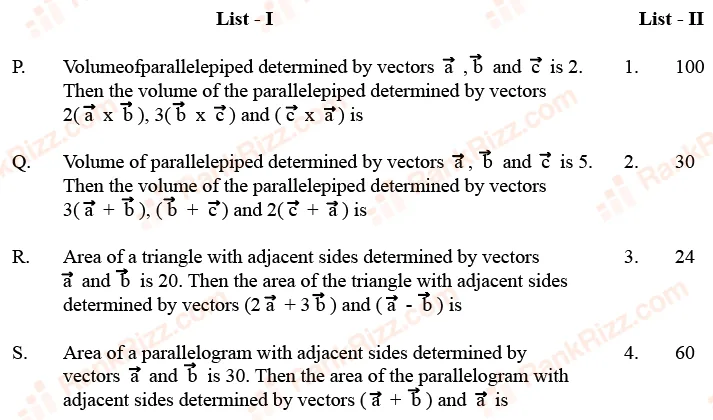
    Match List - I with List - II and select the correct answer using the code given below the lists:
    1. (A)

      P-4, Q-2, R-3, S-1

    2. (B)

      P-2, Q-3, R-1, S-4

    3. (C)

      P-3, Q-4, R-1, S-2

    4. (D)

      P-1, Q-4, R-3, S-2

    rr2.rankrizz.com/jee-advanced/maths/vector-algebra/q/2013-paper-2-q60

  11. 11 · JEE ADVANCED 2011 · PAPER 1

    The vector(s) which is/are coplanar with vectors i^+j^+2k^\hat{i} + \hat{j} + 2\hat{k} and i^+2j^+k^\hat{i} + 2\hat{j} + \hat{k}, and perpendicular to the vector i^+j^+k^\hat{i} + \hat{j} + \hat{k} is/are

    1. (A)

      j^−k^\hat{j} - \hat{k}

    2. (B)

      −i^+j^-\hat{i} + \hat{j}

    3. (C)

      i^−j^\hat{i} - \hat{j}

    4. (D)

      −j^+k^- \hat{j} + \hat{k}

    rr2.rankrizz.com/jee-advanced/maths/vector-algebra/q/2011-paper-1-q54

  12. 12 · JEE ADVANCED 2010 · PAPER 1

    If a→\overrightarrow{a} and b→\overrightarrow{b} are vectors in space given by a→=i^−2j^5\overrightarrow{a} = \frac{\hat{i} - 2 \hat{j}}{\sqrt{5}} and b→=2i^+j^+3k^14\overrightarrow{b} = \frac{2\hat{i} + \hat{j} + 3\hat{k}}{\sqrt{14}}, then the value of (2a→+b→).[(a→×b→)×(a→−2b→)]\left(2\overrightarrow{a} + \overrightarrow{b}\right).\left[\left(\overrightarrow{a} \times \overrightarrow{b}\right) \times \left(\overrightarrow{a} - 2\overrightarrow{b}\right)\right] is

    Answer: ____________

    rr2.rankrizz.com/jee-advanced/maths/vector-algebra/q/2010-paper-1-q49

  13. 13 · JEE ADVANCED 2008 · PAPER 1

    The edges of a parallelopiped are of unit length andare parallel to non-coplanar unit vectors a^,b^,c^\hat{a}, \hat{b}, \hat{c} such that
    a^.b^=b^.c^=c^.a^=12\hat{a} . \hat{b} = \hat{b} . \hat{c} = \hat{c} . \hat{a} = \frac{1}{2}.
    Then, the volume of the parallelopiped is

    1. (A)

      12\frac{1}{\sqrt{2}}

    2. (B)

      122\frac{1}{2\sqrt{2}}

    3. (C)

      32\frac{\sqrt{3}}{2}

    4. (D)

      13\frac{1}{\sqrt{3}}

    rr2.rankrizz.com/jee-advanced/maths/vector-algebra/q/2008-paper-1-q3

  14. 14 · JEE ADVANCED 2007 · PAPER 1

    The number of distinct real values of λ\lambda, for which the vectors −λ2i^+j^+k^,i^−λ2j^+k^-\lambda^2 \hat{i} + \hat{j} + \hat{k}, \hat{i} - \lambda^2 \hat{j} + \hat{k} and i^+j^−λ2k^\hat{i} + \hat{j} - \lambda^2 \hat{k} are coplanar, is

    1. (A)

      zero

    2. (B)

      one

    3. (C)

      two

    4. (D)

      three

    rr2.rankrizz.com/jee-advanced/maths/vector-algebra/q/2007-paper-1-q51

Scalar (dot) product 12

  1. 15 · JEE ADVANCED 2023 · PAPER 2

    Let the position vectors of the points P, Q, R and S be a⃗=i^+2j^−5k^\vec{a} = \hat{i} + 2\hat{j} - 5\hat{k}, b⃗=3i^+6j^+3k^\vec{b} = 3\hat{i} + 6\hat{j} + 3\hat{k}, c⃗=175i^+165j^+7k^\vec{c} = \frac{17}{5}\hat{i} + \frac{16}{5}\hat{j} + 7\hat{k} and d⃗=2i^+j^+k^\vec{d} = 2\hat{i} + \hat{j} + \hat{k}, respectively. Then which of the following statements is true?

    1. (A)

      The points P, Q, R and S are NOT coplanar

    2. (B)

      b⃗+2d⃗3\frac{\vec{b} + 2\vec{d}}{3} is the position vector of a point which divides PR internally in the ratio 5 : 4

    3. (C)

      b⃗+2d⃗3\frac{\vec{b} + 2\vec{d}}{3} is the position vector of a point which divides PR externally in the ratio 5 : 4

    4. (D)

      The square of the magnitude of the vector b⃗×d⃗\vec{b} \times \vec{d} is 95

    rr2.rankrizz.com/jee-advanced/maths/vector-algebra/q/2023-paper-2-q4

  2. 16 · JEE ADVANCED 2022 · PAPER 2

    Let i^\hat{i}, j^\hat{j} and k^\hat{k} be the unit vectors along the three positive coordinate axes. Let

    a⃗=3i^+j^−k^\vec{a} = 3\hat{i} + \hat{j} - \hat{k},

    b⃗=i^+b2j^+b3k^\vec{b} = \hat{i} + b_2\hat{j} + b_3\hat{k},      b2,b3∈Rb_2, b_3 \in \mathbb{R},

    c⃗=c1i^+c2j^+c3k^\vec{c} = c_1\hat{i} + c_2\hat{j} + c_3\hat{k},      c1,c2,c3∈Rc_1, c_2, c_3 \in \mathbb{R}

    be three vectors such that b2b3>0b_2 b_3 > 0, a⃗⋅b⃗=0\vec{a} \cdot \vec{b} = 0 and (0−c3c2c30−c1−c2c10)(1b2b3)=(3−c11−c2−1−c3)\begin{pmatrix} 0 & -c_3 & c_2 \\ c_3 & 0 & -c_1 \\ -c_2 & c_1 & 0 \end{pmatrix} \begin{pmatrix} 1 \\ b_2 \\ b_3 \end{pmatrix} = \begin{pmatrix} 3 - c_1 \\ 1 - c_2 \\ -1 - c_3 \end{pmatrix}.

    Then, which of the following is/are TRUE?

    1. (A)

      a⃗⋅c⃗=0\vec{a} \cdot \vec{c} = 0

    2. (B)

      b⃗⋅c⃗=0\vec{b} \cdot \vec{c} = 0

    3. (C)

      ∣b⃗∣>10|\vec{b}| > \sqrt{10}

    4. (D)

      ∣c⃗∣≤11|\vec{c}| \leq \sqrt{11}

    rr2.rankrizz.com/jee-advanced/maths/vector-algebra/q/2022-paper-2-q13

  3. 17 · JEE ADVANCED 2020 · PAPER 2

    Let 𝑎 and 𝑏 be positive real numbers. Suppose PQ→=ai^+bj^\overrightarrow{PQ} = a\hat{i} + b\hat{j} and PS→=ai^−bj^\overrightarrow{PS} = a\hat{i} - b\hat{j} are adjacent sides of a parallelogram 𝑃𝑄𝑅𝑆. Let u→\overrightarrow{u} and \overrightarrow{v} be the projection vectors of u→=i^+j^\overrightarrow{u} = \hat{i} + \hat{j} along PQ→\overrightarrow{PQ} and PS→\overrightarrow{PS}, respectively. If ∣u→∣+∣v→∣=∣w→∣\mid \overrightarrow{u}\mid + \mid \overrightarrow{v} \mid = \mid \overrightarrow{w} \mid and if the area of the parallelogram 𝑃𝑄𝑅𝑆 is 8, then which of the following statements is/are TRUE?

    1. (A)

      a + 𝑏 = 4

    2. (B)

      a - 𝑏 = 2

    3. (C)

      The length of the diagonal 𝑃𝑅 of the parallelogram 𝑃𝑄𝑅𝑆 is 4

    4. (D)

      w→\overrightarrow{w} is an angle bisector of the vectors PQ→\overrightarrow{PQ} and PS→\overrightarrow{PS}

    rr2.rankrizz.com/jee-advanced/maths/vector-algebra/q/2020-paper-2-q47

  4. 18 · JEE ADVANCED 2020 · PAPER 1

    In a triangle 𝑃𝑄𝑅, let a→=QR→,b→=RP→\overrightarrow{a} = \overrightarrow{QR}, \overrightarrow{b} = \overrightarrow{RP} and c→=PQ→\overrightarrow{c} = \overrightarrow{PQ}. If

    ∣a→∣=3,∣b→∣=4|\overrightarrow{a}| = 3, |\overrightarrow{b}| = 4 and a→⋅(c→−b→)c→⋅(a→−b→)=∣a→∣∣a→∣+∣b→∣\frac{\overrightarrow{a}\cdot(\overrightarrow{c}-\overrightarrow{b})}{\overrightarrow{c}\cdot(\overrightarrow{a}-\overrightarrow{b})} = \frac{|\overrightarrow{a}|}{|\overrightarrow{a}| + |\overrightarrow{b}|},

    then the value of ∣a→×b→∣2\left|\overrightarrow{a} \times \overrightarrow{b}\right|^{2} is ___________

    Answer: ____________

    rr2.rankrizz.com/jee-advanced/maths/vector-algebra/q/2020-paper-1-q52

  5. 19 · JEE ADVANCED 2019 · PAPER 2

    Let a→=2i^+j^−k^\overrightarrow{a} = 2\widehat{i} + \widehat{j} - \widehat{k} and b→=i^+2j^+k^\overrightarrow{b} = \widehat{i} + 2\widehat{j} + \widehat{k} be two vectors. Consider a vector c→=αa→+βb→,α,β∈R.\overrightarrow{c} = \alpha \overrightarrow{a} + \beta \overrightarrow{b}, \alpha, \beta \in R. If the projection of c→\overrightarrow{c} on the vector (a→+b→)\left(\overrightarrow{a} + \overrightarrow{b}\right) is 32,3\sqrt{2}, then the minimum value of (c→−(a→×b→)).c→\left(\overrightarrow{c} - \left(\overrightarrow{a} \times \overrightarrow{b}\right)\right) . \overrightarrow{c} equals _________ .

    Answer: ____________

    rr2.rankrizz.com/jee-advanced/maths/vector-algebra/q/2019-paper-2-q50

  6. 20 · JEE ADVANCED 2017 · PAPER 2

    Let O be the origin and let PQR be an arbitrary triangle. The point S is such that OP→.OQ→+OR→.OS→=OR→.OP→+OQ→.OS→=OQ→.OR→+OP→.OS→\overrightarrow{OP}.\overrightarrow{OQ}+\overrightarrow{OR}.\overrightarrow{OS}=\overrightarrow{OR}.\overrightarrow{OP}+\overrightarrow{OQ}.\overrightarrow{OS}=\overrightarrow{OQ}.\overrightarrow{OR}+\overrightarrow{OP}.\overrightarrow{OS} Then the triangle PQR has S as its

    1. (A)

      centroid

    2. (B)

      circumcentre

    3. (C)

      incentre

    4. (D)

      orthocenter

    rr2.rankrizz.com/jee-advanced/maths/vector-algebra/q/2017-paper-2-q38

  7. 21 · JEE ADVANCED 2015 · PAPER 1

    Let △PQR\triangle PQR be a triangle. Let a→=QR→,b→=RP→\overrightarrow{a} = \overrightarrow{QR}, \overrightarrow{b} = \overrightarrow{RP} and c→=PQ→\overrightarrow{c} = \overrightarrow{PQ}. If ∣a→∣=12,∣b→∣=43|\overrightarrow{a}| = 12, |\overrightarrow{b}| = 4 \sqrt 3 and b→.c→\overrightarrow{b}. \overrightarrow{c} then which of the following is (are) true?

    1. (A)

      ∣c→∣22−∣a→∣=12\frac{|\overrightarrow{c}|^2}{2} - |\overrightarrow{a}| = 12

    2. (B)

      ∣c→∣22+∣a→∣=30\frac{|\overrightarrow{c}|^2}{2} + |\overrightarrow{a}| = 30

    3. (C)

      ∣a→×b→+c→×a→∣=483|\overrightarrow{a} \times \overrightarrow{b} + \overrightarrow{c} \times \overrightarrow{a}| = 48 \sqrt 3

    4. (D)

      a→.b→=−72\overrightarrow{a} . \overrightarrow{b} = -72

    rr2.rankrizz.com/jee-advanced/maths/vector-algebra/q/2015-paper-1-q58

  8. 22 · JEE ADVANCED 2011 · PAPER 1

    Let a→=i^+j^+k^,b→=i^−j^+k^\overrightarrow{a} = \hat{i} + \hat{j} + \hat{k}, \overrightarrow{b} = \hat{i} - \hat{j} + \hat{k} and c→=i^−j^−k^\overrightarrow{c} = \hat{i} - \hat{j} - \hat{k} be three vectors. A vector v→\overrightarrow{v} in the place of a→\overrightarrow{a} and b→\overrightarrow{b}, whose projection on c→\overrightarrow{c} is 13\frac{1}{\sqrt{3}}, is given by

    1. (A)

      i^−3j^+3k^\hat{i} - 3 \hat{j} + 3 \hat{k}

    2. (B)

      −3i^−3j^−k^-3 \hat{i} - 3 \hat{j} - \hat{k}

    3. (C)

      3i^−j^+3k^3 \hat{i} - \hat{j} + 3 \hat{k}

    4. (D)

      i^+3j^−3k^\hat{i} + 3 \hat{j} - 3 \hat{k}

    rr2.rankrizz.com/jee-advanced/maths/vector-algebra/q/2011-paper-1-q49

  9. 23 · JEE ADVANCED 2011 · PAPER 2

    Let a→=−i^−k^,b→=−i^+k^\overrightarrow{a} = -\hat{i} - \hat{k}, \overrightarrow{b} = -\hat{i} + \hat{k} and c→=i^+2j^+3k^\overrightarrow{c} = \hat{i} + 2\hat{j} + 3\hat{k} be three given vectors. If r→\overrightarrow{r} is a vector such that r→×b→=c→×b→\overrightarrow{r} \times \overrightarrow{b} = \overrightarrow{c} \times \overrightarrow{b} and r→.a→=0\overrightarrow{r} . \overrightarrow{a} = 0, then the value of r→.b→\overrightarrow{r} . \overrightarrow{b} is

    Answer: ____________

    rr2.rankrizz.com/jee-advanced/maths/vector-algebra/q/2011-paper-2-q57

  10. 24 · JEE ADVANCED 2010 · PAPER 2

    Two adjacent sides of a parallelogram ABCD are given by
    AB→=2i^+10j^+11k^\overrightarrow{AB} = 2\hat{i} + 10\hat{j} + 11\hat{k} and AD→=−i^+2j^+2k^\overrightarrow{AD} = -\hat{i} + 2\hat{j} + 2\hat{k}
    The side AD is rotated by an acute angle α\alpha in the plane of the parallelogram so that AD becomes AD'. If AD' makes a right angle with the side AB, then the cosine of the angle α\alpha is given by

    1. (A)

      89\frac{8}{9}

    2. (B)

      179\frac{\sqrt{17}}{9}

    3. (C)

      19\frac{1}{9}

    4. (D)

      459\frac{4\sqrt{5}}{9}

    rr2.rankrizz.com/jee-advanced/maths/vector-algebra/q/2010-paper-2-q24

  11. 25 · JEE ADVANCED 2010 · PAPER 1

    Let P, Q, R and S be the points on the plane with position vectors −2i^−j^,4i^,3i^+3j^-2\hat{i}-\hat{j},4\hat{i},3\hat{i}+3\hat{j} and −3i^+2j^-3\hat{i}+2\hat{j} respectively. The quadrilateral PQRS must be a

    1. (A)

      parallelogram, which is neither a rhombus nor a rectangle

    2. (B)

      square

    3. (C)

      rectangle, but not a square

    4. (D)

      rhombus, but not a square

    rr2.rankrizz.com/jee-advanced/maths/vector-algebra/q/2010-paper-1-q32

  12. 26 · JEE ADVANCED 2008 · PAPER 2

    Let two non-collinear unit vectors a^\hat{a} and b^\hat{b} form an acute angle. A point P moves so that at any time t the position vector OP→\overrightarrow{OP}(where O is the origin) is given by a^cos⁡t+b^sin⁡t\hat{a} \cos t + \hat{b} \sin t. When is farthest from origin O, let M be the length of OP→\overrightarrow{OP} and u^\hat{u} be the unit vector along OP→\overrightarrow{OP} . Then

    1. (A)

      u^=a^+b^∣a^+b^∣\hat{u} = \frac{\hat{a} + \hat{b}}{\mid \hat{a} + \hat{b} \mid} and M=(1+a^.b^)12M = (1 + \hat{a}.\hat{b})^{\frac{1}{2}}

    2. (B)

      u^=a^−b^∣a^−b^∣\hat{u} = \frac{\hat{a} - \hat{b}}{\mid \hat{a} - \hat{b} \mid} and M=(1+a^.b^)12M = (1 + \hat{a}.\hat{b})^{\frac{1}{2}}

    3. (C)

      u^=a^+b^∣a^+b^∣\hat{u} = \frac{\hat{a} + \hat{b}}{\mid \hat{a} + \hat{b} \mid} and M=(1+2a^.b^)12M = (1 + 2\hat{a}.\hat{b})^{\frac{1}{2}}

    4. (D)

      u^=a^−b^∣a^−b^∣\hat{u} = \frac{\hat{a} - \hat{b}}{\mid \hat{a} - \hat{b} \mid} and M=(1+2a^.b^)12M = (1 + 2\hat{a}.\hat{b})^{\frac{1}{2}}

    rr2.rankrizz.com/jee-advanced/maths/vector-algebra/q/2008-paper-2-q7

Vector (cross) product and area 11

  1. 27 · JEE ADVANCED 2026 · PAPER 2

    Let a⃗,b⃗\vec{a},\vec{b} be two vectors, and let P,QP,Q and RR be the points with position vectors a⃗\vec{a}, b⃗\vec{b} and a⃗+b⃗\vec{a}+\vec{b}, respectively, with respect to the origin OO. If ∣a⃗+b⃗∣=21|\vec{a}+\vec{b}|=\sqrt{21}, ∣a⃗−b⃗∣=3|\vec{a}-\vec{b}|=3, and a⃗\vec{a} and (a⃗−b⃗)(\vec{a}-\vec{b}) are perpendicular to each other, then the area of the triangle OPROPR is

    1. (A)

      3\sqrt{3}

    2. (B)

      32\dfrac{\sqrt{3}}{2}

    3. (C)

      332\dfrac{3\sqrt{3}}{2}

    4. (D)

      32\dfrac{3}{2}

    rr2.rankrizz.com/jee-advanced/maths/vector-algebra/q/2026-paper-2-q37

  2. 28 · JEE ADVANCED 2021 · PAPER 2

    Let OO be the origin and OA→=2i^+2j^+k^,OB→=i^−2j^+2k^\overrightarrow{OA} = 2\hat{i} + 2\hat{j} + \hat{k}, \overrightarrow{OB} = \hat{i} − 2\hat{j} + 2\hat{k} and OC→=12(OB→−λOA→)\overrightarrow{OC} = \frac{1}{2}(\overrightarrow{OB} −\lambda\overrightarrow{OA}) for some λ>0\lambda > 0. If ∣OB→×OC→∣=92|\overrightarrow{OB} \times \overrightarrow{OC}| = \frac{9}{2}, then which of the following statements is (are) TRUE ?

    1. (A)

      Projection of OC→\overrightarrow{OC} on OA→\overrightarrow{OA} is −32-\frac{3}{2}

    2. (B)

      Area of the triangle OAB is 92\frac{9}{2}

    3. (C)

      Area of the triangle ABC is 92\frac{9}{2}

    4. (D)

      The acute angle between the diagonals of the parallelogram with adjacent sides OA→\overrightarrow{OA} and OC→\overrightarrow{OC} is π3\frac{\pi}{3}

    rr2.rankrizz.com/jee-advanced/maths/vector-algebra/q/2021-paper-2-q5

  3. 29 · JEE ADVANCED 2018 · PAPER 1

    let a→\overrightarrow{a} and b→\overrightarrow{b} be two unit vectors such that a→.b→\overrightarrow{a} .\overrightarrow{b} =0 For some X,y∈RX,y \in R let C→\overrightarrow{C}=Xa→\overrightarrow{a}+Yb→\overrightarrow{b}+(a→×a→)(\overrightarrow{a} \times \overrightarrow{a}).If ∣c→∣\mid \overrightarrow{c} \mid=2 and the c→\overrightarrow{c} is inclined at the same angle α\alpha to both a→\overrightarrow{a} and b→\overrightarrow{b},then the value of 8cos⁡2α8 \cos^{2} \alpha is .......

    Answer: ____________

    rr2.rankrizz.com/jee-advanced/maths/vector-algebra/q/2018-paper-1-q48

  4. 30 · JEE ADVANCED 2017 · PAPER 2

    ∣OX→×OY→∣=\mid\overrightarrow{OX}\times\overrightarrow{OY}\mid=

    1. (A)

      sin⁡(P+Q)\sin(P+Q)

    2. (B)

      sin⁡2R\sin2R

    3. (C)

      sin⁡(P+R)\sin(P+R)

    4. (D)

      sin⁡(Q+R)\sin(Q+R)

    rr2.rankrizz.com/jee-advanced/maths/vector-algebra/q/2017-paper-2-q51

  5. 31 · JEE ADVANCED 2016 · PAPER 2

    Let u^=u1i^+u2j^+u3k^\hat{u} = u_1\hat{i} + u_2\hat{j} + u_3\hat{k} be a unit vector in R3R^3 and ω^=16(i^+j^+2k^)\hat{\omega} = \frac{1}{\sqrt{6}}(\hat{i} + \hat{j} + 2 \hat{k}). Given that there exists a vector v→\overrightarrow{v} in R3R^3 such that ∣u^×v→∣=1\mid \hat{u} \times \overrightarrow{v} \mid = 1 and ω→.(u^×v→)=1\overrightarrow{\omega} . (\hat{u} \times \overrightarrow{v}) = 1. Which of the following statement(s) is(are) correct?

    1. (A)

      There is exactly one choice for such v→\overrightarrow{v}

    2. (B)

      There are infinitely many choices for such v→\overrightarrow{v}

    3. (C)

      If u→\overrightarrow{u} lies in the xy-plane then ∣u1∣=∣u2∣\mid u_1 \mid = \mid u_2 \mid

    4. (D)

      If u→\overrightarrow{u} lies in the xz-plane then 2∣u1∣=∣u3∣2 \mid u_1 \mid = \mid u_3 \mid

    rr2.rankrizz.com/jee-advanced/maths/vector-algebra/q/2016-paper-2-q50

  6. 32 · JEE ADVANCED 2014 · PAPER 1

    Let a→,b→\overrightarrow{a}, \overrightarrow{b} and c→\overrightarrow{c} be three non-coplanar unit vectors such that the angle between every pair of them is π3\frac{\pi}{3}. If a→×b→+b→×c→=pa→+qb→+rc→,\overrightarrow{a} \times \overrightarrow{b} + \overrightarrow{b} \times \overrightarrow{c} = p\overrightarrow{a} + q\overrightarrow{b} + r \overrightarrow{c}, where p, q and r are scalars, then the value of p2+2q2+r2q2\frac{p^2 + 2q^2 + r^2}{q^2} is

    Answer: ____________

    rr2.rankrizz.com/jee-advanced/maths/vector-algebra/q/2014-paper-1-q60

  7. 33 · JEE ADVANCED 2012 · PAPER 2

    If a→\overrightarrow{a} and b→\overrightarrow{b} are vectors such that ∣a→+b→∣=29\mid \overrightarrow{a} + \overrightarrow{b} \mid = \sqrt{29} and a→×(2i^+3j^+4k^)=(2i^+3j^+4k^)×b→\overrightarrow{a} \times (2 \hat{i} + 3 \hat{j} + 4 \hat{k}) = (2 \hat{i} + 3\hat{j} + 4 \hat{k}) \times \overrightarrow{b}, then a possible value of (a→+b→).(−7i^+2j^+3k^)(\overrightarrow{a} + \overrightarrow{b}).(-7 \hat{i} + 2 \hat{j} + 3 \hat{k}) is

    1. (A)

      0

    2. (B)

      3

    3. (C)

      4

    4. (D)

      8

    rr2.rankrizz.com/jee-advanced/maths/vector-algebra/q/2012-paper-2-q42

  8. 34 · JEE ADVANCED 2009 · PAPER 1

    If a→,b→,c→\overrightarrow{a},\overrightarrow{b},\overrightarrow{c} and d→\overrightarrow{d} are unit vectors such that (a→×b→).(c→×d→)=1(\overrightarrow{a}\times\overrightarrow{b}).(\overrightarrow{c}\times\overrightarrow{d})=1 and a→.c→=12\overrightarrow{a}.\overrightarrow{c}=\frac{1}{2} then

    1. (A)

      a→,b→,c→\overrightarrow{a},\overrightarrow{b},\overrightarrow{c} are non-coplanar

    2. (B)

      a→,c→,d→\overrightarrow{a},\overrightarrow{c},\overrightarrow{d} are non-coplanar

    3. (C)

      b→,d→\overrightarrow{b},\overrightarrow{d} are non- parallel

    4. (D)

      a→,d→\overrightarrow{a},\overrightarrow{d} are parallel and b→,c→\overrightarrow{b},\overrightarrow{c}

    rr2.rankrizz.com/jee-advanced/maths/vector-algebra/q/2009-paper-1-q26

  9. 35 · JEE ADVANCED 2008 · PAPER 2

    The unit vector perpendicular to both L1L_1 and L2L_2 is

    1. (A)

      −i^+7j^+7k^99\frac{-\hat{i} + 7\hat{j} + 7\hat{k}}{\sqrt{99}}

    2. (B)

      −i^−7j^+5k^53\frac{-\hat{i} - 7\hat{j} + 5\hat{k}}{5\sqrt{3}}

    3. (C)

      −i^+7j^+5k^53\frac{-\hat{i} + 7\hat{j} + 5\hat{k}}{5\sqrt{3}}

    4. (D)

      7i^−7j^−k^99\frac{7\hat{i} - 7\hat{j} - \hat{k}}{\sqrt{99}}

    rr2.rankrizz.com/jee-advanced/maths/vector-algebra/q/2008-paper-2-q17

  10. 36 · JEE ADVANCED 2007 · PAPER 2

    Let a→,b→,c→\overrightarrow{a}, \overrightarrow{b}, \overrightarrow{c} be unit vectors such that a→+b→+c→=0→\overrightarrow{a} + \overrightarrow{b} + \overrightarrow{c} = \overrightarrow{0}. Which one of the following is correct?

    1. (A)

      a→×b→=b→×c→=c→×a→=0→\overrightarrow{a} \times \overrightarrow{b} = \overrightarrow{b} \times \overrightarrow{c} = \overrightarrow{c} \times \overrightarrow{a} = \overrightarrow{0}

    2. (B)

      a→×b→=b→×c→=c→×a→≠0→\overrightarrow{a} \times \overrightarrow{b} = \overrightarrow{b} \times \overrightarrow{c} = \overrightarrow{c} \times \overrightarrow{a} \neq \overrightarrow{0}

    3. (C)

      a→×b→=b→×c→=a→×c→≠0→\overrightarrow{a} \times \overrightarrow{b} = \overrightarrow{b} \times \overrightarrow{c} = \overrightarrow{a} \times \overrightarrow{c} \neq \overrightarrow{0}

    4. (D)

      a→×b→,b→×c→,c→×a→\overrightarrow{a} \times \overrightarrow{b}, \overrightarrow{b} \times \overrightarrow{c}, \overrightarrow{c} \times \overrightarrow{a} are mutually perpendicular

    rr2.rankrizz.com/jee-advanced/maths/vector-algebra/q/2007-paper-2-q50

  11. 37 · JEE ADVANCED 2007 · PAPER 1

    Let the vectors PQ→,QR→,RS→,ST→,TU→\overrightarrow{PQ}, \overrightarrow{QR}, \overrightarrow{RS}, \overrightarrow{ST}, \overrightarrow{TU} and UP→\overrightarrow{UP} represent the sides of a regular
    hexagon.
    STATEMENT-1: PQ→×(RS→+ST→)≠0→.\overrightarrow{PQ}\times \left(\overrightarrow{RS} + \overrightarrow{ST}\right) \neq \overrightarrow{0}.
    because
    STATEMENT-2: PQ→×RS→=0→\overrightarrow{PQ}\times \overrightarrow{RS} = \overrightarrow{0} and PQ→×ST→≠0→\overrightarrow{PQ}\times \overrightarrow{ST} \neq \overrightarrow{0}

    1. (A)

      Statement-1 is True, Statement-2 is True; Statement-2 is a correct explanation for Statement-1

    2. (B)

      Statement-1 is True, Statement-2 is True; Statement-2 is NOT a correct explanation for Statement-1

    3. (C)

      Statement-1 is True, Statement-2 is False

    4. (D)

      Statement-1 is False, Statement-2 is True

    rr2.rankrizz.com/jee-advanced/maths/vector-algebra/q/2007-paper-1-q56

Vector algebra, components and section formula 3

  1. 38 · JEE ADVANCED 2025 · PAPER 1

    For any two points MM and NN in the XYXY-plane, let MN→\overrightarrow{MN} denote the vector from MM to NN, and 0⃗\vec{0} denote the zero vector. Let P,QP, Q and RR be three distinct points in the XYXY-plane. Let SS be a point inside the triangle △PQR\triangle PQR such that

    SP→+5 SQ→+6 SR→=0⃗.\overrightarrow{SP} + 5\,\overrightarrow{SQ} + 6\,\overrightarrow{SR} = \vec{0}.

    Let EE and FF be the mid-points of the sides PRPR and QRQR, respectively. Then the value of

    length of the line segment EFlength of the line segment ES\frac{\text{length of the line segment } EF}{\text{length of the line segment } ES}

    is ________.

    Answer: ____________

    rr2.rankrizz.com/jee-advanced/maths/vector-algebra/q/2025-paper-1-q9

  2. 39 · JEE ADVANCED 2015 · PAPER 2

    Suppose that p→,q→\overrightarrow{p}, \overrightarrow{q} and r→\overrightarrow{r} are three non-coplanar vectors in R3R^3. Let the components of a vector s→\overrightarrow{s} along p→,q→\overrightarrow{p}, \overrightarrow{q} and r→\overrightarrow{r} be 4, 3 and 5, respectively. If the components of this vector s→\overrightarrow{s} along (−p→+q→+r→),(p→−q→+r→)(-\overrightarrow{p} + \overrightarrow{q} + \overrightarrow{r}), (\overrightarrow{p} - \overrightarrow{q} + \overrightarrow{r}) and (−p→−q→+r→)(-\overrightarrow{p} - \overrightarrow{q} + \overrightarrow{r}) are x, y and z, respectively, then the value of 2x + y + z is

    Answer: ____________

    rr2.rankrizz.com/jee-advanced/maths/vector-algebra/q/2015-paper-2-q48

  3. 40 · JEE ADVANCED 2012 · PAPER 1

    If a→,b→\overrightarrow{a}, \overrightarrow{b} and c→\overrightarrow{c} are unit vectors satisfying ∣a→−b→∣2+∣b→−c→∣2+∣c→−a→∣2=9\mid \overrightarrow{a} - \overrightarrow{b} \mid^2 + \mid \overrightarrow{b} - \overrightarrow{c} \mid^2 + \mid \overrightarrow{c} - \overrightarrow{a} \mid^2 = 9, then ∣2a→+5b→+5c→∣\mid 2 \overrightarrow{a} + 5 \overrightarrow{b} + 5 \overrightarrow{c}\mid is

    Answer: ____________

    rr2.rankrizz.com/jee-advanced/maths/vector-algebra/q/2012-paper-1-q59

Answer key

  1. 01 A
  2. 02 -2
  3. 03 A
  4. 04 2
  5. 05 5
  6. 06 45
  7. 07 7
  8. 08 A, B, C
  9. 09 C
  10. 10 C
  11. 11 A, D
  12. 12 5
  13. 13 A
  14. 14 C
  15. 15 B
  16. 16 B, C, D
  17. 17 A, C
  18. 18 —
  19. 19 —
  20. 20 D
  21. 21 A, C, D
  22. 22 C
  23. 23 9
  24. 24 B
  25. 25 A
  26. 26 A
  27. 27 C
  28. 28 A
  29. 29 —
  30. 30 A
  31. 31 B, C
  32. 32 4
  33. 33 C
  34. 34 C
  35. 35 B
  36. 36 B
  37. 37 C
  38. 38 —
  39. 39 9
  40. 40 3

“—” marks a question whose key we have not checked yet; its page shows the latest on it.

Past questions are reproduced with their sitting. Not affiliated with NTA or the IITs. Every question, online and free: rr2.rankrizz.com/jee-advanced/maths/vector-algebra