RankRizz

Trigonometric Equations — JEE Advanced Previous Year Questions

Trigonometric Equations has been asked in 13 of the 20 JEE Advanced years from 2007 to 2026: 16 questions in all. In 2026 it averaged 1.0 questions per paper (2 across 2 papers), 5.9% of Maths questions, after none in 2025. Across the last 20 papers it carried 1.4% of Maths questions. By type: 9 single-correct, 5 numerical and 2 multiple-correct. Of the 16 with a difficulty tag, 19% are easy, 63% medium and 19% hard. Most asked: Equations with parameters and trigonometric inequalities (12, 75%), Number of solutions in an interval (3, 19%) and General and principal solutions (1, 6%).

DATA UPDATED

Questions

16

Distinct ideas

3

Share of marks

1.4%

Difficulty

MEDIUM

Trigonometric Equations weightage, year by year

The share of each year’s Maths questions that came from Trigonometric Equations, counted from the 19 papers we hold for the last 10 years, and paper by paper inside a year.

Rising: 3.0% of Maths questions in 2024–2026, up from 0.9% in 2017–2023. Its heaviest year was 2026, at 5.9%. Not asked at all in 2017, 2019, 2020, 2021, 2023, 2025.

Trigonometric Equations questions per year, per paper, and as a share of Maths questions
YEARQSPER PAPERSHARE OF MATHSCHANGE
20262 / 341.05.9%+5.9 pts
20250 / 320.00.0%−2.9 pts
20241 / 340.52.9%+2.9 pts
20230 / 340.00.0%−2.8 pts
20221 / 360.52.8%+2.8 pts
20210 / 380.00.0%level
20200 / 360.00.0%level
20190 / 360.00.0%−5.6 pts
20181 / 181.05.6%+5.6 pts
20170 / 360.00.0%—

“QS” is Trigonometric Equations questions out of all Maths questions that year; “per paper” is that count over the year’s papers, and “change” is the share against the year before. A year with more sittings asks more questions, which is why the share, not the count, is the number to compare.

The ideas inside Trigonometric Equations

A chapter is not one subject — it is a handful of procedures the examiner reuses. These are the ones Trigonometric Equations questions actually test.

01General and principal solutionsset 1×
02Number of solutions in an intervalset 3×
03Equations with parameters and trigonometric inequalitiesset 12×

All 16 Trigonometric Equations questions, by topic

Every JEE Advanced Trigonometric Equations question we hold, newest first inside each topic. Open one for its options, answer key and solution.

Equations with parameters and trigonometric inequalities12 QUESTIONS

  1. Let a, b, c be three non-zero real numbers such that the equation √3a cos x+2b sin x=C,X ∈ [-π/2,π/2] has two distinct real roots α and β…2018 · PAPER 1
  2. Let S = \x ε (-π, π): x ≠ 0, ± π/2 \ The sum of all distinct solutions of the equation √3 sec x + cos ec x + 2(tan x - cot x) = 0 in the…2016 · PAPER 1
  3. The number of distinct solutions of the equation 5/4 cos ² 2x + cos ⁴ x + sin ⁴x + cos ⁶ x + sin ⁶ x = 2 in the interval [0, 2π] is2015 · PAPER 1
  4. For x ∈ (0, π), the equation sin x + 2 sin 2x - sin 3x = 3 has2014 · PAPER 2
  5. The number of points in (-∞, ∞), for which x² - x sin x - cos x = 0, is2013 · PAPER 1
  6. Let f(x) = x sin π x, x > 0 Then for all natural numbers n, f'(x) vanishes at2013 · PAPER 1
  7. Let θ, φ ∈ [0, 2 π] be such that 2 cos θ (1 - sin φ) = sin ² θ (tan θ/2 + cot θ/2) cos φ - 1, tan (2 π - θ) > 0 and -1 < sin θ < - √32…2012 · PAPER 1
  8. Let P = \θ: sin θ - cos θ = √2 cos θ \ and Q = \θ: sin θ + cos θ = √2 sin θ \ be two sets. Then2011 · PAPER 1
  9. The numberof values of θ in the interval (-π/2, π/2) such that θ ≠ (n π)/5 for n = 0, ± 1, ± 2 and tan θ = cot 5 θ as well as sin 2 θ = cos…2010 · PAPER 1
  10. The number of all possible values of θ, where 0 < θ < π. for which the system of equations (y + z) cos 3 θ = (xyz) sin 3θ x sin 3 θ = (2…2010 · PAPER 1
  11. If (sin ⁴x)/2+(cos ⁴x)/3 = 1/5 then2009 · PAPER 1
  12. The number of solutions of the pair of equations 2 sin ² θ - cos 2 θ = 0 2 cos ² θ - 3 sin θ = 0 in the interval [0, 2 π] is2007 · PAPER 1

FREE PDF

Trigonometric Equations JEE Advanced PYQs with answer key

All 16 questions on A4, by topic, with the answer key at the end. No sign-up, no email: your browser saves it as a PDF.

Download free PDF

UNIQUE CONCEPTS

Trigonometric Equations: one question per idea

3 ideas, each with the latest past question that tested it, drawn from 81 JEE Main and Advanced questions.

Trigonometric Equations Unique Concepts sheet →

JEE MAIN

Trigonometric Equations in JEE Main

JEE Main has set 65 Trigonometric Equations questions, 2006–2026.

Trigonometric Equations JEE Main PYQs →

Trigonometric Equations: quick answers

Is Trigonometric Equations asked every year in JEE Advanced?

Not every year. It has been asked in 13 of the 20 JEE Advanced years from 2007 to 2026; the years without a Trigonometric Equations question were 2008, 2017, 2019, 2020, 2021, 2023 and 2025.

Which Trigonometric Equations topic is asked most in JEE Advanced?

Equations with parameters and trigonometric inequalities: 12 of the 16 questions (75%). Next come Number of solutions in an interval (3) and General and principal solutions (1).

What share of Maths questions does Trigonometric Equations carry in JEE Advanced?

About 1.4% of Maths questions across the last 20 papers. In 2026 it was 5.9% (2 of 34 Maths questions).

When was Trigonometric Equations last asked in JEE Advanced?

In JEE Advanced 2026 Paper 2, the latest sitting with a Trigonometric Equations question.

How many Trigonometric Equations questions has JEE Advanced asked?

16 from 2007 to 2026, across 3 topics. Every one is listed on this page by topic and links to its own page, with the answer key and solution wherever we have them. Free, no sign-up.

Every Trigonometric Equations question

1–16 OF 16 · NEWEST FIRST

JEE ADVANCED 2026 · PAPER 1Number of solutions in an interval

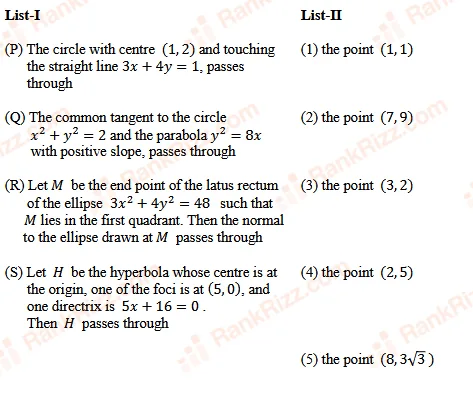
Match each entry in List-I to the correct entry in List-II and choose the correct option.

Figure for JEE Advanced 2026 Mathematics question on Number of solutions in an interval
  1. A

    (P)→\to(3), (Q)→\to(4), (R)→\to(1), (S)→\to(2)

  2. B

    (P)→\to(3), (Q)→\to(2), (R)→\to(1), (S)→\to(5)

  3. C

    (P)→\to(3), (Q)→\to(2), (R)→\to(4), (S)→\to(5)

  4. D

    (P)→\to(4), (Q)→\to(1), (R)→\to(2), (S)→\to(3)

JEE ADVANCED 2026 · PAPER 2Number of solutions in an interval

Question Stem for Question Nos. 15 and 16

Consider the curve C1C_1 given by y=e−xy=e^{-x} for x∈[0,10π]x\in[0,10\pi], and the curve C2C_2 given by y=e−x(sin⁡x+cos⁡x)y=e^{-x}(\sin x+\cos x) for x∈[0,10π]x\in[0,10\pi].

Let nn be the total number of points of intersection of the curves C1C_1 and C2C_2.

Suppose that α1,α2,…,αn∈[0,10π]\alpha_1,\alpha_2,\dots,\alpha_n\in[0,10\pi] are the xx-coordinates of the points of intersection of the curves C1C_1 and C2C_2 such that α1<α2<⋯<αn\alpha_1<\alpha_2<\cdots<\alpha_n.

The value of nn is ___.

JEE ADVANCED 2024 · PAPER 2Number of solutions in an interval

Let f:R→Rf : \mathbb{R} \to \mathbb{R} be a function defined by

f(x)={x2sin⁡(πx2),if x≠0,0,if x=0.f(x) = \begin{cases} x^2 \sin\left(\frac{\pi}{x^2}\right), & \text{if } x \neq 0, \\ 0, & \text{if } x = 0. \end{cases}

Then which of the following statements is TRUE?

  1. A

    f(x)=0f(x) = 0 has infinitely many solutions in the interval [11010,∞)\left[\frac{1}{10^{10}}, \infty\right).

  2. B

    f(x)=0f(x) = 0 has no solutions in the interval [1π,∞)\left[\frac{1}{\pi}, \infty\right).

  3. C

    The set of solutions of f(x)=0f(x) = 0 in the interval (0,11010)\left(0, \frac{1}{10^{10}}\right) is finite.

  4. D

    f(x)=0f(x) = 0 has more than 25 solutions in the interval (1π2,1π)\left(\frac{1}{\pi^2}, \frac{1}{\pi}\right).

JEE ADVANCED 2022 · PAPER 1General and principal solutions

Consider the following lists:

List-IList-II
(I) {x∈[−2π3,2π3]:cos⁡x+sin⁡x=1}\left\{x \in \left[-\frac{2\pi}{3}, \frac{2\pi}{3}\right] : \cos x + \sin x = 1\right\}(P) has two elements
(II) {x∈[−5π18,5π18]:3tan⁡3x=1}\left\{x \in \left[-\frac{5\pi}{18}, \frac{5\pi}{18}\right] : \sqrt{3} \tan 3x = 1\right\}(Q) has three elements
(III) {x∈[−6π5,6π5]:2cos⁡(2x)=3}\left\{x \in \left[-\frac{6\pi}{5}, \frac{6\pi}{5}\right] : 2\cos(2x) = \sqrt{3}\right\}(R) has four elements
(IV) {x∈[−7π4,7π4]:sin⁡x−cos⁡x=1}\left\{x \in \left[-\frac{7\pi}{4}, \frac{7\pi}{4}\right] : \sin x - \cos x = 1\right\}(S) has five elements
(T) has six elements

The correct option is:

  1. A

    (I) →\to (P); (II) →\to (S); (III) →\to (P); (IV) →\to (S)

  2. B

    (I) →\to (P); (II) →\to (P); (III) →\to (T); (IV) →\to (R)

  3. C

    (I) →\to (Q); (II) →\to (P); (III) →\to (T); (IV) →\to (S)

  4. D

    (I) →\to (Q); (II) →\to (S); (III) →\to (P); (IV) →\to (R)

JEE ADVANCED 2018 · PAPER 1Equations with parameters and trigonometric inequalities

Let a, b, c be three non-zero real numbers such that the equation 3acos⁡x+2bsin⁡x=C,X∈[−π2,π2]\sqrt{3}a \cos x+2b \sin x=C,X \in [-\frac{\pi}{2},\frac{\pi}{2}] has two distinct real roots α\alpha and β\beta withα+β=π3\alpha+\beta=\frac{\pi}{3}, then the value of ba\frac{b}{a} is ....... .

JEE ADVANCED 2016 · PAPER 1Equations with parameters and trigonometric inequalities

Let S={xϵ(−π,π):x≠0,±π2}S = \left\{x \epsilon (-\pi, \pi): x \neq 0, \pm \frac{\pi}{2}\right\} The sum of all distinct solutions of the equation 3sec⁡x+cosec⁡x+2(tan⁡x−cot⁡x)=0\sqrt{3} \sec x + \cosec x + 2(\tan x - \cot x) = 0 in the set S is equal to

  1. A

    −7π9-\frac{7 \pi}{9}

  2. B

    −2π9-\frac{2 \pi}{9}

  3. C

    00

  4. D

    5π9\frac{5 \pi}{9}

JEE ADVANCED 2015 · PAPER 1Equations with parameters and trigonometric inequalities

The number of distinct solutions of the equation
54cos⁡22x+cos⁡4x+sin⁡4x+cos⁡6x+sin⁡6x=2\frac{5}{4} \cos^2 2x + \cos^4 x + \sin^4x + \cos^6 x + \sin^6 x = 2
in the interval [0,2π][0, 2\pi] is

JEE ADVANCED 2014 · PAPER 2Equations with parameters and trigonometric inequalities

For x∈(0,π)x \in (0, \pi), the equation sin⁡x+2sin⁡2x−sin⁡3x=3\sin x + 2 \sin 2x - \sin 3x = 3 has

  1. A

    infinitely many solutions

  2. B

    three solutions

  3. C

    one solution

  4. D

    no solution

JEE ADVANCED 2013 · PAPER 1Equations with parameters and trigonometric inequalities

The number of points in (−∞,∞)(-\infty, \infty), for which x2−xsin⁡x−cos⁡x=0,x^2 - x \sin x - \cos x = 0, is

  1. A

    6

  2. B

    4

  3. C

    2

  4. D

    0

JEE ADVANCED 2013 · PAPER 1Equations with parameters and trigonometric inequalities

Let f(x)=xsin⁡πx,x>0f(x) = x \sin \pi x, x > 0 Then for all natural numbers n, f′(x)f'(x) vanishes at

  1. A

    a unique point in the interval (n,n+12)\left(n, n + \frac{1}{2}\right)

  2. B

    a unique point in the interval (n+12,n+1)\left(n + \frac{1}{2}, n + 1\right)

  3. C

    a unique point in the interval (n,n+1)(n, n + 1)

  4. D

    two points in the interval (n,n+1)(n, n + 1)

JEE ADVANCED 2012 · PAPER 1Equations with parameters and trigonometric inequalities

Let θ,ϕ∈[0,2π]\theta, \phi \in [0, 2 \pi] be such that
2cos⁡θ(1−sin⁡ϕ)=sin⁡2θ(tan⁡θ2+cot⁡θ2)cos⁡ϕ−1,tan⁡(2π−θ)>02 \cos \theta (1 - \sin \phi) = \sin^2 \theta \left(\tan \frac{\theta}{2} + \cot \frac{\theta}{2}\right) \cos \phi - 1, \tan(2 \pi - \theta) > 0 and −1<sin⁡θ<−32-1 < \sin \theta < -\frac{\sqrt{3}}{2}. Then ϕ\phi cannot satisfy

  1. A

    0<ϕ<π20 < \phi < \frac{\pi}{2}

  2. B

    π2<ϕ<4π3\frac{\pi}{2} < \phi < \frac{4 \pi}{3}

  3. C

    4π3<ϕ<3π2\frac{4\pi}{3} < \phi < \frac{3 \pi}{2}

  4. D

    3π2<ϕ<2π\frac{3\pi}{2} < \phi < 2 \pi

JEE ADVANCED 2011 · PAPER 1Equations with parameters and trigonometric inequalities

Let P={θ:sin⁡θ−cos⁡θ=2cos⁡θ}P = \left\{\theta : \sin \theta - \cos \theta = \sqrt{2} \cos \theta\right\} and Q={θ:sin⁡θ+cos⁡θ=2sin⁡θ}Q = \left\{\theta : \sin \theta + \cos \theta = \sqrt{2} \sin \theta\right\} be two sets. Then

  1. A

    P⊂QP \subset Q and Q−P≠∅Q - P \neq \varnothing

  2. B

    Q⊄PQ \not \subset P

  3. C

    P⊄QP \not \subset Q

  4. D

    P=QP = Q

JEE ADVANCED 2010 · PAPER 1Equations with parameters and trigonometric inequalities

The numberof values of θ\theta in the interval (−π2,π2)\left(-\frac{\pi}{2}, \frac{\pi}{2}\right) such that θ≠nπ5\theta \neq \frac{n \pi}{5} for n=0,±1,±2n = 0, \pm 1, \pm 2 and tan⁡θ=cot⁡5θ\tan \theta = \cot 5 \theta as well as sin⁡2θ=cos⁡4θ\sin 2 \theta = \cos 4 \theta is

JEE ADVANCED 2010 · PAPER 1Equations with parameters and trigonometric inequalities

The number of all possible values of θ\theta , where 0<θ<π0 < \theta < \pi. for which the system of equations
(y+z)cos⁡3θ=(xyz)sin⁡3θ(y + z) \cos 3 \theta = (xyz) \sin 3\theta
xsin⁡3θ=2cos⁡3θy+2sin⁡3θzx \sin 3 \theta = \frac{2 \cos 3\theta}{y} + \frac{2 \sin 3\theta}{z}
(xyz)sin⁡3θ=(y+2z)cos⁡3θ+ysin⁡3θ(xyz) \sin 3\theta = (y + 2z) \cos 3 \theta + y \sin 3 \theta
have a solution (x0,y0,z0)(x_0, y_0, z_0) with y0z0≤0y_0z_0 \leq 0, is

JEE ADVANCED 2009 · PAPER 1Equations with parameters and trigonometric inequalities

If sin⁡4x2+cos⁡4x3=15\frac{\sin^4x}{2}+\frac{\cos^4x}{3} = \frac{1}{5} then

  1. A

    tan⁡2x=23\tan^2 x = \frac{2}{3}

  2. B

    sin⁡8x8+cos⁡8x27=1125\frac{\sin^8 x}{8}+\frac{\cos^8 x}{27} = \frac{1}{125}

  3. C

    tan⁡2x=13\tan^2 x = \frac{1}{3}

  4. D

    sin⁡8x8+cos⁡8x27=2125\frac{\sin^8 x}{8}+\frac{\cos^8 x}{27} = \frac{2}{125}

JEE ADVANCED 2007 · PAPER 1Equations with parameters and trigonometric inequalities

The number of solutions of the pair of equations
2sin⁡2θ−cos⁡2θ=02 \sin^2 \theta - \cos 2 \theta = 0
2cos⁡2θ−3sin⁡θ=02 \cos^2 \theta - 3 \sin \theta = 0
in the interval [0,2π][0, 2 \pi] is

  1. A

    zero

  2. B

    one

  3. C

    two

  4. D

    four