RankRizz

Applications of Derivatives — JEE Advanced Previous Year Questions

Applications of Derivatives has been asked in 18 of the 20 JEE Advanced years from 2007 to 2026: 45 questions in all. In 2026 it averaged 0.5 questions per paper (1 across 2 papers), 2.9% of Maths questions, down from 3.1% in 2025. Across the last 20 papers it carried 4.8% of Maths questions. By type: 22 single-correct, 14 multiple-correct and 9 numerical. Of the 45 with a difficulty tag, 9% are easy, 69% medium and 22% hard. Most asked: Optimization word and geometry problems (21, 47%), Monotonicity and intervals of increase/decrease (12, 27%) and Rolle's theorem and Lagrange's mean value theorem (4, 9%).

DATA UPDATED

Questions

45

Distinct ideas

8

Share of marks

4.8%

Difficulty

MEDIUM

Applications of Derivatives weightage, year by year

The share of each year’s Maths questions that came from Applications of Derivatives, counted from the 19 papers we hold for the last 10 years, and paper by paper inside a year.

Falling: 3.0% of Maths questions in 2024–2026, down from 5.6% in 2017–2023. Its heaviest year was 2017, at 16.7%. Not asked at all in 2023.

Applications of Derivatives questions per year, per paper, and as a share of Maths questions
YEARQSPER PAPERSHARE OF MATHSCHANGE
20261 / 340.52.9%−0.2 pts
20251 / 320.53.1%+0.2 pts
20241 / 340.52.9%+2.9 pts
20230 / 340.00.0%−2.8 pts
20221 / 360.52.8%+0.2 pts
20211 / 380.52.6%−3.0 pts
20202 / 361.05.6%level
20192 / 361.05.6%level
20181 / 181.05.6%−11.1 pts
20176 / 363.016.7%—

“QS” is Applications of Derivatives questions out of all Maths questions that year; “per paper” is that count over the year’s papers, and “change” is the share against the year before. A year with more sittings asks more questions, which is why the share, not the count, is the number to compare.

The ideas inside Applications of Derivatives

A chapter is not one subject — it is a handful of procedures the examiner reuses. These are the ones Applications of Derivatives questions actually test.

01Rate of change of quantitiesset 1×
02Tangents and normals to curvesset 1×
03Angle between curves and shortest distanceNot set in Advanced
04Monotonicity and intervals of increase/decreaseset 12×
05Monotonicity for inequalities and number of rootsset 3×
06Local maxima and minima and concavityset 1×
07Absolute maxima and minimaset 2×
08Optimization word and geometry problemsset 21×
09Rolle's theorem and Lagrange's mean value theoremset 4×

All 45 Applications of Derivatives questions, by topic

Every JEE Advanced Applications of Derivatives question we hold, newest first inside each topic. Open one for its options, answer key and solution.

Optimization word and geometry problems21 QUESTIONS

  1. Consider all rectangles lying in the region \(x, y) ε R × R: 0 ≤ x ≤ π/2 and 0 ≤ y ≤ 2 sin (2x) \ and having one side on the x-axis. The…2020 · PAPER 1
  2. Let f(x) = (sin π x)/(x²), x > 0. Let x₁ < x₂ < x₃ <... < xₙ <... be all the points of local maximum off and y₁ < y₂ < y₃ <... < yₙ <... be…2019 · PAPER 2
  3. Let f: R → R be given by f(x) = (x - 1)(x - 2)(x - 5). Define F(x) = ∫₀^(x) f(t) dt, x > 0. Then which of the following options is/are…2019 · PAPER 2
  4. If f(x) =, then2017 · PAPER 2
  5. The least value of α ∈ R for which 4 α x² + 1/x ≥ 1, for all x > 0, is2016 · PAPER 1
  6. Let f: R → (0, ∞) and g: R → R be be twice differentiable functions such that f'' and g'' are continuous functions on R. Suppose f'(2) =…2016 · PAPER 2
  7. A cylindrical container is to be made from certain solid material with the following constraints: It has a fixed inner volume of V mm³, has…2015 · PAPER 1
  8. Let a ∈ R and let f: R → R be given by f(x) = x⁵ - 5x + a Then2014 · PAPER 1
  9. The function f(x) = 2 x + x + 2 - x + 2 - 2 x has a local minimum or a local maximum at x =2013 · PAPER 2
  10. Which of the following is true for 0 < x < 1?2013 · PAPER 2
  11. A rectangular sheet of fixed perimeter with sides having their lengths in the ratio 8: 15 is converted into an open rectangular box by…2013 · PAPER 1
  12. If the function e^(-x) f(x) assumes its minimum in the interval [0, 1] at x = 1/4 which of the following is true ?2013 · PAPER 2
  13. Consider the statements: P: There exists some x ∈ IR such that f(x) + 2x = 2(1 + x²) Q: There exists some x ∈ IR such that 2f(x) + 1 = 2x(1…2012 · PAPER 2
  14. Let f: IR → IR be defined as f(x) = x + x² - 1. The total numberof points at which fattains either a local maximum or a local minimum is2012 · PAPER 1
  15. If f(x) = ∫₀^(x) e^(t²)(t - 2)(t - 3) dt for all x ∈ (0, ∞), then2012 · PAPER 2
  16. Let p(x) be a real polynomial of least degree which has a local maximum at x = 1 and local minimum at x = 3. If p(1) = 6 and p(3) = 2, then…2012 · PAPER 1
  17. Let f be a function defined on R (the set of all real numbers) such that f'(x) = 2010(x-2009)(x-2010)²(x-2011)³(x-2012)⁴, for all x ∈ R. If…2010 · PAPER 2
  18. Let f, g and h be real-valued functions defined on the interval [0,1] by f(x) = e^(x²) + e^(-x²), g(x) = xe^(x²) + e^(-x²) and h(x) = x²…2010 · PAPER 1
  19. The maximum value of the function f(x) = 2x³ - 15x² + 36x - 48 on the set A = \x x² + 20 ≤ 9x \ is2009 · PAPER 2
  20. Let p(x) be a polynomial of degree 4 having extremumat x = 1, 2 and lim _(x → 0) (1 + (p(x))/(x²)) = 2. Then the value of p(2) is2009 · PAPER 2
  21. The total number of local maxima and local minima of the function f(x) = (2 + x)³, -3<x ≤ -1 ^(2/3) -1 < x < 2 is2008 · PAPER 1

FREE PDF

Applications of Derivatives JEE Advanced PYQs with answer key

All 45 questions on A4, by topic, with the answer key at the end. No sign-up, no email: your browser saves it as a PDF.

Download free PDF

UNIQUE CONCEPTS

Applications of Derivatives: one question per idea

9 ideas, each with the latest past question that tested it, drawn from 295 JEE Main and Advanced questions.

Applications of Derivatives Unique Concepts sheet →

JEE MAIN

Applications of Derivatives in JEE Main

JEE Main has set 250 Applications of Derivatives questions, 2004–2026.

Applications of Derivatives JEE Main PYQs →

Applications of Derivatives: quick answers

Is Applications of Derivatives asked every year in JEE Advanced?

Not every year. It has been asked in 18 of the 20 JEE Advanced years from 2007 to 2026; the years without a Applications of Derivatives question were 2011 and 2023.

Which Applications of Derivatives topic is asked most in JEE Advanced?

Optimization word and geometry problems: 21 of the 45 questions (47%). Next come Monotonicity and intervals of increase/decrease (12) and Rolle's theorem and Lagrange's mean value theorem (4).

What share of Maths questions does Applications of Derivatives carry in JEE Advanced?

About 4.8% of Maths questions across the last 20 papers. In 2026 it was 2.9% (1 of 34 Maths questions).

When was Applications of Derivatives last asked in JEE Advanced?

In JEE Advanced 2026 Paper 1, the latest sitting with a Applications of Derivatives question.

How many Applications of Derivatives questions has JEE Advanced asked?

45 from 2007 to 2026, across 8 topics. Every one is listed on this page by topic and links to its own page, with the answer key and solution wherever we have them. Free, no sign-up.

Every Applications of Derivatives question

1–20 OF 45 · NEWEST FIRST

JEE ADVANCED 2026 · PAPER 1Local maxima and minima and concavity

Consider the function f:(0,∞)→(−∞,∞)f:(0,\infty)\to(-\infty,\infty) given by

f(x)=x log⁡e(x)−x+1.f(x)=\sqrt{x}\,\log_e(x)-x+1.

Then which one of the following statements is TRUE?

  1. A

    The derivative of the function ff is decreasing in the interval (0,1)(0,1)

  2. B

    The function ff has a local maximum at some point a∈(0,∞)a\in(0,\infty)

  3. C

    The function ff has a local minimum at some point b∈(0,∞)b\in(0,\infty)

  4. D

    The function ff has NEITHER a point of local maximum NOR a point of local minimum in the interval (0,∞)(0,\infty)
JEE ADVANCED 2025 · PAPER 2Absolute maxima and minima

Let R\mathbb{R} denote the set of all real numbers. Let f:R→Rf: \mathbb{R} \to \mathbb{R} be defined by

f(x)={6x+sin⁡x2x+sin⁡xif x≠0,73if x=0.f(x) = \begin{cases} \frac{6x + \sin x}{2x + \sin x} & \text{if } x \neq 0, \\ \frac{7}{3} & \text{if } x = 0. \end{cases}

Then which of the following statements is (are) TRUE?

  1. A

    The point x=0x = 0 is a point of local maxima of ff

  2. B

    The point x=0x = 0 is a point of local minima of ff

  3. C

    Number of points of local maxima of ff in the interval [π,6π][\pi, 6\pi] is 3

  4. D

    Number of points of local minima of ff in the interval [2π,4π][2\pi, 4\pi] is 1

JEE ADVANCED 2024 · PAPER 2Monotonicity and intervals of increase/decrease

Let the function f:R→Rf : \mathbb{R} \to \mathbb{R} be defined by

f(x)=sin⁡xeπx⋅(x2023+2024x+2025)(x2−x+3)+2eπx⋅(x2023+2024x+2025)(x2−x+3)f(x) = \frac{\sin x}{e^{\pi x}} \cdot \frac{(x^{2023} + 2024x + 2025)}{(x^2 - x + 3)} + \frac{2}{e^{\pi x}} \cdot \frac{(x^{2023} + 2024x + 2025)}{(x^2 - x + 3)}.

Then the number of solutions of f(x)=0f(x) = 0 in R\mathbb{R} is ______.

JEE ADVANCED 2022 · PAPER 2Absolute maxima and minima

Let α=∑k=1∞sin⁡2k(π6)\alpha = \displaystyle\sum_{k=1}^{\infty} \sin^{2k}\left(\dfrac{\pi}{6}\right).

Let g:[0,1]→Rg : [0, 1] \to \mathbb{R} be the function defined by g(x)=2αx+2α(1−x)g(x) = 2^{\alpha x} + 2^{\alpha(1-x)}.

Then, which of the following statements is False?

  1. A

    The minimum value of g(x)g(x) is 27/62^{7/6}

  2. B

    The maximum value of g(x)g(x) is 1+21/31 + 2^{1/3}

  3. C

    The function g(x)g(x) attains its maximum at more than one point

  4. D

    The function g(x)g(x) attains its minimum at more than one point

JEE ADVANCED 2021 · PAPER 1Monotonicity and intervals of increase/decrease

Let f:R→Rf : R \rightarrow R be defined by
f(x)=x2−3x−6x2+2x+4f(x) = \frac{x^2 - 3x - 6}{x^2 + 2x + 4}
Then which of the following statements is (are) TRUE?

  1. A

    f is decreasing in the interval (−2, −1)

  2. B

    f is increasing in the interval (1, 2)

  3. C

    f is onto

  4. D

    Range of f is [−32,2]\left[-\frac{3}{2}, 2\right]

JEE ADVANCED 2020 · PAPER 1Optimization word and geometry problems

Consider all rectangles lying in the region

{(x,y)ϵR×R:0≤x≤π2and0≤y≤2sin⁡(2x)}\left\{(x, y) \epsilon R \times R : 0 \leq x \leq \frac{\pi}{2} and 0 \leq y \leq 2\sin(2x)\right\}

and having one side on the xx-axis. The area of the rectangle which has the maximum perimeter among all such rectangles, is

  1. A

    3π2\frac{3\pi}{2}

  2. B

    π\pi

  3. C

    π23\frac{\pi}{2\sqrt{3}}

  4. D

    π32\frac{\pi\sqrt{3}}{2}

JEE ADVANCED 2020 · PAPER 1Rolle's theorem and Lagrange's mean value theorem

For a polynomial g(x)g(x) with real coefficients, let mg denote the number of distinct real roots of
g(x)g(x). Suppose 𝑆 is the set of polynomials with real coefficients defined by

S={(x2−1)2(a0+a1x+a2x2+a3x3)∶a0,a1,a2,a3ϵR}S = \left\{(x^{2} − 1)^{2}(a_{0} + a_{1}x + a_{2}x^{2} + a_{3}x^{3}) ∶ a_{0}, a_{1}, a_{2}, a_{3} \epsilon R\right\}.

For a polynomial f, let f′f{'} and f′′f {'}{'} denote its first and second order derivatives, respectively. Then the minimum possible value of (mf′+mf′′)(m_{f{'}} + m_{f{'}{'}}), where fϵSf \epsilon S, is _____

JEE ADVANCED 2019 · PAPER 2Optimization word and geometry problems

Let
f(x)=sin⁡πxx2,x>0.f(x) = \frac{\sin \pi x}{x^2}, x > 0.
Let x1<x2<x3<...<xn<...x_1 < x_2 < x_3 < ... < x_n < ... be all the points of local maximum off
and y1<y2<y3<...<yn<...y_1 < y_2 < y_3 < ... < y_n < ... be all the points of local minimum off.
Then which of the following options is/are correct?

  1. A

    x1<y1x_1 < y_1

  2. B

    xn+1−xn>2x_{n + 1} - x_n > 2 for every n

  3. C

    xn∈(2n,2n+12)x_n \in \left(2n, 2n + \frac{1}{2}\right) for every n

  4. D

    ∣xn−yn∣>1|x_n - y_n| > 1 for every n

JEE ADVANCED 2019 · PAPER 2Optimization word and geometry problems

Let f:R→Rf : R \rightarrow R be given by f(x)=(x−1)(x−2)(x−5).f(x) = (x - 1)(x - 2)(x - 5). Define
F(x)=∫0xf(t)dt,x>0.F(x) = \int_{0}^{x} f(t) dt, x > 0.
Then which of the following options is/are correct?

  1. A

    F has local minimum at x = 1

  2. B

    F has local maximum at x = 2

  3. C

    F has two local maxima and one local minimum in (0,∞)(0, \infty)

  4. D

    F(x)≠0F(x) \neq 0 for all x∈(0,5)x \in (0,5)

JEE ADVANCED 2018 · PAPER 1Rolle's theorem and Lagrange's mean value theorem

For every twice differentiable function f:R→[−2,2]f : R \rightarrow [-2, 2] with (f(0))2+(f′(0))2=85(f(0))^{2}+(f'(0))^{2}=85 which of the following statement(s) is (are) TRUE?

  1. A

    There exist r,s \in R where r<s such that 𝑓 is one-one on the open interval (r, s)

  2. B

    There exists X0∈(−4,0)X_{0} \in (-4,0) such that∣(f′(x0))∣≤1\mid (f'(x_{0})) \mid \leq 1

  3. C

    lim⁡x→∞f(x)=1\lim_{x\rightarrow\infty } f(x) =1

  4. D

    There exists α\alpha ∈\in (-4,4) such that f(α)+f′′(α)=0f(\alpha)+f''(\alpha) = 0 and f′(α)≠0f'(\alpha) \neq 0

JEE ADVANCED 2017 · PAPER 2Rolle's theorem and Lagrange's mean value theorem

If f:R→Rf:R\rightarrow Ris a twice differentiable function such that f′′(x)>0f''(x)>0 for all xϵRx\epsilon R, and f(12)=12,f(1)=1f(\frac{1}{2})=\frac{1}{2},f(1)=1, then

  1. A

    f′(1)≤0f'(1)\leq0

  2. B

    0<f′(1)≤120<f'(1)\leq\frac{1}{2}

  3. C

    12<f′(1)≤ 1\frac{1}{2}<f'(1)\leq\ 1

  4. D

    f′(1)>1f'(1)>1

JEE ADVANCED 2017 · PAPER 2Monotonicity and intervals of increase/decrease

If f:R→Rf:R\rightarrow R is a differentiable function such that f′(x)>2f(x)f'(x)>2f(x) for all xϵRx\epsilon R, and f(0)=1f(0)=1, then

  1. A

    f(x)f(x) is increasing in (0,∞)(0,\infty)

  2. B

    f(x)f(x) is decreasing in (0,∞)(0,\infty)

  3. C

    f(x)>e2xf(x)>e^{2x} in (0,∞)(0,\infty)

  4. D

    f′(x)<e2xf'(x)<e^{2x} in (0,∞)(0,\infty)

JEE ADVANCED 2017 · PAPER 2Optimization word and geometry problems

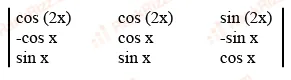
If f(x) = 

Figure for JEE Advanced 2017 Mathematics question on Optimization word and geometry problems

, then

  1. A

    f'(x) = 0 at exactly three points in −π,π-\pi,\pi

  2. B

    f'(x) = 0 at more than three points in −π,π-\pi,\pi

  3. C

    f(x) attains its maximum at x=0

  4. D

    f(x) attains its minimum at x=0

JEE ADVANCED 2017 · PAPER 1Monotonicity and intervals of increase/decrease

Which of the following options is the only CORRECT combination?

  1. A

    (I) (i) (P)

  2. B

    (II) (ii) (Q)

  3. C

    (III) (iii) (R)

  4. D

    (IV) (iv) (S)

JEE ADVANCED 2017 · PAPER 1Monotonicity and intervals of increase/decrease

Which of the following options is the only CORRECT combination?

  1. A

    (I) (ii) (R)

  2. B

    (II) (iii) (S)

  3. C

    (III) (iv) (P)

  4. D

    (IV) (i) (S)

JEE ADVANCED 2017 · PAPER 1Monotonicity and intervals of increase/decrease

Which of the following options is the only INCORRECT combination?

  1. A

    (I) (iii) (P)

  2. B

    (II) (iv) (Q)

  3. C

    (III) (i) (R)

  4. D

    (II) (iii) (P)

JEE ADVANCED 2016 · PAPER 1Optimization word and geometry problems

The least value of α∈R\alpha \in R for which 4αx2+1x≥14 \alpha x^2 + \frac{1}{x} \geq 1, for all x > 0, is

  1. A

    164\frac{1}{64}

  2. B

    132\frac{1}{32}

  3. C

    127\frac{1}{27}

  4. D

    125\frac{1}{25}

JEE ADVANCED 2016 · PAPER 2Optimization word and geometry problems

Let f:R→(0,∞)f : R \rightarrow (0, \infty) and g:R→Rg : R \rightarrow R be be twice differentiable functions such that f′′f'' and g′′g'' are continuous functions on R. Suppose f′(2)=g(2)=0,f′′(2)≠0f'(2) = g(2) = 0, f''(2) \neq 0 and g′(2)≠0g'(2) \neq 0. If lim⁡x→2f(x)g(x)f′(x)g′(x)=1\lim_{x \rightarrow 2}\frac{f(x)g(x)}{f'(x)g'(x)} = 1, then

  1. A

    f has a local minimum at x = 2

  2. B

    f has a local maximum at x = 2

  3. C

    f′′(2)>f(2)f''(2) > f(2)

  4. D

    f(x)−f′′(x)=0f(x) - f''(x) = 0 for at least one xϵRx \epsilon R.

JEE ADVANCED 2015 · PAPER 1Optimization word and geometry problems

A cylindrical container is to be made from certain solid material with the following constraints: It has a fixed inner volume of Vmm3V mm^3, has a 2 mm thick solid wall and is open at the top. The bottom of the container is a solid circular disc of thickness 2 mm and is of radius equal to the outer radius of the container. If the volume of the material used to make the container is minimum when the inner radius of the container is 10 mm, then the value of V250π\frac{V}{250 \pi} is

JEE ADVANCED 2015 · PAPER 2Rolle's theorem and Lagrange's mean value theorem

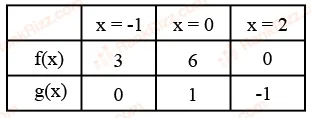
Let f,g:[−1,2]→Rf,g:[-1, 2] \rightarrow R be continuous functions which are twice differentiable on the interval (-1, 2). Let the valuesof f and g at the points —1, 0 and 2 be as given in the following table:

Figure for JEE Advanced 2015 Mathematics question on Rolle's theorem and Lagrange's mean value theorem


In each of the intervals (-1,0) and (0, 2) the function (f−3g)"(f - 3g)" never vanishes. Then the correct statement(s) is(are)

  1. A

    f′(x)−3g′(x)=0f'(x) - 3g'(x) = 0 has exactly three solutions in (−1,0)∪(0,2)(-1, 0) \cup (0, 2)

  2. B

    f′(x)−3g′(x)=0f'(x) - 3g'(x) = 0 has exactly one solution in (-1, 0)

  3. C

    f′(x)−3g′(x)=0f'(x) - 3g'(x) = 0 has exactly one solution in (0, 2)

  4. D

    f′(x)−3g′(x)=0f'(x) - 3g'(x) = 0 has exactly two solutions in (-1, 0) and exactly two solutions in (0, 2)