RankRizz

Straight Lines — JEE Advanced Previous Year Questions

Straight Lines has been asked in 7 of the 20 JEE Advanced years from 2007 to 2026: 10 questions in all. It was not set in any of the 2 2026 papers, after 3.1% of Maths questions in 2025. Across the last 20 papers it carried 0.3% of Maths questions. By type: 7 single-correct, 2 numerical and 1 multiple-correct. Of the 10 with a difficulty tag, 20% are easy, 60% medium and 20% hard. Most asked: Locus problems in coordinate geometry (2, 20%), Area of triangle and collinearity (1, 10%) and Centroid, incentre, circumcentre and orthocentre (1, 10%).

DATA UPDATED

Questions

10

Distinct ideas

9

Share of marks

0.3%

Difficulty

MEDIUM

Straight Lines weightage, year by year

The share of each year’s Maths questions that came from Straight Lines, counted from the 19 papers we hold for the last 10 years, and paper by paper inside a year.

Rising: 1.0% of Maths questions in 2024–2026, up from 0.0% in 2017–2023. Its heaviest year was 2025, at 3.1%. Not asked at all in 2017, 2018, 2019, 2020, 2021, 2022, 2023, 2024, 2026.

Straight Lines questions per year, per paper, and as a share of Maths questions
YEARQSPER PAPERSHARE OF MATHSCHANGE
20260 / 340.00.0%−3.1 pts
20251 / 320.53.1%+3.1 pts
20240 / 340.00.0%level
20230 / 340.00.0%level
20220 / 360.00.0%level
20210 / 380.00.0%level
20200 / 360.00.0%level
20190 / 360.00.0%level
20180 / 180.00.0%level
20170 / 360.00.0%—

“QS” is Straight Lines questions out of all Maths questions that year; “per paper” is that count over the year’s papers, and “change” is the share against the year before. A year with more sittings asks more questions, which is why the share, not the count, is the number to compare.

The ideas inside Straight Lines

A chapter is not one subject — it is a handful of procedures the examiner reuses. These are the ones Straight Lines questions actually test.

01Distance, section formula and shifting of originNot set in Advanced
02Area of triangle and collinearityset 1×
03Centroid, incentre, circumcentre and orthocentreset 1×
04Equations of a line in various formsset 1×
05Angle between lines, parallel and perpendicular linesset 1×
06Distance from a line, foot of perpendicular and imageset 1×
07Position of a point relative to linesNot set in Advanced
08Concurrency and family of linesset 1×
09Angle bisectorsset 1×
10Pair of straight linesset 1×
11Locus problems in coordinate geometryset 2×

All 10 Straight Lines questions, by topic

Every JEE Advanced Straight Lines question we hold, newest first inside each topic. Open one for its options, answer key and solution.

FREE PDF

Straight Lines JEE Advanced PYQs with answer key

All 10 questions on A4, by topic, with the answer key at the end. No sign-up, no email: your browser saves it as a PDF.

Download free PDF

UNIQUE CONCEPTS

Straight Lines: one question per idea

11 ideas, each with the latest past question that tested it, drawn from 216 JEE Main and Advanced questions.

Straight Lines Unique Concepts sheet →

JEE MAIN

Straight Lines in JEE Main

JEE Main has set 206 Straight Lines questions, 2004–2026.

Straight Lines JEE Main PYQs →

Straight Lines: quick answers

Is Straight Lines asked every year in JEE Advanced?

Not every year. It has been asked in 7 of the 20 JEE Advanced years from 2007 to 2026; it was missing in 13 of them, most recently 2026.

Which Straight Lines topic is asked most in JEE Advanced?

Locus problems in coordinate geometry: 2 of the 10 questions (20%). Next come Area of triangle and collinearity (1) and Centroid, incentre, circumcentre and orthocentre (1).

What share of Maths questions does Straight Lines carry in JEE Advanced?

About 0.3% of Maths questions across the last 20 papers. In 2026 it was 0.0% (0 of 34 Maths questions).

When was Straight Lines last asked in JEE Advanced?

In JEE Advanced 2025 Paper 2, the latest sitting with a Straight Lines question. It has not been set since 2025, though the bank holds JEE Advanced papers up to 2026.

How many Straight Lines questions has JEE Advanced asked?

10 from 2007 to 2025, across 9 topics. Every one is listed on this page by topic and links to its own page, with the answer key and solution wherever we have them. Free, no sign-up.

Every Straight Lines question

1–10 OF 10 · NEWEST FIRST

JEE ADVANCED 2025 · PAPER 2Locus problems in coordinate geometry

Let SS denote the locus of the point of intersection of the pair of lines

4x−3y=12α4x - 3y = 12\alpha,

4αx+3αy=124\alpha x + 3\alpha y = 12,

where α\alpha varies over the set of non-zero real numbers. Let TT be the tangent to SS passing through the points (p,0)(p, 0) and (0,q)(0, q), q>0q > 0, and parallel to the line 4x−32y=04x - \frac{3}{\sqrt{2}} y = 0.

Then the value of pqpq is

  1. A

    −62-6\sqrt{2}

  2. B

    −32-3\sqrt{2}

  3. C

    −92-9\sqrt{2}

  4. D

    −122-12\sqrt{2}

JEE ADVANCED 2014 · PAPER 1Distance from a line, foot of perpendicular and image

For a point P in the plane, let d1(P)d_1 (P) and d2(P)d_2 (P) be the distances of the point P from the lines x − y = 0 and x + y = 0 respectively. The area of the region R consisting of all points P lying in the first quadrant of the plane and satisfying 2≤d1(P)+d2(P)≤4,2 \leq d_1 (P) + d_2 (P) \leq 4, is

JEE ADVANCED 2013 · PAPER 1Equations of a line in various forms

For a > b > c > 0, the distance between (1, 1) and the point of intersection of the lines ax + by + c = 0 and bx + ay + c = 0 is less than 222 \sqrt 2. Then

  1. A

    a + b - c > 0

  2. B

    a - b + c < 0

  3. C

    a - b + c > 0

  4. D

    a + b - c < 0

JEE ADVANCED 2011 · PAPER 1Angle between lines, parallel and perpendicular lines

A straight line L through the point (3, -2) is inclined at an angle 60∘60^\circ to the line 3x+y=1\sqrt{3} x + y = 1. If L also intersects the x-axis, then the equation of L is

  1. A

    y+3x+2−33=0y + \sqrt{3} x + 2 - 3 \sqrt{3} = 0

  2. B

    y−3x+2+33=0y - \sqrt{3} x + 2 + 3 \sqrt{3} = 0

  3. C

    3y−x+3+23=0\sqrt{3} y - x + 3 + 2 \sqrt{3} = 0

  4. D

    3y+x−3+23=0\sqrt{3} y + x - 3 + 2 \sqrt{3} = 0

JEE ADVANCED 2009 · PAPER 2Locus problems in coordinate geometry

The locus of the orthocentre of the triangle formed by the lines
(1 + p)x - py + p(1 + p) = 0,
(1 + q)x - qy + q(1 + q) = 0,
and y = 0, where p≠qp \neq q, is

  1. A

    a hyperbola

  2. B

    a parabola

  3. C

    a nellipse

  4. D

    a straight line

JEE ADVANCED 2008 · PAPER 1Pair of straight lines

Let a and b be non-zero real numbers. Then, the equation
(ax2+by2+c)(x2−5xy+6y2)=0(ax^2 + by^2 + c)(x^2 - 5xy + 6y^2) = 0
represents

  1. A

    four straight lines, when c = 0 and a, b are of the same sign

  2. B

    two straight lines and a circle, when a = b, and c is of sign opposite to that of a

  3. C

    two straight lines and a hyperbola, when a and b are of the same sign and c is of sign opposite to that of a

  4. D

    a circle and an ellipse, when a and b are of the same sign and is of sign opposite to that of a

JEE ADVANCED 2008 · PAPER 2Area of triangle and collinearity

Consider three points P=(−sin⁡(β−α),−cos⁡β),Q=(cos⁡(β−α),sin⁡β)P = (-\sin (\beta - \alpha), -\cos \beta), Q = (\cos(\beta - \alpha), \sin \beta) and R=(cos⁡(β−α+θ),sin⁡(β−θ))R = (\cos(\beta - \alpha + \theta), \sin(\beta - \theta)), where 0<α,β,θ<π40 < \alpha, \beta, \theta < \frac{\pi}{4}. Then,

  1. A

    P lies on the line segment RQ

  2. B

    Q lies on the line segment PR

  3. C

    R lies on the line segment QP

  4. D

    P, Q, R are non-collinear

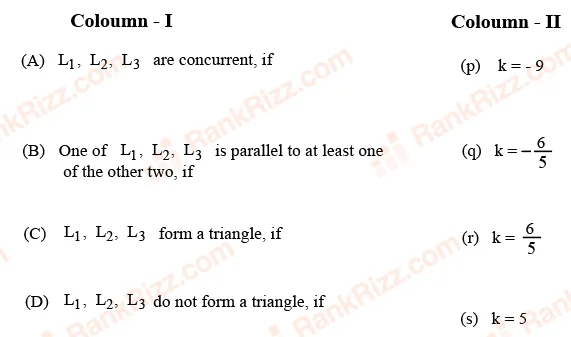
JEE ADVANCED 2008 · PAPER 2Concurrency and family of lines

Consider the lines given by
L1:x+3y−5=0L_1: x + 3y - 5 = 0
L2:3x−ky−1=0L_2: 3x - ky - 1 = 0
L3:5x+2y−12=0L_3: 5x + 2y - 12 = 0
Match the Statements / Expressions in Column I with the Statements / Expressions in Column II and indicate your answer by darkening the appropriate bubbles in the 4×44 \times 4 matrix given in the ORS.

Figure for JEE Advanced 2008 Mathematics question on Concurrency and family of lines
JEE ADVANCED 2007 · PAPER 2Centroid, incentre, circumcentre and orthocentre

Let O(0, 0), P(3, 4), Q(6, 0) be the vertices of the triangle OPQ. The point R inside the triangle OPQ is such that the triangles OPR, PQR, OQR are of equal area. The coordinates of R are

  1. A

    (43,3)\left(\frac{4}{3}, 3\right)

  2. B

    (3,23)\left(3, \frac{2}{3}\right)

  3. C

    (3,43)\left(3, \frac{4}{3}\right)

  4. D

    (43,23)\left(\frac{4}{3}, \frac{2}{3}\right)

JEE ADVANCED 2007 · PAPER 2Angle bisectors

Lines L1:y−x=0L_1 : y - x = 0 and L2:2x+y=0L_2 : 2x + y = 0 intersect the line L3:y+2=0L_3 : y + 2 = 0 at P and Q, respectively. The bisector of the acute angle between L1L_1 and L2L_2 intersects L3L_3 at R.
STATEMENT-1: The ratio PR : RQ equals 22:5.2\sqrt{2} : \sqrt{5}.
because
STATEMENT-2: In any triangle, bisector of an angle divides the triangle into two similar triangles.

  1. A

    Statement-1 is True, Statement-2 is True; Statement-2 is a correct explanation for Statement-1

  2. B

    Statement-1 is True, Statement-2 is True; Statement-2 is NOT a correct explanation for Statement-1

  3. C

    Statement-1 is True, Statement-2 is False

  4. D

    Statement-1 is False, Statement-2 is True