RankRizz

Functions — JEE Advanced Previous Year Questions

Functions has been asked in 12 of the 20 JEE Advanced years from 2007 to 2026: 20 questions in all. In 2026 it averaged 0.5 questions per paper (1 across 2 papers), 2.9% of Maths questions, down from 6.3% in 2025. Across the last 20 papers it carried 2.8% of Maths questions. By type: 7 numerical, 7 multiple-correct, 5 single-correct and 1 match-the-list. Of the 20 with a difficulty tag, 10% are easy, 50% medium and 40% hard. Most asked: Composite functions (5, 25%), One-one, onto functions and counting functions (4, 20%) and Functional equations (4, 20%).

DATA UPDATED

Questions

20

Distinct ideas

7

Share of marks

2.8%

Difficulty

HARD

Functions weightage, year by year

The share of each year’s Maths questions that came from Functions, counted from the 19 papers we hold for the last 10 years, and paper by paper inside a year.

Rising: 4.0% of Maths questions in 2024–2026, up from 2.6% in 2017–2023. Its heaviest year was 2020, at 11.1%. Not asked at all in 2017, 2018, 2019, 2021.

Functions questions per year, per paper, and as a share of Maths questions
YEARQSPER PAPERSHARE OF MATHSCHANGE
20261 / 340.52.9%−3.4 pts
20252 / 321.06.3%+3.4 pts
20241 / 340.52.9%level
20231 / 340.52.9%+0.1 pts
20221 / 360.52.8%+2.8 pts
20210 / 380.00.0%−11.1 pts
20204 / 362.011.1%+11.1 pts
20190 / 360.00.0%level
20180 / 180.00.0%level
20170 / 360.00.0%—

“QS” is Functions questions out of all Maths questions that year; “per paper” is that count over the year’s papers, and “change” is the share against the year before. A year with more sittings asks more questions, which is why the share, not the count, is the number to compare.

The ideas inside Functions

A chapter is not one subject — it is a handful of procedures the examiner reuses. These are the ones Functions questions actually test.

01Domain of real functionsset 1×
02Range of real functionsset 2×
03One-one, onto functions and counting functionsset 4×
04Composite functionsset 5×
05Inverse functionsset 2×
06Even, odd and periodic functionsset 2×
07Greatest integer, fractional part, modulus and signum functionsNot set in Advanced
08Functional equationsset 4×

All 20 Functions questions, by topic

Every JEE Advanced Functions question we hold, newest first inside each topic. Open one for its options, answer key and solution.

FREE PDF

Functions JEE Advanced PYQs with answer key

All 20 questions on A4, by topic, with the answer key at the end. No sign-up, no email: your browser saves it as a PDF.

Download free PDF

UNIQUE CONCEPTS

Functions: one question per idea

8 ideas, each with the latest past question that tested it, drawn from 180 JEE Main and Advanced questions.

Functions Unique Concepts sheet →

JEE MAIN

Functions in JEE Main

JEE Main has set 160 Functions questions, 2004–2026.

Functions JEE Main PYQs →

Functions: quick answers

Is Functions asked every year in JEE Advanced?

Not every year. It has been asked in 12 of the 20 JEE Advanced years from 2007 to 2026; the years without a Functions question were 2007, 2008, 2013, 2016, 2017, 2018, 2019 and 2021.

Which Functions topic is asked most in JEE Advanced?

Composite functions: 5 of the 20 questions (25%). Next come One-one, onto functions and counting functions (4) and Functional equations (4).

What share of Maths questions does Functions carry in JEE Advanced?

About 2.8% of Maths questions across the last 20 papers. In 2026 it was 2.9% (1 of 34 Maths questions).

When was Functions last asked in JEE Advanced?

In JEE Advanced 2026 Paper 2, the latest sitting with a Functions question.

How many Functions questions has JEE Advanced asked?

20 from 2009 to 2026, across 7 topics. Every one is listed on this page by topic and links to its own page, with the answer key and solution wherever we have them. Free, no sign-up.

Every Functions question

1–20 OF 20 · NEWEST FIRST

JEE ADVANCED 2026 · PAPER 2Composite functions

Let N\mathbb{N} denote the set of all positive integers. Consider the sets

A={1,2,3,4,5}andB={1,2,3,4,5,6,7}.A=\{1,2,3,4,5\}\quad\text{and}\quad B=\{1,2,3,4,5,6,7\}.

Let SS be the set of all functions f:A→Bf:A\to B such that f(2)≠2f(2)\neq 2 and f(4)≠4f(4)\neq 4. Consider the set

T={f∈S:there exists a function g:B→N such that g(f(x))=2x for all x∈A}.T=\big\{f\in S:\text{there exists a function }g:B\to\mathbb{N}\text{ such that }g\big(f(x)\big)=2^x\text{ for all }x\in A\big\}.

Then the number of elements in the set TT is ___.

JEE ADVANCED 2025 · PAPER 1Composite functions

Let N\mathbb{N} denote the set of all natural numbers, and Z\mathbb{Z} denote the set of all integers. Consider the functions f:N→Zf: \mathbb{N} \to \mathbb{Z} and g:Z→Ng: \mathbb{Z} \to \mathbb{N} defined by

f(n)={(n+1)/2if n is odd,(4−n)/2if n is even,f(n) = \begin{cases} (n+1)/2 & \text{if } n \text{ is odd}, \\ (4-n)/2 & \text{if } n \text{ is even}, \end{cases}

and

g(n)={3+2nif n≥0,−2nif n<0.g(n) = \begin{cases} 3 + 2n & \text{if } n \geq 0, \\ -2n & \text{if } n < 0. \end{cases}

Define (g∘f)(n)=g(f(n))(g \circ f)(n) = g(f(n)) for all n∈Nn \in \mathbb{N}, and (f∘g)(n)=f(g(n))(f \circ g)(n) = f(g(n)) for all n∈Zn \in \mathbb{Z}.

Then which of the following statements is (are) TRUE?

  1. A

    g∘fg \circ f is NOT one-one and g∘fg \circ f is NOT onto

  2. B

    f∘gf \circ g is NOT one-one but f∘gf \circ g is onto

  3. C

    gg is one-one and gg is onto

  4. D

    ff is NOT one-one but ff is onto

JEE ADVANCED 2025 · PAPER 2Composite functions

Let R\mathbb{R} denote the set of all real numbers. Let f:R→Rf: \mathbb{R} \to \mathbb{R} and g:R→(0,4)g: \mathbb{R} \to (0, 4) be functions defined by

f(x)=log⁡e(x2+2x+4)f(x) = \log_e(x^2 + 2x + 4), \quad and g(x)=41+e−2x\quad g(x) = \frac{4}{1 + e^{-2x}}.

Define the composite function f∘g−1f \circ g^{-1} by (f∘g−1)(x)=f(g−1(x))(f \circ g^{-1})(x) = f(g^{-1}(x)), where g−1g^{-1} is the inverse of the function gg.

Then the value of the derivative of the composite function f∘g−1f \circ g^{-1} at x=2x = 2 is ______.

JEE ADVANCED 2024 · PAPER 2Functional equations

Let f:R→Rf : \mathbb{R} \to \mathbb{R} be a function such that f(x+y)=f(x)+f(y)f(x+y) = f(x) + f(y) for all x,y∈Rx, y \in \mathbb{R}, and g:R→(0,∞)g : \mathbb{R} \to (0, \infty) be a function such that g(x+y)=g(x)g(y)g(x+y) = g(x)g(y) for all x,y∈Rx, y \in \mathbb{R}. If f(−35)=12f\left(\frac{-3}{5}\right) = 12 and g(−13)=2g\left(\frac{-1}{3}\right) = 2, then the value of (f(14)+g(−2)−8)g(0)\left(f\left(\frac{1}{4}\right) + g(-2) - 8\right)g(0) is ______.

JEE ADVANCED 2023 · PAPER 1One-one, onto functions and counting functions

Let S=(0,1)∪(1,2)∪(3,4)S = (0, 1) \cup (1, 2) \cup (3, 4) and T={0,1,2,3}T = \{0, 1, 2, 3\}. Then which of the following statements is(are) true?

  1. A

    There are infinitely many functions from S to T

  2. B

    There are infinitely many strictly increasing functions from S to T

  3. C

    The number of continuous functions from S to T is at most 120

  4. D

    Every continuous function from S to T is differentiable

JEE ADVANCED 2022 · PAPER 1Range of real functions

Let ∣M∣|M| denote the determinant of a square matrix MM. Let g:[0,π2]→Rg: \left[0, \frac{\pi}{2}\right] \to \mathbb{R} be the function defined by

g(θ)=f(θ)−1+f(π2−θ)−1g(\theta) = \sqrt{f(\theta) - 1} + \sqrt{f\left(\frac{\pi}{2} - \theta\right) - 1}

where

f(θ)=12∣1sin⁡θ1−sin⁡θ1sin⁡θ−1−sin⁡θ1∣+∣sin⁡πcos⁡(θ+π4)tan⁡(θ−π4)sin⁡(θ−π4)−cos⁡π2log⁡e(4π)cot⁡(θ+π4)log⁡e(π4)tan⁡π∣.f(\theta) = \frac{1}{2} \begin{vmatrix} 1 & \sin\theta & 1 \\ -\sin\theta & 1 & \sin\theta \\ -1 & -\sin\theta & 1 \end{vmatrix} + \begin{vmatrix} \sin\pi & \cos\left(\theta + \frac{\pi}{4}\right) & \tan\left(\theta - \frac{\pi}{4}\right) \\ \sin\left(\theta - \frac{\pi}{4}\right) & -\cos\frac{\pi}{2} & \log_e\left(\frac{4}{\pi}\right) \\ \cot\left(\theta + \frac{\pi}{4}\right) & \log_e\left(\frac{\pi}{4}\right) & \tan\pi \end{vmatrix}.

Let p(x)p(x) be a quadratic polynomial whose roots are the maximum and minimum values of the function g(θ)g(\theta), and p(2)=2−2p(2) = 2 - \sqrt{2}. Then, which of the following is/are TRUE?

  1. A

    p(3+24)<0p\left(\frac{3+\sqrt{2}}{4}\right) < 0

  2. B

    p(1+324)>0p\left(\frac{1+3\sqrt{2}}{4}\right) > 0

  3. C

    p(52−14)>0p\left(\frac{5\sqrt{2}-1}{4}\right) > 0

  4. D

    p(5−24)<0p\left(\frac{5-\sqrt{2}}{4}\right) < 0

JEE ADVANCED 2020 · PAPER 1One-one, onto functions and counting functions

If the function f:R→Rf: R \rightarrow R is defined by f(x)=∣x∣(x−sin⁡x)f(x) = |x|(x − \sin x), then which of the following statements is TRUE?

  1. A

    f is one-one, but NOT onto

  2. B

    f is onto, but NOT one-one

  3. C

    f is BOTH one-one and onto

  4. D

    f is NEITHER one-one NOR onto

JEE ADVANCED 2020 · PAPER 1Even, odd and periodic functions

Let f:[0,2]→Rf:[0, 2]\rightarrow R be the function defined by

f(x)=(3−sin⁡(2πx))sin⁡(πx−π4)−sin⁡(3πx+π4)f(x) = (3- \sin(2\pi x)) \sin \left(\pi x - \frac{\pi}{4}\right) - \sin\left(3\pi x + \frac{\pi}{4}\right)

If α,βϵ[0,2]\alpha, \beta \epsilon [0, 2] are such that {xϵ[0,2]:f(x)≥0}=[α,β]\left\{x \epsilon [0,2] : f(x) \geq 0\right\} = [\alpha, \beta], then the value of β−α\beta - \alpha is _________

JEE ADVANCED 2020 · PAPER 2Functional equations

Let the function f:[0,1]→Rf:[0, 1] \rightarrow R be defined by f(x)=4x4x+2f(x) = \frac{4^x}{4^x + 2}. Then the value of f(140)+f(240)+f(340)+.....+f(3940)−f(12)f\left(\frac{1}{40}\right)+f\left(\frac{2}{40}\right)+f\left(\frac{3}{40}\right)+.....+f\left(\frac{39}{40}\right) - f\left(\frac{1}{2}\right) is__________.

JEE ADVANCED 2020 · PAPER 2Functional equations

Let the function f:(0,π)→Rf:(0, \pi) \rightarrow R be defined by
f(θ)=(sin⁡θ+cos⁡θ)2+(sin⁡θ−cos⁡θ)4f(\theta) = (\sin \theta + \cos \theta)^2 + (\sin \theta - \cos \theta)^4.
Suppose the function 𝑓 has a local minimum at θ\theta precisely when θ∈{λ1π,....,λrπ}\theta \in \left\{\lambda_1 \pi, ...., \lambda_r \pi\right\} where 0<λ1<...<λr<10 < \lambda_1 < ... < \lambda_r < 1. Then the value of λ1+...+λr\lambda_1 + ... + \lambda_r is _________

JEE ADVANCED 2015 · PAPER 1Range of real functions

Let f(x)=sin⁡(π6sin⁡(π2sin⁡x))f(x) = \sin \left(\frac{\pi}{6}\sin\left(\frac{\pi}{2}\sin x\right)\right) for all x∈Rx \in R and g(x)=π2sin⁡xg(x) = \frac{\pi}{2} \sin x for all x∈Rx \in R. Let (f o g)(x) denote f(g(x)) and (g o f)(x) denote g(f(x)). Then which of the following is (are) true?

  1. A

    Range of f is [−12,12]\left[-\frac{1}{2}, \frac{1}{2}\right]

  2. B

    Range of f o g is [−12,12]\left[-\frac{1}{2}, \frac{1}{2}\right]

  3. C

    lim⁡x→0f(x)g(x)=π6\lim_{x \rightarrow 0}\frac{f(x)}{g(x)} = \frac{\pi}{6}

  4. D

    There is an x∈Rx \in R such that (g o f)(x) = 1

JEE ADVANCED 2014 · PAPER 1Even, odd and periodic functions

Let f:(−π2,π2)→Rf:(-\frac{\pi}{2}, \frac{\pi}{2}) \rightarrow R be given by
f(x)=(log⁡(sec⁡x+tan⁡x))3.f(x) = (\log (\sec x + \tan x))^3.
Then

  1. A

    f(x) is an odd function

  2. B

    f(x) is a one-one function

  3. C

    f(x) is an onto function

  4. D

    f(x) is an even function

JEE ADVANCED 2014 · PAPER 2Composite functions

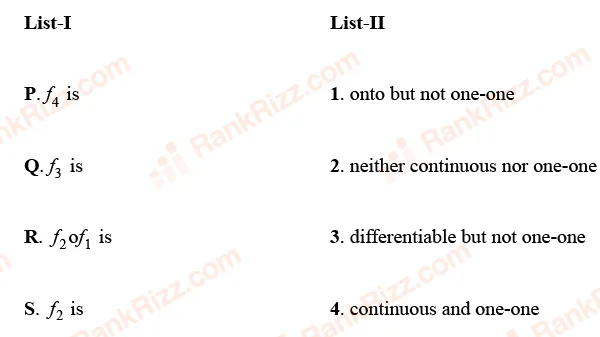
Let f1:R→R,f2:[0,∞)→R,f3:R→Rf_1 : R \rightarrow R, f_2 :[0, \infty) \rightarrow R, f_3 : R \rightarrow R and f4:R→[0,∞)f_4 : R \rightarrow [0, \infty) be defined by
f1(x)={∣x∣ifx<0,exifx≥0;f_1 (x) = \begin{cases}|x| & if x < 0,\\e^x & if x \geq 0;\end{cases}
f2(x)=x2;f_2 (x) = x^2;
f3(x)={sin⁡xifx<0,xifx≥0;f_3 (x) = \begin{cases}\sin x & if x < 0,\\x & if x \geq 0;\end{cases}
and
f4(x)={f2(f1(x))ifx<0,f2(f1(x))−1ifx≥0.f_4 (x) = \begin{cases}f_2(f_1(x)) & if x < 0,\\f_2(f_1(x)) - 1 & if x \geq 0.\end{cases}

Figure for JEE Advanced 2014 Mathematics question on Composite functions
  1. A

    P - 3, Q - 1, R - 4, S - 2

  2. B

    P - 1, Q - 3, R - 4, S - 2

  3. C

    P - 3, Q - 1, R - 2, S - 4

  4. D

    P - 1, Q - 3, R - 2, S - 4

JEE ADVANCED 2012 · PAPER 1One-one, onto functions and counting functions

The function f:[0,3]→[1,29]f: [0, 3] \rightarrow [1, 29], defined by f(x)=2x3−15x2+36x+1f(x) = 2x^3 - 15x^2 + 36x + 1, is

  1. A

    one-one and onto.

  2. B

    onto but not one-one.

  3. C

    one-one but not onto.

  4. D

    neither one-one noronto.

JEE ADVANCED 2012 · PAPER 2Functional equations

Let f:(−1,1)→IRf : (-1, 1) \rightarrow IR be such that f(cos⁡4θ)=22−sec⁡2θf(\cos 4 \theta) = \frac{2}{2 - \sec^2 \theta} for θ∈(0,π4)∪(π4,π2)\theta \in \left(0, \frac{\pi}{4}\right)\cup \left(\frac{\pi}{4}, \frac{\pi}{2}\right) Then the value(s) of f(13)f\left(\frac{1}{3}\right) is (are)

  1. A

    1−321 - \sqrt{\frac{3}{2}}

  2. B

    1+321 + \sqrt{\frac{3}{2}}

  3. C

    1−231 - \sqrt{\frac{2}{3}}

  4. D

    1+231 + \sqrt{\frac{2}{3}}

JEE ADVANCED 2011 · PAPER 2Composite functions

Let f(x)=x2f(x) = x^2 and g(x)=sin⁡xg(x) = \sin x for all x∈Rx \in R. Then the set of all x satisfying (f∘g∘g∘f)(x)=(g∘g∘f)(x)(f\circ g \circ g \circ f)(x) = (g\circ g \circ f)(x), where (f∘g)(x)=f(g(x))(f \circ g)(x) = f(g(x)), is

  1. A

    ±nπ,n∈{0,1,2,....}\pm \sqrt{n \pi}, n \in \left\{0, 1, 2, ....\right\}

  2. B

    ±nπ,n∈{1,2,....}\pm \sqrt{n \pi}, n \in \left\{1, 2, ....\right\}

  3. C

    π2+2nπ,n∈{.....,−2,−1,0,1,2,....}\frac{\pi}{2} + 2n \pi, n \in \left\{....., -2, -1, 0, 1, 2, ....\right\}

  4. D

    2nπ,n∈{.....,−2,−1,0,1,2,....}2n \pi, n \in \left\{....., -2, -1, 0, 1, 2, ....\right\}

JEE ADVANCED 2011 · PAPER 2Inverse functions

Let f:(0,1)→Rf : (0, 1) \rightarrow R be defined by
f(x)=b−x1−bxf(x) = \frac{b - x}{1 - bx}, where b is a constant such that 0 < b < 1. Then

  1. A

    f is not invertible on (0, 1)

  2. B

    f≠f−1f \neq f^{-1} on (0, 1) and f′(b)=1f′(0)f'(b) = \frac{1}{f'(0)}

  3. C

    f=f−1f = f^{-1} on (0, 1) and f′(b)=1f′(0)f'(b) = \frac{1}{f'(0)}

  4. D

    f−1f^{-1} is differentiable on (0, 1)

JEE ADVANCED 2011 · PAPER 2Domain of real functions

Match the statements given in Column I with the intervals/union of intervals given in Column II
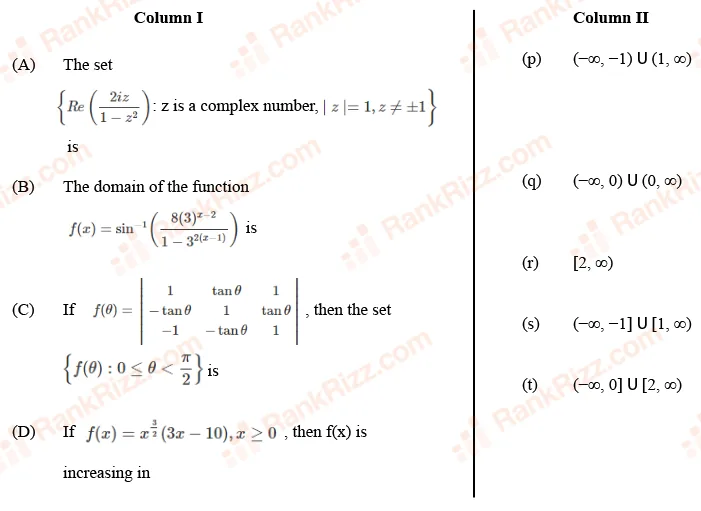
Figure for JEE Advanced 2011 Mathematics question on Domain of real functions
JEE ADVANCED 2010 · PAPER 2One-one, onto functions and counting functions

Let S = {1, 2, 3, 4}. The total number of unordered pairs of disjoint subsets of S is equal to

  1. A

    25

  2. B

    34

  3. C

    42

  4. D

    41

JEE ADVANCED 2009 · PAPER 2Inverse functions

If the function f(x)=x3+ex2f(x) = x^3 + e^{\frac{x}{2}} and g(x)=f−1(x)g(x) = f^{-1}(x), then the value of g′(1)g'(1) is