Continuity and Differentiability JEE Advanced PYQs with answer key
MATHS · 30 PAST QUESTIONS · 3 TOPICS · 2007–2026
HOW TO USE THIS SHEET
Every JEE Advanced Continuity and Differentiability question we hold, grouped by topic, most-asked topic first and newest first inside each. The answer key is at the end (29 of 30 questions have a checked key); the worked solution is on each question’s page, printed beside it.
Differentiability at a point 20
Let denote the set of all real numbers. Let be an arbitrary function and let be the function defined by
Then which of the following statements is (are) TRUE?
- (A)
The function is always continuous at
- (B)
If is continuous at , then is differentiable at
- (C)
If is differentiable at , then is continuous at
- (D)
If is differentiable at , then exists
rr2.rankrizz.com/jee-advanced/maths/continuity-and-differentiability/q/2026-paper-1-q39
- (A)
Consider the function defined by
where is the greatest integer less than or equal to .
Let be the total number of points in the interval at which is NOT continuous, and let be the total number of points in the interval at which is NOT differentiable. Then the value of is ___.
Answer: ____________
rr2.rankrizz.com/jee-advanced/maths/continuity-and-differentiability/q/2026-paper-1-q42
Let be the real number such that . For a given real number , define
for all real numbers .
Then which one of the following statements is TRUE?
- (A)
For ,
- (B)
For ,
- (C)
For ,
- (D)
For ,
rr2.rankrizz.com/jee-advanced/maths/continuity-and-differentiability/q/2025-paper-2-q1
- (A)
Let denote the set of all real numbers. Define the function by
Then which one of the following statements is TRUE?
- (A)
The function is NOT differentiable at
- (B)
There is a positive real number , such that is a decreasing function on the interval
- (C)
For any positive real number , the function is NOT an increasing function on the interval
- (D)
is a point of local minima of
rr2.rankrizz.com/jee-advanced/maths/continuity-and-differentiability/q/2025-paper-1-q3
- (A)
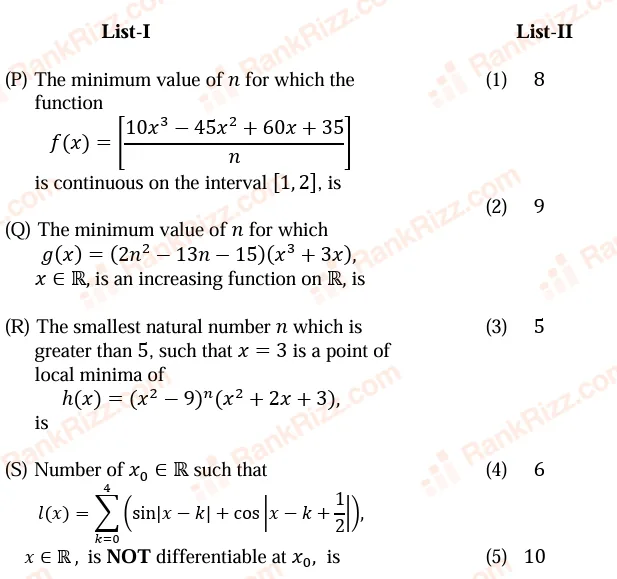
Let denote the set of all real numbers. For a real number , let denote the greatest integer less than or equal to . Let denote a natural number.
Match each entry in List-I to the correct entry in List-II and choose the correct option.
- (A)
(P)(1), (Q)(3), (R)(2), (S)(5)
- (B)
(P)(2), (Q)(1), (R)(4), (S)(3)
- (C)
(P)(5), (Q)(1), (R)(4), (S)(3)
- (D)
(P)(2), (Q)(3), (R)(1), (S)(5)
rr2.rankrizz.com/jee-advanced/maths/continuity-and-differentiability/q/2025-paper-1-q15
- (A)
Let be the function defined as , where denotes the greatest integer less than or equal to . Then which of the following statements is(are) true?
- (A)
The function is discontinuous exactly at one point in
- (B)
There is exactly one point in at which the function is continuous but NOT differentiable
- (C)
The function is NOT differentiable at more than three points in
- (D)
The minimum value of the function is
rr2.rankrizz.com/jee-advanced/maths/continuity-and-differentiability/q/2023-paper-2-q6
- (A)
Let the function be defined by and let be an arbitrary function. Let be the product function defined by . Then which of the following statements is/are TRUE?
- (A)
If g is continuous at , then fg is differentiable at
- (B)
If fg is differentiable at , then 𝑔 is continuous at
- (C)
If g is differentiable at , then 𝑓𝑔 is differentiable at
- (D)
If fg is differentiable at , then 𝑔 is differentiable at
rr2.rankrizz.com/jee-advanced/maths/continuity-and-differentiability/q/2020-paper-1-q43
- (A)
Let and be functions satisfying
and
for all . If , then which of the following statements is/are TRUE?- (A)
f is differentiable at every
- (B)
If g(0) = 1, then g is differentiable at every
- (C)
The derivative is equal to 1
- (D)
The derivative is equal to 1
rr2.rankrizz.com/jee-advanced/maths/continuity-and-differentiability/q/2020-paper-2-q45
- (A)
Let bea function. We say that f has
PROPERTY 1 if exists and is finite, and
PROPERTY 2 if exists and is finite.
Then which of the following options is/are correct?- (A)
has PROPERTY 1
- (B)
has PROPERTY 1
- (C)
has PROPERTY 2
- (D)
has PROPERTY 2
rr2.rankrizz.com/jee-advanced/maths/continuity-and-differentiability/q/2019-paper-2-q40
- (A)
Let and be bedefined by . Then f is
- (A)
differentiable at x = 0 if a = 0 and b = 1
- (B)
differentiable at x = 1 if a = 1 and b = 0
- (C)
NOT differentiable at x = 0 if a = 1 and b = 0
- (D)
NOT differentiable at x = 1 if a = 1 and b = 1
rr2.rankrizz.com/jee-advanced/maths/continuity-and-differentiability/q/2016-paper-2-q44
- (A)
Let g: be a differentiable function with g(0) = 0, g'(0) = 0 and . Let
and for all . Let (f o h) (x) denote f(h(x)) and (h o f) (x) denote h(f(x)). Then which of the following is (are) true?- (A)
f is differentiable at x = 0
- (B)
h is differentiable at x = 0
- (C)
f o h is differentiable at x = 0
- (D)
h o f is differentiable at x = 0
rr2.rankrizz.com/jee-advanced/maths/continuity-and-differentiability/q/2015-paper-1-q56
- (A)
Let be a continuous function and let be defined as
Then- (A)
g(x) is continuous but not differentiable at a
- (B)
g(x) is differentiable on R
- (C)
g(x) is continuous but not differentiable at b
- (D)
g(x) is continuous and differentiable at either a or b but not both
rr2.rankrizz.com/jee-advanced/maths/continuity-and-differentiability/q/2014-paper-1-q45
- (A)
Let and be respectively given by and . Define by
The number of points at which h(x) is not differentiable isAnswer: ____________
rr2.rankrizz.com/jee-advanced/maths/continuity-and-differentiability/q/2014-paper-1-q54
Let , then f is
- (A)
differentiable both at x = 0 andat x = 2
- (B)
differentiable at x = 0 but not differentiable at x = 2
- (C)
not differentiable at x = 0 butdifferentiable at x = 2
- (D)
differentiable neither at x = 0 nor at x =2
rr2.rankrizz.com/jee-advanced/maths/continuity-and-differentiability/q/2012-paper-1-q42
- (A)
If
, then- (A)
f(x) is continuous at
- (B)
f(x) is not differentiable at x =0
- (C)
f(x) is differentiable at x=1
- (D)
f(x) is differentiable at
rr2.rankrizz.com/jee-advanced/maths/continuity-and-differentiability/q/2011-paper-2-q49
- (A)
Let be a function such that
If f(x) is differentiable at x = 0, Then- (A)
f(x) is differentiable only in a finite interval containing zero
- (B)
f(x) is continuous
- (C)
f '(x) is constant
- (D)
f(x) is differentiable except at finitely many points
rr2.rankrizz.com/jee-advanced/maths/continuity-and-differentiability/q/2011-paper-1-q55
- (A)
Let
, m and n are integers, , and let p be the left hand derivative of at x=1.
If , then- (A)
n = 1, m = 1
- (B)
n = 1, m = -1
- (C)
n = 2, m = 2
- (D)
n > 2, m = n
rr2.rankrizz.com/jee-advanced/maths/continuity-and-differentiability/q/2008-paper-1-q5
- (A)
Let f(x) be a non-constant twice differentiable function defined on such that f(x) = f(1 - x) and . Then,
- (A)
vanishes at least twice on [0, 1]
- (B)
- (C)
- (D)
rr2.rankrizz.com/jee-advanced/maths/continuity-and-differentiability/q/2008-paper-1-q10
- (A)
Let for all real x.
STATEMENT-1: For each real t, there exists a point c in such that
because
STATEMENT-2: for each real t.- (A)
Statement-1 is True, Statement-2 is True; Statement-2 is a correct explanation for Statement-1
- (B)
Statement-1 is True, Statement-2 is True; Statement-2 is NOT a correct explanation for Statement-1
- (C)
Statement-1 is True, Statement-2 is False
- (D)
Statement-1 is False, Statement-2 is True
rr2.rankrizz.com/jee-advanced/maths/continuity-and-differentiability/q/2007-paper-2-q56
- (A)
In the following [x] denotes the greatest integer less than or equal to x.
Match the functions in Column I with the properties in Column II and indicate your answer by darkening the appropriate bubbles in the 4 x 4 matrix given in the ORS.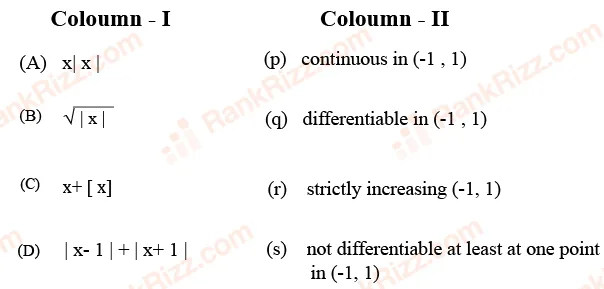
rr2.rankrizz.com/jee-advanced/maths/continuity-and-differentiability/q/2007-paper-1-q65
Continuity at a point 9
For a real number , let denote the greatest integer less than or equal to . For a finite set , let denote the number of elements in the set .
Consider the functions and defined by
and
Let
and
Then the value of is ___.
Answer: ____________
rr2.rankrizz.com/jee-advanced/maths/continuity-and-differentiability/q/2026-paper-2-q50
Let and be functions defined by and
Let . Define the function by , .
Match each entry in List-I to the correct entry in List-II.
List-I List-II (P) If and , then (1) is one-one (Q) If and , then (2) is onto (R) If and , then (3) is differentiable on (S) If and , then (4) the range of is (5) the range of is - (A)
(P) (4), (Q) (3), (R) (1), (S) (2)
- (B)
(P) (5), (Q) (2), (R) (4), (S) (3)
- (C)
(P) (5), (Q) (3), (R) (2), (S) (4)
- (D)
(P) (4), (Q) (2), (R) (1), (S) (3)
rr2.rankrizz.com/jee-advanced/maths/continuity-and-differentiability/q/2024-paper-1-q17
- (A)
Let the functions and be defined by
and ,
where denotes the greatest integer less than or equal to 𝑥. Let be the composite function defined by . Suppose c is the number of points in the interval (-1, 1) at which is NOT continuous, and suppose d is the number of points in the interval(-1, 1) at which is NOT differenciable. Then the value of c + d is ____________Answer: ____________
rr2.rankrizz.com/jee-advanced/maths/continuity-and-differentiability/q/2020-paper-2-q41
Let be given by
Then which of the following options is/are correct?- (A)
f is increasing on
- (B)
f' has a local maximum at x = 1
- (C)
f is onto
- (D)
f' is NOT differentiable at x = 1
rr2.rankrizz.com/jee-advanced/maths/continuity-and-differentiability/q/2019-paper-1-q46
- (A)
Let [x] be the greatest integer less than or equals to x. Then, at which of the following point(s) the function is discontinuous?
- (A)
x = -1
- (B)
x = 0
- (C)
x = 1
- (D)
x = 2
rr2.rankrizz.com/jee-advanced/maths/continuity-and-differentiability/q/2017-paper-1-q39
- (A)
Let be a continuous function. Then, which of the following function(s) has (have) the value zero at some point in the interval (0, 1)?
- (A)
- (B)
- (C)
- (D)
rr2.rankrizz.com/jee-advanced/maths/continuity-and-differentiability/q/2017-paper-1-q40
- (A)
Let and be functions defined by and , where denotes the greatest integer less than or equal to y for . Then
- (A)
f is discontinuous exactly at three points in
- (B)
f is discontinuous exactly at four points in
- (C)
g is NOT differentiable exactly at four points in
- (D)
g is NOT differentiable exactly at five points in
rr2.rankrizz.com/jee-advanced/maths/continuity-and-differentiability/q/2016-paper-2-q46
- (A)
For every pair of continuous functions such that
the correct statement(s) is(are) :- (A)
for some
- (B)
for some
- (C)
for some
- (D)
for some
rr2.rankrizz.com/jee-advanced/maths/continuity-and-differentiability/q/2014-paper-1-q42
- (A)
For every integer n, let and be real numbers. Let function be given by
, for all integers n.
If f is continuous, then which of the following hold(s) for all n?- (A)
- (B)
- (C)
- (D)
rr2.rankrizz.com/jee-advanced/maths/continuity-and-differentiability/q/2012-paper-2-q57
- (A)
Differentiability via functional equations 1
Let denote the set of all real numbers. Let be a function such that for all , and for all .
Let the real numbers be in an arithmetic progression. If , and
then the value of
is ________.
Answer: ____________
rr2.rankrizz.com/jee-advanced/maths/continuity-and-differentiability/q/2025-paper-1-q12
Answer key
- 01 B, D
- 02 5.00
- 03 C
- 04 C
- 05 B
- 06 A, B
- 07 A, C
- 08 A, B, D
- 09 B, C
- 10 A, B
- 11 A, D
- 12 A, C
- 13 3
- 14 B
- 15 A, B, C, D
- 16 B, C
- 17 C
- 18 A
- 19 B
- 20 A-PQR, B-PS, C-RS, D-PQ
- 21 56.00
- 22 C
- 23 —
- 24 B, C, D
- 25 A, B, D
- 26 A, B
- 27 B, C
- 28 A, D
- 29 B, D
- 30 96
“—” marks a question whose key we have not checked yet; its page shows the latest on it.
Past questions are reproduced with their sitting. Not affiliated with NTA or the IITs. Every question, online and free: rr2.rankrizz.com/jee-advanced/maths/continuity-and-differentiability