In the print dialog choose “Save as PDF”. Turn off the browser’s own headers and footers; the chapter has its own.

RankRizzFREE PDF

Trigonometric Equations JEE Advanced PYQs with answer key

MATHS · 16 PAST QUESTIONS · 3 TOPICS · 2007–2026

HOW TO USE THIS SHEET

Every JEE Advanced Trigonometric Equations question we hold, grouped by topic, most-asked topic first and newest first inside each. The answer key is at the end (15 of 16 questions have a checked key); the worked solution is on each question’s page, printed beside it.

Equations with parameters and trigonometric inequalities 12

  1. 01 · JEE ADVANCED 2018 · PAPER 1

    Let a, b, c be three non-zero real numbers such that the equation 3acos⁡x+2bsin⁡x=C,X∈[−π2,π2]\sqrt{3}a \cos x+2b \sin x=C,X \in [-\frac{\pi}{2},\frac{\pi}{2}] has two distinct real roots α\alpha and β\beta withα+β=π3\alpha+\beta=\frac{\pi}{3}, then the value of ba\frac{b}{a} is ....... .

    Answer: ____________

    rr2.rankrizz.com/jee-advanced/maths/trigonometric-equations/q/2018-paper-1-q49

  2. 02 · JEE ADVANCED 2016 · PAPER 1

    Let S={xϵ(−π,π):x≠0,±π2}S = \left\{x \epsilon (-\pi, \pi): x \neq 0, \pm \frac{\pi}{2}\right\} The sum of all distinct solutions of the equation 3sec⁡x+cosec⁡x+2(tan⁡x−cot⁡x)=0\sqrt{3} \sec x + \cosec x + 2(\tan x - \cot x) = 0 in the set S is equal to

    1. (A)

      −7π9-\frac{7 \pi}{9}

    2. (B)

      −2π9-\frac{2 \pi}{9}

    3. (C)

      00

    4. (D)

      5π9\frac{5 \pi}{9}

    rr2.rankrizz.com/jee-advanced/maths/trigonometric-equations/q/2016-paper-1-q39

  3. 03 · JEE ADVANCED 2015 · PAPER 1

    The number of distinct solutions of the equation
    54cos⁡22x+cos⁡4x+sin⁡4x+cos⁡6x+sin⁡6x=2\frac{5}{4} \cos^2 2x + \cos^4 x + \sin^4x + \cos^6 x + \sin^6 x = 2
    in the interval [0,2π][0, 2\pi] is

    Answer: ____________

    rr2.rankrizz.com/jee-advanced/maths/trigonometric-equations/q/2015-paper-1-q41

  4. 04 · JEE ADVANCED 2014 · PAPER 2

    For x∈(0,π)x \in (0, \pi), the equation sin⁡x+2sin⁡2x−sin⁡3x=3\sin x + 2 \sin 2x - \sin 3x = 3 has

    1. (A)

      infinitely many solutions

    2. (B)

      three solutions

    3. (C)

      one solution

    4. (D)

      no solution

    rr2.rankrizz.com/jee-advanced/maths/trigonometric-equations/q/2014-paper-2-q46

  5. 05 · JEE ADVANCED 2013 · PAPER 1

    The number of points in (−∞,∞)(-\infty, \infty), for which x2−xsin⁡x−cos⁡x=0,x^2 - x \sin x - \cos x = 0, is

    1. (A)

      6

    2. (B)

      4

    3. (C)

      2

    4. (D)

      0

    rr2.rankrizz.com/jee-advanced/maths/trigonometric-equations/q/2013-paper-1-q44

  6. 06 · JEE ADVANCED 2013 · PAPER 1

    Let f(x)=xsin⁡πx,x>0f(x) = x \sin \pi x, x > 0 Then for all natural numbers n, f′(x)f'(x) vanishes at

    1. (A)

      a unique point in the interval (n,n+12)\left(n, n + \frac{1}{2}\right)

    2. (B)

      a unique point in the interval (n+12,n+1)\left(n + \frac{1}{2}, n + 1\right)

    3. (C)

      a unique point in the interval (n,n+1)(n, n + 1)

    4. (D)

      two points in the interval (n,n+1)(n, n + 1)

    rr2.rankrizz.com/jee-advanced/maths/trigonometric-equations/q/2013-paper-1-q53

  7. 07 · JEE ADVANCED 2012 · PAPER 1

    Let θ,ϕ∈[0,2π]\theta, \phi \in [0, 2 \pi] be such that
    2cos⁡θ(1−sin⁡ϕ)=sin⁡2θ(tan⁡θ2+cot⁡θ2)cos⁡ϕ−1,tan⁡(2π−θ)>02 \cos \theta (1 - \sin \phi) = \sin^2 \theta \left(\tan \frac{\theta}{2} + \cot \frac{\theta}{2}\right) \cos \phi - 1, \tan(2 \pi - \theta) > 0 and −1<sin⁡θ<−32-1 < \sin \theta < -\frac{\sqrt{3}}{2}. Then ϕ\phi cannot satisfy

    1. (A)

      0<ϕ<π20 < \phi < \frac{\pi}{2}

    2. (B)

      π2<ϕ<4π3\frac{\pi}{2} < \phi < \frac{4 \pi}{3}

    3. (C)

      4π3<ϕ<3π2\frac{4\pi}{3} < \phi < \frac{3 \pi}{2}

    4. (D)

      3π2<ϕ<2π\frac{3\pi}{2} < \phi < 2 \pi

    rr2.rankrizz.com/jee-advanced/maths/trigonometric-equations/q/2012-paper-1-q51

  8. 08 · JEE ADVANCED 2011 · PAPER 1

    Let P={θ:sin⁡θ−cos⁡θ=2cos⁡θ}P = \left\{\theta : \sin \theta - \cos \theta = \sqrt{2} \cos \theta\right\} and Q={θ:sin⁡θ+cos⁡θ=2sin⁡θ}Q = \left\{\theta : \sin \theta + \cos \theta = \sqrt{2} \sin \theta\right\} be two sets. Then

    1. (A)

      P⊂QP \subset Q and Q−P≠∅Q - P \neq \varnothing

    2. (B)

      Q⊄PQ \not \subset P

    3. (C)

      P⊄QP \not \subset Q

    4. (D)

      P=QP = Q

    rr2.rankrizz.com/jee-advanced/maths/trigonometric-equations/q/2011-paper-1-q53

  9. 09 · JEE ADVANCED 2010 · PAPER 1

    The numberof values of θ\theta in the interval (−π2,π2)\left(-\frac{\pi}{2}, \frac{\pi}{2}\right) such that θ≠nπ5\theta \neq \frac{n \pi}{5} for n=0,±1,±2n = 0, \pm 1, \pm 2 and tan⁡θ=cot⁡5θ\tan \theta = \cot 5 \theta as well as sin⁡2θ=cos⁡4θ\sin 2 \theta = \cos 4 \theta is

    Answer: ____________

    rr2.rankrizz.com/jee-advanced/maths/trigonometric-equations/q/2010-paper-1-q47

  10. 10 · JEE ADVANCED 2010 · PAPER 1

    The number of all possible values of θ\theta , where 0<θ<π0 < \theta < \pi. for which the system of equations
    (y+z)cos⁡3θ=(xyz)sin⁡3θ(y + z) \cos 3 \theta = (xyz) \sin 3\theta
    xsin⁡3θ=2cos⁡3θy+2sin⁡3θzx \sin 3 \theta = \frac{2 \cos 3\theta}{y} + \frac{2 \sin 3\theta}{z}
    (xyz)sin⁡3θ=(y+2z)cos⁡3θ+ysin⁡3θ(xyz) \sin 3\theta = (y + 2z) \cos 3 \theta + y \sin 3 \theta
    have a solution (x0,y0,z0)(x_0, y_0, z_0) with y0z0≤0y_0z_0 \leq 0, is

    Answer: ____________

    rr2.rankrizz.com/jee-advanced/maths/trigonometric-equations/q/2010-paper-1-q55

  11. 11 · JEE ADVANCED 2009 · PAPER 1

    If sin⁡4x2+cos⁡4x3=15\frac{\sin^4x}{2}+\frac{\cos^4x}{3} = \frac{1}{5} then

    1. (A)

      tan⁡2x=23\tan^2 x = \frac{2}{3}

    2. (B)

      sin⁡8x8+cos⁡8x27=1125\frac{\sin^8 x}{8}+\frac{\cos^8 x}{27} = \frac{1}{125}

    3. (C)

      tan⁡2x=13\tan^2 x = \frac{1}{3}

    4. (D)

      sin⁡8x8+cos⁡8x27=2125\frac{\sin^8 x}{8}+\frac{\cos^8 x}{27} = \frac{2}{125}

    rr2.rankrizz.com/jee-advanced/maths/trigonometric-equations/q/2009-paper-1-q32

  12. 12 · JEE ADVANCED 2007 · PAPER 1

    The number of solutions of the pair of equations
    2sin⁡2θ−cos⁡2θ=02 \sin^2 \theta - \cos 2 \theta = 0
    2cos⁡2θ−3sin⁡θ=02 \cos^2 \theta - 3 \sin \theta = 0
    in the interval [0,2π][0, 2 \pi] is

    1. (A)

      zero

    2. (B)

      one

    3. (C)

      two

    4. (D)

      four

    rr2.rankrizz.com/jee-advanced/maths/trigonometric-equations/q/2007-paper-1-q53

Number of solutions in an interval 3

  1. 13 · JEE ADVANCED 2026 · PAPER 1

    Match each entry in List-I to the correct entry in List-II and choose the correct option.
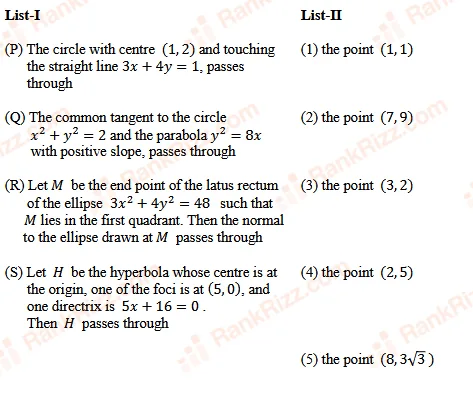
    image
    1. (A)

      (P)→\to(3), (Q)→\to(4), (R)→\to(1), (S)→\to(2)

    2. (B)

      (P)→\to(3), (Q)→\to(2), (R)→\to(1), (S)→\to(5)

    3. (C)

      (P)→\to(3), (Q)→\to(2), (R)→\to(4), (S)→\to(5)

    4. (D)

      (P)→\to(4), (Q)→\to(1), (R)→\to(2), (S)→\to(3)

    rr2.rankrizz.com/jee-advanced/maths/trigonometric-equations/q/2026-paper-1-q48

  2. 14 · JEE ADVANCED 2026 · PAPER 2

    Question Stem for Question Nos. 15 and 16

    Consider the curve C1C_1 given by y=e−xy=e^{-x} for x∈[0,10π]x\in[0,10\pi], and the curve C2C_2 given by y=e−x(sin⁡x+cos⁡x)y=e^{-x}(\sin x+\cos x) for x∈[0,10π]x\in[0,10\pi].

    Let nn be the total number of points of intersection of the curves C1C_1 and C2C_2.

    Suppose that α1,α2,…,αn∈[0,10π]\alpha_1,\alpha_2,\dots,\alpha_n\in[0,10\pi] are the xx-coordinates of the points of intersection of the curves C1C_1 and C2C_2 such that α1<α2<⋯<αn\alpha_1<\alpha_2<\cdots<\alpha_n.

    The value of nn is ___.

    Answer: ____________

    rr2.rankrizz.com/jee-advanced/maths/trigonometric-equations/q/2026-paper-2-q51

  3. 15 · JEE ADVANCED 2024 · PAPER 2

    Let f:R→Rf : \mathbb{R} \to \mathbb{R} be a function defined by

    f(x)={x2sin⁡(πx2),if x≠0,0,if x=0.f(x) = \begin{cases} x^2 \sin\left(\frac{\pi}{x^2}\right), & \text{if } x \neq 0, \\ 0, & \text{if } x = 0. \end{cases}

    Then which of the following statements is TRUE?

    1. (A)

      f(x)=0f(x) = 0 has infinitely many solutions in the interval [11010,∞)\left[\frac{1}{10^{10}}, \infty\right).

    2. (B)

      f(x)=0f(x) = 0 has no solutions in the interval [1π,∞)\left[\frac{1}{\pi}, \infty\right).

    3. (C)

      The set of solutions of f(x)=0f(x) = 0 in the interval (0,11010)\left(0, \frac{1}{10^{10}}\right) is finite.

    4. (D)

      f(x)=0f(x) = 0 has more than 25 solutions in the interval (1π2,1π)\left(\frac{1}{\pi^2}, \frac{1}{\pi}\right).

    rr2.rankrizz.com/jee-advanced/maths/trigonometric-equations/q/2024-paper-2-q4

General and principal solutions 1

  1. 16 · JEE ADVANCED 2022 · PAPER 1

    Consider the following lists:

    List-IList-II
    (I) {x∈[−2π3,2π3]:cos⁡x+sin⁡x=1}\left\{x \in \left[-\frac{2\pi}{3}, \frac{2\pi}{3}\right] : \cos x + \sin x = 1\right\}(P) has two elements
    (II) {x∈[−5π18,5π18]:3tan⁡3x=1}\left\{x \in \left[-\frac{5\pi}{18}, \frac{5\pi}{18}\right] : \sqrt{3} \tan 3x = 1\right\}(Q) has three elements
    (III) {x∈[−6π5,6π5]:2cos⁡(2x)=3}\left\{x \in \left[-\frac{6\pi}{5}, \frac{6\pi}{5}\right] : 2\cos(2x) = \sqrt{3}\right\}(R) has four elements
    (IV) {x∈[−7π4,7π4]:sin⁡x−cos⁡x=1}\left\{x \in \left[-\frac{7\pi}{4}, \frac{7\pi}{4}\right] : \sin x - \cos x = 1\right\}(S) has five elements
    (T) has six elements

    The correct option is:

    1. (A)

      (I) →\to (P); (II) →\to (S); (III) →\to (P); (IV) →\to (S)

    2. (B)

      (I) →\to (P); (II) →\to (P); (III) →\to (T); (IV) →\to (R)

    3. (C)

      (I) →\to (Q); (II) →\to (P); (III) →\to (T); (IV) →\to (S)

    4. (D)

      (I) →\to (Q); (II) →\to (S); (III) →\to (P); (IV) →\to (R)

    rr2.rankrizz.com/jee-advanced/maths/trigonometric-equations/q/2022-paper-1-q15

Answer key

  1. 01 —
  2. 02 C
  3. 03 8
  4. 04 D
  5. 05 C
  6. 06 B, C
  7. 07 A, C, D
  8. 08 D
  9. 09 3
  10. 10 3
  11. 11 A
  12. 12 C
  13. 13 B
  14. 14 11.00
  15. 15 D
  16. 16 B

“—” marks a question whose key we have not checked yet; its page shows the latest on it.

Past questions are reproduced with their sitting. Not affiliated with NTA or the IITs. Every question, online and free: rr2.rankrizz.com/jee-advanced/maths/trigonometric-equations