Straight Lines JEE Advanced PYQs with answer key
MATHS · 10 PAST QUESTIONS · 9 TOPICS · 2007–2025
HOW TO USE THIS SHEET
Every JEE Advanced Straight Lines question we hold, grouped by topic, most-asked topic first and newest first inside each. The answer key is at the end (9 of 10 questions have a checked key); the worked solution is on each question’s page, printed beside it.
Locus problems in coordinate geometry 2
Let denote the locus of the point of intersection of the pair of lines
,
,
where varies over the set of non-zero real numbers. Let be the tangent to passing through the points and , , and parallel to the line .
Then the value of is
- (A)
- (B)
- (C)
- (D)
rr2.rankrizz.com/jee-advanced/maths/straight-lines/q/2025-paper-2-q4
- (A)
The locus of the orthocentre of the triangle formed by the lines
(1 + p)x - py + p(1 + p) = 0,
(1 + q)x - qy + q(1 + q) = 0,
and y = 0, where , is- (A)
a hyperbola
- (B)
a parabola
- (C)
a nellipse
- (D)
a straight line
rr2.rankrizz.com/jee-advanced/maths/straight-lines/q/2009-paper-2-q23
- (A)
Area of triangle and collinearity 1
Consider three points and , where . Then,
- (A)
P lies on the line segment RQ
- (B)
Q lies on the line segment PR
- (C)
R lies on the line segment QP
- (D)
P, Q, R are non-collinear
rr2.rankrizz.com/jee-advanced/maths/straight-lines/q/2008-paper-2-q5
- (A)
Centroid, incentre, circumcentre and orthocentre 1
Let O(0, 0), P(3, 4), Q(6, 0) be the vertices of the triangle OPQ. The point R inside the triangle OPQ is such that the triangles OPR, PQR, OQR are of equal area. The coordinates of R are
- (A)
- (B)
- (C)
- (D)
rr2.rankrizz.com/jee-advanced/maths/straight-lines/q/2007-paper-2-q45
- (A)
Equations of a line in various forms 1
For a > b > c > 0, the distance between (1, 1) and the point of intersection of the lines ax + by + c = 0 and bx + ay + c = 0 is less than . Then
- (A)
a + b - c > 0
- (B)
a - b + c < 0
- (C)
a - b + c > 0
- (D)
a + b - c < 0
rr2.rankrizz.com/jee-advanced/maths/straight-lines/q/2013-paper-1-q48
- (A)
Angle between lines, parallel and perpendicular lines 1
A straight line L through the point (3, -2) is inclined at an angle to the line . If L also intersects the x-axis, then the equation of L is
- (A)
- (B)
- (C)
- (D)
rr2.rankrizz.com/jee-advanced/maths/straight-lines/q/2011-paper-1-q52
- (A)
Distance from a line, foot of perpendicular and image 1
For a point P in the plane, let and be the distances of the point P from the lines x − y = 0 and x + y = 0 respectively. The area of the region R consisting of all points P lying in the first quadrant of the plane and satisfying is
Answer: ____________
rr2.rankrizz.com/jee-advanced/maths/straight-lines/q/2014-paper-1-q59
Concurrency and family of lines 1
Consider the lines given by
Match the Statements / Expressions in Column I with the Statements / Expressions in Column II and indicate your answer by darkening the appropriate bubbles in the matrix given in the ORS.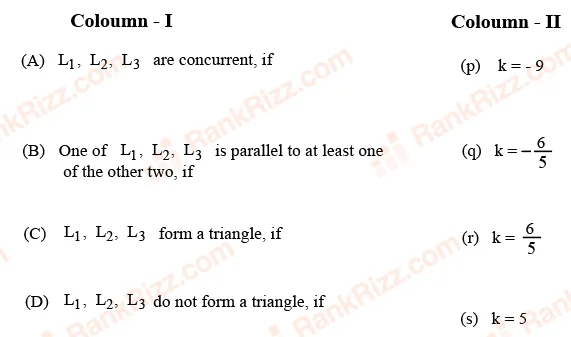
Answer: ____________
rr2.rankrizz.com/jee-advanced/maths/straight-lines/q/2008-paper-2-q20
Angle bisectors 1
Lines and intersect the line at P and Q, respectively. The bisector of the acute angle between and intersects at R.
STATEMENT-1: The ratio PR : RQ equals
because
STATEMENT-2: In any triangle, bisector of an angle divides the triangle into two similar triangles.- (A)
Statement-1 is True, Statement-2 is True; Statement-2 is a correct explanation for Statement-1
- (B)
Statement-1 is True, Statement-2 is True; Statement-2 is NOT a correct explanation for Statement-1
- (C)
Statement-1 is True, Statement-2 is False
- (D)
Statement-1 is False, Statement-2 is True
rr2.rankrizz.com/jee-advanced/maths/straight-lines/q/2007-paper-2-q57
- (A)
Pair of straight lines 1
Let a and b be non-zero real numbers. Then, the equation
represents- (A)
four straight lines, when c = 0 and a, b are of the same sign
- (B)
two straight lines and a circle, when a = b, and c is of sign opposite to that of a
- (C)
two straight lines and a hyperbola, when a and b are of the same sign and c is of sign opposite to that of a
- (D)
a circle and an ellipse, when a and b are of the same sign and is of sign opposite to that of a
rr2.rankrizz.com/jee-advanced/maths/straight-lines/q/2008-paper-1-q4
- (A)
Answer key
- 01 A
- 02 D
- 03 D
- 04 C
- 05 A, C
- 06 B
- 07 6
- 08 —
- 09 C
- 10 B
“—” marks a question whose key we have not checked yet; its page shows the latest on it.
Past questions are reproduced with their sitting. Not affiliated with NTA or the IITs. Every question, online and free: rr2.rankrizz.com/jee-advanced/maths/straight-lines