In the print dialog choose “Save as PDF”. Turn off the browser’s own headers and footers; the chapter has its own.

RankRizzFREE PDF

Functions JEE Advanced PYQs with answer key

MATHS · 20 PAST QUESTIONS · 7 TOPICS · 2009–2026

HOW TO USE THIS SHEET

Every JEE Advanced Functions question we hold, grouped by topic, most-asked topic first and newest first inside each. The answer key is at the end (15 of 20 questions have a checked key); the worked solution is on each question’s page, printed beside it.

Composite functions 5

  1. 01 · JEE ADVANCED 2026 · PAPER 2

    Let N\mathbb{N} denote the set of all positive integers. Consider the sets

    A={1,2,3,4,5}andB={1,2,3,4,5,6,7}.A=\{1,2,3,4,5\}\quad\text{and}\quad B=\{1,2,3,4,5,6,7\}.

    Let SS be the set of all functions f:A→Bf:A\to B such that f(2)≠2f(2)\neq 2 and f(4)≠4f(4)\neq 4. Consider the set

    T={f∈S:there exists a function g:B→N such that g(f(x))=2x for all x∈A}.T=\big\{f\in S:\text{there exists a function }g:B\to\mathbb{N}\text{ such that }g\big(f(x)\big)=2^x\text{ for all }x\in A\big\}.

    Then the number of elements in the set TT is ___.

    Answer: ____________

    rr2.rankrizz.com/jee-advanced/maths/functions/q/2026-paper-2-q46

  2. 02 · JEE ADVANCED 2025 · PAPER 1

    Let N\mathbb{N} denote the set of all natural numbers, and Z\mathbb{Z} denote the set of all integers. Consider the functions f:N→Zf: \mathbb{N} \to \mathbb{Z} and g:Z→Ng: \mathbb{Z} \to \mathbb{N} defined by

    f(n)={(n+1)/2if n is odd,(4−n)/2if n is even,f(n) = \begin{cases} (n+1)/2 & \text{if } n \text{ is odd}, \\ (4-n)/2 & \text{if } n \text{ is even}, \end{cases}

    and

    g(n)={3+2nif n≥0,−2nif n<0.g(n) = \begin{cases} 3 + 2n & \text{if } n \geq 0, \\ -2n & \text{if } n < 0. \end{cases}

    Define (g∘f)(n)=g(f(n))(g \circ f)(n) = g(f(n)) for all n∈Nn \in \mathbb{N}, and (f∘g)(n)=f(g(n))(f \circ g)(n) = f(g(n)) for all n∈Zn \in \mathbb{Z}.

    Then which of the following statements is (are) TRUE?

    1. (A)

      g∘fg \circ f is NOT one-one and g∘fg \circ f is NOT onto

    2. (B)

      f∘gf \circ g is NOT one-one but f∘gf \circ g is onto

    3. (C)

      gg is one-one and gg is onto

    4. (D)

      ff is NOT one-one but ff is onto

    rr2.rankrizz.com/jee-advanced/maths/functions/q/2025-paper-1-q6

  3. 03 · JEE ADVANCED 2025 · PAPER 2

    Let R\mathbb{R} denote the set of all real numbers. Let f:R→Rf: \mathbb{R} \to \mathbb{R} and g:R→(0,4)g: \mathbb{R} \to (0, 4) be functions defined by

    f(x)=log⁡e(x2+2x+4)f(x) = \log_e(x^2 + 2x + 4), \quad and g(x)=41+e−2x\quad g(x) = \frac{4}{1 + e^{-2x}}.

    Define the composite function f∘g−1f \circ g^{-1} by (f∘g−1)(x)=f(g−1(x))(f \circ g^{-1})(x) = f(g^{-1}(x)), where g−1g^{-1} is the inverse of the function gg.

    Then the value of the derivative of the composite function f∘g−1f \circ g^{-1} at x=2x = 2 is ______.

    Answer: ____________

    rr2.rankrizz.com/jee-advanced/maths/functions/q/2025-paper-2-q14

  4. 04 · JEE ADVANCED 2014 · PAPER 2

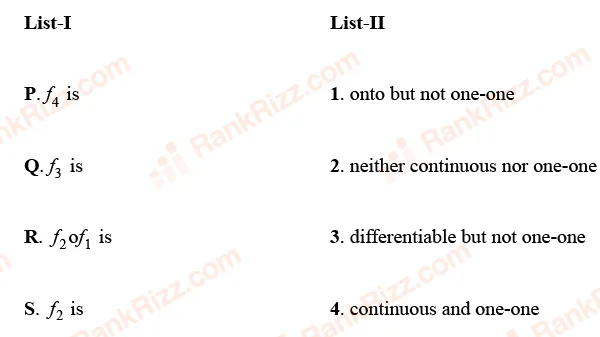
    Let f1:R→R,f2:[0,∞)→R,f3:R→Rf_1 : R \rightarrow R, f_2 :[0, \infty) \rightarrow R, f_3 : R \rightarrow R and f4:R→[0,∞)f_4 : R \rightarrow [0, \infty) be defined by
    f1(x)={∣x∣ifx<0,exifx≥0;f_1 (x) = \begin{cases}|x| & if x < 0,\\e^x & if x \geq 0;\end{cases}
    f2(x)=x2;f_2 (x) = x^2;
    f3(x)={sin⁡xifx<0,xifx≥0;f_3 (x) = \begin{cases}\sin x & if x < 0,\\x & if x \geq 0;\end{cases}
    and
    f4(x)={f2(f1(x))ifx<0,f2(f1(x))−1ifx≥0.f_4 (x) = \begin{cases}f_2(f_1(x)) & if x < 0,\\f_2(f_1(x)) - 1 & if x \geq 0.\end{cases}

    1. (A)

      P - 3, Q - 1, R - 4, S - 2

    2. (B)

      P - 1, Q - 3, R - 4, S - 2

    3. (C)

      P - 3, Q - 1, R - 2, S - 4

    4. (D)

      P - 1, Q - 3, R - 2, S - 4

    rr2.rankrizz.com/jee-advanced/maths/functions/q/2014-paper-2-q60

  5. 05 · JEE ADVANCED 2011 · PAPER 2

    Let f(x)=x2f(x) = x^2 and g(x)=sin⁡xg(x) = \sin x for all x∈Rx \in R. Then the set of all x satisfying (f∘g∘g∘f)(x)=(g∘g∘f)(x)(f\circ g \circ g \circ f)(x) = (g\circ g \circ f)(x), where (f∘g)(x)=f(g(x))(f \circ g)(x) = f(g(x)), is

    1. (A)

      ±nπ,n∈{0,1,2,....}\pm \sqrt{n \pi}, n \in \left\{0, 1, 2, ....\right\}

    2. (B)

      ±nπ,n∈{1,2,....}\pm \sqrt{n \pi}, n \in \left\{1, 2, ....\right\}

    3. (C)

      π2+2nπ,n∈{.....,−2,−1,0,1,2,....}\frac{\pi}{2} + 2n \pi, n \in \left\{....., -2, -1, 0, 1, 2, ....\right\}

    4. (D)

      2nπ,n∈{.....,−2,−1,0,1,2,....}2n \pi, n \in \left\{....., -2, -1, 0, 1, 2, ....\right\}

    rr2.rankrizz.com/jee-advanced/maths/functions/q/2011-paper-2-q47

One-one, onto functions and counting functions 4

  1. 06 · JEE ADVANCED 2023 · PAPER 1

    Let S=(0,1)∪(1,2)∪(3,4)S = (0, 1) \cup (1, 2) \cup (3, 4) and T={0,1,2,3}T = \{0, 1, 2, 3\}. Then which of the following statements is(are) true?

    1. (A)

      There are infinitely many functions from S to T

    2. (B)

      There are infinitely many strictly increasing functions from S to T

    3. (C)

      The number of continuous functions from S to T is at most 120

    4. (D)

      Every continuous function from S to T is differentiable

    rr2.rankrizz.com/jee-advanced/maths/functions/q/2023-paper-1-q1

  2. 07 · JEE ADVANCED 2020 · PAPER 1

    If the function f:R→Rf: R \rightarrow R is defined by f(x)=∣x∣(x−sin⁡x)f(x) = |x|(x − \sin x), then which of the following statements is TRUE?

    1. (A)

      f is one-one, but NOT onto

    2. (B)

      f is onto, but NOT one-one

    3. (C)

      f is BOTH one-one and onto

    4. (D)

      f is NEITHER one-one NOR onto

    rr2.rankrizz.com/jee-advanced/maths/functions/q/2020-paper-1-q38

  3. 08 · JEE ADVANCED 2012 · PAPER 1

    The function f:[0,3]→[1,29]f: [0, 3] \rightarrow [1, 29], defined by f(x)=2x3−15x2+36x+1f(x) = 2x^3 - 15x^2 + 36x + 1, is

    1. (A)

      one-one and onto.

    2. (B)

      onto but not one-one.

    3. (C)

      one-one but not onto.

    4. (D)

      neither one-one noronto.

    rr2.rankrizz.com/jee-advanced/maths/functions/q/2012-paper-1-q43

  4. 09 · JEE ADVANCED 2010 · PAPER 2

    Let S = {1, 2, 3, 4}. The total number of unordered pairs of disjoint subsets of S is equal to

    1. (A)

      25

    2. (B)

      34

    3. (C)

      42

    4. (D)

      41

    rr2.rankrizz.com/jee-advanced/maths/functions/q/2010-paper-2-q21

Functional equations 4

  1. 10 · JEE ADVANCED 2024 · PAPER 2

    Let f:R→Rf : \mathbb{R} \to \mathbb{R} be a function such that f(x+y)=f(x)+f(y)f(x+y) = f(x) + f(y) for all x,y∈Rx, y \in \mathbb{R}, and g:R→(0,∞)g : \mathbb{R} \to (0, \infty) be a function such that g(x+y)=g(x)g(y)g(x+y) = g(x)g(y) for all x,y∈Rx, y \in \mathbb{R}. If f(−35)=12f\left(\frac{-3}{5}\right) = 12 and g(−13)=2g\left(\frac{-1}{3}\right) = 2, then the value of (f(14)+g(−2)−8)g(0)\left(f\left(\frac{1}{4}\right) + g(-2) - 8\right)g(0) is ______.

    Answer: ____________

    rr2.rankrizz.com/jee-advanced/maths/functions/q/2024-paper-2-q8

  2. 11 · JEE ADVANCED 2020 · PAPER 2

    Let the function f:[0,1]→Rf:[0, 1] \rightarrow R be defined by f(x)=4x4x+2f(x) = \frac{4^x}{4^x + 2}. Then the value of f(140)+f(240)+f(340)+.....+f(3940)−f(12)f\left(\frac{1}{40}\right)+f\left(\frac{2}{40}\right)+f\left(\frac{3}{40}\right)+.....+f\left(\frac{39}{40}\right) - f\left(\frac{1}{2}\right) is__________.

    Answer: ____________

    rr2.rankrizz.com/jee-advanced/maths/functions/q/2020-paper-2-q52

  3. 12 · JEE ADVANCED 2020 · PAPER 2

    Let the function f:(0,π)→Rf:(0, \pi) \rightarrow R be defined by
    f(θ)=(sin⁡θ+cos⁡θ)2+(sin⁡θ−cos⁡θ)4f(\theta) = (\sin \theta + \cos \theta)^2 + (\sin \theta - \cos \theta)^4.
    Suppose the function 𝑓 has a local minimum at θ\theta precisely when θ∈{λ1π,....,λrπ}\theta \in \left\{\lambda_1 \pi, ...., \lambda_r \pi\right\} where 0<λ1<...<λr<10 < \lambda_1 < ... < \lambda_r < 1. Then the value of λ1+...+λr\lambda_1 + ... + \lambda_r is _________

    Answer: ____________

    rr2.rankrizz.com/jee-advanced/maths/functions/q/2020-paper-2-q54

  4. 13 · JEE ADVANCED 2012 · PAPER 2

    Let f:(−1,1)→IRf : (-1, 1) \rightarrow IR be such that f(cos⁡4θ)=22−sec⁡2θf(\cos 4 \theta) = \frac{2}{2 - \sec^2 \theta} for θ∈(0,π4)∪(π4,π2)\theta \in \left(0, \frac{\pi}{4}\right)\cup \left(\frac{\pi}{4}, \frac{\pi}{2}\right) Then the value(s) of f(13)f\left(\frac{1}{3}\right) is (are)

    1. (A)

      1−321 - \sqrt{\frac{3}{2}}

    2. (B)

      1+321 + \sqrt{\frac{3}{2}}

    3. (C)

      1−231 - \sqrt{\frac{2}{3}}

    4. (D)

      1+231 + \sqrt{\frac{2}{3}}

    rr2.rankrizz.com/jee-advanced/maths/functions/q/2012-paper-2-q60

Range of real functions 2

  1. 14 · JEE ADVANCED 2022 · PAPER 1

    Let ∣M∣|M| denote the determinant of a square matrix MM. Let g:[0,π2]→Rg: \left[0, \frac{\pi}{2}\right] \to \mathbb{R} be the function defined by

    g(θ)=f(θ)−1+f(π2−θ)−1g(\theta) = \sqrt{f(\theta) - 1} + \sqrt{f\left(\frac{\pi}{2} - \theta\right) - 1}

    where

    f(θ)=12∣1sin⁡θ1−sin⁡θ1sin⁡θ−1−sin⁡θ1∣+∣sin⁡πcos⁡(θ+π4)tan⁡(θ−π4)sin⁡(θ−π4)−cos⁡π2log⁡e(4π)cot⁡(θ+π4)log⁡e(π4)tan⁡π∣.f(\theta) = \frac{1}{2} \begin{vmatrix} 1 & \sin\theta & 1 \\ -\sin\theta & 1 & \sin\theta \\ -1 & -\sin\theta & 1 \end{vmatrix} + \begin{vmatrix} \sin\pi & \cos\left(\theta + \frac{\pi}{4}\right) & \tan\left(\theta - \frac{\pi}{4}\right) \\ \sin\left(\theta - \frac{\pi}{4}\right) & -\cos\frac{\pi}{2} & \log_e\left(\frac{4}{\pi}\right) \\ \cot\left(\theta + \frac{\pi}{4}\right) & \log_e\left(\frac{\pi}{4}\right) & \tan\pi \end{vmatrix}.

    Let p(x)p(x) be a quadratic polynomial whose roots are the maximum and minimum values of the function g(θ)g(\theta), and p(2)=2−2p(2) = 2 - \sqrt{2}. Then, which of the following is/are TRUE?

    1. (A)

      p(3+24)<0p\left(\frac{3+\sqrt{2}}{4}\right) < 0

    2. (B)

      p(1+324)>0p\left(\frac{1+3\sqrt{2}}{4}\right) > 0

    3. (C)

      p(52−14)>0p\left(\frac{5\sqrt{2}-1}{4}\right) > 0

    4. (D)

      p(5−24)<0p\left(\frac{5-\sqrt{2}}{4}\right) < 0

    rr2.rankrizz.com/jee-advanced/maths/functions/q/2022-paper-1-q14

  2. 15 · JEE ADVANCED 2015 · PAPER 1

    Let f(x)=sin⁡(π6sin⁡(π2sin⁡x))f(x) = \sin \left(\frac{\pi}{6}\sin\left(\frac{\pi}{2}\sin x\right)\right) for all x∈Rx \in R and g(x)=π2sin⁡xg(x) = \frac{\pi}{2} \sin x for all x∈Rx \in R. Let (f o g)(x) denote f(g(x)) and (g o f)(x) denote g(f(x)). Then which of the following is (are) true?

    1. (A)

      Range of f is [−12,12]\left[-\frac{1}{2}, \frac{1}{2}\right]

    2. (B)

      Range of f o g is [−12,12]\left[-\frac{1}{2}, \frac{1}{2}\right]

    3. (C)

      lim⁡x→0f(x)g(x)=π6\lim_{x \rightarrow 0}\frac{f(x)}{g(x)} = \frac{\pi}{6}

    4. (D)

      There is an x∈Rx \in R such that (g o f)(x) = 1

    rr2.rankrizz.com/jee-advanced/maths/functions/q/2015-paper-1-q57

Inverse functions 2

  1. 16 · JEE ADVANCED 2011 · PAPER 2

    Let f:(0,1)→Rf : (0, 1) \rightarrow R be defined by
    f(x)=b−x1−bxf(x) = \frac{b - x}{1 - bx}, where b is a constant such that 0 < b < 1. Then

    1. (A)

      f is not invertible on (0, 1)

    2. (B)

      f≠f−1f \neq f^{-1} on (0, 1) and f′(b)=1f′(0)f'(b) = \frac{1}{f'(0)}

    3. (C)

      f=f−1f = f^{-1} on (0, 1) and f′(b)=1f′(0)f'(b) = \frac{1}{f'(0)}

    4. (D)

      f−1f^{-1} is differentiable on (0, 1)

    rr2.rankrizz.com/jee-advanced/maths/functions/q/2011-paper-2-q52

  2. 17 · JEE ADVANCED 2009 · PAPER 2

    If the function f(x)=x3+ex2f(x) = x^3 + e^{\frac{x}{2}} and g(x)=f−1(x)g(x) = f^{-1}(x), then the value of g′(1)g'(1) is

    Answer: ____________

    rr2.rankrizz.com/jee-advanced/maths/functions/q/2009-paper-2-q38

Even, odd and periodic functions 2

  1. 18 · JEE ADVANCED 2020 · PAPER 1

    Let f:[0,2]→Rf:[0, 2]\rightarrow R be the function defined by

    f(x)=(3−sin⁡(2πx))sin⁡(πx−π4)−sin⁡(3πx+π4)f(x) = (3- \sin(2\pi x)) \sin \left(\pi x - \frac{\pi}{4}\right) - \sin\left(3\pi x + \frac{\pi}{4}\right)

    If α,βϵ[0,2]\alpha, \beta \epsilon [0, 2] are such that {xϵ[0,2]:f(x)≥0}=[α,β]\left\{x \epsilon [0,2] : f(x) \geq 0\right\} = [\alpha, \beta], then the value of β−α\beta - \alpha is _________

    Answer: ____________

    rr2.rankrizz.com/jee-advanced/maths/functions/q/2020-paper-1-q51

  2. 19 · JEE ADVANCED 2014 · PAPER 1

    Let f:(−π2,π2)→Rf:(-\frac{\pi}{2}, \frac{\pi}{2}) \rightarrow R be given by
    f(x)=(log⁡(sec⁡x+tan⁡x))3.f(x) = (\log (\sec x + \tan x))^3.
    Then

    1. (A)

      f(x) is an odd function

    2. (B)

      f(x) is a one-one function

    3. (C)

      f(x) is an onto function

    4. (D)

      f(x) is an even function

    rr2.rankrizz.com/jee-advanced/maths/functions/q/2014-paper-1-q46

Domain of real functions 1

  1. 20 · JEE ADVANCED 2011 · PAPER 2

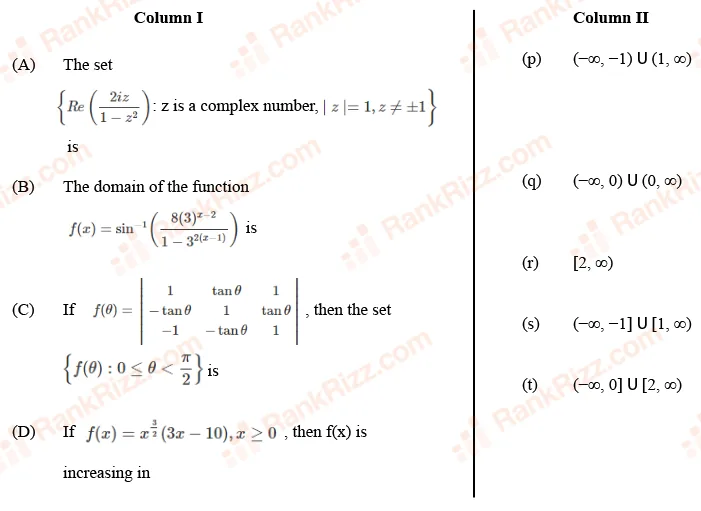
    Match the statements given in Column I with the intervals/union of intervals given in Column II
    rr2.rankrizz.com/jee-advanced/maths/functions/q/2011-paper-2-q60

Answer key

  1. 01 1860.00
  2. 02 A, D
  3. 03 —
  4. 04 D
  5. 05 A
  6. 06 A, C, D
  7. 07 C
  8. 08 B
  9. 09 D
  10. 10 51
  11. 11 —
  12. 12 —
  13. 13 A
  14. 14 A, C
  15. 15 A, B, C
  16. 16 A
  17. 17 —
  18. 18 —
  19. 19 A, B, C
  20. 20 A-S, B-T, C-R, D-R

“—” marks a question whose key we have not checked yet; its page shows the latest on it.

Past questions are reproduced with their sitting. Not affiliated with NTA or the IITs. Every question, online and free: rr2.rankrizz.com/jee-advanced/maths/functions