Oscillations JEE Advanced PYQs with answer key
PHYSICS · 27 PAST QUESTIONS · 5 TOPICS · 2008–2026
HOW TO USE THIS SHEET
Every JEE Advanced Oscillations question we hold, grouped by topic, most-asked topic first and newest first inside each. The answer key is at the end (24 of 27 questions have a checked key); the worked solution is on each question’s page, printed beside it.
Spring-block oscillations 22
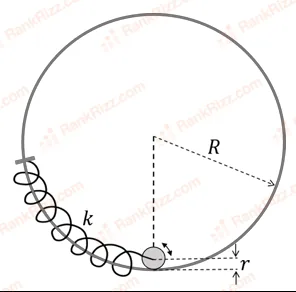
The center of a disk of radius and mass is attached to a spring of spring constant , inside a ring of radius as shown in the figure. The other end of the spring is attached on the periphery of the ring. Both the ring and the disk are in the same vertical plane. The disk can only roll along the inside periphery of the ring, without slipping. The spring can only be stretched or compressed along the periphery of the ring, following the Hooke's law. In equilibrium, the disk is at the bottom of the ring. Assuming small displacement of the disc, the time period of oscillation of center of mass of the disk is written as . The correct expression for is ( is the acceleration due to gravity):
- (A)
- (B)
- (C)
- (D)
rr2.rankrizz.com/jee-advanced/physics/oscillations/q/2025-paper-1-q17
- (A)
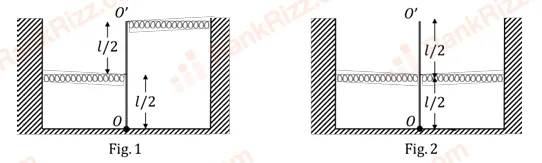
As shown in the figures, a uniform rod of length is hinged at the point and held in place vertically between two walls using two massless springs of same spring constant. The springs are connected at the midpoint and at the top-end () of the rod, as shown in Fig. 1 and the rod is made to oscillate by a small angular displacement. The frequency of oscillation of the rod is . On the other hand, if both the springs are connected at the midpoint of the rod, as shown in Fig. 2 and the rod is made to oscillate by a small angular displacement, then the frequency of oscillation is .
Ignoring gravity and assuming motion only in the plane of the diagram, the value of is:
- (A)
- (B)
- (C)
- (D)
rr2.rankrizz.com/jee-advanced/physics/oscillations/q/2025-paper-2-q19
- (A)
If the collision occurs at time , the value of will be ________.
Answer: ____________
rr2.rankrizz.com/jee-advanced/physics/oscillations/q/2024-paper-2-q33
If the collision occurs at time , then the value of will be ________.
Answer: ____________
rr2.rankrizz.com/jee-advanced/physics/oscillations/q/2024-paper-2-q34
On a frictionless horizontal plane, a bob of mass kg is attached to a spring with natural length m. The spring constant is N m when the length of the spring and is N m when . Initially the bob is released from m. Assume that Hooke's law remains valid throughout the motion. If the time period of the full oscillation is T = s, then the integer closest to is _______.
Answer: ____________
rr2.rankrizz.com/jee-advanced/physics/oscillations/q/2022-paper-2-q25
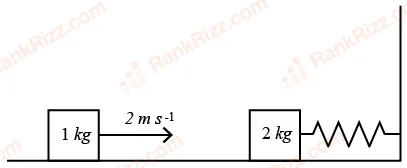
A spring-block system is resting on a friction less floor as shown in the figure. The spring constant is 2.0 and the mass of the block is 2.0 kg. Ignore the mass of the spring. Initially the spring is in an unstretched condition. Another block of mass 1.0 kg moving with a speed of 2.0 collides elastically with the first block. The collision is such that the 2.0 kg block does not hit the wall. The distance, in metres, between the two blocks when the spring returns to its unstretched position for the first time after the collision is _________.
Answer: ____________
rr2.rankrizz.com/jee-advanced/physics/oscillations/q/2018-paper-1-q10
A block with mass M is connected by a massless spring with stiffness constant k to a rigid wall and moves without friction on a horizontal surface. The block oscillates with small amplitude A about an equilibrium position . Consider two cases:
(i) when the block is at ; and
(ii) when the block is at .
In both thecases, a particle with mass m(< M) is softly placed on the block after which they stick to each other. Which of the following statement(s) is(are) true about the motion after the mass mis placed on the mass M ?- (A)
The amplitude of oscillation in thefirst case changes by a factor of , where as in the secondcase it remains unchanged
- (B)
The final time period of oscillation in both the cases is same
- (C)
The total energy decreases in both the cases
- (D)
The instantaneous speed at of the combined masses decreases in both the cases
rr2.rankrizz.com/jee-advanced/physics/oscillations/q/2016-paper-2-q12
- (A)
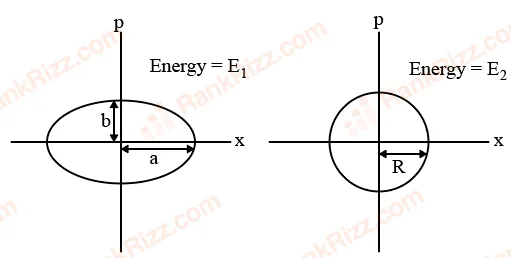
Two independent harmonic oscillators of equal mass are oscillating about the origin with angular frequencies and and have total energies and , respectively. The variations of their momenta p with positions x are shown in the figures. If and , then the correct equation(s) is(are)
- (A)
- (B)
- (C)
- (D)
rr2.rankrizz.com/jee-advanced/physics/oscillations/q/2015-paper-1-q11
- (A)
A particle of mass mis attached to one end of a mass-less spring of force constant k, lying on a frictionless horizontal plane. The other end of the spring is fixed. The particle starts moving horizontally from its equilibrium position at time t = 0 with an initial velocity . When the speed of the particle is 0.5 ,it collides elastically with a rigid wail. After this collision,
- (A)
the speed of the particle when it returns to its equilibrium position is .
- (B)
the time at which the particle passes through the equilibrium position for the first time is .
- (C)
the time at which the maximum compression of the spring occurs is .
- (D)
the time at which the particle passes through the equilibrium position for the second time is .
rr2.rankrizz.com/jee-advanced/physics/oscillations/q/2013-paper-2-q6
- (A)
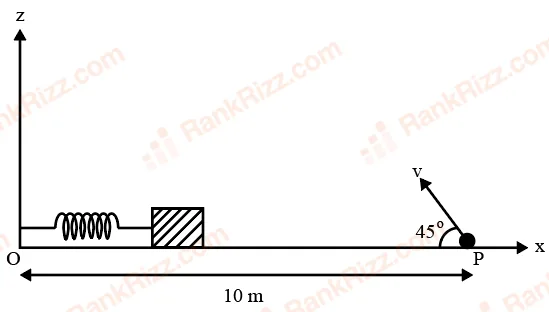
A small block is connected to one end of a massless spring of un-stretched length 4.9 m. The other end of the spring (See thefigure)is fixed. The system lies on a horizontal frictionless surface. The blockis stretched by 0.2 m and released from rest at t= 0. It then executes simple harmonic motion with angular frequency rad/s. Simultaneously at t = 0, a small pebble is projected with speed v from point P at an angle of as shownin thefigure. Point P is at a horizontal distance of 10 m from O. If the pebble hits the block at + = 1s, the value of v is (take g = 10 )
- (A)
m/s
- (B)
m/s
- (C)
m/s
- (D)
m/s
rr2.rankrizz.com/jee-advanced/physics/oscillations/q/2012-paper-1-q5
- (A)
A point mass is subjected to two simultaneous sinusoidal displacements in x-direction, and . Adding a third sinusoidal displacement brings the mass to a complete rest. The value of B and are
- (A)
- (B)
- (C)
- (D)
rr2.rankrizz.com/jee-advanced/physics/oscillations/q/2011-paper-2-q24
- (A)
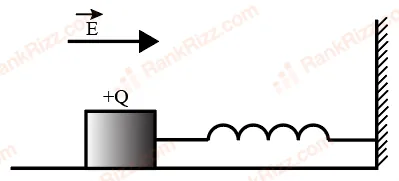
A wooden block performs SHM on a frictionless surface with frequency, . The block carries a charge +Q on its surface. If now a uniform electric field is switched-on as shown, then the SHM of the block will be
- (A)
of the same frequency and with shifted mean position.
- (B)
of the same frequency and with the same mean position.
- (C)
of changed frequency and with shifted mean position.
- (D)
of changed frequency and with the same mean position.
rr2.rankrizz.com/jee-advanced/physics/oscillations/q/2011-paper-2-q28
- (A)
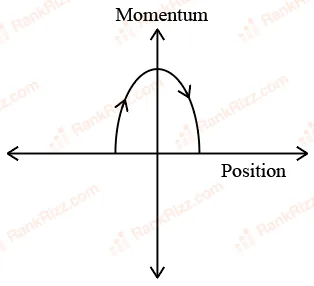
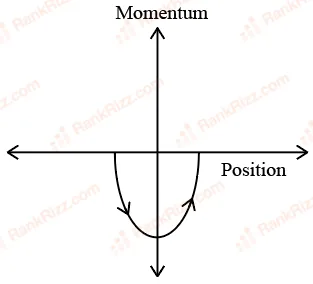
The phase space diagram for a ball thrown vertically up from ground is-
- (A)
- (B)
- (C)
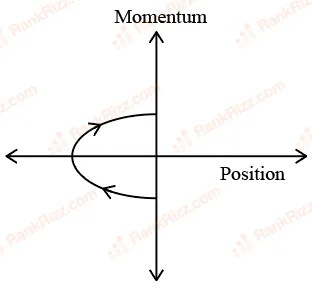
- (D)
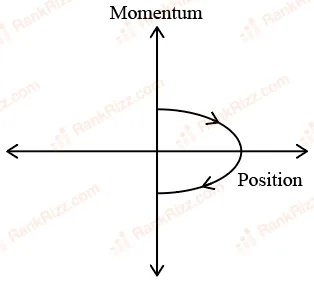
rr2.rankrizz.com/jee-advanced/physics/oscillations/q/2011-paper-1-q35
- (A)
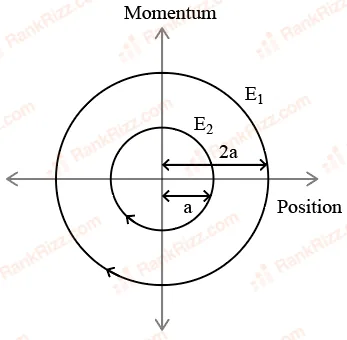
The phase space diagram for simple harmonic motion is a circle centered at the origin. In the figure, the two circles represent the same oscillator but for different initial conditions, and and are the total mechanical energies respectively. Then-
- (A)
- (B)
- (C)
- (D)
rr2.rankrizz.com/jee-advanced/physics/oscillations/q/2011-paper-1-q36
- (A)
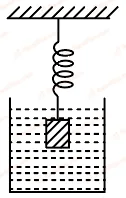
Consider the spring-mass system, with the mass submerged in water, as shown in figure. The phase space diagram for one cycle of this system is-
- (A)
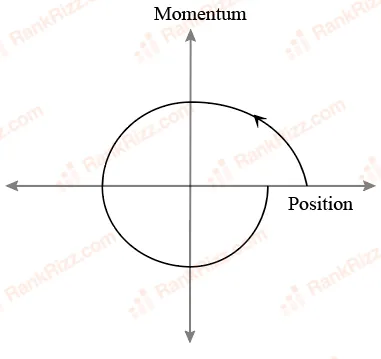
- (B)
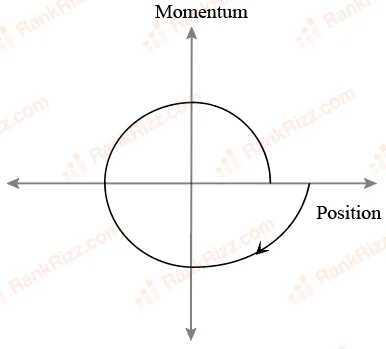
- (C)
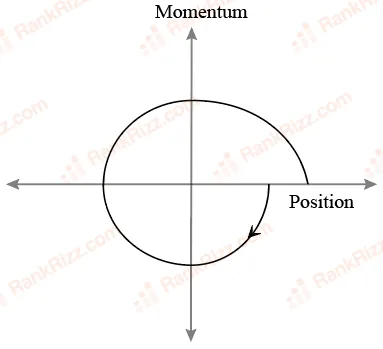
- (D)
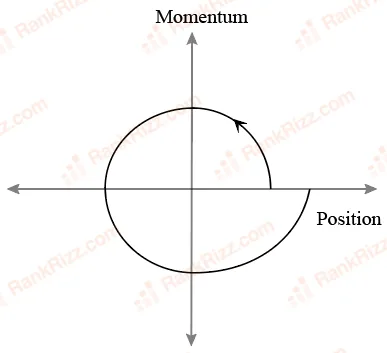
rr2.rankrizz.com/jee-advanced/physics/oscillations/q/2011-paper-1-q37
- (A)
If the total energy of the particle is E, it will perform periodic motion only if
- (A)
E < 0
- (B)
E > 0
- (C)
- (D)
rr2.rankrizz.com/jee-advanced/physics/oscillations/q/2010-paper-1-q70
- (A)
For periodic motion of small amplitude A, the time period T of this particle is proportional to
- (A)
- (B)
- (C)
- (D)
rr2.rankrizz.com/jee-advanced/physics/oscillations/q/2010-paper-1-q71
- (A)
A 0.1 kg mass is suspended from a wire of negligible mass. The length of the wire is 1m and its cross-sectional area is . If the mass is pulled a little in
the vertically downward direction and released, it performs simple harmonic motion of angular frequency 140 rad . If the Young’s modulus of the material of the wire is , the value of n isAnswer: ____________
rr2.rankrizz.com/jee-advanced/physics/oscillations/q/2010-paper-1-q80
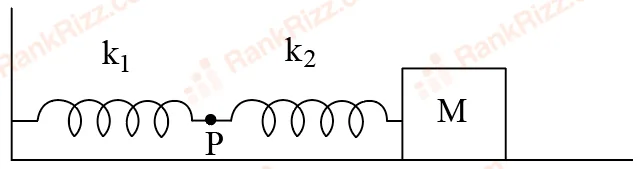
The mass M shown in the figure oscillates in simple harmonic motion with amplitude A. The amplitude of the point P is
- (A)
- (B)
- (C)
- (D)
rr2.rankrizz.com/jee-advanced/physics/oscillations/q/2009-paper-2-q39
- (A)
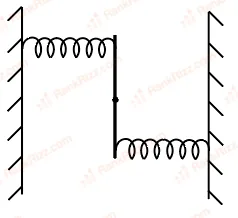
A uniform rod of length L and mass M is pivoted at the centre. Its two ends are attached to two springs of equal spring constants k. The springs are fixed to rigid supports as shown in the figure, and the rod is free to oscillate in the horizontal plane. The rod is gently pushed through a small angle in one direction and released. The frequency of oscillation is
- (A)
- (B)
- (C)
- (D)
rr2.rankrizz.com/jee-advanced/physics/oscillations/q/2009-paper-2-q42
- (A)
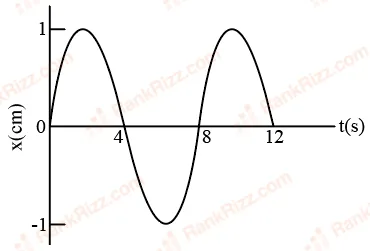
The x-t graph of a particle undergoing simple harmonic is shown below. The acceleration of the particle at is-
- (A)
- (B)
- (C)
- (D)
rr2.rankrizz.com/jee-advanced/physics/oscillations/q/2009-paper-1-q42
- (A)
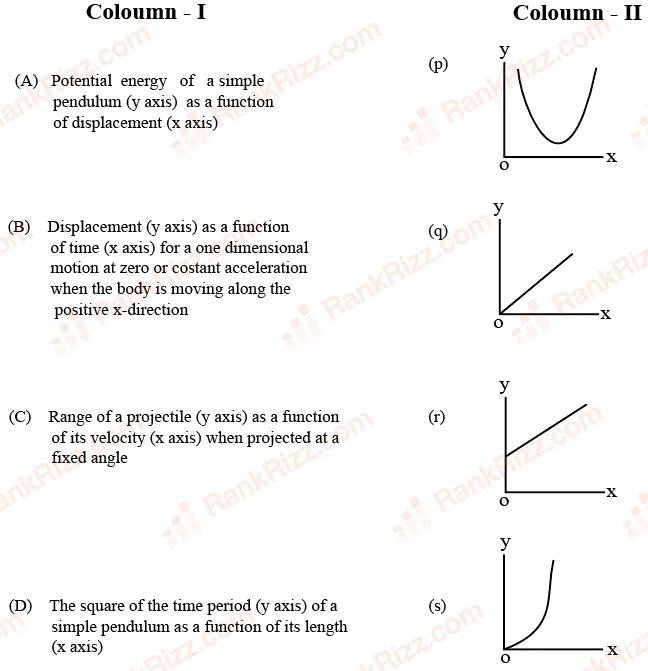
Column I gives a list of possible set of parameters measured in some experiments. The variations of the parameters in the form of graphs are shown in Column II. Match the set of parameters given in Column I with the graphs given in Column II. Indicate your answer by darkening the appropriate bubbles of the matrix given in the ORS.
rr2.rankrizz.com/jee-advanced/physics/oscillations/q/2008-paper-2-q42
SHM: equation, phase, velocity and acceleration 2
A person sitting inside an elevator performs a weighing experiment with an object of mass 50 kg. Suppose that the variation of the height (in m) of the elevator, from the ground, with time (in s) is given by , where s. Taking acceleration due to gravity, m/s, the maximum variation of the object's weight (in N) as observed in the experiment is ________.
Answer: ____________
rr2.rankrizz.com/jee-advanced/physics/oscillations/q/2025-paper-1-q24
A block of mass 5 kg moves along the x-direction subject to the force N, with the value of in metre. At time s, it is at rest at position m. The position and momentum of the block at s are
- (A)
m, kg m/s
- (B)
m, kg m/s
- (C)
m, kg m/s
- (D)
m, kg m/s
rr2.rankrizz.com/jee-advanced/physics/oscillations/q/2024-paper-1-q21
- (A)
Superposition of SHMs 1
A particle of mass 1 kg is subjected to a force which depends on the position as kg m s with kg s. At time , the particle's position m and its velocity m s. Let and denote the x and y components of the particle's velocity, respectively. Ignore gravity. When m, the value of is _______ m s.
Answer: ____________
rr2.rankrizz.com/jee-advanced/physics/oscillations/q/2022-paper-2-q19
SHM of floating bodies, liquids, gases and charged systems 1
A tank contains two immiscible liquids of densities and . The higher density liquid is filled up to a height from the bottom. A thin rod of density and length is fully immersed and hinged at the bottom so that it can oscillate freely, as shown in the figure. If the rod is slightly disturbed from its equilibrium, the time period of small oscillations is , where is the acceleration due to gravity. The value of is:
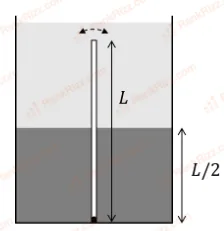
Answer: ____________
rr2.rankrizz.com/jee-advanced/physics/oscillations/q/2026-paper-1-q9
Damped and forced oscillations and resonance 1
The acceleration of this particle for is
- (A)
proportional to
- (B)
proportional to
- (C)
proportional to
- (D)
zero
rr2.rankrizz.com/jee-advanced/physics/oscillations/q/2010-paper-1-q72
- (A)
Answer key
- 01 A
- 02 C
- 03 0.75
- 04 4.25
- 05 6
- 06 —
- 07 A, B, D
- 08 B, D
- 09 A, D
- 10 A
- 11 B
- 12 A
- 13 D
- 14 C
- 15 B
- 16 B, C
- 17 B
- 18 4
- 19 D
- 20 C
- 21 D
- 22 —
- 23 2
- 24 C
- 25 3
- 26 —
- 27 D
“—” marks a question whose key we have not checked yet; its page shows the latest on it.
Past questions are reproduced with their sitting. Not affiliated with NTA or the IITs. Every question, online and free: rr2.rankrizz.com/jee-advanced/physics/oscillations